Farmer’s Lung: Understanding Hypersensitivity Pneumonitis and Mold Risks

Updated: 2 days ago
Medically reviewed by Dr. Baraa Alnahhal, MD · Last reviewed: October 2026
Quick Answer: What is farmer's lung?
Farmer's lung is a type of hypersensitivity pneumonitis triggered by inhaling mold particles from damp hay, straw or grain, mainly affecting agricultural workers. Symptoms range from acute flu-like chills and cough to chronic breathlessness from lung scarring. Treatment is strict mold avoidance and corticosteroids; repeated exposure causes irreversible fibrosis, and severe cases may need a transplant. [4]
What the research says
Occupational hypersensitivity pneumonitis is not rare across jobs. A meta-analysis of 46 articles covering more than 2.8 million participants estimated the overall prevalence of occupational hypersensitivity pneumonitis at 4.2% (95% CI 2.1% to 8.0%), with large differences by occupation and region (Zhang et al., International Journal of Environmental Health Research, 2024 [1]).
Scarring on CT and ongoing exposure raise the risk of death. A meta-analysis of 22 studies identified older age, male sex, honeycombing, and traction bronchiectasis on high-resolution CT as the main mortality-related risk factors in hypersensitivity pneumonitis, with continued antigen exposure an added risk factor in chronic disease (Dasgupta et al., Expert Review of Respiratory Medicine, 2022 [2]).
Corticosteroids help less once the lungs are scarred. A meta-analysis of 23 studies including 975 patients noted that the benefit of corticosteroids is limited in fibrotic hypersensitivity pneumonitis, reported mean improvements in diffusing capacity (DLCO%) of 6.69 with rituximab and 5.98 with mycophenolate mofetil, and concluded that firm conclusions remain limited by heterogeneity and a lack of high-quality trials (Nabeh et al., Respiratory Medicine, 2026 [3]).
Understanding farmer’s lung
Farmer’s lung is a specific form of hypersensitivity pneumonitis in which the immune system overreacts to inhaled mold spores, causing inflammation in the small air sacs (alveoli) of the lungs. Unlike common seasonal allergies that cause hay fever, farmer’s lung can lead to permanent respiratory damage [4].
Feature | Description |
Medical category | Hypersensitivity pneumonitis |
Primary trigger | Mold dust from hay, grain, or straw |
Target area | Alveoli (small air sacs) |
Risk level | High for chronic lung scarring |
Contagious? | No |
The three stages of farmer’s lung
The condition progresses through three distinct clinical phases based on the intensity and frequency of exposure [4].
Type | Onset and duration | Key characteristics |
Acute | Within hours of exposure | Flu-like symptoms; resolves in days |
Subacute | Repeated low-level exposure | Lingering symptoms; feels like a long cold |
Chronic | Long-term repeated attacks | Irreversible scarring (fibrosis); worsens over time |

Symptoms and warning signs
Symptoms vary significantly between the sudden onset of an acute attack and the slow progression of chronic disease [4].
Acute attack symptoms
Sudden shortness of breath (dyspnea)
Dry, hacking cough
Chest tightness
Fever and chills
Muscle aches and fatigue
Chronic progression signs
Symptom | Description |
Progressive dyspnea | Shortness of breath that worsens with minimal activity |
Persistent fatigue | Exhaustion that does not improve with rest |
Weight loss | Unintended loss of body mass |
Digital clubbing | Bulging or rounding of the tips of the fingers or toes |
Causes and high-risk groups
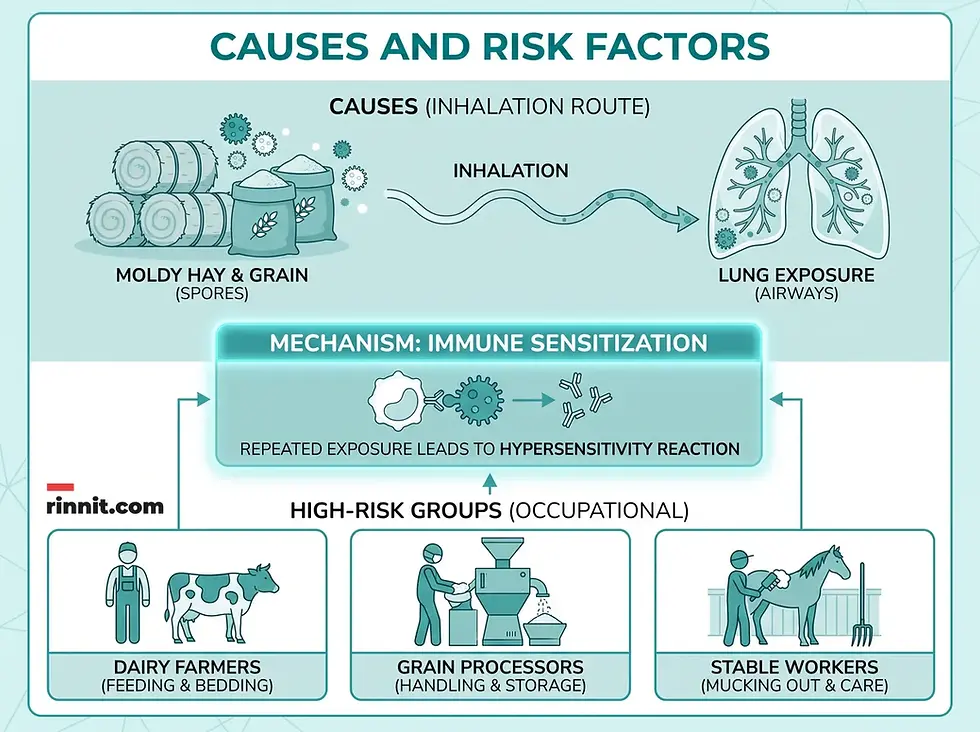
The primary cause of farmer’s lung is inhalation of microscopic mold particles disturbed while handling crops. The body becomes more sensitized with each exposure, leading to worsening immune responses [4].
Common triggers
Breaking open moldy hay or straw bales
Processing and loading damp grains
Working in stables or confined animal housing
Handling damp crops in late winter or early spring
Occupational risk groups
High-risk group | Primary exposure source |
Dairy farmers | Moldy hay and straw bedding |
Grain processors | Dust from silos and loading areas |
Stable workers | Stored hay and straw in stalls |
Zoo workers | Handling animal feed and bedding |
Diagnosis and clinical testing
Healthcare providers diagnose farmer’s lung by combining occupational history with specific tests that assess lung function and inflammation [4].
Test type | Purpose |
HP panel | Blood test for signs of a reaction to specific proteins |
Imaging | Chest X-rays and CT scans to detect scarring (fibrosis) |
Pulmonary function tests (PFTs) | Measure how well the lungs move air and oxygen |
Bronchoscopy | Uses a flexible tube to view the lungs and collect samples |
Treatment and long-term management
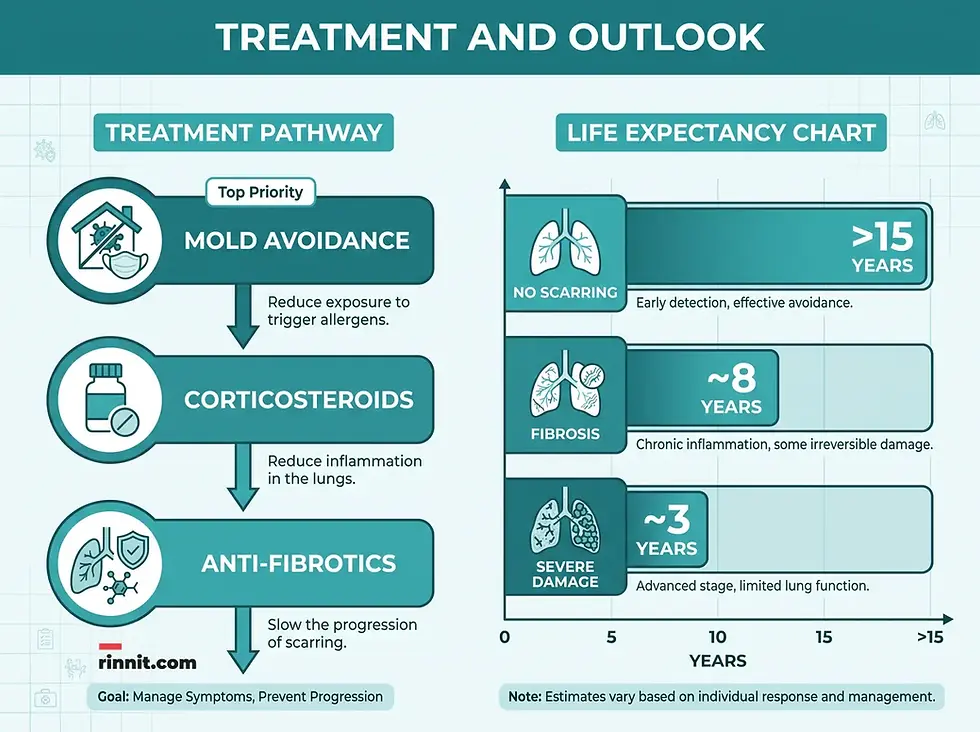
The cornerstone of treatment is absolute avoidance of the mold triggers that caused the initial reaction. Without avoidance, medications only provide temporary relief while damage continues to accumulate [4].
Medication options
Corticosteroids: Prednisone to reduce acute inflammation.
Immunosuppressants: Mycophenolate or azathioprine for long-term control.
Anti-fibrotics: Pirfenidone or nintedanib to slow lung scarring.
Advanced care
Treatment | When it is used |
Oxygen therapy | For severe cases with low blood oxygen levels |
Pulmonary rehabilitation | Physical therapy to improve breathing efficiency |
Lung transplant | For end-stage pulmonary fibrosis and honeycombing |
Outlook and life expectancy
The prognosis for farmer’s lung depends heavily on the extent of lung damage at the time of diagnosis. Chronic cases with significant scarring have a reduced life expectancy. The estimates below are based on other forms of hypersensitivity pneumonitis [4].
Condition at diagnosis | Approximate life expectancy |
No scarring (fibrosis) | More than 15 years |
Fibrosis present | About 8 years |
Fibrosis plus honeycombing | About 3 years |
Prevention and safety strategies
Agricultural workers can reduce their risk by controlling moisture and using protective equipment [4].
Strategy | Action step |
Moisture control | Make sure hay and grain are dry before storage |
Automation | Use machines to handle hay and grain and reduce dust inhalation |
Ventilation | Improve airflow in stables and silos |
Protection | Wear specialized masks when handling potentially moldy crops |
Conclusion
Farmer’s lung is a serious occupational hazard that requires immediate attention if symptoms like a persistent cough or shortness of breath develop. While acute attacks are reversible, the chronic form leads to life-shortening lung damage. The most effective way to manage the condition is to catch it early and strictly avoid further mold exposure.
Contact your provider if
You have a lingering cold that you can’t shake.
You notice worsening shortness of breath during routine farm work.
You experience sudden fever and chills after handling hay or grain.
Frequently Asked Questions
What is the difference between farmer’s lung and a regular allergy?
Farmer’s lung is a hypersensitivity pneumonitis, which is a deeper and more severe immune reaction in the air sacs (alveoli) of the lungs. Unlike regular hay fever or asthma, repeated exposure to the mold that causes farmer’s lung can cause permanent, irreversible scarring of the lung tissue.
Can farmer’s lung be cured?
Acute and subacute forms of farmer’s lung can be successfully managed and the inflammation reversed if you strictly avoid further exposure to the mold triggers. However, the chronic form, which involves permanent scarring (pulmonary fibrosis), cannot be cured, though treatment can help manage symptoms and slow progression.
Is farmer’s lung contagious?
No, farmer’s lung is not contagious. It is an individual allergic-type reaction caused by inhaling specific mold spores found in agricultural materials like hay and grain. You cannot catch it from another person or pass it to others.
Who is most at risk for developing farmer’s lung?
The highest risk is among agricultural workers, particularly dairy farmers and grain processors between the ages of 50 and 70. The risk increases in late winter and early spring when stored hay and grain are more likely to be damp and moldy.
What are the long-term complications of farmer’s lung?
The most serious long-term complications include pulmonary fibrosis (permanent lung scarring) and pulmonary hypertension (high blood pressure in the vessels between the heart and lungs). These conditions can significantly reduce life expectancy and may eventually require a lung transplant.
How do doctors test for farmer’s lung?
Diagnosis usually involves a combination of your work history, a physical exam, and specific tests. These include a hypersensitivity pneumonitis blood panel, imaging tests like chest X-rays or CT scans to look for scarring, and pulmonary function tests to measure how well your lungs are working.
What medications are used to treat farmer’s lung?
Doctors often prescribe corticosteroids like prednisone to reduce inflammation. In chronic cases, immunosuppressive medications or anti-fibrotic drugs may be used to slow down lung scarring. If oxygen levels are low, oxygen therapy may also be necessary.
Does wearing a mask prevent farmer’s lung?
Wearing specialized, high-filtration masks can help reduce the amount of mold dust you inhale, but it is not a guaranteed prevention method. The most effective prevention is improving ventilation and ensuring that hay and grain are stored dry to prevent mold growth in the first place.
What is “digital clubbing” in farmer’s lung?
Digital clubbing is a sign of chronic lung disease where the tips of the fingers or toes become rounded and bulging. This occurs due to long-term low oxygen levels in the blood and is often a sign that farmer’s lung has progressed to a chronic, more severe stage.
Can I still work on a farm if I have farmer’s lung?
Continuing to work around the mold triggers that caused your reaction is highly dangerous. Even with medication, repeated exposure will cause worsening lung damage. You must work with your healthcare provider to create a plan that eliminates your exposure to moldy hay and grain.
What is the life expectancy for someone with chronic farmer’s lung?
Life expectancy depends on the severity of lung damage. Those with no scarring can live more than 15 years after diagnosis. If scarring (fibrosis) is present, the average is around 8 years, and if severe damage like honeycombing is present, it may be around 3 years without a transplant.
References
Zhang X, Igor B, Elena D, et al. Prevalence of occupational hypersensitivity pneumonitis: a systematic review and meta-analysis. International Journal of Environmental Health Research. 2024;34(11):3891-3908. PMID 38544315. https://doi.org/10.1080/09603123.2024.2333021
Dasgupta S, Bhattacharya A, Abhijit RD, et al. Risk factors associated with mortality in hypersensitivity pneumonitis: a meta-analysis. Expert Review of Respiratory Medicine. 2022;16(7):801-811. PMID 35819125. https://doi.org/10.1080/17476348.2022.2100352
Nabeh OA, Soliman YMA, Elkorashy RI, et al. Beyond corticosteroids: a systematic review and meta-analysis of novel therapies for hypersensitivity pneumonitis. Respiratory Medicine. 2026;252:108661. PMID 41554302. https://doi.org/10.1016/j.rmed.2026.108661
Cleveland Clinic. Farmer’s lung. Cleveland Clinic. Medically reviewed December 10, 2024. https://my.clevelandclinic.org/health/diseases/farmers-lung
Medical disclaimer
This article was prepared for general information only and is not a substitute for professional medical advice.



Comments