Eye Stroke (Retinal Artery Occlusion): Symptoms, Causes, Diagnosis, Treatment, Outlook and When to Get Emergency Care — What You Need to Know

Updated: 2 days ago
Medically reviewed by Dr. Baraa Alnahhal, MD · Last reviewed: September 2026
Quick Answer
An eye stroke — medically called a retinal artery occlusion — happens when something blocks an artery that supplies blood to your retina. It is a medical emergency. The main symptom is usually a sudden, painless loss or change of vision in one eye, which may include floaters and flashes, blurred vision, or blind spots. It is most often caused by a blood clot, either an embolism (material breaking off from your heart or another artery) or thrombosis (blood thickening and clotting). Treatments include pressure-lowering medications, clot-dissolving medications, laser therapy, eye massage, paracentesis and hyperbaric oxygen therapy. If you suddenly lose vision in one eye, get emergency help immediately — early treatment generally leads to the best outcomes.
TL;DR: Eye Stroke at a Glance
An eye stroke occurs when an artery feeding your retina becomes blocked, cutting off the blood flow the light-sensing retina needs. The blockage is often a blood clot, and it usually strikes just one eye without any pain.
The telltale sign is sudden vision loss or change in one eye — floaters, flashes, blurriness, blind spots or darkness. Because eye strokes share risk factors with brain strokes, having one may signal that you are at risk of a stroke in your brain.
This is a medical emergency. Seek immediate care even if the vision loss is temporary, because temporary loss can be a "mini-stroke" in your eye. Early treatment generally leads to the best outcomes.
MEDICAL EMERGENCY Get immediate help if you suddenly lose vision in one eye. Eye strokes almost always affect just one eye. Seek medical help even if your vision loss is temporary — temporary vision loss can be caused by a "mini-stroke" in your eye. Do not wait to see if your vision returns. Early treatment generally leads to the best outcomes.
Limitation statement: The referenced clinical source publishes one prevalence statistic for this topic: eye strokes (retinal artery occlusions) affect about 1 to 2 per 100,000 people each year. No other prevalence, incidence, or outcome statistics are invented in this article.
Key facts at a glance
What it is: A blockage of an artery supplying blood to the retina
Medical name: Retinal artery occlusion ("occlusion" = blockage)
Usual cause: Often a blood clot
First symptom: Sudden, painless loss or change of vision in one eye
Prevalence: About 1 to 2 per 100,000 people each year
Severity: Medical emergency — seek immediate help
Link to brain stroke: An eye stroke may indicate risk of a future brain stroke

What Is an Eye Stroke?
An eye stroke is a term for what happens when something blocks an artery that supplies blood to your retina. The medical name for an eye stroke is "retinal artery occlusion." Occlusion means blockage. The blockage is often a blood clot.
Your retina is the part of your eye that communicates with your brain to turn light into images.
You can also have a blockage in the vein serving your retina. This is called a retinal vein occlusion.
Eye strokes (retinal artery occlusions) are medical emergencies.
Are there different types of eye strokes?
A retinal artery occlusion may have different names based on the location of the blockage. The terms for these can also apply to blockages in veins.
Central retinal artery occlusion (CRAO): a blockage of the main artery in your eye — like the trunk of a tree. The effects of the stroke can be seen throughout the eye.
Branch retinal artery occlusion (BRAO): a blockage of one of the smaller arteries — like a branch connected to the trunk. The effects can be seen in a smaller area of the eye.
Twig retinal artery occlusion: a blockage of an even smaller blood vessel — like a twig on a branch. It affects the smallest portion of the eye.
How common are eye strokes?
The number of people who have retinal artery occlusion, or eye stroke, is estimated at about 1 to 2 per 100,000 people each year.
What Are the Signs and Symptoms of an Eye Stroke?
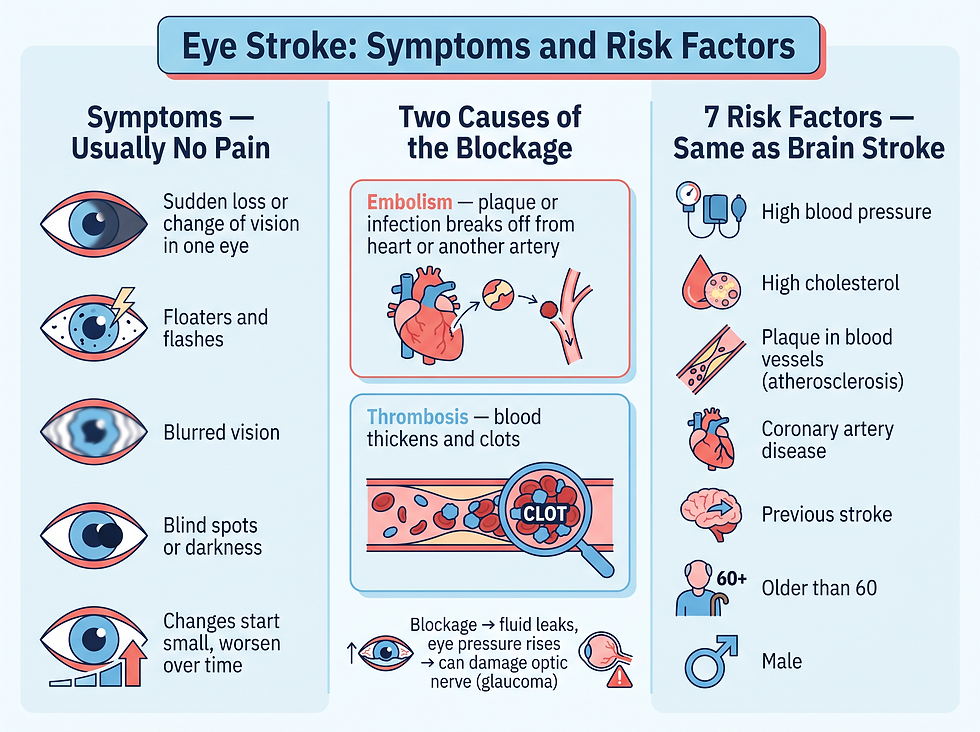
The symptoms of an eye stroke usually don't include pain. The first and main symptom is usually a sudden loss of vision or change in vision in one eye. Vision loss that comes and goes can be a related warning sign — see our guide to amaurosis fugax (temporary vision loss).
Sudden vision loss or change: affects one eye; the first and main symptom
Floaters and flashes: spots or light flashes in your vision (learn more about eye floaters)
Blurred vision: vision becomes out of focus
Blind spots or darkness: areas of your vision go dark or missing
Progressive worsening: vision changes that start out small but get worse over time
What Causes a Stroke in the Eye?
An eye stroke is caused by an interruption of blood flow to your retina.
The blockage can be caused by something solid, like plaque or infection, that breaks off from another part of your body, like the inside of your heart or another artery. This type of blockage is called an embolism.
The blockage can also be caused by blood getting thicker and clotting. This type of blockage is called thrombosis.
These blockages cause fluid to leak and ocular (a term that refers to your vision or eyes) pressure to increase. This pressure can damage the optic nerve, which happens with glaucoma.
What are the risk factors for having an eye stroke?
Most of the risk factors for having a stroke in one of your eyes are similar to the risk factors for having a stroke in general. These things include:
High blood pressure (hypertension).
High cholesterol (hyperlipidemia).
A build-up of plaque in your blood vessels (atherosclerosis).
Surviving a previous stroke.
Being older than 60.
Being male.
Because a temporary blockage can act as a warning sign, a "mini-stroke" of the brain or eye (a transient ischemic attack) should never be ignored.
How Is an Eye Stroke Diagnosed?
A sudden complete or partial loss of vision in one eye is a medical emergency. Your provider may take a medical history and ask about your symptoms.
A complete eye exam follows. This includes fundoscopy (ophthalmoscopy), where your provider uses a bright light and an ophthalmoscope to look at your eyes.
Medical history: your provider asks about your symptoms
Complete eye exam: includes fundoscopy (ophthalmoscopy) — your provider uses a bright light and an ophthalmoscope to look at your eyes
Fluorescein angiography: uses a special dye that shows the way your blood flows in your eyes
Color fundus photography: provides images of the fundus — the part of your eye that contains your retina
Optical coherence tomography: an imaging test that shows the blood vessels in your retina
If your provider thinks you might have a disorder like giant cell arteritis (temporal arteritis), they may order other tests, including:
An ultrasound.
An echocardiogram.
Blood tests to check for markers of inflammation.
How Is an Eye Stroke Treated?
Treatments for an eye stroke include medications to reduce pressure in your eye or to dissolve the blood clot, laser treatment to close up leaking blood vessels, massaging the closed eye, paracentesis — which involves using a needle to take fluid from your eye to relieve pressure — and hyperbaric oxygen therapy, which involves breathing pure oxygen in a special chamber.
Medications (pressure-lowering): reduce pressure in your eye
Medications (clot-dissolving): dissolve the blood clot causing the blockage
Laser treatment: closes up leaking blood vessels
Massaging the closed eye: a manual technique used during treatment
Paracentesis: uses a needle to take fluid from your eye to relieve pressure
Hyperbaric oxygen therapy: involves breathing pure oxygen in a special chamber
What Can I Expect If I Have an Eye Stroke?
Some eye strokes cause more damage than others. The branch or twig retinal artery occlusions involve smaller portions of your eye than central retinal artery occlusions. Even with treatment, you may have some vision loss.
Having an eye stroke may be an indication that you are at risk of having a brain stroke. Many of the risk factors are the same for both conditions. Speak with your provider to see if you may be at risk.
How Can I Reduce My Risk of Developing an Eye Stroke?
You may be able to reduce your risk of an eye stroke by:
Eating a healthy diet and getting enough exercise.
Keeping your blood sugar levels steady if you have diabetes.
Managing your blood pressure, blood cholesterol and eye pressure levels.
Having regular appointments with your eye care provider.
Quitting smoking.

When Should I See My Healthcare Provider?
You should get immediate help if you suddenly lose vision in one eye. Eye strokes almost always affect just one eye.
Seek medical help even if your vision loss is temporary. Temporary vision loss can be caused by a "mini-stroke" in your eye.
A note from your care team: "Having any type of vision loss, even temporarily, can be scary. It's very important that you seek help immediately if you have vision loss, especially if it's only in one eye. Just like for a stroke in your brain, getting immediate treatment is best for an eye stroke. Early treatment generally leads to the best outcomes."
Sudden vision loss in one eye: get immediate emergency help
Temporary vision loss: seek medical help — it can be a "mini-stroke" in your eye
Eye stroke survivor: speak with your provider about brain stroke risk
Ongoing risk management: regular eye care provider appointments; manage blood pressure, cholesterol, blood sugar and eye pressure
Conclusion: Every Minute Counts
An eye stroke is a blockage of the artery that carries blood to your retina — the light-sensing layer that turns light into images for your brain. Most often caused by a blood clot, whether an embolism breaking off from the heart or another artery or blood that has thickened and clotted in place, it strikes suddenly, painlessly and almost always in just one eye.
The warning signs are unmistakable: sudden vision loss or change, floaters and flashes, blurriness, blind spots or spreading darkness. Because the same risk factors — high blood pressure, high cholesterol, atherosclerosis, coronary artery disease, a prior stroke, age over 60 and male sex — drive both eye strokes and brain strokes, an eye stroke can be an early alarm for a future brain stroke.
This is a medical emergency. From medications that lower eye pressure or dissolve the clot, to laser therapy, eye massage, paracentesis and hyperbaric oxygen, treatment exists — but it works best when it starts early. Reduce your risk with a healthy diet, exercise, steady blood sugar, pressure management, regular eye visits and no smoking.
Take these three steps:
Treat it as an emergency — if you suddenly lose vision in one eye, get immediate medical help, and do so even if the vision loss is temporary.
Assess your brain stroke risk — after an eye stroke, speak with your provider, because many risk factors overlap with brain stroke.
Protect your vessels long-term — eat well, exercise, keep blood sugar steady if you have diabetes, manage blood pressure and cholesterol, attend regular eye appointments and quit smoking.
This article provides general information and is not a substitute for professional medical advice. Always consult a qualified healthcare provider for diagnosis and treatment.
Frequently Asked Questions
What is an eye stroke? An eye stroke is a term for what happens when something blocks an artery that supplies blood to your retina. The medical name for an eye stroke is "retinal artery occlusion."
What does "retinal artery occlusion" mean? "Occlusion" means blockage. So a retinal artery occlusion is a blockage of an artery that supplies blood to your retina.
What is the retina? Your retina is the part of your eye that communicates with your brain to turn light into images.
Is an eye stroke a medical emergency? Yes. Eye strokes (retinal artery occlusions) are medical emergencies. A sudden complete or partial loss of vision in one eye requires immediate care.
Is an eye stroke the same as a brain stroke? No, but they are related. An eye stroke blocks an artery in the eye, while a brain stroke blocks blood flow in the brain. Having an eye stroke may indicate you are at risk of having a brain stroke, because many of the risk factors are the same.
Are there different types of eye strokes? Yes. Types include central retinal artery occlusion (CRAO), branch retinal artery occlusion (BRAO) and twig retinal artery occlusion, based on where the blockage occurs.
What is a central retinal artery occlusion (CRAO)? CRAO describes a blockage in the main artery in your eye — like the trunk of a tree. The effects of the stroke can be seen throughout the eye.
What is a branch retinal artery occlusion (BRAO)? BRAO refers to a blockage in one of the smaller arteries in your eye, like a branch connected to the trunk of a tree. The effects can be seen in a smaller area of the eye.
What is a twig retinal artery occlusion? A blockage in an even smaller blood vessel — like a twig that is part of a branch connected to the trunk of a tree.
Do these terms apply to veins too? Yes. The terms for these blockages can also apply to blockages in veins. A blockage in the vein serving your retina is called a retinal vein occlusion.
How common are eye strokes? The number of people who have retinal artery occlusion, or eye stroke, is estimated at about 1 to 2 per 100,000 people each year.
What does an eye stroke feel like? Eye stroke symptoms usually don't include pain. The first and main symptom is usually a sudden loss of vision or change in vision in one eye.
What are the symptoms of an eye stroke? Sudden loss or change of vision in one eye, which may include floaters and flashes, blurred vision, blind spots or darkness, and vision changes that start out small but get worse over time.
Does an eye stroke hurt? No. The symptoms of an eye stroke usually don't include pain — which is why sudden painless vision loss still demands immediate attention.
What causes a stroke in the eye? An interruption of blood flow to your retina. The blockage can be an embolism (something solid like plaque or infection breaking off from your heart or another artery) or thrombosis (blood getting thicker and clotting).
What is an embolism in the eye? An embolism is a blockage caused by something solid, like plaque or infection, that breaks off from another part of your body — like the inside of your heart or another artery — and lodges in the eye's artery.
What is thrombosis? Thrombosis is a blockage caused by blood getting thicker and clotting.
What happens inside the eye during an eye stroke? Blockages cause fluid to leak and ocular (eye) pressure to increase. This pressure can damage the optic nerve, which happens with glaucoma.
What are the risk factors for an eye stroke? High blood pressure (hypertension), high cholesterol (hyperlipidemia), a build-up of plaque in your blood vessels (atherosclerosis), coronary artery disease, surviving a previous stroke, being older than 60 and being male.
Does high blood pressure increase eye stroke risk? Yes. High blood pressure (hypertension) is one of the risk factors, most of which are similar to the risk factors for having a stroke in general.
Does age affect eye stroke risk? Yes. Being older than 60 is a listed risk factor.
Are men at higher risk of eye stroke? Being male is listed as a risk factor for having a stroke in one of your eyes.
How is an eye stroke diagnosed? Your provider takes a medical history and asks about your symptoms, then performs a complete eye exam including fundoscopy (ophthalmoscopy), and may order fluorescein angiography, color fundus photography and optical coherence tomography.
What is fundoscopy (ophthalmoscopy)? A part of the complete eye exam where your provider uses a bright light and an ophthalmoscope to look at your eyes.
What is fluorescein angiography? A test that uses a special dye that shows the way your blood flows in your eyes.
What does optical coherence tomography show? This imaging test shows the blood vessels in your retina.
Can an eye stroke be linked to giant cell arteritis? If your provider suspects a disorder like giant cell arteritis (temporal arteritis), they may order additional tests including an ultrasound, an echocardiogram and blood tests to check for markers of inflammation.
How is an eye stroke treated? Treatments include medications to reduce pressure in your eye or dissolve the blood clot, laser treatment to close up leaking blood vessels, massaging the closed eye, paracentesis (using a needle to take fluid from your eye to relieve pressure) and hyperbaric oxygen therapy (breathing pure oxygen in a special chamber).
What is paracentesis for an eye stroke? Paracentesis involves using a needle to take fluid from your eye to relieve pressure.
What is hyperbaric oxygen therapy? A treatment that involves breathing pure oxygen in a special chamber.
What can I expect after an eye stroke? Some eye strokes cause more damage than others — branch or twig occlusions involve smaller portions of your eye than central occlusions. Even with treatment, you may have some vision loss. An eye stroke may also indicate that you are at risk of having a brain stroke, so speak with your provider.
Can I reduce my risk of an eye stroke? You may be able to reduce your risk by eating a healthy diet and getting enough exercise, keeping blood sugar steady if you have diabetes, managing blood pressure, cholesterol and eye pressure, having regular eye care appointments and quitting smoking.
When should I see my healthcare provider? Get immediate help if you suddenly lose vision in one eye — eye strokes almost always affect just one eye. Seek medical help even if your vision loss is temporary, because temporary vision loss can be caused by a "mini-stroke" in your eye.
What is a "mini-stroke" in the eye? A temporary loss of vision in the eye, which can be caused by a mini-stroke. The source advises seeking medical help even when vision loss is temporary.
Is early treatment important for an eye stroke? Yes. Just like for a stroke in your brain, getting immediate treatment is best for an eye stroke. Early treatment generally leads to the best outcomes.
Additional Resources
American Heart Association — Stroke affecting the eye requires immediate treatment, can signal future vascular events: https://newsroom.heart.org/news/stroke-affecting-the-eye-requires-immediate-treatment-can-signal-future-vascular-events
British Heart Foundation — What's an eye stroke?: https://www.bhf.org.uk/informationsupport/heart-matters-magazine/medical/ask-the-experts/eye-strokes
Foundation of the American Society of Retinal Specialists — Retinal Artery Occlusion: https://www.asrs.org/patients/retinal-diseases/32/retinal-artery-occlusion
Merck Manual, Consumer Version — Blockage of Central Retinal Arteries and Branch Retinal Arteries: https://www.merckmanuals.com/home/eye-disorders/retinal-disorders/blockage-of-central-retinal-arteries-and-branch-retinal-arteries
Optometrists.org — What is an eye stroke?: https://www.optometrists.org/general-practice-optometry/guide-to-eye-conditions/guide-to-blurry-vision-and-headaches/when-is-blurred-vision-a-medical-emergency/what-is-an-eye-stroke/
Schorr EM, Rossi KC, Stein LK, et al. Characteristics and outcomes of retinal artery occlusion: nationally representative data. Stroke: https://www.ahajournals.org/doi/10.1161/STROKEAHA.119.027034
Comments