Equinophobia (Fear of Horses): Causes, Symptoms, and How Treatment Helps You Overcome It

Updated: 2 days ago
Medically reviewed by Dr. Baraa Alnahhal, MD · Last reviewed: October 2026
Quick Answer
Equinophobia, also called hippophobia, is a specific phobic disorder that causes an extreme, unnecessary fear of horses, sometimes extending to ponies, donkeys, stables and horse images [1]. The fear usually lasts at least six months, interferes with daily life and typically starts after a scary horse experience [1]. CBT, exposure therapy, hypnotherapy or medications can help you overcome it [1].
What the research says
Exposure-based therapy is the best-supported psychological treatment for specific phobias. A meta-analysis of 33 randomized treatment studies found that exposure-based treatment produced large effect sizes compared with no treatment and outperformed placebo conditions and alternative psychotherapies. Treatments with in vivo (real-life) contact with the feared target also did better than other modes of exposure right after treatment, though not at follow-up, and the results did not differ by type of phobia (PubMed: Wolitzky-Taylor et al., Clin Psychol Rev, 2008 [2]). These studies covered specific phobias in general, not horse fear alone.
Virtual reality exposure works about as well as real-life exposure. A meta-analysis of 30 randomized trials with 1,057 participants (14 of them for specific phobias) estimated a large effect for virtual reality exposure therapy versus waitlist (g = 0.90) and a medium-to-large effect versus psychological placebo (g = 0.78), with no significant difference compared with in vivo exposure (g = −0.07) (PubMed: Carl et al., J Anxiety Disord, 2019 [3]).
What Is Equinophobia?
Equinophobia is an extreme fear of horses. People who have it may also fear ponies, donkeys, and mules [1]. The word itself tells you what it is: "Equus" is the Latin word for horses, and "Phobos" is the Greek word for fear [1].
You may also hear the term hippophobia. "Hippos" is the Greek word for horses [1]. In English, "equine" is the word most commonly linked to horses — an equestrian, for example, is a person who rides horses [1].
It is important to understand that equinophobia is not simply a dislike of horses. It is a phobia — a type of anxiety disorder that makes you unnecessarily fearful of something that is not likely to cause harm [1]. Equinophobia is classified as a specific phobic disorder focused on horses [1].
What do people with equinophobia fear?
The fear can reach well beyond standing next to an animal. A person with equinophobia may be afraid of:
What triggers the fear | Examples |
Direct contact | Riding a horse; touching or being near a horse [1] |
Images of horses | Photos, movie scenes, TV shows — including animated horses [1] |
Horse sounds | Neighs or the sound of galloping hooves [1] |
Horse environments and gear | Stables and tack, such as saddles, bridles, bits, and reins [1] |
How common is equinophobia?
It is hard to know exactly how many people have a specific phobia like equinophobia. Many people keep this fear to themselves, or may not recognize they have it. What is known is how common specific phobias are overall:

Symptoms: How Does Equinophobia Feel?
If you have an extreme fear of horses, you may go to great lengths to avoid seeing or being near them. At a parade or fair with horses, you may run in the other direction or hide [1]. Some people become immobilized with fear [1].
Physical symptoms
When faced with horses — or even the thought of them — equinophobia can produce a strong physical reaction:
Symptom | What you may experience |
Chills [1] | Sudden cold feeling |
Dizziness and lightheadedness [1] | Feeling faint or unsteady |
Excessive sweating (hyperhidrosis) [1] | Sweating beyond what the situation calls for |
Heart palpitations [1] | Noticeable pounding or racing heartbeat |
Nausea [1] | Upset stomach, urge to vomit |
Shortness of breath (dyspnea) [1] | Feeling unable to catch your breath |
Trembling or shaking [1] | Visible shakes or trembling |
Upset stomach or indigestion (dyspepsia) [1] | Digestive discomfort |
Behavioral signs
The behavioral side is often the clearest sign. Avoidance of anything connected to horses — including pictures, sounds, stables, and tack — is a hallmark [1]. People may rearrange their routines, skip events, or hide to keep horses out of their life.

Causes: Why Do I Have a Fear of Horses?
Horses are powerfully strong animals [1]. Their behaviors can be unpredictable, especially if they are not well trained or if they have experienced abuse or neglect [1]. That combination of size and unpredictability is what makes horse experiences so frightening when things go wrong.
Traumatic experiences
Many people become fearful of horses after a scary or traumatic experience [1]:
Traumatic experience | How it connects to the fear |
Being thrown from a horse [1] | A fall that causes injury or a near-miss |
Being bitten, stepped on, or kicked [1] | Direct physical harm from the animal |
Witnessing someone injured by a horse [1] | Fear formed by watching a traumatic event |
Being unable to stop a runaway horse while riding [1] | Loss of control during a ride |
Risk factors
Some people are more likely to develop equinophobia than others:
Associated phobias
People who have a fear of horses may also have other specific phobias [1]:
Diagnosis: How Is Equinophobia Diagnosed?
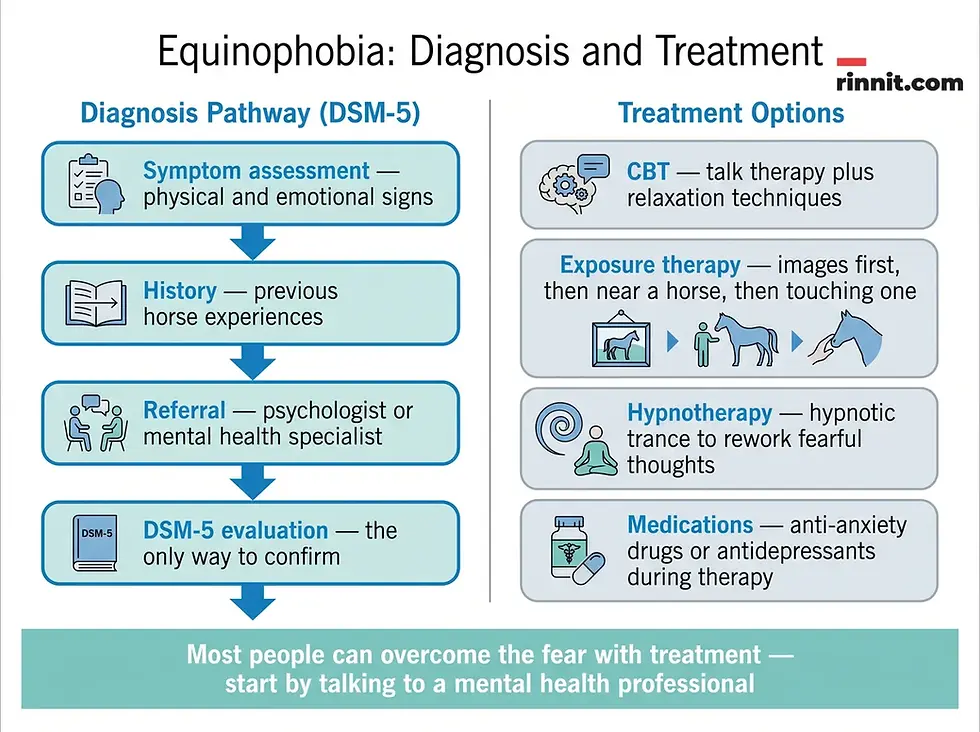
A healthcare provider will assess your symptoms and ask about your previous experiences with horses [1]. You may be referred to a mental health professional, such as a psychologist [1]. To diagnose a specific phobic disorder, providers use the DSM-5 [1] — the American Psychiatric Association's Diagnostic and Statistical Manual of Mental Disorders.
The diagnostic criteria
Under the DSM-5, you may have a specific phobic disorder like equinophobia if you meet these conditions:
Criterion | What it looks like |
Phobia symptoms triggered by horses | Symptoms appear when you see or think about horses [1] |
Persistent fear | The fear lasts for at least six months [1] |
Behavioral changes | You have changed your routines or behaviors to avoid seeing or being near horses [1] |
Reduced quality of life | Phobia symptoms have diminished your quality of life [1] |
What the diagnostic process looks like
Step | What happens |
Symptom assessment | Provider reviews your physical and emotional symptoms |
History taking | Questions about previous experiences with horses |
Mental health referral | You may see a psychologist or other specialist |
DSM-5 evaluation | Criteria are checked to confirm a specific phobic disorder |
Treatment: How Can You Get Over a Fear of Horses?
A psychologist or other mental health specialist can help you overcome a fear of horses. You may benefit from one or more of these treatments:
Treatment | How it works |
Cognitive behavioral therapy (CBT) | Talk therapy that explores the underlying cause of the phobia. You learn relaxation techniques to manage phobia symptoms and overcome your fear [1] |
Exposure therapy (desensitization) | |
Hypnotherapy | Puts you into a hypnotic state, or trance, to help you overcome thoughts and emotions related to horses [1] |
Medications | Anti-anxiety drugs or antidepressants ease symptoms during therapy. These medicines can make it easier for you to be around horses until you finish therapy [1] |
Exposure therapy follows a gradual ladder — images first, then proximity, then touch [1] — which is why many people find it manageable even when the idea of facing their fear feels overwhelming.
Complications: why treatment matters
A severe phobic disorder increases your risk of several complications [1]. That is why seeking help matters even if the fear feels "small" to others.
If you are experiencing thoughts of suicide, the 988 Suicide and Crisis Lifeline is available 24/7 — call or text 988.
Outlook: What Can I Expect?
Recovery is realistic. Psychotherapies, including CBT and exposure therapy, can make it easier for you to be around horses [1]. Even in cities — where police officers often patrol on horseback and horses may take tourists around — the phobia can interfere with daily life [1]. Having a phobia also increases your risk for other phobias, anxiety disorders, and panic attacks [1], so the sooner you address it, the better.
When should you call the doctor?
You should call your healthcare provider if you experience:
Questions to ask your healthcare provider
Question | Why it matters |
What is causing equinophobia? | Helps target the treatment |
What is the best treatment for me? | Personalizes the plan |
Should I try exposure therapy? | Explores the most direct path to overcoming the fear |
How long will I need therapy? | Sets realistic expectations |
Can medications help? | Addresses symptom relief during therapy |
Should I watch for signs of complications? | Catches depression or panic disorder early |
Prevention: Can Equinophobia Be Prevented?
There is no guaranteed way to prevent a specific phobia, since many start with a single traumatic experience. What is known is that people with a family history of phobias or anxiety disorders carry higher risk [1]. Early treatment after a frightening horse experience — before avoidance patterns become entrenched — is the best available protective step.
Key Takeaways
Equinophobia is a real anxiety disorder, not a quirk. It starts with horses — or even the thought of them — but its effects can reach into your routines, your social life, and your mood. If a parade, a trail ride, or a childhood fall left you with an enduring fear of horses, know that this is a recognized and treatable condition. With CBT, exposure therapy, hypnotherapy, or supportive medications, most people can steadily reduce their fear and get their life back.
Take the Next Step
If fear of horses — or anything connected to them — has been shaping your choices for six months or more, schedule an appointment with a mental health professional today. And if you are ever in crisis or having thoughts of suicide, the 988 Suicide and Crisis Lifeline is available around the clock — call or text 988.
Further reading: APA — What Is Exposure Therapy? · NIMH — Specific Phobia · NHS — Overview: Phobias · ADAA — Specific Phobia · APA — DSM-5 Overview
Frequently Asked Questions
1. What is equinophobia?
Equinophobia is a specific phobic disorder — an extreme, unnecessary fear of horses. The name comes from Equus (Latin for horses) and Phobos (Greek for fear). It may also include fear of ponies, donkeys, and mules. It is classified as an anxiety disorder.
2. What is another name for fear of horses?
Fear of horses is also called hippophobia. "Hippos" is the Greek word for horses. In English, "equine" is the more common root word, which is why equinophobia is the term most often used.
3. What causes equinophobia?
Many people develop equinophobia after a traumatic horse experience, such as being thrown from a horse, or being bitten, stepped on, or kicked. Risk factors include a family history of phobias or anxiety disorders and gene changes linked to anxiety.
4. What are the symptoms of equinophobia?
Symptoms include chills, dizziness and lightheadedness, excessive sweating, heart palpitations, nausea, shortness of breath, trembling or shaking, and upset stomach or indigestion. People also go to great lengths to avoid horses and may hide or run away near them.
5. How is equinophobia diagnosed?
A healthcare provider assesses symptoms and your history with horses, often referring you to a psychologist. Using DSM-5 criteria, a specific phobic disorder is diagnosed when fear is triggered by horses, lasts at least six months, changes your behavior, and reduces your quality of life.
6. Can you overcome a fear of horses?
Yes. A psychologist or mental health specialist can help using cognitive behavioral therapy, exposure therapy, hypnotherapy, or medications. These treatments help you manage symptoms and gradually reduce your fear.
7. What is exposure therapy for equinophobia?
Exposure therapy (also called desensitization) gradually exposes you to horses while you use relaxation techniques. You may start with images of horses, work up to being near a horse, and eventually touching one, becoming less responsive to the fear over time.
8. Can medications help with equinophobia?
Yes. Anti-anxiety drugs or antidepressants can ease symptoms while you go through therapy. These medicines can make it easier to be around horses until you finish treatment.
9. Is equinophobia common?
It is hard to know exactly how many people have it, since many keep the fear private. However, about 1 in 10 American adults and 1 in 5 teenagers will deal with a specific phobia disorder at some point in their lives. Females are more likely to have specific phobias, but they affect all ages and sexes.
10. What are the complications of untreated equinophobia?
A severe phobic disorder increases your risk of depression, social isolation, suicidal thoughts, panic attacks and panic disorder, and substance use disorder. That is why seeking help early matters.
Related Reading
References
Cleveland Clinic. Equinophobia (Fear of Horses). Cleveland Clinic. Last updated Mar. 24, 2022. https://my.clevelandclinic.org/health/diseases/22568-equinophobia-fear-of-horses
Wolitzky-Taylor KB, Horowitz JD, Powers MB, Telch MJ. Psychological approaches in the treatment of specific phobias: a meta-analysis. Clin Psychol Rev. 2008;28(6):1021-1037. doi:10.1016/j.cpr.2008.02.007. PMID: 18410984.
Carl E, Stein AT, Levihn-Coon A, et al. Virtual reality exposure therapy for anxiety and related disorders: a meta-analysis of randomized controlled trials. J Anxiety Disord. 2019;61:27-36. doi:10.1016/j.janxdis.2018.08.003. PMID: 30287083.
Medical Disclaimer
This article is for informational purposes only and does not constitute medical advice. Always seek the advice of your physician or other qualified health provider with any questions you may have regarding a medical condition. Never disregard professional medical advice or delay in seeking it because of something you have read here.



Comments