Epidermolysis Bullosa: Symptoms, Types, Causes, Diagnosis, Treatment and When to See Your Provider — What You Need to Know

Updated: 2 days ago
Medically reviewed by Dr. Baraa Alnahhal, MD · Last reviewed: September 2026
Quick Answer: Epidermolysis bullosa (EB) is a group of genetic disorders that makes skin fragile, so it blisters and tears easily from simple friction — clothing rubbing, bumping a limb, or minor pressure. There are four main types, from the common epidermis simplex to very rare Kindler syndrome. Blistering usually begins in infancy or early childhood and can affect the skin, mouth, esophagus, eyes and other organs. There is no cure, but treatment focuses on preventing blisters, caring for wounds, managing pain and addressing nutrition problems. The condition affects an estimated 1 in 50,000 people in the United States. Because it is usually inherited, people with a family history of EB should discuss genetic counseling with a provider.
TL;DR: Epidermolysis Bullosa at a Glance
Epidermolysis bullosa is a connective tissue disorder that causes your skin to blister and tear easily. A gene defect weakens the "glue" that binds the skin's layers together, so everyday friction — even clothing rubbing against your body — can create blisters and sores. Treatment cannot cure the disease, but it can prevent blisters, protect wounds, manage pain and keep nutrition on track.
Limitation statement: This article reports only the figures published by the source: an estimated 1 in 50,000 people in the United States have EB. No other prevalence numbers, incidence rates or survival statistics beyond those stated in the source are provided here. Any other numbers found elsewhere on the internet are not supported by this source and have not been included.
Fact | What the source says |
What it is | A group of genetic (inherited) disorders that make skin fragile, blisters and tears easily |
How common | An estimated 1 in 50,000 people in the United States |
Who it affects | People of all sexes, races and ethnic backgrounds; more likely if a parent has the disorder |
When it starts | Signs usually appear when you're a baby or toddler |
How many types | Four primary subtypes (EBS, JEB, DEB, Kindler syndrome) |
Is there a cure | No — treatment focuses on prevention, wound care, nutrition and pain |
Is it contagious | No — it is usually inherited; rarely it is an acquired autoimmune disorder |
What Is Epidermolysis Bullosa?

Epidermolysis bullosa (EB) is a group of genetic (inherited) disorders that causes your skin to be fragile and blister and tear easily. Blisters and sores form when clothing rubs against your skin, or you bump your skin.
Mild cases of the disease usually cause painful blisters on the hands, elbows, knees and feet. However, tears and blisters can appear anywhere on the body. EB symptoms can range from very mild to very severe.
In some cases, blisters form inside the body in places such as the mouth, esophagus, other internal organs or eyes. When the blisters heal, they can cause painful scarring. In severe cases, blisters and scars can harm internal organs and tissue enough to be fatal.
How many types of epidermolysis bullosa are there?
EB has four primary subtypes, defined by which layer of the skin is affected:
Subtype | Abbreviation | Where blisters form | How it behaves |
EB simplex | EBS | The top layer of your skin (epidermis) | The most common form; ranges from mild (not very painful) to severe (very painful); blisters rarely scar after healing |
Junctional EB | JEB | The mouth and airway | Rare; ranges from moderate (uncomfortable, mild pain) to severe |
Dystrophic EB | DEB | The middle layer of your skin (dermis) | Ranges from mild to severe |
Kindler syndrome | — | All layers of your skin | Very rare |
Healthcare providers diagnose EBS, JEB and DEB according to your affected layers of skin. Kindler syndrome may appear as blisters throughout different layers of your skin.
How common is epidermolysis bullosa?
An estimated 1 in 50,000 people in the United States have EB. The condition affects people of all sexes, races and ethnic backgrounds. However, you're more likely to have EB if you have a parent with the disorder.
Is epidermolysis bullosa fatal?
It depends on what type of EB you have. Mild cases of EB aren't fatal. People with severe cases of EB have a life expectancy that ranges from infancy to 30 years of age.
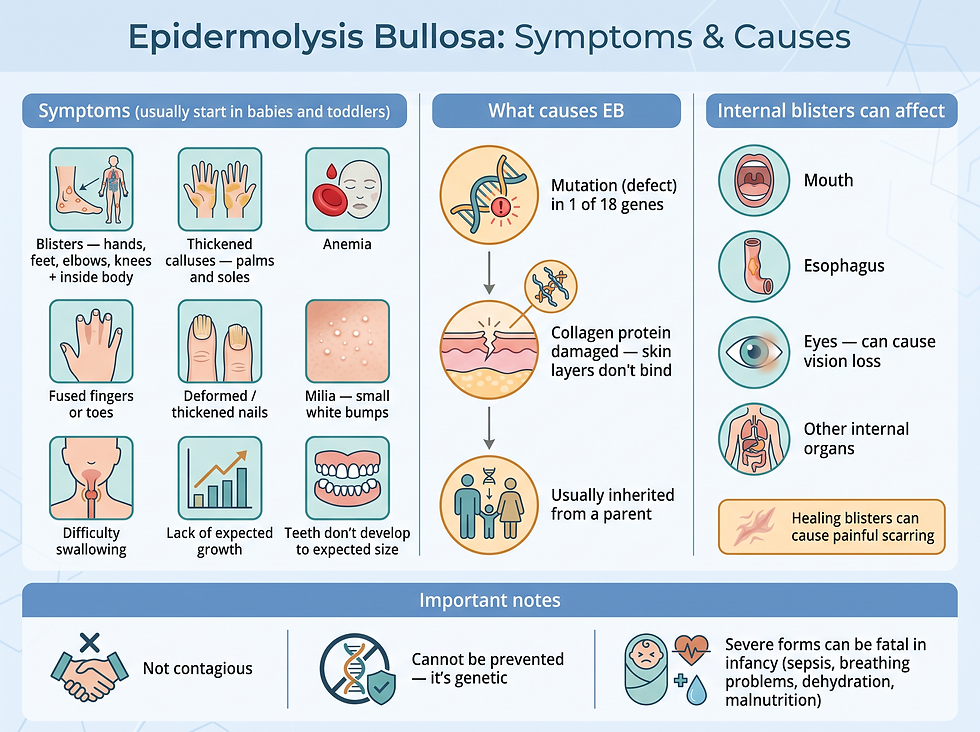
What Are the Symptoms of Epidermolysis Bullosa?
The signs and symptoms of EB depend on the type, and they usually appear when you're a baby or toddler. Some symptoms overlap between the types.
What symptoms should you watch for?
Symptom | Notes |
Blisters | On your skin (hands, feet, elbows and knees) or inside your body |
Thickened calluses | On the palms of your hands and soles of your feet |
Anemia | Low levels of red blood cells |
Fused fingers or toes | Fingers or toes that have become attached |
Nail changes | Deformed and/or thickened fingernails and toenails |
Milia | Small white bumps on the skin |
Difficulty swallowing (dysphagia) | From blisters in the mouth or esophagus |
Poor growth | Lack of expected growth in an infant |
Dental changes | Teeth that don't develop into an expected size (hypoplasia) |
How does epidermolysis bullosa affect the body?
Severe cases of EB may cause blisters in your eyes, which can result in vision loss. It may result in severe scarring and deformities of your skin and muscles, making it difficult to move your fingers, hands, feet and joints.
Some people with EB are at an increased risk of developing a type of skin cancer called squamous cell carcinoma. Death can sometimes occur during infancy due to severe infection (sepsis), breathing problems due to blocked airways, dehydration and malnutrition.
What Causes Epidermolysis Bullosa?
A mutation (defect) in one of 18 genes causes EB. People with the disorder have a missing or damaged gene that affects a protein used to make collagen. Collagen gives connective tissues, like skin, their strength and structure.
Because of this defect, the epidermis and dermis layers of your skin don't bind together as they normally would. This results in skin that's fragile and blisters and tears easily.
Is epidermolysis bullosa inherited?
EB is usually an inherited disorder, which means that one parent may have it and pass it down to their children. In rare cases, EB may also be an acquired autoimmune disorder — this form is sometimes called EB acquisita, and experts don't currently know what causes it.
Is epidermolysis bullosa contagious?
EB isn't contagious. It's usually an inherited disorder.
How Is Epidermolysis Bullosa Diagnosed?
Doctors diagnose EB with a test called a skin biopsy. In this test, a doctor removes a small skin sample and studies it under a microscope.
A genetic test can confirm the type of EB by identifying the defective gene. A prenatal genetic test can confirm if parents are at risk for having a baby with EB.
How Is Epidermolysis Bullosa Treated?

There is no cure for EB. Treatment helps prevent blisters from forming, care for blisters and skin so that complications don't occur, treat nutritional problems that may occur due to blisters in the mouth or esophagus, and manage pain.
How do doctors prevent blisters from forming?
To avoid damage and friction that may cause the skin to blister or tear, doctors recommend:
Prevention measure | Details |
Clothing | Wear soft, loose-fitting clothing made out of natural fibers; turn clothing inside-out to avoid contact with seams |
Temperature | Avoid getting too hot; keep rooms at a comfortable and even temperature |
Sun protection | Stay out of the sun or wear sunscreen |
Bandaging | Apply special bandages to protect the skin — use nonadhesive (doesn't stick to skin) bandages and tape and rolled gauze |
How are blisters treated?
To treat blisters, your doctor may recommend treating wounds daily with ointments, using medicated bandages to help blisters heal and prevent infection, and taking medications to manage pain.
How are infections treated?
To treat infections, your doctor may recommend taking antibiotics by mouth or applying antibiotic cream, and using a special wound covering for sores that don't heal.
How are nutrition problems handled?
To prevent nutrition problems due to difficulty eating because of blisters in the mouth or esophagus, your doctor may recommend:
Nutrition strategy | Details |
Special baby bottle | Using a baby bottle with a special nipple |
Alternative feeding | Feeding your baby with an eyedropper or syringe |
Thinned foods | Adding liquids to mashed foods to thin them down, making them easier to eat |
Soft diet | Eating a diet of soft foods, such as soups, mashed foods, pudding and applesauce |
Food temperature | Serving foods at a warm (not hot) temperature |
Dietitian support | Seeing a dietitian to monitor your special nutrition needs |
When is surgery needed?
For severe cases of EB, you may need surgery. Surgery will widen the esophagus (the tube leading from the mouth to the stomach) if blisters and scarring have caused it to narrow. Inserting a feeding tube directly into the stomach, bypassing the esophagus entirely, is another option for some people. Surgery also separates fingers or toes that have fused from the blisters.
How do you take care of yourself with EB?
The following tips will help you take care of yourself: sleep on sheets and bedding made of soft, natural fibers, such as silk or satin; wear loose, comfortable shoes; avoid standing or walking on your feet for long periods; avoid scratching or rubbing your skin; apply anti-itch medications to reduce itching; be aware of your surroundings to avoid accidentally hitting or scratching your skin; and moisturize your skin frequently to reduce friction.
You can pop blisters with a sterile needle or clean scissors. Use nonadhesive (not sticky) bandages, or apply petroleum jelly (Vaseline™) or skincare ointments (Aquaphor™) to your bandages to prevent them from sticking.
How do you care for a child with EB?
Your child's needs are unique, and they may not yet have the ability or vocabulary to express what's bothering them. The source offers detailed care tips:
Care area | What to do |
Handling | Thoroughly wash your hands before handling your child's skin; avoid latex gloves, which may create friction |
Bathing | Gently bathe your baby's skin in sections rather than putting their whole body in a shallow tub |
Diapering | Lay your newborn on absorbent pads instead of diapers when possible; use diapers with Velcro® straps (adhesive tape can stick to skin); cut the elastic off diaper leg holes; place silicone gel sheets in the diaper lining to prevent sticking to open blisters |
Lifting | Avoid putting your hands under their armpits; if their thighs and back are free from blisters or sores, wrap one arm around their thighs and support their back with the other |
Activity | Encourage them to be as active as their EB allows — inactivity may cause constipation and muscle loss (atrophy); swimming has minimal impact; discourage rough, physical play, especially anything that causes overheating and sweating |
It may be difficult treating your child's symptoms, and you may feel overwhelmed or stressed. Ask your healthcare provider about any other tips or suggestions on how to keep your child — and you — as comfortable as possible. Parent support groups also allow you to share your experiences and learn new ways to manage your child's EB.
What Is the Outlook for Epidermolysis Bullosa?
The outlook for people with EB depends on the type and severity. Severe forms of the disease can result in severe pain, disfigurement, disability, wounds that never heal and early death.
Healthcare providers can help you manage symptoms with proper treatment and, if needed, medicines for pain management. Preventive measures — extensive every-other-day wrapping of the skin with nonadhesive, protective dressings — and regular bathing and wound care can help manage EB's impact.
Can epidermolysis bullosa be prevented?
Because it's genetic, you can't prevent EB. People with a family history of EB who are thinking about becoming parents may benefit from genetic counseling to decide how to grow their families.
In addition, experts don't currently know what causes EB acquisita (the acquired autoimmune form). Therefore, healthcare providers don't know how to prevent it.
What's the difference between bullous pemphigoid and epidermolysis bullosa?
Bullous pemphigoid is a rare autoimmune skin disorder that may cause itchy, hive-like welts or fluid-filled blisters. Bullous pemphigoid occurs most often in people over the age of 60, and it usually goes away within five years.
EB may be an autoimmune disorder, but a gene mutation that affects the collagen in your skin is typically the cause. EB usually occurs in infancy or early childhood. There is no cure for EB, so you may experience symptoms throughout your life.
When Should You See Your Provider?
Contact your healthcare provider if you have difficulty breathing, difficulty swallowing, wounds that look infected (red, purple, gray or white skin; irritation or swelling), or if you develop new symptoms.
What questions should I ask my healthcare provider?
# | Question |
1 | How can you tell that I have EB? |
2 | If I don't have EB, what other skin condition might I have? |
3 | How can I control my symptoms? |
4 | What medications do you recommend? |
5 | Do the medications have any side effects? |
6 | What at-home treatments do you recommend? |
7 | What else should I do to improve my symptoms? |
8 | Is there a cream or ointment that you can prescribe? |
9 | Should I see a dermatologist or another specialist? |
What to Remember
Epidermolysis bullosa causes blisters, tears and sores on your skin, which may be mild or severe. The life expectancy for people with severe EB is poor. However, most people with EB continue to live well for decades after diagnosis, though they may have to take more precautions to protect their skin. EB is usually an inherited disorder. If you have a family history of EB, it's a good idea to see your healthcare provider to discuss genetic counseling to help you make family-planning decisions.
Clinical care-team note (verbatim from the source): "Epidermolysis bullosa causes blisters, tears and sores on your skin, which may be mild or severe. The life expectancy for people with severe EB is poor. However, most people with EB continue to live well for decades after diagnosis, though they may have to take more precautions to protect their skin. EB is usually an inherited disorder. If you have a family history of EB, it's a good idea to see your healthcare provider to discuss genetic counseling to help you make family-planning decisions."
Conclusion: Daily Care Makes the Biggest Difference
There is no cure for epidermolysis bullosa, but day-to-day care profoundly shapes how the condition feels and progresses. Preventing blisters through soft clothing, temperature control and nonadhesive bandaging, treating wounds before they become infected, and keeping nutrition on track can reduce pain and complications for both children and adults. Because EB is genetic, prevention isn't possible — but genetic counseling helps families make informed planning decisions.
Take these three steps:
See a provider promptly if you have difficulty breathing or swallowing, wounds that look infected, or any new symptoms.
Follow daily skin-protection habits — soft natural-fiber clothing turned inside-out, nonadhesive bandages, loose shoes, frequent moisturizing and careful activity choices.
Ask about genetic counseling if EB runs in your family, especially before starting a family.
This article provides general information and is not a substitute for professional medical advice. Always consult a qualified healthcare provider for diagnosis and treatment.
Frequently Asked Questions
What is epidermolysis bullosa?
Epidermolysis bullosa (EB) is a group of genetic (inherited) disorders that causes your skin to be fragile and blister and tear easily. Blisters and sores form when clothing rubs against your skin, or you bump your skin.
Why is it called "epidermolysis bullosa"?
"Epidermolysis" refers to the skin separating (epidermo- for skin, -lysis for breaking apart), and "bullosa" means blisters — the skin of people with EB blisters and separates easily.
Is epidermolysis bullosa genetic?
Yes. A mutation (defect) in one of 18 genes causes EB. The defect affects a protein used to make collagen, which gives connective tissues like skin their strength and structure.
Is epidermolysis bullosa inherited?
Yes. EB is usually an inherited disorder, meaning one parent may have it and pass it down to their children. In rare cases it can be an acquired autoimmune disorder.
Is epidermolysis bullosa contagious?
No. EB isn't contagious. It's usually an inherited disorder.
How common is epidermolysis bullosa?
An estimated 1 in 50,000 people in the United States have EB.
Who does epidermolysis bullosa affect?
EB affects everyone — people of all sexes, races and ethnic backgrounds can have it. However, you're more likely to have EB if you have a parent with the disorder.
When do epidermolysis bullosa symptoms start?
Signs and symptoms usually appear when you're a baby or toddler.
How many types of epidermolysis bullosa are there?
There are four primary subtypes: EB simplex (EBS), junctional EB (JEB), dystrophic EB (DEB) and Kindler syndrome.
What is EB simplex (EBS)?
EBS is the most common form of EB. It can range from mild (not very painful) to severe (very painful). Blisters develop in the top layer of your skin (epidermis) and rarely scar after healing.
What is junctional EB (JEB)?
JEB causes blisters to form in your mouth and airway. It's rare, and it can range from moderate (uncomfortable, mild pain) to severe.
What is dystrophic EB (DEB)?
DEB causes blisters to grow in the middle layer of your skin (dermis). It can range from mild to severe.
What is Kindler syndrome?
Kindler syndrome is a very rare form of EB in which blisters can form in all layers of your skin.
Can epidermolysis bullosa affect internal organs?
Yes. In some cases, blisters form inside the body in places such as the mouth, esophagus, other internal organs or eyes.
Can epidermolysis bullosa affect the eyes?
Yes. Severe cases of EB may cause blisters in your eyes, which can result in vision loss.
What are the symptoms of epidermolysis bullosa?
Symptoms include blisters on your skin (hands, feet, elbows and knees) or inside your body, thickened calluses on the palms and soles, anemia, fused fingers or toes, deformed or thickened nails, small white bumps (milia), difficulty swallowing, lack of expected growth in infants, and teeth that don't develop to expected size.
Can epidermolysis bullosa cause difficulty swallowing?
Yes. Blisters in the mouth or esophagus can cause difficulty swallowing (dysphagia).
Can epidermolysis bullosa cause fused fingers and toes?
Yes. Blisters and scarring can cause fingers or toes to become fused (attached), and surgery can separate them.
Can epidermolysis bullosa cause skin cancer?
Yes. Some people with EB are at an increased risk of developing a type of skin cancer called squamous cell carcinoma.
Is epidermolysis bullosa painful?
Yes. Mild cases usually cause painful blisters on the hands, elbows, knees and feet, and severe forms can cause severe pain along with disfigurement, disability and wounds that never heal.
Is epidermolysis bullosa fatal?
It depends on the type. Mild cases aren't fatal. People with severe cases have a life expectancy that ranges from infancy to 30 years of age. In severe cases, death can sometimes occur during infancy due to sepsis, breathing problems from blocked airways, dehydration and malnutrition.
How is epidermolysis bullosa diagnosed?
Doctors diagnose EB with a skin biopsy — a small skin sample studied under a microscope. A genetic test can confirm the type by identifying the defective gene, and a prenatal genetic test can show if parents are at risk of having a baby with EB.
Is there a cure for epidermolysis bullosa?
No. There is no cure for EB. Treatment helps prevent blisters from forming, care for blisters and skin, treat nutritional problems and manage pain.
How is epidermolysis bullosa treated?
Treatment includes soft, loose-fitting clothing turned inside-out, temperature control, sun protection, nonadhesive bandages, daily wound ointments, medicated bandages, pain medications, antibiotics for infections, nutrition strategies, and sometimes surgery.
Can surgery treat epidermolysis bullosa?
For severe cases, surgery can widen a narrowed esophagus, insert a feeding tube directly into the stomach, and separate fingers or toes fused by blisters.
How do people with EB eat?
Doctors may recommend a baby bottle with a special nipple, feeding with an eyedropper or syringe, thinning mashed foods, a soft diet (soups, mashed foods, pudding, applesauce), warm (not hot) foods, and seeing a dietitian.
How can you prevent blisters with epidermolysis bullosa?
Wear soft, loose-fitting natural-fiber clothing turned inside-out, keep rooms at a comfortable even temperature, stay out of the sun or wear sunscreen, and protect skin with nonadhesive bandages, tape and rolled gauze.
What should you avoid with epidermolysis bullosa?
Avoid tight clothing, seams against skin, heat, sun, scratching or rubbing, standing or walking on your feet for long periods, and latex gloves (they may create friction). Discourage rough play that causes overheating and sweating.
What is the difference between bullous pemphigoid and epidermolysis bullosa?
Bullous pemphigoid is a rare autoimmune skin disorder that occurs most often in people over 60 and usually goes away within five years. EB is usually caused by a gene mutation affecting collagen, occurs in infancy or early childhood, has no cure, and causes lifelong symptoms.
What is EB acquisita?
EB acquisita is the rare acquired autoimmune form of EB. Experts don't currently know what causes it, and healthcare providers don't know how to prevent it.
What is the prognosis for epidermolysis bullosa?
The outlook depends on the type and severity. Severe forms can cause severe pain, disfigurement, disability, nonhealing wounds and early death. However, most people with EB continue to live well for decades after diagnosis with proper treatment and precautions.
Can epidermolysis bullosa be prevented?
Because it's genetic, you can't prevent EB. People with a family history of EB who are thinking about becoming parents may benefit from genetic counseling to decide how to grow their families.
When should I see my healthcare provider?
Contact your healthcare provider if you have difficulty breathing, difficulty swallowing, wounds that look infected (red, purple, gray or white skin; irritation or swelling), or if you develop new symptoms.
Should I see a dermatologist for epidermolysis bullosa?
The source suggests asking your provider whether you should see a dermatologist or another specialist as part of your care.
Additional Resources
For further reading, these authoritative external references support the information above:
Content reviewed and produced following the Rinnit editorial framework. Last updated: September 28, 2026.
Comments