Encephalocele: Types, Symptoms, Causes, Diagnosis, Surgery, Survival Rates and When to See Your Provider — What You Need to Know

Updated: 2 days ago
Medically reviewed by Dr. Baraa Alnahhal, MD · Last reviewed: September 2026
Quick Answer: What Is Encephalocele?
Encephalocele is a rare birth defect in which brain tissue grows through an opening in a newborn's skull. It is a type of neural tube defect that occurs when the top of the neural tube — the early form of the brain and spinal cord — doesn't close completely during the first weeks of pregnancy. It affects about 1 in 10,500 U.S. babies (roughly 375 per year). Treatment is surgery to repair the skull and remove the tissue outside it, often requiring more than one operation. Babies can survive with treatment, and openings near the front of the head carry a better outcome than those at the back.
TL;DR
What it is: a birth defect in which brain tissue grows through an opening in the baby's skull — a neural tube defect.
How rare: about 1 in 10,500 babies in the United States; roughly 375 babies born in the U.S. each year.
Severity range: can range from mild to life-threatening.
Treatment: surgery to repair the skull and remove tissue outside it; children usually need more than one surgery.
Survival: for large encephalocele, the CDC estimates 45% mortality (55% survival); front-of-head openings have better outcomes than back-of-head openings.
Prevention: no known way to prevent it; folic acid (400 mcg daily) before and during pregnancy reduces neural tube defect risk.
Limitation statement: this article is based strictly on the cited clinical source. The prevalence figures (1 in 10,500; about 375 U.S. births per year) and the 45% mortality estimate for large encephalocele come from CDC data as reported in the source. No overall cure rate or long-term quality-of-life statistics are available from the source, and none are invented here.
What Is Encephalocele?
Encephalocele (pronounced "en-SEF-al-oh-SEEL") is a birth defect that causes brain tissue to grow through an opening of your baby's skull. This condition is a neural tube defect. The neural tube is the early form of the brain and spinal cord when the fetus is developing in the uterus. Another neural tube defect is anencephaly.
If there's a problem with how the top of the neural tube closes during the first few weeks of pregnancy, encephalocele can happen. This condition can range from mild to life-threatening.

What are the types of encephalocele?
The types of encephalocele identify the location of the opening in the skull:
Occipital: the lower back of your baby's head.
Parietal: top, nearest the back of your baby's head.
Frontoethmoidal (also called sincipital): near your baby's forehead.
Sphenoidal: front-middle or behind your baby's eyes and in front of their ears.
In addition, you may hear your child's healthcare provider mention two broader categories of encephalocele. Anterior refers to the front of your child's skull, and posterior refers to the back of their skull.
How common is encephalocele?
Encephalocele is rare. An estimated 1 in 10,500 babies are born with the condition in the United States. Each year, this equals about 375 babies born in the U.S.
What Does Encephalocele Look Like and What Are the Symptoms?
How does it appear at birth?
A newborn with encephalocele will have a gap in their skull that isn't closed. This causes a bulge or sac of brain tissue covered in skin coming out of the skull opening. This can look similar to a balloon coming out of your child's head.
Depending on where the skull opening is, the skin on the sac may have hair on it. The skull opening can happen anywhere on their head. It's most common on the forehead or the lower back of their head near the base of your baby's skull.
What are the signs and symptoms?
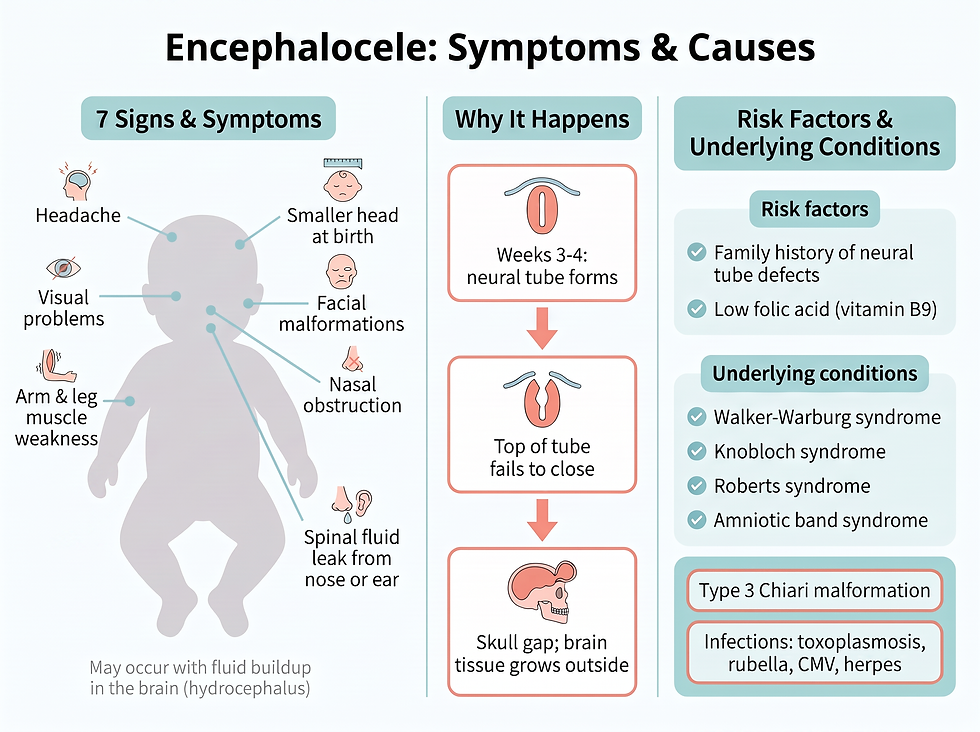
Signs and symptoms of encephalocele include headache, visual problems, muscle weakness in arms and legs, a smaller-than-expected head size at birth, uncoordinated movements (ataxia), facial malformations, nasal obstruction, and spinal fluid leaking from nose or ear.
Symptoms vary based on the size and location of the skull opening and how much brain tissue is outside of the skull at birth. Symptoms can be associated with fluid buildup in the brain (hydrocephalus).
What Are the Complications of Encephalocele?
What problems can develop over time?
Some cases of encephalocele have few to no complications. Long-term complications could include developmental delay, problems with cognitive development (intellectual disability), vision issues, delayed growth, and seizures.
What Causes Encephalocele?
How does a congenital encephalocele form?
Most encephaloceles are congenital, meaning your child is born with it, but some can be acquired as a result of trauma, tumor or other rare conditions such as idiopathic intracranial hypertension.
Congenital encephaloceles form when there's an issue with how the top of the neural tube closes. The neural tube is a piece of tissue that's the early version of the brain and spinal cord. It forms the shape of a tube during the third and fourth weeks of pregnancy.
The neural tube should fold and close during embryonic development. If the top part of the tube doesn't close as expected during this time, the skull doesn't close completely. As a result, part of your baby's brain grows out of this opening in the skull.
Why doesn't the neural tube close completely?
The exact reason why the neural tube doesn't close completely is unknown. Research suggests it could be the result of a genetic change that happens during conception, an infection (toxoplasmosis, rubella, cytomegalovirus, herpes simplex virus), or a neurological condition such as type 3 Chiari malformation.
An underlying medical condition may lead to encephalocele. These conditions include Walker-Warburg syndrome, Knobloch syndrome, Roberts syndrome and amniotic band syndrome.
What are the risk factors?
You're more likely to have a child with encephalocele if you have a history of neural tube defects (NTD) in your biological family history. You're also more likely to have a child with an NTD if you don't get enough folic acid (vitamin B9) before and during pregnancy.
How Is Encephalocele Diagnosed?
When can it be detected?
Your healthcare provider can diagnose encephalocele at a routine ultrasound during pregnancy. Your provider may order a prenatal MRI imaging test to learn more about the birth defect during pregnancy.
Confirmation of the diagnosis happens immediately after your baby is born based on a visual examination of your baby. Further blood and imaging tests may help diagnose an underlying cause or let your child's healthcare provider understand how the condition affects your baby so they can treat it.
Can encephalocele go undiagnosed?
Yes, small encephalocele openings in the skull may go undiagnosed. These usually happen near your baby's nose or forehead. Small encephalocele openings don't usually cause symptoms that affect your newborn or complications that affect them as they grow.
How Is Encephalocele Treated?
What does surgery involve?
Treatment for encephalocele is surgery to repair the skull and remove brain tissue that grew outside of the skull. Often, the portion of the brain that's outside of the skull isn't functional and can be removed. When the opening is small, sometimes, the brain can be gently moved back into the skull before a surgeon repairs the skull.
Treatment usually happens shortly after birth or within the first few months to a year, depending on the size, location and effects the condition has on your baby. Children usually need more than one surgery to treat this condition. Surgery can also treat facial growth irregularities and hydrocephalus.
What other support do children need as they grow?
As your child grows, they may need additional support to treat associated conditions. This can include special education programs in school, medications for seizures, and glasses for vision problems.

Are there side effects of the treatment?
Each surgery comes with possible side effects. Your baby's care team is highly trained to prevent or reduce your child's risk of complications during and after surgery. Risks include infection, spinal fluid leak and bleeding.
When the opening is larger and involves more brain tissue, there's a higher risk of neurological issues. Talk to your child's healthcare provider about the side effects of treatment before it begins.
Can Babies Survive Encephalocele?
What does the evidence say about survival?
Yes, babies can survive encephalocele. Treatment with surgery to repair the skull can help them survive. Babies with large skull openings may have more symptoms and complications than babies with smaller openings. This increases their risk of life-threatening outcomes or a shorter life expectancy.
Studies found that newborns with skull openings near the front of their heads have a better outcome than babies with openings in the back of their heads.
What is the mortality rate?
The U.S. Centers for Disease Control and Prevention (CDC) estimates the mortality (death) rate for large encephalocele is 45%. That means that the survival rate is 55%. The risk of life-threatening complications increases due to the size and location of the skull opening and the overall health of your baby at birth.
Can Encephalocele Be Prevented?
There's no known way to prevent encephalocele. You can reduce your risk of having a child with a neural tube defect by getting plenty of folic acid.
Talk to your healthcare provider before you plan on becoming pregnant. They may recommend you take 400 mcg of folic acid daily, even if you don't plan to get pregnant right away. Neural tube defects (NTDs) happen in the first month of pregnancy. This is often before you even know you're pregnant, which is why it's essential to start taking folic acid early.
In addition, let your healthcare provider know if you have a family history of NTDs or if you had a child with an NTD. Your provider can help you prevent future NTDs.
When Should You See a Healthcare Provider?
If you're planning to become pregnant, talk with a healthcare provider about preconception counseling. They can help you maintain good health to lower your risk of having a child with a birth defect.
After your child's diagnosis and treatment, stay up to date on wellness visits with your child's healthcare provider. They'll monitor your child's growth to make sure they meet developmental milestones for their age and are healing as expected.
Questions to ask your healthcare provider
Where is the skull opening on my newborn? Location (anterior vs. posterior) strongly affects outcome.
Does my child need surgery? Surgery is the standard treatment and timing varies.
What are the side effects of surgery? Risks include infection, spinal fluid leak and bleeding.
How do I take care of my child after surgery? Recovery may require a hospital stay and follow-up monitoring.
What complications should I look out for? Long-term risks include seizures, developmental delay and vision issues.
What do I do if my child misses developmental milestones for their age? Wellness visits track growth and healing as expected.
Conclusion: Support Makes the Emotional Journey Manageable
Having a child with encephalocele can be an emotional journey. You may feel stressed, overwhelmed or helpless while your newborn receives treatment to repair their skull. But your baby can survive with surgical repair, and your care team will monitor recovery closely.
Having a child with encephalocele can be an emotional journey. You may feel stressed, overwhelmed or helpless while your newborn receives treatment to repair their skull. Your baby may need to stay in the hospital after their surgery so their care team can monitor their recovery. During this time, surround yourself with family and friends who can offer support when you need it most. Many people find comfort in speaking with a mental health professional, especially if you face an unexpected loss. Complications from encephalocele can affect your child as they grow. Stay up-to-date on wellness visits with your child's healthcare provider. They'll monitor your child's growth to make sure they meet developmental milestones for their age and are healing as expected.
What to do next. If you're planning a pregnancy, start 400 mcg of folic acid daily now — neural tube defects form in the first month, often before you know you're pregnant — and ask your provider about preconception counseling, especially if neural tube defects run in your biological family. If your newborn has been diagnosed, write down the questions above before your next appointment. And if the weight of this journey feels overwhelming, speak with a mental health professional — support is part of the treatment plan, not a sign of weakness.
This content is for general educational purposes only and is not a substitute for professional medical advice, diagnosis or treatment. Always seek the advice of your physician or other qualified health provider with any questions you may have regarding a medical condition.
Frequently Asked Questions (FAQ)
What is encephalocele?
Encephalocele (pronounced "en-SEF-al-oh-SEEL") is a birth defect that causes brain tissue to grow through an opening of your baby's skull. It is a neural tube defect.
Is encephalocele a neural tube defect?
Yes. The neural tube is the early form of the brain and spinal cord when the fetus is developing in the uterus. If there's a problem with how the top of the neural tube closes during the first few weeks of pregnancy, encephalocele can happen.
How severe is encephalocele?
This condition can range from mild to life-threatening.
How common is encephalocele?
Encephalocele is rare. An estimated 1 in 10,500 babies are born with the condition in the United States. Each year, this equals about 375 babies born in the U.S.
Where on the skull does the opening occur?
The skull opening can happen anywhere on the head. It's most common on the forehead or the lower back of the head near the base of the baby's skull.
What are the types of encephalocele?
The types identify the location of the opening: occipital (lower back of the head), parietal (top, nearest the back), frontoethmoidal or sincipital (near the forehead), and sphenoidal (front-middle or behind the eyes and in front of the ears).
What are anterior and posterior encephalocele?
Anterior refers to an opening at the front of the child's skull; posterior refers to the back of their skull.
What does encephalocele look like?
A newborn with encephalocele will have a gap in their skull that isn't closed. This causes a bulge or sac of brain tissue covered in skin coming out of the skull opening. This can look similar to a balloon coming out of your child's head.
Does the sac have hair on it?
Depending on where the skull opening is, the skin on the sac may have hair on it.
What are the symptoms of encephalocele?
Signs and symptoms include headache, visual problems, muscle weakness in arms and legs, a smaller-than-expected head size at birth, uncoordinated movements (ataxia), facial malformations, nasal obstruction, and spinal fluid leaking from nose or ear.
What is ataxia in encephalocele?
Ataxia refers to uncoordinated movements, one of the possible signs of encephalocele.
Can encephalocele cause a small head size?
Yes — a smaller-than-expected head size at birth (microcephaly) is one of the signs and symptoms.
What causes the symptoms to differ between babies?
Symptoms vary based on the size and location of the skull opening and how much brain tissue is outside of the skull at birth.
Can encephalocele be associated with hydrocephalus?
Yes — symptoms can be associated with fluid buildup in the brain (hydrocephalus).
What are the long-term complications?
Some cases have few to no complications. Long-term complications could include developmental delay, problems with cognitive development (intellectual disability), vision issues, delayed growth, and seizures.
What causes encephalocele?
Congenital encephaloceles form when there's an issue with how the top of the neural tube closes during the third and fourth weeks of pregnancy. Most encephaloceles are congenital, but some can be acquired as a result of trauma, tumor or other rare conditions such as idiopathic intracranial hypertension.
Why doesn't the neural tube close completely?
The exact reason is unknown. Research suggests it could be the result of a genetic change during conception, an infection (toxoplasmosis, rubella, cytomegalovirus, herpes simplex virus), or a neurological condition like type 3 Chiari malformation.
Which medical conditions can lead to encephalocele?
Underlying conditions include Walker-Warburg syndrome, Knobloch syndrome, Roberts syndrome and amniotic band syndrome.
Who is at higher risk of having a child with encephalocele?
You're more likely to have a child with encephalocele if you have a history of neural tube defects (NTD) in your biological family history, or if you don't get enough folic acid (vitamin B9) before and during pregnancy.
Can encephalocele be detected during pregnancy?
Yes. Your healthcare provider can diagnose encephalocele at a routine ultrasound during pregnancy, and may order a prenatal MRI imaging test to learn more about the birth defect.
When is encephalocele confirmed?
Confirmation of the diagnosis happens immediately after your baby is born based on a visual examination of your baby.
Can small encephaloceles go undiagnosed?
Yes, small encephalocele openings in the skull may go undiagnosed. These usually happen near your baby's nose or forehead, and don't usually cause symptoms or later complications.
How is encephalocele treated?
Treatment is surgery to repair the skull and remove brain tissue that grew outside of the skull. Often, the portion of the brain that's outside isn't functional and can be removed. When the opening is small, sometimes the brain can be gently moved back into the skull before the surgeon repairs the skull.
When does treatment happen?
Treatment usually happens shortly after birth or within the first few months to a year, depending on the size, location and effects the condition has on your baby.
How many surgeries does a child need?
Children usually need more than one surgery to treat this condition. Surgery can also treat facial growth irregularities and hydrocephalus.
What support do children need later?
As your child grows, they may need special education programs in school, medications for seizures, and glasses for vision problems.
What are the risks of surgery?
Risks include infection, spinal fluid leak and bleeding. When the opening is larger and involves more brain tissue, there's a higher risk of neurological issues. Talk to your child's healthcare provider about side effects before treatment begins.
Can babies survive encephalocele?
Yes, babies can survive encephalocele. Treatment with surgery to repair the skull can help them survive. The CDC estimates the mortality rate for large encephalocele is 45%, meaning the survival rate is 55%. Babies with openings near the front of the head have a better outcome than babies with openings in the back.
Can encephalocele be prevented?
There's no known way to prevent encephalocele. You can reduce your risk of having a child with a neural tube defect by getting plenty of folic acid — providers often recommend 400 mcg daily before and during pregnancy, since NTDs happen in the first month, often before you know you're pregnant.
What should I do if I'm planning to become pregnant?
Talk with a healthcare provider about preconception counseling. They can help you maintain good health to lower your risk of having a child with a birth defect, and help you prevent future NTDs if you have a family history or had a previous child with an NTD.
External References
Centers for Disease Control and Prevention (U.S.). Facts About Encephalocele (last reviewed December 16, 2022) — source of the 1 in 10,500 prevalence and 45% mortality figures.
National Organization for Rare Disorders, Inc. — Encephalocele (last updated September 8, 2023)
Comments