Amniotic Band Syndrome: What Parents Need to Know About Causes, Signs, and Treatment

Updated: 2 days ago
Medically reviewed by Dr. Baraa Alnahhal, MD · Last reviewed: September 2026
TL;DR
Amniotic band syndrome (ABS) occurs when loose bands of tissue from the amniotic sac wrap around a developing fetus during pregnancy and restrict blood flow. About 80% of cases involve the hands or feet, and severity ranges from mild skin indentations to missing limbs or life-threatening organ damage. ABS affects roughly 1 in 1,200 to 15,000 live births, and most babies survive it. While there is no way to prevent it — most cases are random — treatment after birth through surgery, prosthetics, and physical and occupational therapy helps most children adapt well.
Quick Answer
What it is: Amniotic band syndrome is a condition where bands of tissue from the amniotic sac wrap around a developing fetus and restrict blood flow to body parts, affecting how they grow — it can also affect internal organs and the umbilical cord.
How common: ABS occurs in about 1 out of every 1,200 to 15,000 live births, and about 80% of cases involve damage to the hands or feet.
Severity range: From mild constriction rings (skin indentations) to missing fingers, toes, or limbs, shortened limbs, cleft lip and palate, clubfoot, and — in the most severe cases — organ damage that can be life-threatening.
Outlook: Most babies survive ABS; the outlook is good for mild cases, children with limb differences typically adapt well to prosthetics and rehabilitation, and severe organ damage from restricted umbilical cord blood flow is usually fatal — about 1 in 70 stillbirths occur due to ABS.
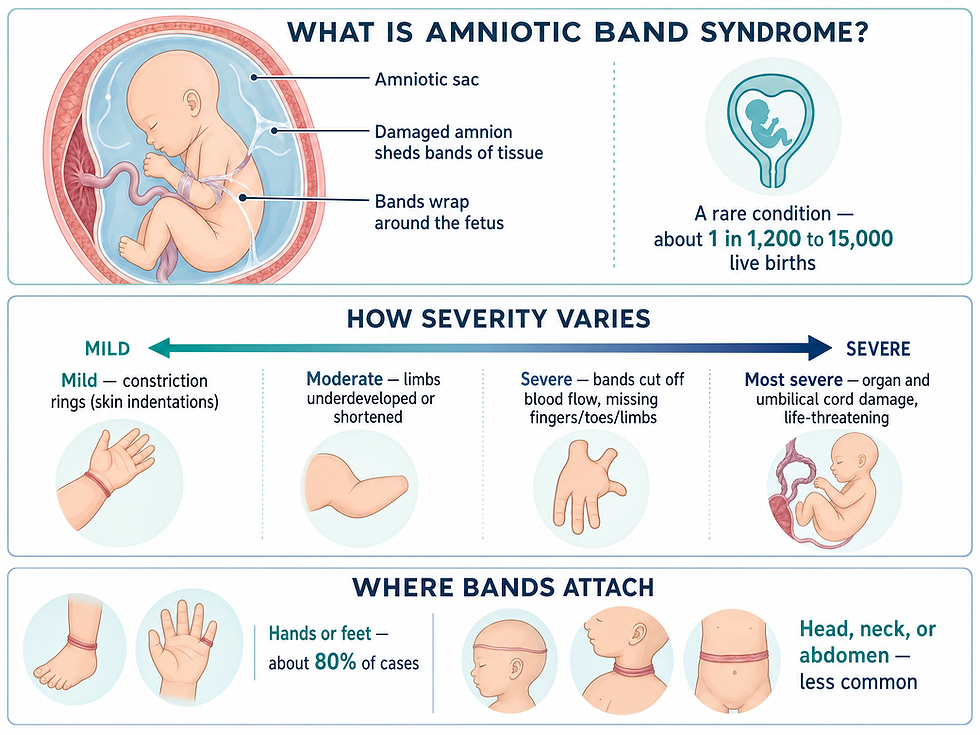
What Is Amniotic Band Syndrome?
Amniotic band syndrome (ABS) occurs when loose bands of tissue from the amniotic sac get wrapped around the fetus during pregnancy. These pieces of tissue are called amniotic bands, and they develop when the amnion — a layer of the amniotic sac — becomes damaged. The damage causes the amnion to "shed" bands of tissue, which can then tangle around the fetus.
The bands can prevent blood from reaching the fetus's body parts, affecting how they grow. They can also affect internal organs and the umbilical cord. The result can be birth defects (congenital disorders) or loss of limbs (amputation).
The severity of ABS depends on two things: how tight the bands are and where they are located on the fetus's body. Some infants are born with mild indentations on their skin, while others are born with missing limbs, fingers, or toes. When loose bands restrict blood flow from the placenta, it could result in death.
| Key Fact | Detail | | --- | --- | | Prevalence | About 1 in 1,200 to 15,000 live births | | Primary mechanism | Bands from the damaged amnion wrap around the fetus and restrict blood flow | | Most affected area | Hands or feet — about 80% of cases | | Diagnosis timing | Detectable on prenatal ultrasound, but most diagnoses happen at birth |
The condition goes by several other names, including amniotic band sequence, constriction band/rings syndrome, amniotic band disruption complex, congenital constricting bands/rings, ADAM complex (amniotic deformities/adhesions/mutilations), and Streeter anomaly.
What Are the Signs of Amniotic Band Syndrome?
The signs of ABS depend on where the bands attach and how tightly they're wrapped around the fetus. Most cases — about 80% — involve damage to the hands or feet. But the bands can also tighten around the head, neck, or abdomen.
Sometimes ABS is mild and only restricts blood flow to the surface of the skin. This could result in a baby being born with constriction rings (skin indentations) or mild malformations of their limbs. Other times, the bands are so tightly wound and deep that they cut off circulation to an organ or body part entirely — leading to amputation, loss of blood supply, or life-threatening complications.
| Sign | Description | | --- | --- | | Constriction rings | Skin indentations where bands tightened | | Missing digits or limbs | Missing fingers, toes, or entire limbs | | Syndactyly | Webbing or fusion between fingers or toes | | Shortened limbs | Shortened or underdeveloped limbs | | Swelling | In the areas affected by the bands | | Clubfoot | Foot turned inward and downward | | Cleft lip and palate | Facial opening affecting the lip or roof of the mouth | | Bone deformities | Including scoliosis (curvature of the spine) | | Choanal atresia | Underdeveloped nasal passage | | Microphthalmia | Small or underdeveloped eyeballs |

What Are the Complications?
ABS can cause complications, some of which are lifelong. Some complications can be serious or life-threatening.
| Complication | Description | | --- | --- | | Encephalocele | Openings in the skull | | Body wall defects | Openings or defects in the abdomen or chest | | Organ system damage | Damage to vital systems like the gastrointestinal (GI) or genitourinary system | | Umbilical cord complications | The band restricts blood supply to the fetus | | Premature birth | ABS often causes early delivery, which carries its own risks | | Pregnancy loss | Increased risk of miscarriage or stillbirth |
Children with ABS may also need physical or occupational therapy support for several years, or until they adapt to the challenges of missing or underdeveloped limbs.
What Causes Amniotic Band Syndrome?
Most research shows that amniotic band syndrome has no clear cause other than damage that occurs to the amnion — the lining of the amniotic sac. When that lining is damaged, it sheds the tissue strands that become the bands.
| Suspected Cause | Description | | --- | --- | | Prenatal tests | Chorionic villus sampling (CVS) or amniocentesis puncture the amniotic sac with a needle to sample fluid or tissue — damage from these tests is rare | | Open fetal surgery | Performed only for serious, life-threatening fetal conditions |
But in some cases of ABS, the amniotic sac is intact and is not the cause. So other experts believe ABS is the result of circulation (blood flow) problems in the fetus. It's possible that some fetuses have an abnormal gene that makes them more likely to have poor circulation.
What Are the Risk Factors?
You may be more likely to have a fetus with ABS if you have pregnancy complications, have vascular Ehlers–Danlos syndrome, smoke during pregnancy, or use drugs that aren't prescribed to you or take certain medications during pregnancy.
| Risk Factor | Why It Matters | | --- | --- | | Pregnancy complications | Associated with higher ABS likelihood | | Vascular Ehlers–Danlos syndrome | A connective-tissue condition affecting blood vessels | | Smoking during pregnancy | A modifiable risk factor | | Unprescribed drugs or certain medications | Linked to elevated risk |
How Is Amniotic Band Syndrome Diagnosed?
A healthcare provider usually diagnoses ABS soon after birth when they examine the baby. Sometimes, a provider detects signs of ABS on a pregnancy ultrasound. An ultrasound can show lines from the tightened bands of tissue. More often, though, the ultrasound will show missing limbs or body parts that aren't growing.
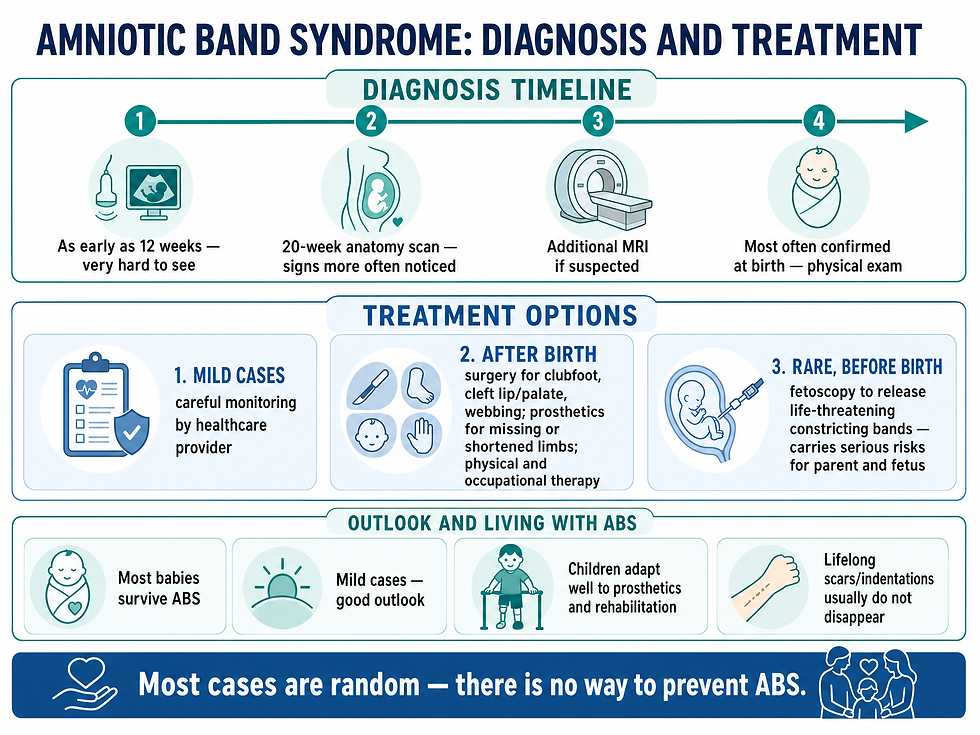
| Milestone | What Happens | | --- | --- | | 12 weeks | Signs may be visible but are very hard to see | | 20-week anatomy scan | This is when care providers more often notice signs of ABS | | Additional imaging | If suspected, providers may order an MRI | | Birth | Most ABS diagnoses are confirmed by examination at birth |
The pattern matters: mild cases may only show thin band lines on imaging, while severe cases present as missing or non-growing body parts. A suspected diagnosis should prompt closer monitoring and additional imaging to define the plan.
How Is Amniotic Band Syndrome Treated?
Treatment typically happens after the baby is born. The exact treatment depends on the location of the bands and how tight they were.
| Scenario | Treatment | | --- | --- | | Mild ABS | Careful monitoring by a healthcare provider | | Severe ABS affecting organ function | Immediate treatment | | Clubfoot, cleft lip and palate, webbing | Surgery can correct these issues | | Missing or shortened limbs | Prosthetics (artificial body parts); physical therapy and occupational therapy help the child use the prosthetic and improve overall function | | Life-threatening constriction bands (rare) | Fetoscopy — surgery to remove amniotic banding while the fetus is still in the uterus; the goal is to release the constrictive bands so they don't cause further damage; this procedure carries serious health risks for the parent and fetus |
The before-birth option deserves emphasis: fetoscopy is rare and reserved for constriction bands that are life-threatening, because of the serious risks involved. After birth, the care model is longer-term — surgery for structural corrections, prosthetics for limb differences, and years of therapy to build function.
Can Babies Survive Amniotic Band Syndrome?
Yes, most babies survive ABS. Survival depends on factors like the location of the bands and how tight the bands were.
| Scenario | Outcome | | --- | --- | | Most babies | Survive ABS | | Mild ABS | Good outlook | | Limb conditions | Children typically adapt well to prosthetics and rehabilitation | | Severe organ damage from restricted umbilical cord blood flow | Babies usually don't survive; about 1 in 70 stillbirths occur due to ABS |
Will the Amniotic Bands or Marks Disappear?
No. In most cases, the indentations or scars from the amniotic bands don't go away. This depends on how deeply the bands embedded themselves into the skin. Ask your healthcare provider about potential treatment options for scarring due to ABS.
How Can Amniotic Band Syndrome Be Prevented?
There's no way to prevent amniotic band syndrome. Healthcare providers believe that most cases are random.
While smoking during pregnancy and unprescribed drug use are listed as risk factors, ABS cannot be reliably prevented by avoiding them — most cases occur without any identifiable cause, and even parents with none of the listed risk factors can have a child with ABS.
What Should I Do If My Child Has Amniotic Band Syndrome?
Children with ABS will need a strong support system and long-term care. Parents, family members, and healthcare providers can help them as they adapt to the cosmetic and functional challenges of ABS.
Your child may see a variety of specialists depending on which body parts are affected — such as orthopedic surgeons and neurologists. Families and siblings may benefit from support groups.
| Support Element | Role | | --- | --- | | Specialist team | Orthopedic surgeons, neurologists, and others based on affected body parts | | Therapies | Physical and occupational therapy over several years | | Family support | Support groups for families and siblings | | Parent guidance | Ask providers about the diagnosis, ultrasounds during pregnancy, and what the plan means for your family |
If your baby receives an amniotic band syndrome diagnosis, know that your healthcare team is there to support you and take good care of you and your baby. Your exact situation will depend on how tight the bands are and where they're located. This may mean more frequent ultrasounds during pregnancy, or your baby may need surgery at birth, long-term rehabilitation, or prosthetics to restore function of their limbs.
Conclusion
Amniotic band syndrome is one of the most emotionally charged diagnoses a family can face — but the clinical reality offers genuine reassurance for the majority of cases. Most babies survive ABS. Most cases are random, not caused by anything the parents did. And children with limb differences typically adapt remarkably well to prosthetics and rehabilitation with a strong care team behind them.
What determines the outcome is severity. Mild cases may need only monitoring; severe cases involving organ function need immediate treatment; and the rare cases where bands restrict blood flow from the placenta are the ones that can be life-threatening. Understanding where your child falls on that spectrum — through early ultrasound detection, additional imaging, and specialist consultation — is the foundation of the right care plan.
CTA: If your prenatal ultrasound flagged possible banding, constriction rings, or a limb difference, ask your obstetric provider about additional imaging and a referral to a fetal medicine specialist. After birth, ask whether surgery, prosthetics, or therapy would benefit your child — and connect with a support group, because no family should navigate ABS alone.
FAQ
What is amniotic band syndrome?
Amniotic band syndrome (ABS) is a condition where loose bands of tissue from the amniotic sac wrap around a developing fetus during pregnancy and restrict blood flow to body parts, affecting how they grow. It can also affect internal organs and the umbilical cord, leading to birth defects or limb loss.
How common is amniotic band syndrome?
ABS occurs in about 1 out of every 1,200 to 15,000 live births. About 80% of cases involve damage to the hands or feet, though bands can also tighten around the head, neck, or abdomen.
What causes amniotic band syndrome?
Most research points to damage to the amnion, the lining of the amniotic sac, which sheds bands of tissue that tangle around the fetus. Rarely, damage from prenatal tests like CVS or amniocentesis, or from open fetal surgery, may be involved. Some experts believe circulation problems in the fetus — possibly linked to an abnormal gene — may also cause ABS.
Can anything prevent amniotic band syndrome?
No. There is no way to prevent amniotic band syndrome, and healthcare providers believe most cases are random.
Can babies survive amniotic band syndrome?
Yes — most babies survive ABS. Survival depends on the location and tightness of the bands. The outlook is good for mild cases, and children with limb differences typically adapt well to prosthetics and rehabilitation. However, about 1 in 70 stillbirths occur due to ABS when bands severely restrict umbilical cord blood flow.
When can ABS be seen on an ultrasound?
Signs may be visible as early as 12 weeks, but they are very hard to see. More often, care providers notice signs of ABS at the 20-week anatomy scan. If ABS is suspected, additional imaging such as an MRI may be ordered, though most diagnoses are confirmed at birth.
Will the marks from amniotic bands go away?
No. In most cases, the indentations or scars from the amniotic bands don't go away — it depends on how deeply the bands embedded into the skin. Providers can discuss treatment options for scarring.
How is amniotic band syndrome treated?
Treatment usually happens after birth and depends on band location and tightness: mild cases need careful monitoring; surgery can correct clubfoot, cleft lip and palate, or webbing; prosthetics help with missing or shortened limbs; and physical and occupational therapy build function. Rarely, fetoscopy releases life-threatening constriction bands before birth, though the procedure carries serious risks.
References
Singh AP, Gorla SR. Amniotic Band Syndrome. In: StatPearls [Internet]. Treasure Island (FL): StatPearls Publishing; 2024 Jan. Updated 2022 Dec 11. https://www.ncbi.nlm.nih.gov/books/NBK545283/
National Organization for Rare Disorders (U.S.). Amniotic Band Syndrome. Last updated 11/2023. https://rarediseases.org/rare-diseases/amniotic-band-syndrome/
Genetic and Rare Diseases Information Center (U.S.). Constriction rings syndrome. Last updated 7/2024. https://rarediseases.info.nih.gov/diseases/429/amniotic-band-syndrome
Pediatric Orthopaedic Society of North America. Amniotic Band Syndrome. https://posna.org/physician-education/study-guide/amniotic-band-syndrome
Inglesby DC, Janssen PL, Graziano FD, Gopman JM, et al. Amniotic Band Syndrome: Head-to-Toe Manifestations and Clinical Management Guidelines. Plast Reconstr Surg. 2023 Aug 1;152(2):338e-346e. https://pubmed.ncbi.nlm.nih.gov/37498929/
Demetri LRF, Starcevich AG, Manske MCB, James MA. Clinical Manifestations of Constriction Band Syndrome. J Bone Joint Surg Am. 2022 Jul 20;104(14):1301-1310. https://pubmed.ncbi.nlm.nih.gov/35856931/
Gueneuc A, Chalouhi GE, Borali D, Mediouni I, et al. Fetoscopic Release of Amniotic Bands Causing Limb Constriction: Case Series and Review of the Literature. Fetal Diagn Ther. 2019;46(4):246-256. https://pubmed.ncbi.nlm.nih.gov/30726851/
Holmes LB, Nasri HZ. Terminal transverse limb defects with "nubbins". Birth Defects Res. 2021 Aug 1;113(13):1007-1014. https://pubmed.ncbi.nlm.nih.gov/34240582/
Holmes LB, Westgate MN, Nasri H, Toufaily MH. Malformations attributed to the process of vascular disruption. Birth Defects Res. 2018 Jan;110(2):98-107. https://pubmed.ncbi.nlm.nih.gov/29377641/
Disclaimer: This article is for general educational purposes only and is not a substitute for professional medical advice, diagnosis, or treatment. Always consult a qualified healthcare provider — such as an obstetrician or pediatric specialist — for guidance specific to your pregnancy and child.
Comments