Double Uterus: Symptoms, Causes, Diagnosis, and Treatment Explained

Updated: 2 days ago
Medically reviewed by Dr. Baraa Alnahhal, MD · Last reviewed: September 2026
Quick answer: what does a double uterus mean for your health?
A double uterus is a congenital condition, meaning it is present from birth, in which the two small tubes that normally fuse into a single uterus during fetal development each develop into a separate organ instead. Most women with a double uterus have no symptoms, active sex lives, routine pregnancies, and successful deliveries, but the condition can increase the chances of miscarriage and premature birth. It is usually found during a routine pelvic exam or on imaging ordered for repeated miscarriages, and confirmation requires tests such as ultrasound, sonohysterogram, MRI, or hysterosalpingography. Treatment is often not needed; surgery is reserved for specific cases, such as an unexplained pregnancy loss with a partially divided uterus or a divided vagina that could make childbirth harder.
TL;DR
A double uterus is a rare condition present at birth that develops when the two small tubes that form a female fetus's uterus fail to join completely, leaving two separate uterus organs. It often causes no symptoms and is frequently discovered during a routine pelvic exam or imaging for repeated miscarriages. The most distinctive sign is menstrual bleeding that is not stopped by a tampon, which can happen when a double vagina accompanies a double uterus. Women with a double uterus often have successful pregnancies, though the condition raises the risk of miscarriage, premature birth, and sometimes infertility. Treatment is often unnecessary; surgery is considered in limited situations.
What is a double uterus?
A double uterus is a rare condition that is present at birth in some women. It belongs to a family of congenital uterine anomalies: structural differences in the reproductive organs that form before birth, rather than conditions that develop later in life.
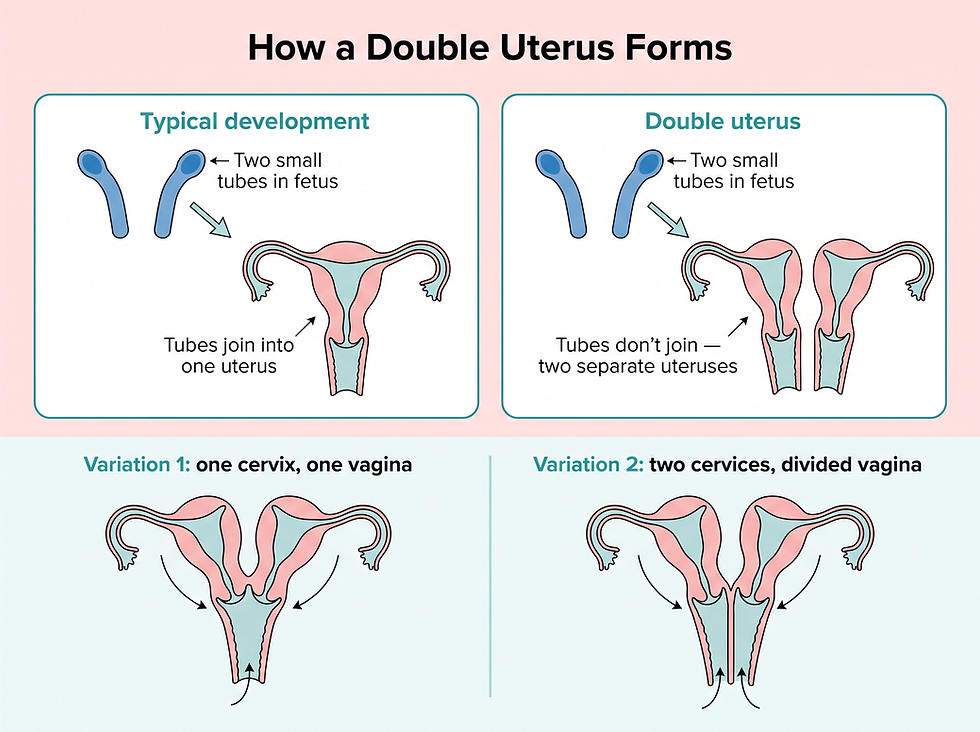
To understand how it happens, it helps to know how a uterus normally forms. In a female fetus, the uterus starts out as two small tubes. As the fetus grows, these tubes typically join to create one larger, hollow organ, the uterus. Sometimes the tubes don't join completely. Instead, each one develops into a separate organ, resulting in a double uterus. The condition can look different from person to person, depending on how far the separation extends.
How does the anatomy of a double uterus differ from a typical uterus?
The arrangement of the cervix and vagina varies in a double uterus. A double uterus may have one opening into one vagina; this opening is called the cervix. In other cases, each uterus has its own cervix. Often, there is also a thin wall of tissue that runs down the length of the vagina. This wall divides the vagina in two, with two separate openings.
Anatomical feature | Typical uterus | Double uterus (variation 1) | Double uterus (variation 2) |
Uterus count | One uterus | Two separate uteruses | Two separate uteruses |
Cervix | One cervix | One shared cervix | Each uterus has its own cervix |
Vagina | Single vagina | Single vagina | Often divided into two by a thin wall of tissue, with two separate openings |
For comparison with another common variation in uterine position, see our guide explaining why an anteverted uterus is completely normal.
Symptoms checklist: what to watch for
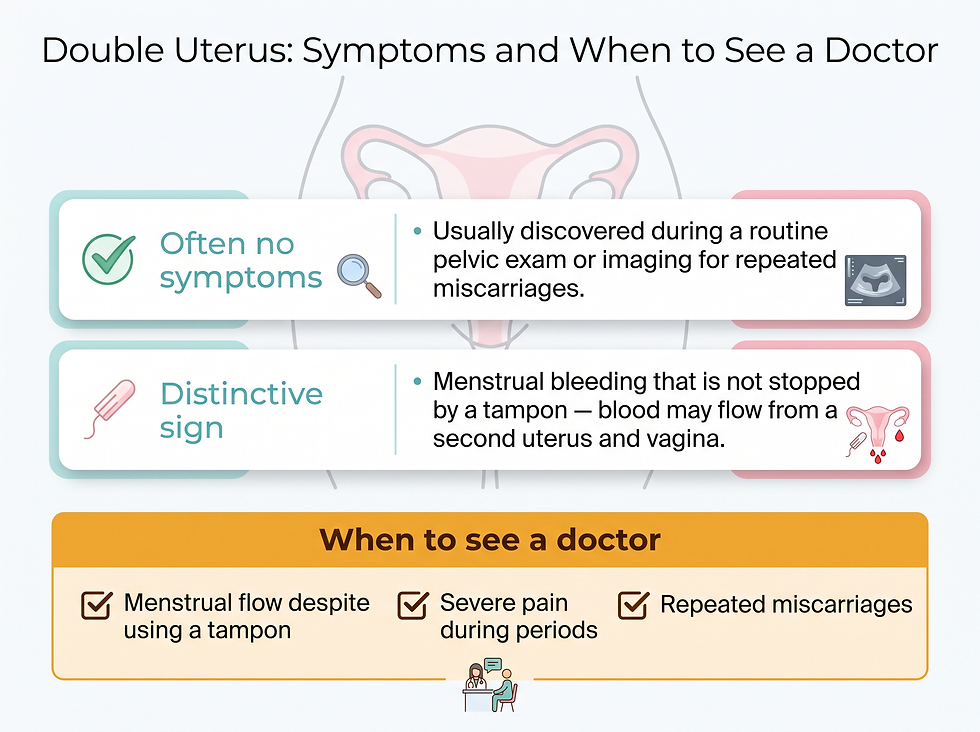
A double uterus often causes no symptoms at all. In many cases, the condition is discovered during a regular pelvic exam, when a healthcare provider notices an unusually shaped uterus or a double cervix. It may also be found during imaging tests performed to find the cause of repeated miscarriages. In other words, many women learn about the condition only while investigating a different concern.
Why does menstrual bleeding continue despite using a tampon?
The most distinctive possible symptom involves menstrual flow. Women who have a double vagina along with a double uterus may first see a healthcare provider for menstrual bleeding that isn't stopped by a tampon. This happens because a tampon placed in one vagina cannot absorb blood flowing from the second uterus and vagina. This specific pattern, continued bleeding despite a properly placed tampon, is a recognizable signal that can prompt investigation.
When should you see a doctor?
Seek medical advice if you have a menstrual flow despite using a tampon. Two other situations also warrant a call to your provider: severe pain during your periods, and repeated miscarriages, since imaging ordered to investigate miscarriage is one of the ways a double uterus is commonly discovered. To learn more about why pregnancy loss occurs, see our article on the chromosome counting error behind most miscarriages.
Symptom or situation | Why it matters |
No symptoms | Very common; often discovered by chance during a pelvic exam |
Menstrual flow despite a tampon | Possible sign of a double vagina with a double uterus |
Severe pain during periods | A reason to seek medical advice |
Repeated miscarriages | May lead to imaging that reveals the condition |
What causes a double uterus?
Health experts don't know exactly why some fetuses develop a double uterus. The condition forms during fetal development, when the two small tubes that should fuse into a single uterus fail to join completely. Genetics may play a role. This rare condition sometimes runs in families, which suggests a hereditary component even though the exact mechanism is unknown.
What increases the risk of having a double uterus?
The risk factors for a double uterus are not well understood, and the cause isn't known either. What is understood is that genetics likely plays a role, along with other unknown factors. No lifestyle factor, medication, or behavior has been identified as a risk, because the condition forms before birth and nothing a woman does can cause or prevent it.
Question | What is known |
Is the exact cause known? | No. Health experts don't know exactly why some fetuses develop a double uterus |
Can genetics play a role? | Yes. The condition sometimes runs in families |
Are other risk factors identified? | No. Risk factors are not well understood; genetics likely plays a role along with other unknown factors |
Can lifestyle cause it? | No. The condition is present at birth and forms during fetal development |
Can you get pregnant with a double uterus? (Complications)
Many women with a double uterus have active sex lives. They also may have routine pregnancies and successful deliveries. The condition does not automatically prevent pregnancy or healthy childbirth. However, the condition can make you more likely to have a miscarriage or premature birth. In some cases, a double uterus and other uterine factors can cause additional complications.
What complications can a double uterus cause?
A double uterus and other uterine factors can sometimes cause four main complications: infertility, miscarriage, premature birth, and kidney problems.
Complication | Note |
Infertility | Possible but not guaranteed; many women conceive routinely |
Miscarriage | The condition can make miscarriage more likely |
Premature birth | The condition can make premature birth more likely |
Kidney problems | Sometimes associated; doctors may check the kidneys |
The kidney connection is worth noting: because the reproductive and urinary systems develop from similar tissue in the fetus, sometimes ultrasound or MRI is also done to check for kidney problems when a double uterus is diagnosed.
"Women who have a double uterus often have successful pregnancies. But the condition can make you more likely to have a miscarriage or premature birth."
What these sources do not say: The source pages describe the condition as "rare" but do not give an incidence rate, and they do not publish statistics on how often pregnancy loss or premature birth occurs with a double uterus. This article does not invent such figures.
How is a double uterus diagnosed?
A double uterus may be diagnosed during a routine pelvic exam. Your doctor may observe a double cervix or feel an unusually shaped uterus. To confirm the diagnosis, you may need certain tests.
What tests confirm a double uterus?
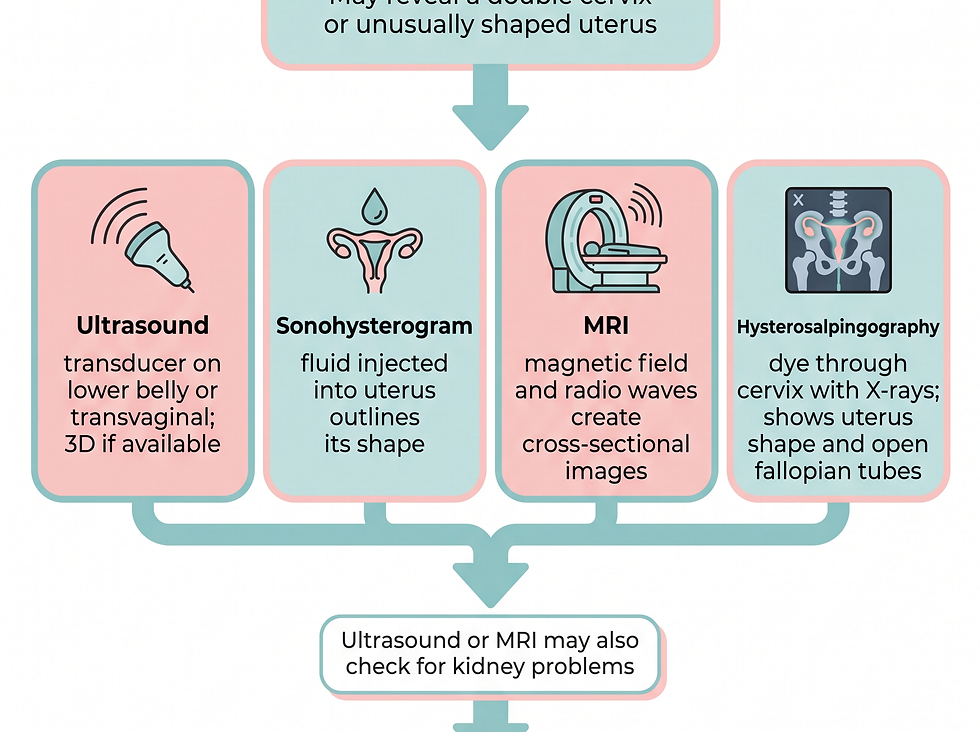
Four imaging approaches are used to confirm a double uterus, each revealing different information about the structure of the uterus and reproductive tract.
Test | How it works | What it shows |
Ultrasound | High-frequency sound waves create images of the inside of your body | The structure of the uterus; a transducer is pressed against the lower belly or placed in the vagina (transvaginal ultrasound); both types may be needed, and a 3D ultrasound may be used if available |
Sonohysterogram | A special type of ultrasound scan with fluid injected through a tube into your uterus | The fluid outlines the shape of your uterus, allowing the doctor to look for anything unusual |
Magnetic resonance imaging (MRI) | A painless test using a magnetic field and radio waves to create cross-sectional images | Detailed cross-sectional images of the inside of your body; you lie on a movable table that slides into a tunnel-like machine open at both ends |
Hysterosalpingography | A special dye is injected into your uterus through your cervix while X-rays are taken | The shape and size of your uterus, and whether your fallopian tubes are open |
Sometimes, ultrasound or MRI is also done to check for kidney problems, reflecting the link between uterine anomalies and kidney development.
Diagnosis and treatment pathway
Is treatment needed for a double uterus?
Treatment often isn't needed for a double uterus if you have no symptoms or other problems. Surgery to join a double uterus isn't usually done. In most cases, the condition is managed with watchful observation rather than intervention. But sometimes surgery can help.
When is surgery considered?
If the uterus is partially divided, and you've had a pregnancy loss with no other medical explanation for the loss, your doctor might recommend surgery. This may help you keep a future pregnancy. Surgery also might help if you have a double vagina along with a double uterus. The procedure removes the wall of tissue separating the two vaginas. This can make childbirth a little easier.
Scenario | Typical approach |
No symptoms or problems | Treatment often isn't needed |
Partially divided uterus with an unexplained pregnancy loss | Surgery might be recommended; may help you keep a future pregnancy |
Double vagina along with a double uterus | Surgery can remove the wall separating the two vaginas, making childbirth a little easier |
Who should you see, and how should you prepare?
You may start by seeing your primary doctor or other care provider. Or you may be referred to a specialist. A gynecologist specializes in conditions that affect the female reproductive system. A reproductive endocrinologist specializes in reproductive hormones and helping with fertility.
What should you bring to your appointment?
When you make the appointment, ask if there's anything you need to do to get ready. You may be given instructions for preparing for certain tests. Then make a list of four things:
Your symptoms, including any that seem unrelated to the reason for your appointment.
Key personal information, including major stresses, recent life changes, and family medical history.
All medicines, vitamins, or other supplements you take, including the doses.
Questions to ask your doctor.
Bring a family member or friend along, if you're able. They can help you remember what you talk with your doctor about during your appointment.
What questions should you ask your doctor?
Question category | Suggested questions |
Cause | What's likely causing my symptoms? Could there be other possible causes for my symptoms? |
Testing | Do I need any tests done? |
Treatment | Do I need treatment? Are there any alternatives to the treatment you're suggesting? |
Follow-up | Are there restrictions I need to follow? Should I see a specialist? |
Resources | Do you have any brochures or other printed material I can take with me? What websites do you recommend? |
Don't hesitate to ask other questions as they occur to you.
What will your doctor ask you?
Doctor's question | Why it matters |
When did your symptoms begin? | Establishes timeline |
Do your symptoms happen all the time or only every so often? | Establishes pattern |
How bad are your symptoms? | Establishes severity |
Do you have regular periods? | Reproductive history |
Have you ever been pregnant? | Pregnancy history |
Have you ever given birth? | Birth history |
Does anything seem to make your symptoms better? | Modifying factors |
Does anything seem to make your symptoms worse? | Modifying factors |
Conclusion: what you should take away
A double uterus is a rare congenital condition that usually causes no symptoms and is compatible with active sex lives, routine pregnancies, and successful deliveries. It does carry a higher chance of miscarriage and premature birth, and it is sometimes linked to kidney problems. The condition is usually found by accident during a pelvic exam or on imaging for repeated miscarriages, and diagnosis relies on ultrasound, sonohysterogram, MRI, or hysterosalpingography.
Treatment is often unnecessary. Surgery is reserved for a partially divided uterus after an unexplained pregnancy loss, or for a divided vagina that could complicate childbirth.
Your next step: If you experience menstrual flow despite using a tampon, severe pain during periods, or repeated miscarriages, seek medical advice and ask whether imaging of your uterus, and possibly your kidneys, is appropriate. If you've been diagnosed with a double uterus, bring the appointment-preparation checklist above to your next visit, and don't hesitate to ask whether a gynecologist or reproductive endocrinologist should be part of your care.
Frequently asked questions
What is a double uterus? A double uterus is a rare condition present at birth in which the two small tubes that normally fuse into a single uterus during fetal development each develop into a separate organ.
Is a double uterus the same as a bicornuate uterus or a septate uterus? The sources describe a double uterus specifically: two separate uteruses that formed because the fetal tubes didn't join completely. They do not define or compare bicornuate or septate uteruses, so those distinctions are beyond what this article covers.
Does a double uterus always cause symptoms? No. A double uterus often causes no symptoms and may be discovered during a regular pelvic exam or during imaging tests for repeated miscarriages.
Why would menstrual bleeding continue despite using a tampon? This can happen when a double vagina accompanies a double uterus. A tampon placed in one vagina cannot stop blood flowing from the second uterus and vagina.
Can you have a normal sex life with a double uterus? Yes. Many women with a double uterus have active sex lives.
Can you get pregnant with a double uterus? Yes. Women who have a double uterus often have successful pregnancies, though the condition can make you more likely to have a miscarriage or premature birth.
Does a double uterus cause infertility? It can contribute. A double uterus and other uterine factors can sometimes cause infertility, miscarriage, premature birth, and kidney problems.
Why is kidney health checked in women with a double uterus? Sometimes ultrasound or MRI is done to check for kidney problems when a double uterus is found, reflecting a known association between uterine and kidney development.
What tests diagnose a double uterus? A routine pelvic exam may reveal a double cervix or an unusually shaped uterus. Confirmation may involve ultrasound (including transvaginal and 3D ultrasound), sonohysterogram, MRI, or hysterosalpingography.
Does a double uterus need surgery? Treatment often isn't needed if you have no symptoms or other problems, and surgery to join a double uterus isn't usually done. Surgery may help if the uterus is partially divided and you've had an unexplained pregnancy loss, or if a double vagina could complicate childbirth.
What kind of doctor treats a double uterus? You may start with a primary care provider, then be referred to a gynecologist (who specializes in the female reproductive system) or a reproductive endocrinologist (who specializes in reproductive hormones and fertility).
Can a double uterus run in families? Genetics may play a role, because this rare condition sometimes runs in families.
Does a double uterus affect periods? Periods themselves are not described as abnormal in the sources. The notable menstrual-related sign is bleeding that a tampon cannot stop, which suggests a double vagina with a double uterus.
Can anything cause or prevent a double uterus? No. The condition is present at birth and forms during fetal development. The exact cause is unknown, though genetics likely plays a role along with other unknown factors.
External references
Medical disclaimer: This article is for general educational purposes only and does not replace professional medical advice. Always consult a qualified healthcare provider for diagnosis and treatment decisions.
Comments