Depersonalization-Derealization Disorder: Symptoms, Causes, Diagnosis & Treatment — Complete Guide

Updated: 3 days ago
Medically reviewed by Dr. Baraa Alnahhal, MD · Last reviewed: October 2026
Quick Answer: What Is Depersonalization-Derealization Disorder?
Depersonalization-derealization disorder (DPDR) is a condition in which you always or often feel you are seeing yourself from outside your body, sense that your surroundings are not real, or both. Brief episodes are common, but it becomes a disorder when feelings persist and impair functioning. The main treatment is psychotherapy, sometimes with medicines for related anxiety or depression. [1]
What the research says
Brief episodes are common, but the disorder itself is not. A systematic review of 23 studies found a prevalence of around 1% in the general population (0–1.9% across studies), 5–20% in outpatients, and 17.5–41.9% in inpatients; rates were highest (25–53.8%) in people who had experienced interpersonal abuse, and the disorder was more common in adolescents and young adults. (Yang et al., J Trauma Dissociation, 2023) [3]
Emotional numbing has a measurable physical signature. A systematic review of 11 studies (148 patients with depersonalization disorder and 173 healthy people) found depersonalization marked by a high baseline skin conductance level and blunted skin responses to negative stimuli, pointing to hypervigilance combined with emotional detachment; the authors cautioned that the studies were small. (Horn et al., J Affect Disord, 2020) [4]
Treatment research beyond talk therapy is still early. In a randomized trial of 17 patients with medication-resistant depersonalization disorder, one session of magnetic stimulation to either of two brain sites reduced symptoms, but the authors judged the benefit possibly non-specific and called the approach a potential option only if replicated. (Jay et al., Brain Stimul, 2014) [5]
Depersonalization-Derealization Disorder at a Glance
What is it? Feeling detached from your body/self or your surroundings — or both
How common are brief episodes? Fairly common; most people have a passing experience at some point
When does it usually start? Middle/late teenage years or early adulthood; rare in children and older adults
How long do episodes last? Hours, days, weeks, or months — in some cases ongoing feelings that wax and wane
Do you lose touch with reality? No — you know these are feelings, not reality
Main causes: Not well understood; linked to trauma, serious stress, fear; possibly genetic and environmental factors
Main treatment: Talk therapy (CBT or psychodynamic therapy); medicines may be added
Is it treatable? Yes — talk therapy can make symptoms improve or go away
What Is Depersonalization-Derealization Disorder?
Depersonalization-derealization disorder occurs when you always or often feel that you're seeing yourself from outside your body or you sense that things around you are not real — or both. These feelings can be very disturbing, and you may feel like you're living in a dream.
Many people have a passing experience of depersonalization or derealization at some point. Short experiences are fairly common and are not always a cause for concern. But when these feelings keep occurring or never fully go away, and they make it hard for you to function, it's likely depersonalization-derealization disorder.
One important fact offers real comfort: during these bouts, you know that your sense of being disconnected from your body or surroundings is only a feeling — not reality. The condition is more common in people who experience trauma, such as violence, abuse, or other kinds of extreme stress.
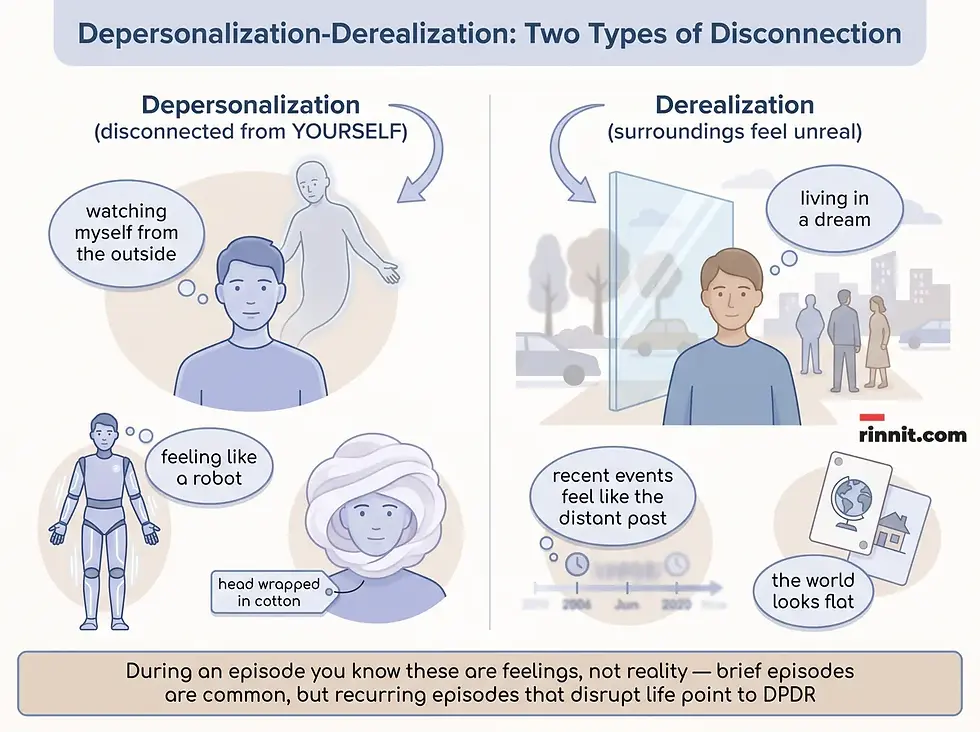
The two types of disconnection — depersonalization (disconnected from yourself) and derealization (surroundings feel unreal). During an episode you know these are feelings, not reality; brief episodes are common, but recurring ones that disrupt life point to DPDR.
What are the symptoms of depersonalization-derealization disorder?
The experience and feelings of the condition can be hard to describe. Worrying about "going crazy" can cause you to become focused on checking that you exist and finding out what's real. Symptoms usually begin in the middle or late teenage years, or in early adulthood, and the disorder is rare in children and older adults. [1]
Depersonalization Symptoms (Detached From Yourself)
Watching yourself from the outside: Seeing your thoughts, feelings, body, or body parts from outside — you may feel like you're floating in the air above yourself.
Feeling robotic: Feeling like a robot, or like you're not in control of what you say or how you move.
Body distortion: Your body, legs, or arms appear twisted, wrong-shaped, or larger or smaller than usual; your head may feel wrapped in cotton.
Numbness: Emotional or physical numbness of your senses or responses to the world.
Emotionless memories: A sense that your memories lack emotion — and they may or may not feel like your own memories.
Derealization Symptoms (The World Feels Unreal)
Living in a movie or dream: Feeling that people and your surroundings are not real.
A glass wall between you and others: Feeling emotionally disconnected from people you care about.
Distorted surroundings: Surroundings appear out of shape, blurry, or colorless; flat with two dimensions and no depth — or, at times, clearer and more intense than usual.
Unreal time: Thoughts about time that don't match reality — recent events feel like the distant past.
Unreal space: Unrealistic thoughts about distance and the size and shape of objects.
Bouts may last hours, days, weeks, or months. In some people, these bouts turn into ongoing feelings of depersonalization or derealization that may get better or worse at times.
When to See a Doctor
See a doctor if you have feelings of depersonalization or derealization that disturb you or disrupt your emotions, do not go away or keep coming back, or get in the way of work, relationships, or daily activities. Persistent feelings of detachment and distortion of your surroundings can signal DPDR — or another physical or mental health condition worth evaluating.
Causes: Why Does It Happen?
The cause of depersonalization-derealization disorder is not well understood. Some people may be more likely to experience depersonalization and derealization than others, possibly due to genetic and environmental factors. High levels of stress and fear may cause bouts. [1]
Symptoms may also be related to childhood trauma or other experiences or events that cause severe emotional stress or trauma.
What are the risk factors for depersonalization-derealization disorder?
Depersonalization-derealization disorder is more likely with certain personality traits, serious trauma, major stress, depression or anxiety, and drug misuse.
Certain personality traits — a tendency to avoid stressful situations or difficulty describing your emotional experience.
Serious trauma as a child or adult, such as experiencing or witnessing violence or abuse.
Serious stress — major relationship, financial, or work-related issues.
Depression or anxiety — especially serious or long-lasting depression, or anxiety with panic attacks.
Drug misuse — which can cause bouts of depersonalization or derealization.
How does depersonalization-derealization disorder affect daily life?
Depersonalization-derealization disorder can make it hard to function, with lasting bouts that affect concentration, work, relationships and mood. Lasting and returning bouts can cause problems at work or school and in other important areas of life. Specifically, episodes can:
Concentration: Make it hard to focus on tasks or remember things.
Work and routine: Get in the way of work and other routine activities.
Relationships: Cause problems with family and friends.
Mood: Make you feel anxious, depressed, or hopeless.
How is depersonalization-derealization disorder diagnosed?
Your doctor may determine or rule out DPDR based on three kinds of evaluation: [2]
Physical exam — in some cases, symptoms of depersonalization or derealization may be linked to another physical health problem, medicines, recreational drugs, or alcohol.
Lab tests — some lab tests help find out whether symptoms are related to medical or other issues.
Mental health evaluation — talking about your symptoms, thoughts, feelings, and behavior patterns helps determine whether you have DPDR or another mental health condition.
How is depersonalization-derealization disorder treated?
Depersonalization-derealization disorder is mainly treated with talk therapy, with medicines sometimes added to the treatment plan. The goal of talk therapy is to control the symptoms — to make them better or make them go away. [2]
Talk Therapy: The Main Treatment
Two types of talk therapy are used: cognitive behavioral therapy (CBT) and psychodynamic therapy. In sessions, talk therapy can help you:
Learn why depersonalization and derealization occur
Learn techniques that take your mind off your symptoms and reconnect you to your world and your feelings
Learn coping strategies for stressful situations and times of extreme stress
Talk about the emotions related to past trauma you've experienced
Learn about other mental health conditions you may have, such as anxiety or depression
Medicines
No medicine has been proven to effectively treat depersonalization-derealization disorder itself. However, medicines may be used to treat specific symptoms or to treat the depression and anxiety that are often related to the condition.

The complete guide to depersonalization-derealization disorder — what it is, the five warning signs, the two types of disconnection, risk factors, the talk-therapy-first treatment approach, and coping steps.
How can people cope with depersonalization-derealization disorder?
Depersonalization-derealization disorder can be treated, and following your treatment plan, learning about the condition and staying connected with others all support recovery. Three practical steps support your recovery:
Follow your treatment plan. Talk therapy may involve practicing certain techniques daily to help reduce or stop the feelings. Seeking treatment early makes it more likely you'll use these techniques successfully.
Learn about the condition. Books and internet resources explain why depersonalization and derealization occur and how to cope. Ask your mental health professional to suggest educational materials.
Connect with others. Stay connected with supportive and caring people — family, friends, or faith leaders.
How should you prepare for a depersonalization-derealization disorder appointment?
You'll likely start by seeing your primary care doctor or professional. You may then be referred to a neurologist (a specialist in brain and nervous system conditions) or a psychiatrist (a specialist in mental health conditions). If possible, take a family member or friend along — they may remember something you missed or forgot.
What You Can Do
Before your appointment, make a list of:
Any symptoms you have — even if they're not related to the reason for your visit
Key personal information — including major stresses or recent life changes
All medicines, vitamins, herbs, and supplements — including doses
Questions to ask — such as what's most likely causing your symptoms, whether you need tests, what treatments are available, whether a specialist is needed, and whether printed materials or recommended websites are available
What to Expect From Your Doctor
Be ready to answer questions such as:
When did you first begin feeling symptoms?
Have symptoms been constant, or do they only occur once in a while?
How serious are your symptoms, and what makes them better or worse?
Do you have any long-term health conditions?
Do you have mental health conditions such as anxiety, depression, or PTSD?
What medicines or herbal supplements do you take?
Do you drink alcohol or use recreational drugs?
Answering thoroughly saves time for the topics that matter most to you.
What are common questions about depersonalization-derealization disorder?
Depersonalization-derealization disorder causes ongoing feelings of seeing yourself from outside your body, sensing that your surroundings are not real, or both.
What is depersonalization-derealization disorder?
Depersonalization-derealization disorder (DPDR) occurs when you always or often feel you're seeing yourself from outside your body, sense that things around you are not real, or experience both. It is more common in people who have experienced trauma, and the main treatment is talk therapy, sometimes with medicines added.
Is it normal to feel disconnected from reality sometimes?
Yes — short experiences of depersonalization or derealization are fairly common, and many people have a passing experience at some point. It only becomes a disorder when the feelings keep occurring or never fully go away and make it hard to function.
How do depersonalization and derealization differ?
Depersonalization means feeling detached from yourself — watching yourself from the outside, feeling robotic, or feeling emotionally or physically numb. Derealization means your surroundings feel unreal — like living in a movie or dream, or like the world has lost depth and color.
Do people with DPDR lose touch with reality?
No. During episodes, people with DPDR know that their sense of disconnection is only a feeling and not reality. This preserved insight is a defining feature of the condition and one reason it is treatable.
What causes depersonalization-derealization disorder?
The cause is not well understood. It is possibly related to genetic and environmental factors, and it is more common in people with serious trauma, high stress, or fear. Depression, anxiety with panic attacks, and drug misuse also raise the risk.
What is the best treatment for DPDR?
Talk therapy is the main treatment — specifically cognitive behavioral therapy and psychodynamic therapy. It helps you understand why the episodes occur, practice daily techniques that reconnect you to your world, and work through past trauma. No medicine has been proven to treat DPDR itself, but medicines may help related anxiety or depression. [2]
Can the episodes go away?
Yes — the goal of talk therapy is to control symptoms so they become better or go away entirely. Early treatment and daily practice of coping techniques make success more likely, and staying connected with supportive people strengthens recovery.
Conclusion
Depersonalization-derealization disorder is frightening to experience — but three facts from this guide should bring real reassurance:
Your insight is intact. You know the disconnection is a feeling, not reality — and that insight is the foundation treatment builds on.
Brief episodes are common; a disorder is defined by persistence and disruption. Recurring or never-ending episodes that disturb you, disrupt work or relationships, or block daily life are the signal to see a doctor.
It is treatable. Talk therapy — CBT or psychodynamic therapy — is the proven main treatment, and its goal is to make symptoms improve or disappear.
Understanding the difference between depersonalization and derealization, recognizing the triggers (trauma, stress, fear), and starting talk therapy early transforms DPDR from a source of fear into a manageable condition. For a related mental health topic, including the role of substance use, read our alcohol use disorder complete guide.
This article is for informational purposes only and is not a substitute for professional medical advice, diagnosis, or treatment. Always consult a qualified healthcare provider about any medical condition.
References
Mayo Clinic Staff. Depersonalization-derealization disorder - Symptoms and causes. Mayo Clinic. September 5, 2025. https://www.mayoclinic.org/diseases-conditions/depersonalization-derealization-disorder/symptoms-causes/syc-20352911
Mayo Clinic Staff. Depersonalization-derealization disorder - Diagnosis and treatment. Mayo Clinic. September 5, 2025. https://www.mayoclinic.org/diseases-conditions/depersonalization-derealization-disorder/diagnosis-treatment/drc-20352916
Yang J, et al. The Prevalence of Depersonalization-Derealization Disorder: A Systematic Review. J Trauma Dissociation. 2023;24(1):8-41. PMID 35699456. https://doi.org/10.1080/15299732.2022.2079796
Horn M, et al. Emotional response in depersonalization: A systematic review of electrodermal activity studies. J Affect Disord. 2020;276:877-882. PMID 32739705. https://doi.org/10.1016/j.jad.2020.07.064
Jay EL, et al. Testing a neurobiological model of depersonalization disorder using repetitive transcranial magnetic stimulation. Brain Stimul. 2014;7(2):252-9. PMID 24439959. https://doi.org/10.1016/j.brs.2013.12.002



Comments