Dentophobia (Fear of Dentists): Why It Happens, How It's Treated, and How to Get Back in the Chair

Updated: 2 days ago
Medically reviewed by Dr. Baraa Alnahhal, MD · Last reviewed: October 2026
Quick Answer
Dentophobia is an extreme fear of dentists that can make people avoid dental care even when in pain [1]. Some fear of dental treatment affects about 36% of Americans, though true dentophobia is much less common [1]. Symptoms include sweating, palpitations and nausea [1]. Exposure therapy is the main treatment, alongside CBT and sedation [1]. Talk to a provider if fear blocks care.
What the research says
Dental fear is common in adults worldwide, and more so in women. A systematic review and meta-analysis of 31 publications covering 72,577 adults estimated the global prevalence of dental fear and anxiety at 15.3% (95% CI 10.2–21.2), with high dental fear at 12.4% and severe dental fear at 3.3% (95% CI 0.9–7.1). Prevalence was higher among women and younger adults (PubMed: Silveira et al., J Dent, 2021 [7]).
Cognitive behavioral therapy shows a measurable benefit for dental phobia. A systematic review of randomized controlled trials (173 trials met inclusion criteria; 67 qualified for pooled analyses) found low-to-moderate certainty evidence supporting psychotherapy (SMD −0.48, 95% CI −0.72 to −0.24) and CBT specifically (SMD −0.43, 95% CI −0.68 to −0.17) for dental phobia, while virtual reality exposure therapy was not supported (PubMed: Steenen et al., J Anxiety Disord, 2024 [8]).
Avoiding care has an oral-health cost. A meta-analysis of 26 papers covering 334,503 people found that psychiatric diagnoses, including depression, anxiety and dental phobia, were associated with more dental decay and greater tooth loss (OR 1.22, 95% CI 1.14–1.30) (PubMed: Kisely et al., J Affect Disord, 2016 [9]).
What Is Dentophobia?
Dentophobia, also called odontophobia, is a fear of dentists [1]. Someone with dentophobia may have extreme anxiety at the thought of going to the dentist or while in the dentist's office.
Phobias are a kind of anxiety disorder [1] [2]. They lead to excessive fear of an event or situation that isn't actually harmful. Dentophobia is a type of specific phobia disorder — a specific situation (going to the dentist) leads to a fearful response [1].
The American Psychiatric Association (APA) recognizes dentophobia as a specific phobic disorder in the Diagnostic and Statistical Manual of Mental Disorders (DSM) [1].
Dentophobia vs. Severe Fear of Dental Treatment
It's important to know where intense dental anxiety ends and dentophobia begins, because the two behave very differently.
Factor | Dentophobia | Severe Fear of Dental Treatment |
|---|---|---|
Intensity | Extreme, out of proportion to the situation | Distressing but less extreme |
Behavior | Avoids the dentist even when in pain [1] | Still sees the dentist for treatment [1] |
Health impact | Can lead to very poor dental health [1] | Manageable with ongoing care |
Life impact | May affect relationships and job prospects [1] | Generally contained to dental visits |
How Common Is Dental Fear?
Fear of the dentist is far more widespread than most people realize.
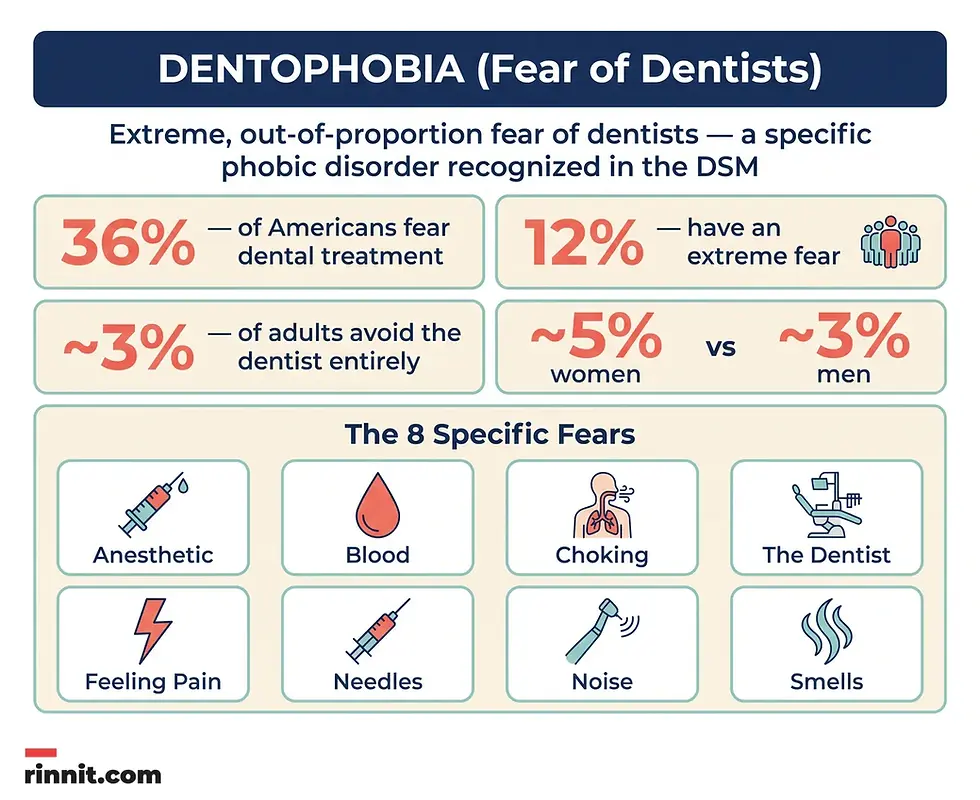
What Do People with Dentophobia Actually Fear?
The fear is rarely about the dentist's office as a whole — people typically fear specific aspects of dental care.
Specific Fear | What It Looks Like |
|---|---|
Anesthetic | Not the numbing drug itself, but fear it won't work, or fear of side effects like temporary lip numbness [1] |
Blood | Fear or panic about even minor bleeding during a dental procedure (hemophobia) [1] |
Choking | Fear of gagging or not being able to breathe or swallow while the mouth is numbed [1] |
The dentist | Negative feelings toward the dentist, worse after a bad past experience [1] |
Feeling pain | Fear of discomfort during treatment or recovery, especially in people highly sensitive to pain [1] |
Needles | Fear of the injections dentists use during procedures [1] |
Noise | Fear of drills and other dental instruments [1] |
Smells | Anxiety about the smell of the dental office or treatment aromas [1] |
Symptoms and Causes
What Are the Symptoms?
Dentophobia symptoms can range from mild to extreme [1].
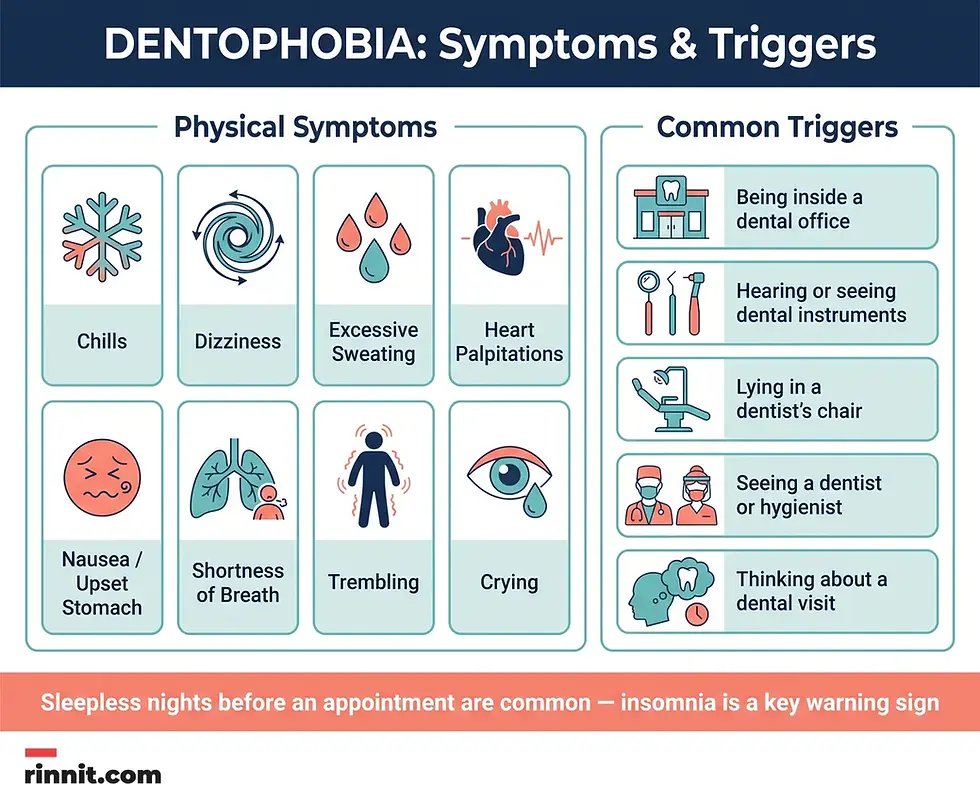
Physical symptoms include chills, dizziness and lightheadedness, excessive sweating (hyperhidrosis), heart palpitations, nausea, shortness of breath (dyspnea), trembling or shaking, and upset stomach or indigestion (dyspepsia) [1].
Beyond physical symptoms, dentophobia triggers may cause some people to cry when thinking about visiting a dentist, and to have insomnia before a dental appointment [1].
Symptom | Description |
|---|---|
Chills | Cold shivers at the thought of a dental visit |
Dizziness, lightheadedness | Feeling faint when triggered |
Excessive sweating | Hyperhidrosis during or before exposure |
Heart palpitations | Racing or pounding heartbeat |
Nausea; upset stomach | Stomach distress, indigestion |
Shortness of breath | Dyspnea when triggered |
Trembling or shaking | Physical shaking response |
Crying | Crying when thinking about visiting a dentist |
Insomnia | Trouble sleeping before a dental appointment |
What Triggers Dentophobia?
Triggers are the situations that set off the fear response. They include being inside a dental office, hearing or seeing dental instruments, lying in a dentist's chair, seeing a dentist or dental hygienist, and thinking about a dental visit [1].
Who Is at Risk?
You're more likely to develop dentophobia — or a different specific phobia — if you already have another phobia, an anxiety disorder, panic disorder, or a substance use disorder [1].
Risk Factor | Notes |
|---|---|
Another phobia | Existing phobias raise the likelihood of new ones |
Anxiety disorder | Underlying anxiety increases risk |
Panic disorder | A history of panic attacks raises risk |
Substance use disorder | Associated with higher phobia risk |
Other phobias commonly associated with dentophobia include algophobia (fear of pain), emetophobia (fear of vomiting), haphephobia (fear of being touched), iatrophobia (fear of doctors), and trypanophobia (fear of needles) [1].
What Causes Dentophobia?
Possible causes include family history, embarrassment, feelings of helplessness, modeling, past negative experiences, and traumatic history [1].
Cause | How It Leads to Dentophobia |
|---|---|
Family history | |
Feeling embarrassed | Discomfort with someone working so close to your face; worry about how your teeth look or your breath smells [1] |
Feeling helpless | Lying in the chair with your mouth open for an extended period creates a loss of control [1] |
Modeling | |
Past negative experiences | |
Traumatic history | A history of abuse — bullying, child abuse, or sexual violence — can lead to dentophobia [1] |
Diagnosis and Tests
How Is Dentophobia Diagnosed?
The American Psychiatric Association (APA) recognizes dentophobia as a specific phobic disorder in the DSM [1]. Your healthcare provider may diagnose dentophobia if you experience intense anxiety or fear when thinking about or visiting the dentist [1].
Your dentist or healthcare provider may suggest that you see a mental health professional like a psychologist, who can formally evaluate your symptoms, including how the phobia impacts your daily life [1].
You may have this specific phobic disorder if your fear of dentists meets these criteria.
Can Children Have Dentophobia?
A constant fear of the dentist can be extremely upsetting for your child. If your child is very young, it may be difficult for them to verbalize what's wrong [1].
If severe fear of the dentist greatly impacts your child's life, your child's healthcare provider or dentist may recommend they visit a mental health professional. This professional can look at your child's symptoms, offer a diagnosis, and help you form a treatment plan [1].

Management and Treatment
What Are the Treatments?
Exposure therapy is one of the main treatments for a fear of dentists. During exposure therapy, a mental health professional exposes you to situations and images that may trigger your symptoms — in a controlled setting where you can work through your responses [1]. Most people with specific phobias see their symptoms improve after this type of psychotherapy (talk therapy) [1].
Exposure therapy typically progresses through steps: first, you learn breathing and muscle relaxation techniques to use before and during an exposure. Next, you view images or videos of people visiting the dentist. Then you gradually progress to visiting a dentist's office without getting treatment. Finally, you have a cleaning or checkup with the hygienist or dentist [1].
Treatment Approach | How It Helps |
|---|---|
Exposure therapy (main treatment) | Gradual, controlled exposure to dental triggers; most people with specific phobias improve [1] |
Cognitive behavioral therapy (CBT) | |
Acupuncture | |
Guided imagery | |
Hypnotherapy | |
Relaxation techniques | |
Distraction | |
Sedation |
Outlook / Prognosis
What Are the Complications of Untreated Dentophobia?
Severe dentophobia often results in poor oral health when people don't visit the dentist. Poor oral health can in turn lead to complications from diabetes, decayed teeth, gum (periodontal) disease, heart disease (coronary artery disease), missing teeth, and pneumonia and respiratory infections [1].
Complication Category | Examples |
|---|---|
Oral health | Decayed teeth, gum disease, missing teeth [1] |
Systemic health | Diabetes complications, coronary artery disease, pneumonia and respiratory infections [1] |
Well-being | Embarrassment about teeth; avoiding friends and family; lower performance at work or school [1] |
Emotional | Aggression, low self-esteem and self-confidence, sleep disorders [1] |
Fear of dentists can also have a negative effect on your general well-being. People whose oral health has been impacted by dentophobia may become embarrassed about their teeth and avoid seeing friends or family [1]. Dentophobia can also affect performance at work or school, and can spur aggression, low self-esteem and self-confidence, and sleep disorders [1].
Living With Dentophobia
How Can You Cope During a Dental Visit?
In addition to seeking long-term treatment if needed, you can try certain techniques to cope with dentophobia during a dental visit.
Coping Technique | How It Helps |
|---|---|
Schedule a consultation first | The dentist explains next steps before any care visit, so you feel more comfortable moving forward [1] |
Tell your dentist you're anxious | They can suggest calming medications or other techniques [1] |
Bring a friend | A companion offers support in the chair [1] |
Choose a fear-free dentist | A dentist who listens and works with you to reduce anxiety [1] |
Agree on a stop signal | |
Visit at a less busy time | Early mornings limit the impact of noise from other patients' treatments [1] |
When Should You Call the Doctor?
You should call your healthcare provider if you have panic attacks, or persistent anxiety that interferes with daily life or sleeping.
How Can You Find a Dentist Who Understands Dentophobia?
To find a dentist who understands dentophobia, first get dentist suggestions from trusted friends and family members. Then make an initial appointment with the dentist to discuss your fears.
Based on the initial meeting, you'll need to evaluate if you feel comfortable with the dentist. It may take some trial and error to find a dentist who understands your situation. It's worth spending the time to find someone who'll help you feel less anxious during any treatments.
Key Takeaways
Dentophobia is a real, DSM-recognized specific phobic disorder — not just "nervousness" about dental visits. About 36% of Americans fear dental treatment [1] and roughly 3% of adults avoid the dentist entirely [1], a pattern more common in women than men. The fear is usually about specific aspects of care — needles, pain, choking, loss of control — rather than dentists as a whole. If the fear lasts six months or more and stops you from seeking care even when you're in pain, professional help is warranted. Exposure therapy is the main treatment and most people improve with psychotherapy [1]; CBT, guided imagery, hypnotherapy, and sedation add further options. The cost of avoiding care is high — decayed teeth, gum disease, and even heart and lung complications — but the path out of dentophobia is well established.
Take the next step: If dental fear has kept you out of the dental chair, start by talking to your healthcare provider or a fear-free dentist. An initial consultation with no treatment involved is often the first, lowest-pressure step — and with the right support, most people overcome dental fear and get back to regular care.
Frequently Asked Questions (FAQ)
1. Is dentophobia real?
Yes. Dentophobia is a real phobic disorder recognized by the American Psychiatric Association in the DSM as a specific phobic disorder. Even phobias not found in the DSM are real if they affect your life, and people with a fear of the dentist can use treatment and coping strategies to overcome it.
2. What is dentophobia?
Dentophobia, also called odontophobia, is a fear of dentists - an extreme anxiety at the thought of going to the dentist or while in the dentist's office. It's a type of specific phobia disorder, a category of anxiety disorder.
3. How common is fear of the dentist?
About 36% of people in the U.S. have a fear of dental treatment, with 12% having an extreme fear. About 3% of adults in industrialized countries have dentophobia and avoid going to the dentist at all. It's more common in women (nearly 5%) than men (nearly 3%).
4. What's the difference between dentophobia and dental anxiety?
Dentophobia is an extreme, out-of-proportion fear that makes people avoid the dentist even when in pain, and can damage dental health, relationships, and job prospects. Severe dental anxiety involves distress, but people still see their dentist for treatment.
5. What causes dentophobia?
Possible causes include family history of phobic or anxiety disorders, feeling embarrassed, feeling helpless in the dental chair, modeling (hearing others' fear), past negative dental experiences, and a traumatic history such as bullying, child abuse, or sexual violence.
6. What are the symptoms of dentophobia?
Symptoms range from mild to extreme and include chills, dizziness, excessive sweating, heart palpitations, nausea, shortness of breath, trembling, and upset stomach. Some people also cry when thinking about a dental visit or have insomnia before an appointment.
7. What triggers dentophobia?
Common triggers include being inside a dental office, hearing or seeing dental instruments, lying in a dentist's chair, seeing a dentist or hygienist, and thinking about a dental visit.
8. How is dentophobia diagnosed?
A provider may diagnose it when fear occurs at the thought or visit of a dentist, prevents dental care even when in pain, triggers fear that doesn't match the actual danger, and lasts at least six months. A psychologist can formally evaluate how the phobia impacts daily life.
9. What is the main treatment for dentophobia?
Exposure therapy is one of the main treatments. You gradually face dental triggers in a controlled setting - learning relaxation techniques, viewing images of dental visits, visiting the office without treatment, and finally having a cleaning or checkup.
10. What other treatments help with fear of dentists?
Cognitive behavioral therapy (often with exposure therapy), acupuncture, guided imagery, hypnotherapy, relaxation techniques, distraction (music, movies, TV), and sedation options like nitrous oxide, oral pills, or IV sedation.
11. Can dentophobia be prevented or managed during a visit?
During visits you can schedule a consultation first, tell your dentist you're anxious, bring a friend, choose a fear-free dentist, agree on a stop signal, and visit at a less busy time like early morning.
12. What happens if dentophobia goes untreated?
Avoiding the dentist can lead to poor oral health - decayed teeth, gum disease, missing teeth - and complications like diabetes issues, coronary artery disease, and pneumonia. It can also cause embarrassment, social withdrawal, poor work or school performance, low self-esteem, and sleep disorders.
13. When should I call my doctor about dental fear?
Call your healthcare provider if you have panic attacks, or persistent anxiety that interferes with daily life or sleeping.
Related Reading
References
Cleveland Clinic. Dentophobia (Fear of Dentists). Cleveland Clinic. Last updated Mar. 31, 2022. https://my.clevelandclinic.org/health/diseases/22594-dentophobia-fear-of-dentists
American Psychiatric Association. What Are Anxiety Disorders? Psychiatry.org. Physician review May 2026. https://www.psychiatry.org/patients-families/anxiety-disorders/what-are-anxiety-disorders
Appukuttan DP. Strategies to manage patients with dental anxiety and dental phobia: literature review. Clin Cosmet Investig Dent. 2016;8:35-50. doi:10.2147/CCIDE.S63626. PMID: 27022303.
Beaton L, Freeman R, Humphris G. Why are people afraid of the dentist? Observations and explanations. Med Princ Pract. 2014;23(4):295-301. doi:10.1159/000357223. PMID: 24356305.
Samra CK, Torrico TJ, Abdijadid S. Specific Phobia. In: StatPearls. Treasure Island (FL): StatPearls Publishing; updated Aug. 12, 2024. https://www.ncbi.nlm.nih.gov/books/NBK499923/. PMID: 29763098.
Leutgeb V, Übel S, Schienle A. Can you read my pokerface? A study on sex differences in dentophobia. Eur J Oral Sci. 2013;121(5):465-470. doi:10.1111/eos.12079. PMID: 24028595.
Silveira ER, Cademartori MG, Schuch HS, Armfield JA, Demarco FF. Estimated prevalence of dental fear in adults: a systematic review and meta-analysis. J Dent. 2021;108:103632. doi:10.1016/j.jdent.2021.103632. PMID: 33711405.
Steenen SA, Linke F, van Westrhenen R, de Jongh A. Interventions to reduce adult state anxiety, dental trait anxiety, and dental phobia: a systematic review and meta-analyses of randomized controlled trials. J Anxiety Disord. 2024;105:102891. doi:10.1016/j.janxdis.2024.102891. PMID: 38945067.
Kisely S, Sawyer E, Siskind D, Lalloo R. The oral health of people with anxiety and depressive disorders - a systematic review and meta-analysis. J Affect Disord. 2016;200:119-132. doi:10.1016/j.jad.2016.04.040. PMID: 27130961.
Medical Disclaimer
This article is for informational purposes only and does not constitute medical advice. Always seek the advice of your physician or other qualified health provider with any questions you may have regarding a medical condition. Never disregard professional medical advice or delay in seeking it because of something you have read here.



Comments