Delayed Sleep Phase (DSWPD): Symptoms, Causes, Diagnosis & Treatment — Complete Guide

Updated: 3 days ago
Medically reviewed by Dr. Baraa Alnahhal, MD · Last reviewed: October 2026
Quick Answer: What Is Delayed Sleep Phase?
Delayed sleep phase, or delayed sleep-wake phase disorder (DSWPD), is a sleep timing problem in which the body's internal clock runs at least two hours later than typical, so you fall asleep and wake very late. It is not insomnia; on your own schedule you sleep fine. Treatment shifts your schedule with sleep hygiene, melatonin, morning light therapy or chronotherapy. [1]
What the research says
Young people with DSWPD have more depressive symptoms. In a meta-analysis of 16 studies (766 participants), 13 of 15 studies found significantly greater depression severity in young people with DSWPD than in those without it, with a large pooled effect (Cohen's d = 0.92, 95% CI 0.76–1.08). (Dama et al., Can J Psychiatry, 2025) [3]
Morning light therapy moved teens' sleep earlier and sharpened thinking. In adolescents with DSWPD, 3 weeks of light therapy was followed, at 3 months, by earlier sleep timing (d = 0.56–0.65), more total sleep time (d = 0.52), less daytime sleepiness (d = 1.33) and better working memory and processing speed. (Richardson et al., J Adolesc, 2018) [4]
Combining light and melatonin was not clearly better for DSWPD. A systematic review of 8 studies found combined bright light and melatonin beat either alone for phase advances in other groups, but showed no added benefit in the two studies of patients with DSWPD. (Cheng et al., Sleep Med Rev, 2021) [5]
Delayed Sleep Phase at a Glance
Also known as: Delayed sleep-wake phase disorder (DSWPD)
Core problem: Internal clock (circadian rhythm) out of sync with daily life
Typical sleep delay: At least 2 hours, often 3 to 6 hours late
Most common in: Teenagers and young adults
How long it lasts: At least 3 months, often years
Main complications: Poor school or work performance, anxiety, depression
Diagnosis tools: Sleep diary, actigraphy, sleep study (if needed)
Treatment options: Sleep hygiene, melatonin, light therapy, chronotherapy
What Is Delayed Sleep Phase?
Your body runs on an internal timing system called the circadian rhythm — a roughly 24-hour cycle that controls when you feel sleepy and when you feel awake. Delayed sleep phase happens when this clock falls out of sync with the world around you.
The clock normally takes its cues from the environment. The most important signals are light and darkness, but eating and physical activity also help set the timing.
In delayed sleep phase, the whole schedule shifts later. A person might feel most alert late at night and most sleepy in the morning. The sleep itself is not the problem — sleep quality can be perfectly normal when the person sleeps on their own late schedule.
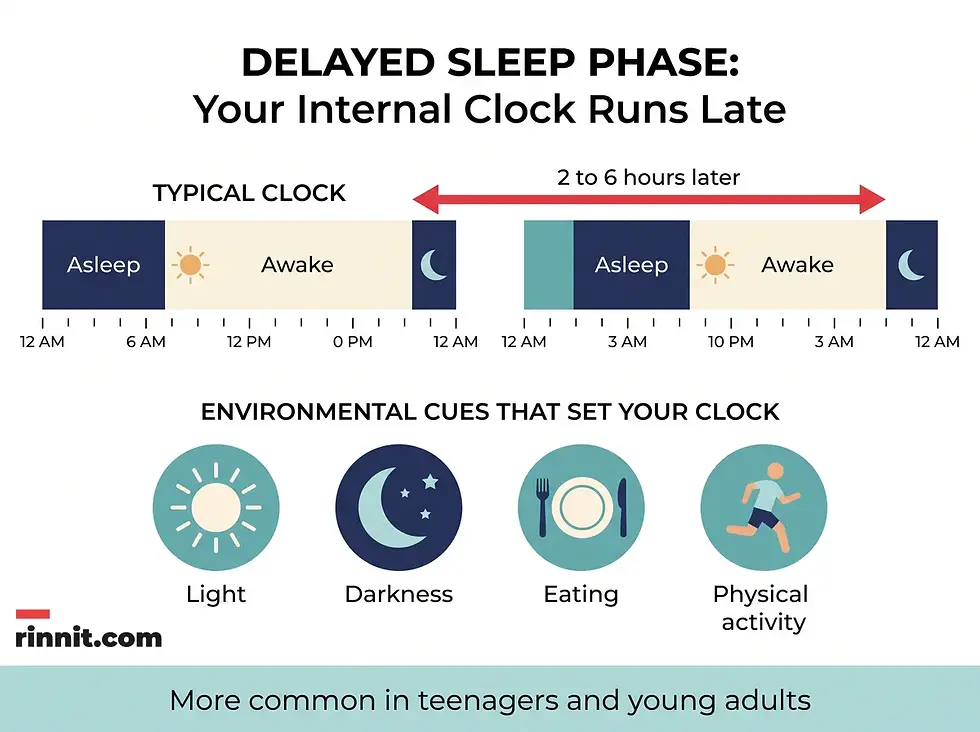
The typical sleep schedule versus a delayed sleep phase schedule, which runs 2 to 6 hours later. Your internal clock is set by cues such as light, darkness, eating, and physical activity.
Delayed Sleep Phase Symptoms: The 4 Key Signs
The hallmark of this condition is timing, not sleep quality. The delay must last at least three months and often continues for years. The four most common signs are: [1]
Can't fall asleep at a typical bedtime. The sleep delay feels like insomnia — you lie in bed wide awake when others are falling asleep.
Trouble waking for work or school. Getting up at a normal morning hour is painful, and waking up at the "right" time feels nearly impossible.
Extreme daytime drowsiness. Morning grogginess is severe and lingers into the day.
Trouble staying alert. Concentration, energy, and alertness suffer during daytime hours.
The delay is usually at least 2 hours, and in some people it stretches to 3 to 6 hours. A classic pattern is falling asleep around 3 a.m. and waking around 10 a.m.
Delayed Sleep Phase vs. Insomnia
Main problem: In delayed sleep phase, sleep comes too late; in insomnia, you have trouble sleeping anywhere on the schedule.
Sleep on your preferred schedule: Usually good and refreshing in delayed sleep phase; still difficult in insomnia.
Alertness on your preferred schedule: Normal in delayed sleep phase; still impaired in insomnia.
Typical bedtime: Very late (for example 2–4 a.m.) in delayed sleep phase; varies in insomnia, often normal but unsuccessful.
Causes and Risk Factors
The exact cause is not known. What experts understand is that the internal clock drifts out of alignment with daily demands. Several patterns are well documented: [1]
Biology in teenagers. Circadian rhythms naturally shift later during adolescence for biological reasons. This is one key reason the condition clusters in teens.
Late-night habits make it worse. Staying up late for homework, TV, or time online pushes the clock even later.
Age. It can affect children and adults of any age, but it is most common in teenagers and young adults.
So a teenager with a delayed clock is often dealing with biology plus habits — both worth addressing.
Complications: Why It Shouldn't Be Ignored
Left untreated, delayed sleep phase can harm more than your mornings. In teenagers, it is linked to:
Poor school performance — the schedule fights the school day.
Behavior issues, including attention problems resembling ADHD.
Higher rates of anxiety and depression in both teenagers and adults.
The condition is also associated with autism spectrum disorder. If low mood or anxiety is already present, it deserves attention in its own right — treating it improves coping while you reset your sleep-wake cycle.
When to See a Doctor
Talk to a healthcare professional if:
Your late sleep pattern has lasted more than three months.
You regularly can't wake up on time for work or school.
You feel extremely drowsy during the day.
Your child has these symptoms and they aren't going away.
How Delayed Sleep Phase Is Diagnosed
Diagnosis starts with a review of your family and medical history, and sometimes a physical exam. Three tools help confirm the pattern: [2]
Sleep diary: You log sleep and wake times daily. It shows your sleep-wake pattern over a week or longer.
Actigraphy: A small wrist device tracks motion (and sometimes light). It shows sleep and wake times across many days.
Sleep study (polysomnography): Overnight monitoring in a sleep center. It records brain activity, heart rate, oxygen levels, eye movements, and breathing.
A sleep study is usually ordered only if your doctor suspects a different sleep disorder. Actigraphy and the sleep diary together capture the signature pattern of DSWPD.
Treatment: 4 Ways to Reset Your Internal Clock
Your healthcare professional will build a plan to shift your sleep and wake times earlier. The four standard approaches can be used alone or combined. [2]
1. Sleep Hygiene (Lifestyle Changes)
This is the foundation of every treatment plan. The rules:
Keep a regular schedule — same bedtime and wake time, including weekends.
Take no daytime naps.
Avoid caffeine and alcohol close to bedtime, and don't use tobacco products near sleep time.
Exercise during the day, finishing at least 2 hours before bedtime.
Avoid stimulating activities (and bright screens) near bedtime.
Use the bedroom for sleeping only.
2. Melatonin Supplements
Melatonin is the hormone that drives the sleep-wake cycle. Taken in the early evening, a supplement can pull your internal clock back toward an earlier schedule.
3. Light Therapy
Exposure to a bright light box in the morning signals to your brain that the day has started, reinforcing the earlier schedule.
4. Chronotherapy
Chronotherapy deliberately moves your bedtime later, not earlier. You delay bedtime by 1 to 2.5 hours every 6 days until the clock wraps around to your desired bedtime.
The catch: once you reach the target schedule, you must maintain it strictly — the delay can return if the schedule slips.

A full guide to delayed sleep phase — the key signs, how it is diagnosed, and the four standard treatment approaches.
Coping and Support
Changing a sleep schedule is a family project as much as a personal one. Ask your household for support:
Keep lights low and the house quiet before bedtime.
Turn off electronics about two hours before bed.
Have the whole family follow sleep hygiene habits.
Sleep timing problems affect school and work performance and can feed depression and anxiety. Tell your healthcare team about any mood symptoms — treating them makes the schedule change far easier to sustain.
Preparing for Your Appointment
What You Can Do Beforehand
Ask whether you should prepare — keeping a sleep diary is often the first step.
Make lists of: your symptoms (including any that seem unrelated, and when they began), your family history of sleep problems, and all medicines, vitamins, and supplements with doses.
Bring a family member or friend if possible.
Questions Worth Asking
What tests do I need, and how should I prepare?
Is this condition short-term or long-lasting?
What treatments are available, and which fits me best?
How should I manage this alongside other health conditions?
Should I see a specialist?
Do you have brochures or recommended websites?
Your doctor will likely ask when symptoms began, whether they are constant or come and go, how severe they are, what improves or worsens them, and how well you sleep when following your preferred (late) schedule — a key clue for diagnosis.
Prevention Tips
You can't always prevent a delayed clock — especially in teens, where biology leads. But two habits help:
Keep a regular, consistent bedtime schedule.
Limit bright light and screens before bed.
Delayed Sleep Phase FAQ
What is delayed sleep-wake phase disorder (DSWPD)?
DSWPD is a circadian rhythm disorder in which your internal clock runs at least two hours later than typical. You fall asleep late and wake late, making it hard to meet school, work, or family schedules. Sleep quality is usually fine — it is the timing that is out of place.
Is delayed sleep phase the same as insomnia?
No. Insomnia means trouble sleeping even on a normal schedule. With delayed sleep phase, you sleep well once you get to sleep — the problem is that sleep only comes very late. If you sleep on your preferred late schedule, you feel alert and rested.
Why is delayed sleep phase most common in teenagers?
During adolescence, circadian rhythms naturally shift later for biological reasons. Late-night homework, TV, and screen time push the clock even later. That combination makes teenagers and young adults the most affected group, though any age can develop the condition.
How is delayed sleep phase diagnosed?
A doctor reviews your history and typically uses a sleep diary kept for a week or more and actigraphy, a wrist device that tracks sleep and wake times over many days. A full sleep study is added only if another sleep disorder is suspected. [2]
Does delayed sleep phase go away on its own?
Usually not quickly. The delay lasts at least three months and often years. However, a consistent treatment plan — sleep hygiene plus melatonin, light therapy, or chronotherapy — can successfully shift the schedule back to a normal pattern.
Can delayed sleep phase affect school performance and mood?
Yes. In teenagers it is linked to poor school performance and behavior issues, including attention problems resembling ADHD. Depression and anxiety commonly occur alongside the condition, and it is also associated with autism spectrum disorder — so mood deserves treatment too.
What is chronotherapy and how does it work?
Chronotherapy deliberately delays bedtime by 1 to 2.5 hours every 6 days, moving the sleep window around the clock until it reaches your desired bedtime. It works, but once the target schedule is reached you must keep it strictly — a single slip can restart the delay.
Conclusion
Delayed sleep phase is not laziness and it is not ordinary insomnia — it is your internal clock running on a schedule that fights your life. The good news is that it is recognizable, diagnosable, and treatable.
Three lessons to remember from this guide:
The pattern defines it: falling asleep 2+ hours late, for at least 3 months, with daytime sleepiness — while sleep itself is fine on your late schedule.
Teens are most at risk: biology shifts the clock later, and late screens and homework push it further.
Four proven tools: sleep hygiene, melatonin in the early evening, morning light therapy, and chronotherapy — used together, they reset the clock.
If you live with this pattern, start the sleep diary today and talk to a healthcare professional. Getting help early protects school performance, work, and mental health.
This article is for informational purposes only and is not a substitute for professional medical advice, diagnosis, or treatment. Always consult a qualified healthcare provider about any medical condition.
References
Mayo Clinic Staff. Delayed sleep phase — Symptoms and causes. Mayo Clinic. February 27, 2026. https://www.mayoclinic.org/diseases-conditions/delayed-sleep-phase/symptoms-causes/syc-20353340
Mayo Clinic Staff. Delayed sleep phase — Diagnosis and treatment. Mayo Clinic. February 27, 2026. https://www.mayoclinic.org/diseases-conditions/delayed-sleep-phase/diagnosis-treatment/drc-20353341
Dama MH, Martin J, Tassone VK, et al. The association between delayed sleep-wake phase disorder and depression among young individuals: a systematic review and meta-analysis. Can J Psychiatry. 2025;70(12):869-886. PMID 40129277. https://doi.org/10.1177/07067437251328308
Richardson C, Micic G, Cain N, et al. Cognitive performance in adolescents with delayed sleep-wake phase disorder: treatment effects and a comparison with good sleepers. J Adolesc. 2018;65:72-84. PMID 29555485. https://doi.org/10.1016/j.adolescence.2018.03.002
Cheng DCY, Ganner JL, Gordon CJ, et al. The efficacy of combined bright light and melatonin therapies on sleep and circadian outcomes: a systematic review. Sleep Med Rev. 2021;58:101491. PMID 33962317. https://doi.org/10.1016/j.smrv.2021.101491



Comments