Cyclosporiasis: Symptoms, Causes, Treatment and Prevention

Updated: 3 days ago
Medically reviewed by Dr. Baraa Alnahhal, MD · Last reviewed: October 17, 2026
Quick Answer
Cyclosporiasis is an intestinal infection caused by the parasite Cyclospora cayetanensis, usually swallowed through contaminated water or fresh produce [1] [2]. The main symptom is watery, explosive diarrhea within about a week of exposure [1], often with fatigue and nausea. Most people recover fully in one to two weeks after the antibiotic trimethoprim/sulfamethoxazole [1] [3]. It rarely, if ever, spreads person to person [1] [3].
What the research says
Most U.S. cases are domestic and cluster in spring and summer. CDC surveillance for 2011–2015 recorded 2,207 cyclosporiasis cases (1,988 confirmed, 219 probable) from 37 states and New York City; annual counts ranged from 130 to 798. About 18.8% of patients had traveled internationally, 62.7% had not, and 92.9% of domestically acquired cases with known onset began in May–August. Ten outbreaks (438 cases) were investigated, with cilantro from Mexico implicated in at least three. The report notes that routine chemical disinfection is unlikely to kill the parasite and that Cyclospora testing must be requested explicitly (PubMed: Casillas et al., MMWR Surveill Summ, 2019 [2]).
Person-to-person spread is unlikely, and antibiotics work, but relapses happen. A review explains that the parasite's oocysts leave the body unsporulated and must mature in the environment, making direct person-to-person transmission unlikely. The disease is self-limiting in most people with healthy immune systems, trimethoprim-sulfamethoxazole is the antibiotic of choice, and relapses may occur. It is a narrative review without pooled numbers (PubMed: Almeria et al., Microorganisms, 2019 [3]).
The true burden is probably underestimated. A Lancet Infectious Diseases review concluded that the effect of cyclosporiasis on human health is likely underestimated because few epidemiological data exist, and noted that although more than 2 million children die each year from diarrheal diseases, it is not known to what extent Cyclospora is involved (PubMed: Giangaspero and Gasser, Lancet Infect Dis, 2019 [4]).
What Is Cyclosporiasis?
Cyclosporiasis is a form of food poisoning caused by the parasite Cyclospora cayetanensis (also called C. cayetanensis or simply Cyclospora). The parasite is so small it cannot be seen without a microscope, and it mostly lives off people and other primates [1].
Symptoms usually begin within a week of swallowing the parasite [1]. The main symptom is watery diarrhea, which can be loud and explosive, but the infection can also cause a range of other stomach problems [1].

Left untreated, symptoms may take a long time to clear [1]. They may also disappear and then return [1]. Fortunately, cyclosporiasis is usually not life-threatening [1].
Cyclosporiasis is uncommon in the U.S., but outbreaks happen from time to time [1]. It is more common in tropical and subtropical parts of the world, and in areas without widespread water treatment [1] [2]. These regions include countries in Central America, South America, Europe, Asia, and Africa [1].
Key Fact | Detail |
Cause | Parasite Cyclospora cayetanensis (microscopic, invisible without a microscope) [1] |
Type of illness | A form of food poisoning [1] (intestinal parasite infection) |
Where it's common | |
Regions of higher occurrence | Central America, South America, Europe, Asia, Africa [1] |
U.S. frequency | Uncommon overall, but outbreaks happen [1] |
Symptom onset | Usually within a week of swallowing the parasite [1] |
Main symptom | Watery, sometimes explosive diarrhea [1] |
Person-to-person spread | No evidence that it spreads from person to person [1] |
Prognosis | Usually not life-threatening [1]; outlook good with treatment |
An infection can range from mild to severe [1]. The risk of a severe infection is greater if you have a weakened immune system [1]. Children and older adults may also experience severe symptoms [1].
What are the symptoms of cyclosporiasis?
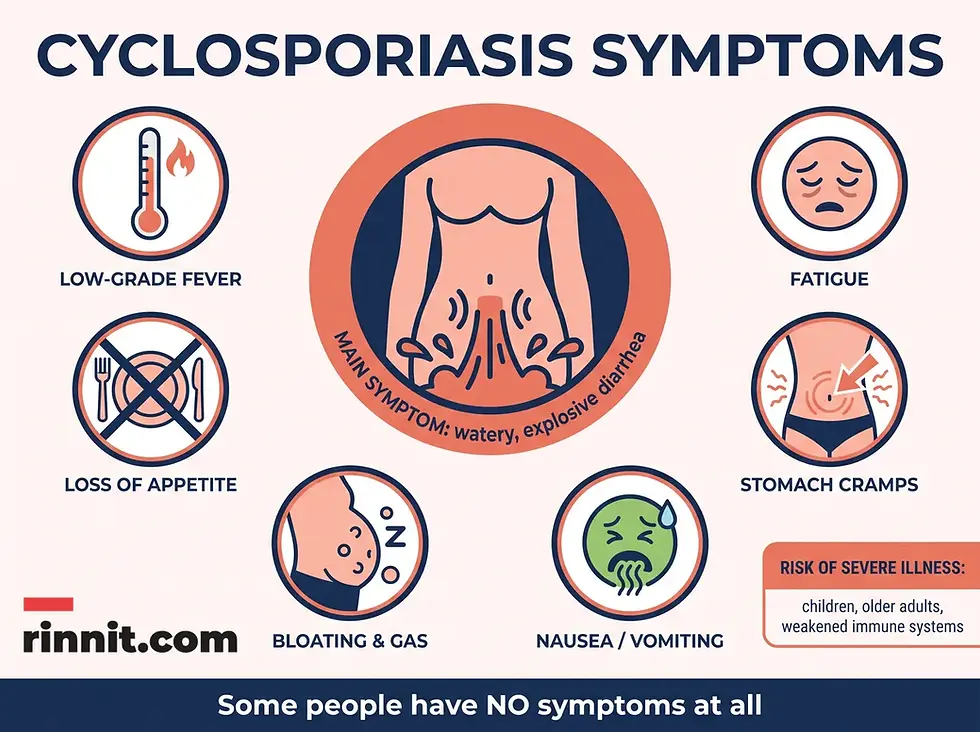
The hallmark symptom is loud, watery (explosive) diarrhea [1]. Beyond that, a Cyclospora infection can produce a cluster of stomach-related symptoms that make it feel like a persistent stomach bug. The full list of possible symptoms includes the following.
Symptom | What It Feels Like |
Explosive watery diarrhea | The main symptom; loud, watery, multiple bouts |
Loss of appetite [1] | Not feeling like eating at all |
Bloating | Includes burping and farting (gas) [1] |
Extreme tiredness (fatigue) [1] | Feeling wiped out beyond ordinary tiredness |
Low-grade fever [1] | Mild fever, not a high temperature |
Stomach cramps [1] | Cramping abdominal pain |
Nausea [1] | Feeling sick to your stomach |
Vomiting [1] | Throwing up |
One important caveat: in some cases, you can carry a Cyclospora infection without having any symptoms at all [1].
How do you get cyclosporiasis?
C. cayetanensis causes cyclosporiasis. Because the parasite mostly lives off people and other primates, infection almost always traces back to contamination of something you swallowed.
How It Is Transmitted
Cyclosporiasis spreads through the fecal-oral route — germs from contaminated feces get into your mouth [1]. This can happen in two main ways.
Route | How Contamination Happens |
Contaminated water | Drinking untreated water, or accidentally swallowing contaminated swimming water from pools, hot tubs, or lakes. C. cayetanensis can survive chlorinated pool water for a long time [1]. |
Contaminated foods | Fresh produce linked to outbreaks, especially if contaminated water was used to grow or wash it, or if feces were used to fertilize produce [1]. |
There is no evidence that cyclosporiasis spreads from person to person [1].
Risk Factors and Outbreak-Linked Produce
Anyone can get cyclosporiasis, but your risk rises if you live or travel in areas where the parasite is more common [1]. Eating fresh, imported produce also increases your risk [1] [2]. The following fruits and vegetables have been tied to cyclosporiasis outbreaks in the U.S.
What happens if cyclosporiasis is left untreated?
Cyclosporiasis can make it hard to hydrate properly. Losing large amounts of fluid through persistent diarrhea can lead to serious complications, which is the main reason treatment is recommended rather than waiting it out.
Without treatment, symptoms may last for a month or longer, and they may go away and come back [1]. Each of these scenarios keeps you at risk of severe dehydration and its complications.
How do doctors diagnose cyclosporiasis?
Diagnosis starts the same way most stomach illnesses do. A provider reviews your health history, asks about your symptoms, and performs a physical exam. They may also ask about anything you ate or drank recently, as well as any recent travel [1]. If cyclosporiasis is suspected, the provider will recommend a stool (poop) test [1]. A lab examines the sample to look for C. cayetanensis parasites.
Diagnostic Step | What Happens |
Health history review | Provider asks about symptoms, foods, drinks, and recent travel |
Physical exam | Standard in-person exam |
Stool (poop) test | Lab looks for C. cayetanensis in the sample |
Repeat sampling | Parasite shedding varies day to day, so you may need to give several samples over several days for an accurate diagnosis [1] |
The repeat-sampling detail matters. Some days you may pass a lot of parasites; other days you may pass none [1]. Multiple samples over several days give your provider the most reliable answer.
What are the treatment options for cyclosporiasis?
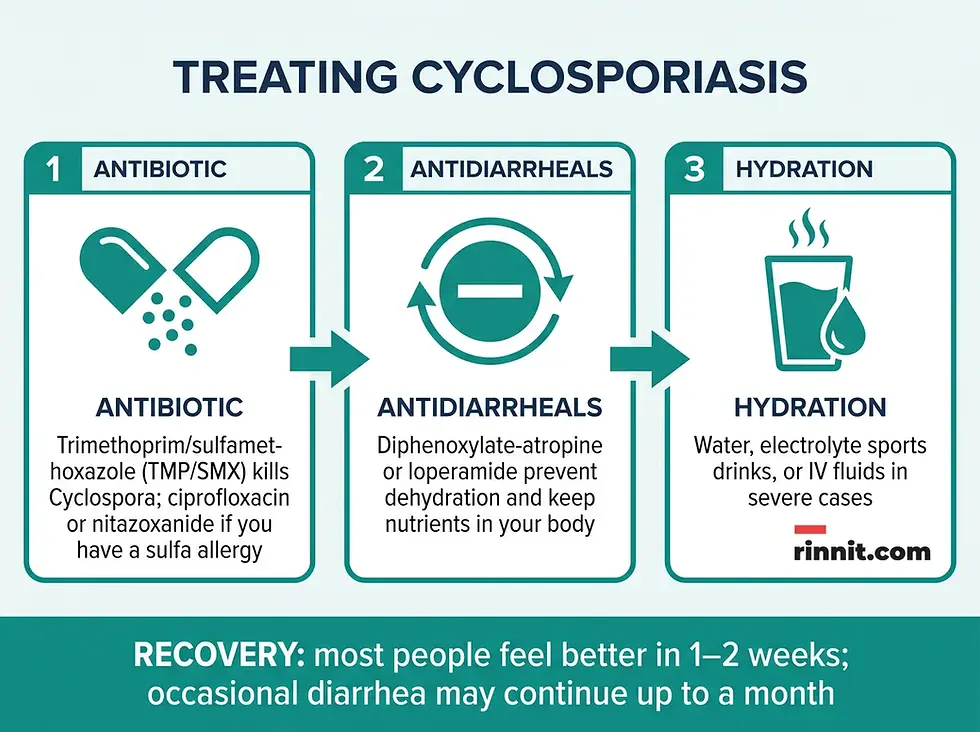
Healthcare providers treat cyclosporiasis with antibiotics [1] [3]. The standard prescription is trimethoprim/sulfamethoxazole (TMP/SMX), which kills Cyclospora.
Treatment Component | Details |
First-line antibiotic | Trimethoprim/sulfamethoxazole (TMP/SMX) to kill Cyclospora |
Sulfa-allergy alternatives | Ciprofloxacin or nitazoxanide if you have a sulfa drug allergy [1] |
Antidiarrheal medications | Diphenoxylate-atropine or loperamide to prevent dehydration and keep important nutrients in your body [1] |
Hydration | Water, electrolyte sports drinks, or IV fluids in severe cases [1] |
Will It Clear Up on Its Own?
A Cyclospora infection sometimes resolves without treatment [1]. However, if you skip treatment, your symptoms may last for a month or longer, putting you at risk of severe dehydration and other complications [1]. It's a good idea to check with a healthcare provider about whether you need antibiotics rather than waiting for it to clear.
Recovery Time
With proper diagnosis and treatment, most people feel better after a week or two [1]. You may still experience occasional bouts of diarrhea for up to a month after that [1].
When should you see a healthcare provider about cyclosporiasis?
Knowing when to act keeps a manageable illness from becoming dangerous.
Situation | Action to Take |
Several bouts of watery diarrhea per day | Reach out to a healthcare provider |
Symptoms return or worsen after finishing your full antibiotic course | Contact your provider again |
Weakened immune system with any infectious disease symptoms | Go to the nearest emergency room |
Signs of severe dehydration (confusion, dizziness, dark-colored pee, peeing much less) | Go to the nearest emergency room |
During your appointment, helpful questions to ask include how to take your medication, how to manage symptoms at home, what to eat or drink, which foods or drinks to avoid, and how to avoid spreading cyclosporiasis.
What is the outlook for cyclosporiasis and how can people live with it?
Your outlook depends largely on the strength of your immune system. If you have a healthy immune system, the outlook is good [1]. For some people, cyclosporiasis is self-limiting — it goes away on its own — and antibiotic treatment helps it clear faster [1]. If you have a weakened immune system, your provider will monitor you closely. In that situation, Cyclospora can cause severe, ongoing illness if your immune system cannot fight it off [1].
How to Feel Better at Home
If you have cyclosporiasis, staying hydrated and getting whatever nutrition you can is critical, because severe diarrhea can cause serious complications.
How can you prevent cyclosporiasis?
Cyclosporiasis outbreaks are hard for individuals to control, but several everyday habits meaningfully reduce your risk.
Prevention Habit | Why It Helps |
Cook fruits and vegetables to at least 158°F (70°C) [1] | Heat kills the parasite |
Thoroughly wash or peel fresh fruits and veggies before eating [1] | Removes surface contamination |
Wash hands with soap and water after using the bathroom and before, during, and after food prep [1] | Cuts the fecal-oral route |
Wash all food prep surfaces, dishes, and utensils with hot water and soap after use [1] | Removes any parasite residue |
Avoid swimming if you have diarrhea; wait at least two weeks after it ends to swim [1] | Protects shared water from contamination |
Avoid drinking untreated water or using it to cook [1] | Untreated water is a primary transmission route |
Conclusion
Cyclosporiasis is an uncommon but disruptive parasitic infection, most often traced to contaminated water or fresh produce — basil, cilantro, raspberries, bagged salads, and peas have all been linked to U.S. outbreaks. The explosive watery diarrhea it causes can last for weeks without treatment and may return after seeming to resolve. The good news is that diagnosis is straightforward (a stool test, sometimes repeated over several days), treatment is highly effective (a short antibiotic course), and recovery is typically complete within one to two weeks. Simple food-safety habits — washing or peeling produce, cooking when possible, safe water practices, and good hand hygiene — are your best everyday defense.
If you're experiencing several bouts of watery diarrhea per day, contact a healthcare provider today. They can test for Cyclospora, prescribe the right antibiotic, and help you avoid dehydration and other complications before they start.
Related guides: food poisoning and traveler's diarrhea.
Frequently Asked Questions
1. What is cyclosporiasis and what causes it?
Cyclosporiasis is a form of food poisoning caused by the parasite Cyclospora cayetanensis, a microscopic organism that mostly lives off people and other primates. You get it by swallowing the parasite through contaminated water or contaminated fresh produce.
2. What is the main symptom of cyclosporiasis?
The main symptom is loud, watery (explosive) diarrhea, which typically begins within a week of ingesting the parasite. Other symptoms can include fatigue, stomach cramps, nausea, vomiting, bloating, loss of appetite, and a low-grade fever.
3. How long does cyclosporiasis last?
With proper diagnosis and antibiotic treatment, most people feel better within a week or two, though occasional diarrhea bouts can continue for up to a month. Without treatment, symptoms may last a month or longer and may go away and come back.
4. How is cyclosporiasis treated?
Providers usually prescribe the antibiotic trimethoprim/sulfamethoxazole (TMP/SMX) to kill the parasite. People with a sulfa drug allergy may receive ciprofloxacin or nitazoxanide instead. Antidiarrheals and hydration support recovery.
5. Can cyclosporiasis go away on its own?
Yes, a Cyclospora infection sometimes clears on its own. However, untreated infections can last a month or longer and raise your risk of severe dehydration and other complications, so checking with a provider is recommended.
6. How is cyclosporiasis diagnosed?
A provider reviews your symptoms, diet, and travel history, then orders a stool test to look for C. cayetanensis. Because parasite shedding varies day to day, you may need to provide several samples over several days for an accurate result.
7. Can cyclosporiasis spread from person to person?
There is no evidence that cyclosporiasis spreads from person to person. It spreads through the fecal-oral route — germs from contaminated feces getting into your mouth via water or food.
8. Which foods are linked to cyclosporiasis outbreaks?
In the U.S., outbreaks have been tied to fresh, imported produce including basil, bagged salads and salad mixes, cilantro, mesclun lettuce, parsley, raspberries, snow peas, and sweet peas.
9. Is cyclosporiasis dangerous?
Cyclosporiasis is usually not life-threatening, but prolonged diarrhea can cause severe dehydration, electrolyte imbalance, and loss of fluid volume in the body. Children, older adults, and people with weakened immune systems are at higher risk of severe illness.
10. How can I prevent cyclosporiasis?
Wash or peel fresh fruits and vegetables, cook them to at least 158°F (70°C) when possible, wash hands with soap and water around food prep, wash surfaces and utensils with hot soapy water, avoid untreated drinking water, and don't swim while you have diarrhea (wait at least two weeks after it ends).
11. Should I go to the ER for cyclosporiasis?
Go to the nearest ER if you have a weakened immune system with any symptoms of infection, or if you show signs of severe dehydration such as confusion, dizziness, dark-colored urine, or significantly reduced urination.
References
Cleveland Clinic. Cyclosporiasis. Cleveland Clinic. April 14, 2026. https://my.clevelandclinic.org/health/diseases/17957-cyclosporiasis
Casillas SM, Hall RL, Herwaldt BL. Cyclosporiasis surveillance — United States, 2011–2015. MMWR Surveill Summ. 2019;68(3):1-16. doi:10.15585/mmwr.ss6803a1. PMID: 31002104.
Almeria S, Cinar HN, Dubey JP. Cyclospora cayetanensis and cyclosporiasis: an update. Microorganisms. 2019;7(9):317. doi:10.3390/microorganisms7090317. PMID: 31487898.
Giangaspero A, Gasser RB. Human cyclosporiasis. Lancet Infect Dis. 2019;19(7):e226-e236. doi:10.1016/S1473-3099(18)30789-8. PMID: 30885589.
Medical Disclaimer
This article is for informational purposes only and does not constitute medical advice. Always seek the advice of your physician or other qualified health provider with any questions you may have regarding a medical condition. Never disregard professional medical advice or delay in seeking it because of something you have read here.



Comments