Cyberphobia (Fear of Computers): Causes, Symptoms, Triggers, Diagnosis, and Treatment

Updated: 2 days ago
Medically reviewed by Dr. Baraa Alnahhal, MD · Last reviewed: October 2026
Quick Answer
Cyberphobia is an extreme fear of computers that can extend to smartphones and the internet [1]. A specific phobia, it causes intense anxiety, avoidance and physical symptoms like sweating and palpitations [1], and severe cases can disrupt work, school and relationships. No medication treats it directly, but cognitive behavioral therapy, exposure therapy and technology education help many people manage it [1].
What the research says
Computer anxiety is higher in people who use technology less independently. In a cross-sectional study of 117 Italian adults aged 50–67, people who were non-autonomous, used technology infrequently, or felt they needed help had significantly higher computer anxiety (all P < 0.01). The authors suggest technophobia may affect quality of life by limiting digital participation. The sample was small and limited to one country, and it measured computer anxiety rather than diagnosed cyberphobia (PubMed: Di Giacomo et al., Behav Sci, 2019 [2]).
Exposure-based therapy works well for phobias. A meta-analysis of 30 randomized trials (1,057 participants, 14 of them on specific phobias) found that virtual reality exposure therapy had a large effect compared with a waitlist (g = 0.90) and no significant difference from in-person exposure (g = −0.07). These trials were not about fear of computers specifically (PubMed: Carl et al., J Anxiety Disord, 2019 [3]).
Gradual exposure in real life and in virtual reality performed similarly for specific phobia. A systematic review of 9 randomized trials (371 participants) comparing equal amounts of virtual reality and in-person exposure found large effects for both and no significant difference for specific phobia (g = −0.15) or agoraphobia (g = −0.01). Only 4 of the 9 studies were in specific phobia, so confidence is limited (PubMed: Wechsler et al., Front Psychol, 2019 [4]).
What Is Cyberphobia?
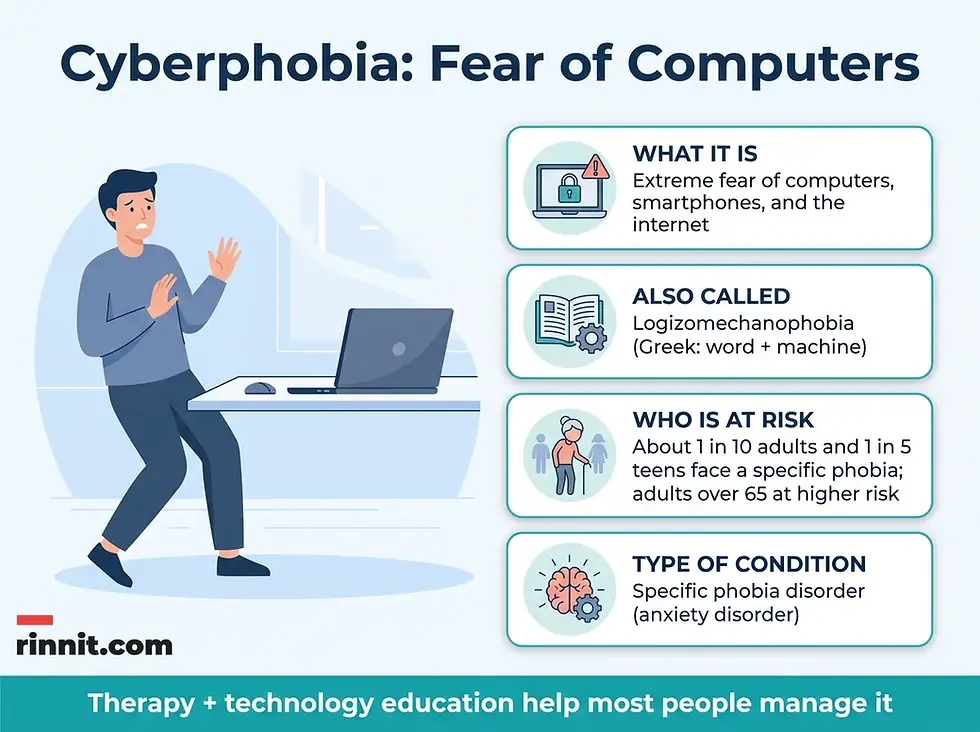
Cyberphobia is an extreme fear of computers [1]. Someone with this condition has an intense fear of using a computer or even being around one, and may avoid places like an office or school where computers might be present [1].
Healthcare providers also call this phobia logizomechanophobia, a name built from the Greek words "log" (word) and "machano" (machine) [1]. People with the condition may also feel anxious or worried about using the internet. In severe cases, cyberphobia can cause people to stop using computers or the internet completely [1]. They may also avoid smartphones, which are essentially mini computers [1].
How Common Is Cyberphobia?
About 1 in 10 American adults and 1 in 5 teenagers will deal with a specific phobia disorder at some point in their lives [1]. Providers do not know exactly how many people have cyberphobia specifically [1]. However, providers believe people over age 65 are more likely to develop this phobia because they did not grow up with computers [1] and may not understand how to use them. Advanced technology can feel overwhelming and confusing, which can be scary.
Key Fact | Detail |
Medical name | Cyberphobia (also called logizomechanophobia) [1] |
Type of condition | Specific phobia disorder (an anxiety disorder) [1] |
What it involves | Extreme fear of computers, and sometimes smartphones and the internet |
Adults with any specific phobia | About 1 in 10 in their lifetime [1] |
Teenagers with any specific phobia | About 1 in 5 in their lifetime [1] |
Most at-risk group | Adults over age 65 [1] |
Main treatment | Therapy plus technology education |
Can it be prevented? | No known prevention strategy [1] |
What Is a Phobia?
Phobias are anxiety disorders [1]. They cause people to have extreme, unrealistic fears [1]. People with phobias are afraid of things that other people do not find scary or troubling. Cyberphobia is a type of specific phobia disorder. These disorders cause people to have a reaction to a specific situation or object. The object or situation may be harmless, but the person with the phobia has an unusually strong reaction to it. People with a specific phobia disorder go to great lengths to avoid encountering the object that scares or upsets them [1].
Cyberphobia and Related Fears
Cyberphobia belongs to a family of technology-related fears. Understanding how it relates to similar conditions helps explain why the fear can spread from one device to another.
Related Fear | What It Is | How It Connects to Cyberphobia |
Technophobia | Extreme fear of technology in general | Cyberphobia is a type of technophobia [1] |
Mechanophobia | Fear of machines | Closely related to cyberphobia [1] |
Telephonophobia (telephobia) | Anxiety when talking on the phone | Can occur along with cyberphobia, especially in people who fear smartphones [1] |
Agoraphobia | Fear of leaving the house or public places | Can develop as a complication of severe cyberphobia [1] |
Because technology plays a major role in modern life and computers are everywhere, extreme cyberphobia can cause significant problems. Therapy can help people with this disorder manage symptoms and learn to accept and use this technology [1].
What are the symptoms and causes of cyberphobia?
Cyberphobia, like other phobias, is thought to result from a combination of genetics, environmental factors and personal history [1].
What Causes Cyberphobia?
Providers believe that phobias result from a combination of genetics, environmental factors, and personal history [1]. People who have anxiety disorders, other phobias, or mental illnesses are more likely to develop a phobia [1]. People with these conditions may be more vulnerable to developing cyberphobia if they have an unpleasant experience with a computer or smartphone [1]. You are more likely to have a specific phobia disorder such as cyberphobia if you have any of the following conditions:
Risk Factor | Why It Increases Vulnerability |
Depression [1] | Mental health conditions increase general phobia vulnerability |
Generalized anxiety disorder (GAD) [1] | Existing anxiety makes new phobias more likely |
Mental illness (e.g., delusional disorder, schizophrenia) [1] | Increases phobia risk overall |
Obsessive-compulsive disorder (OCD) [1] | Anxiety disorders raise phobia vulnerability |
Other phobias or a family history of phobias [1] | Genetics and prior phobias add risk |
Panic attacks or panic disorder [1] | Existing panic responses compound new fears |
Substance abuse disorder [1] | Increases general mental health vulnerability |
What Are the Triggers of Cyberphobia?
People with this disorder can become extremely anxious when they see, think about, or use a computer. Even being in the same room with a computer or smartphone can cause distress [1]. The idea of learning to use a computer may seem too complex, which can itself cause anxiety [1].
People with cyberphobia may also have concerns about using the internet. They might worry about sharing personal information online. This concern can lead to feelings of vulnerability and anxiety about protecting their privacy and security [1]. They might worry about getting "hacked" or having a computer steal their financial information [1]. These views cause people to see computers as dangerous. They may fear for their safety or feel as if someone is watching or spying on them [1].

What Are the Symptoms of Cyberphobia?
People with this disorder get extremely anxious or afraid when they think about, see, or have to use a computer or the internet [1]. The physical signs mirror those of a panic response, because phobias are anxiety disorders.
Symptom | What It Feels Like |
Chills [1] | Sudden cold sensation |
Dizziness and lightheadedness [1] | Feeling unsteady or faint |
Excessive sweating (hyperhidrosis) [1] | Sweating beyond what the situation warrants |
Heart palpitations [1] | Racing or pounding heartbeat |
Nausea [1] | Stomach unease, feeling sick |
Shortness of breath (dyspnea) [1] | Feeling unable to get enough air |
Trembling or shaking [1] | Uncontrollable muscle tremors |
Upset stomach or indigestion (dyspepsia) [1] | Stomach discomfort during anxiety |
How is cyberphobia diagnosed?
Cyberphobia is diagnosed through questions about your fear of computers, including when symptoms happen and what triggers them, sometimes with referral to a mental health professional [1].
How Do Healthcare Providers Diagnose Cyberphobia?
Your provider will ask you several questions about your fear of computers. They may ask when you have symptoms, how often they occur, and what triggers them [1]. They will also ask if you have other phobias or anxiety disorders [1]. Tell your provider if your symptoms affect your sleep, daily activities, work, or school [1]. To confirm a diagnosis, your provider may refer you to a mental health professional. These specialists have specific training in diagnosing phobias and other anxiety disorders [1].
Diagnostic Step | What Happens |
Symptom history | Provider asks when symptoms occur, how often, and what triggers them [1] |
Trigger assessment | Discussion of situations involving computers, smartphones, or the internet |
Screening for related conditions | Provider asks about other phobias or anxiety disorders [1] |
Impact evaluation | You describe effects on sleep, daily activities, work, or school |
Specialist referral | Mental health professional may confirm the diagnosis [1] |
How is cyberphobia managed and treated?
Therapy is the main treatment for cyberphobia, along with learning the basics of computer use and internet safety [1].
How Do Providers Treat Cyberphobia?
Therapy is the main treatment for cyberphobia [1]. To help you feel comfortable with this technology, it is important to learn how to use it properly. Learning the basics of computer use and internet safety can help you see these technologies in a positive way [1]. Several types of therapy can help people with this disorder:
Therapy Type | How It Helps |
Cognitive behavioral therapy (CBT) | Helps you change the way you respond to fear when you see or think about a computer [1] |
Exposure therapy | Gradually increases your exposure to computers; a one-on-one tutor may teach computer use in a compassionate environment [1] |
Psychotherapy (talk therapy) | Helps you understand your fears and where they come from [1] |
Hypnotherapy | Guided relaxation exercises while your mind is calm; helps you see computers as helpful, not harmful [1] |
Mindfulness, yoga, breathing exercises, meditation | Teach you to control your anxiety and your body's response to it [1] |

What about medication? There are no medications to treat cyberphobia directly [1]. However, if you have other mental health concerns, your provider may recommend medications to treat depression [1]. Other drugs can relieve anxiety or control panic attacks [1].
What Are the Complications of Cyberphobia?
Without treatment, people with this condition can withdraw from everyday life [1]. They may become paranoid about their information getting stolen through the internet [1]. This intense paranoia or fear can cause them to stop sending or responding to emails or using a smartphone [1].
Complication | How It Develops |
Paranoia about online theft | Intense fear of information being stolen can stop email and smartphone use [1] |
Avoiding work or school | People stop going anywhere a computer might be present [1] |
Agoraphobia | Fear of leaving the house can develop from avoidance [1] |
Staying home constantly | Remaining home allows control over exposure to computers |
Secondary problems | Damaged relationships, financial problems, isolation, and depression can result [1] |
When Should I See My Healthcare Provider?
Talk to your provider if you have severe signs of cyberphobia. If you avoid going to work or school, or if your anxiety affects your daily life, see your provider.
How Can I Reduce My Risk of Cyberphobia?
There is not a way to prevent cyberphobia [1]. But you can lower your risk by talking to a therapist or counselor [1]. If you have other phobias or a family history of phobias or mental illness, talk to your provider. They can connect you with a mental health professional who can work with you to address symptoms and help you manage them.
What Is the Outlook for People Who Have Cyberphobia?
Therapy and technological education can help many people manage this phobia [1]. But the outlook depends on several factors, including how severe the phobia is [1]. You might need long-term therapy as computer technology continues to evolve, or you may need a combination of therapies [1].
Conclusion
Cyberphobia is more than being "not tech-savvy" — it is a recognized specific phobia disorder that produces real physical symptoms and, in severe cases, can keep people away from work, school, and normal life. The good news is that it responds well to treatment: cognitive behavioral therapy, exposure therapy, talk therapy, hypnotherapy, and mindfulness techniques, combined with patient technology education, give most people a path back to comfortable daily life.
If fear of computers is shaping your choices — the places you go, the devices you avoid, or the life you lead — the best next step is to talk to a healthcare provider. A mental health professional can confirm what you are experiencing and build a treatment plan that fits your situation.
For a related anxiety condition, see our guide to obsessive-compulsive disorder.
Frequently Asked Questions
1. What is cyberphobia?
Cyberphobia is an extreme fear of computers, which can extend to smartphones and the internet. Also called logizomechanophobia, it is a specific phobia disorder in which seeing, thinking about, or using a computer triggers intense anxiety, avoidance, and physical symptoms.
2. Why am I so scared of computers?
Phobias result from a combination of genetics, environmental factors, and personal history. People with anxiety disorders, other phobias, or mental illnesses are more vulnerable, especially after an unpleasant experience with a computer or smartphone. Not understanding how computers work can also make technology feel overwhelming and scary.
3. What does cyberphobia feel like?
People with cyberphobia feel extreme anxiety or fear when thinking about, seeing, or having to use a computer or the internet. Physical symptoms include chills, dizziness, excessive sweating, heart palpitations, nausea, shortness of breath, trembling, and upset stomach.
4. How common is cyberphobia?
About 1 in 10 American adults and 1 in 5 teenagers will deal with a specific phobia disorder at some point in their lives. Providers do not know exactly how many people have cyberphobia, but adults over 65 are thought to be at higher risk because they did not grow up with computers.
5. What is the fear of computers officially called?
Providers also call cyberphobia logizomechanophobia, built from the Greek words "log" (word) and "machano" (machine). It is a type of technophobia, an extreme fear of technology, and is closely related to mechanophobia, the fear of machines.
6. Can you be afraid of computers because of the internet?
Yes. People with cyberphobia may worry about sharing personal information online, feeling vulnerable about privacy and security. Some worry about being "hacked" or having a computer steal their financial information, which makes computers feel dangerous or like a form of surveillance.
7. Is cyberphobia related to fear of smartphones?
Yes. People with cyberphobia may also avoid smartphones, which are essentially mini computers. Telephonophobia — anxiety when talking on the phone — can occur along with cyberphobia, especially among people who fear smartphones.
8. How is cyberphobia diagnosed?
Your provider will ask about when symptoms occur, how often, and what triggers them, and whether you have other phobias or anxiety disorders. Tell your provider if symptoms affect your sleep, daily activities, work, or school. A mental health professional may be referred to confirm the diagnosis.
9. What is the best treatment for cyberphobia?
Therapy is the main treatment, especially cognitive behavioral therapy (CBT), which changes how you respond to fear of computers, and exposure therapy, which gradually increases exposure to computers. Talk therapy, hypnotherapy, and mindfulness or breathing exercises also help. Learning basic computer use and internet safety supports recovery.
10. Is there medication for cyberphobia?
No medication treats cyberphobia directly. However, if you have other mental health concerns, a provider may prescribe medications for depression, or drugs that relieve anxiety or control panic attacks, as part of your overall treatment.
11. What happens if cyberphobia goes untreated?
Without treatment, people can withdraw from everyday life, become paranoid about online information theft, stop using email or smartphones, and avoid work or school. Some may develop agoraphobia (fear of leaving the house), leading to damaged relationships, financial problems, isolation, and depression.
12. Can cyberphobia be prevented?
There is no way to prevent cyberphobia. You can lower your risk by talking to a therapist or counselor, especially if you have other phobias or a family history of phobias or mental illness. A mental health professional can help you manage symptoms early.
13. Will cyberphobia ever go away?
Therapy and technological education help many people manage the phobia, but the outlook depends on how severe it is. You may need long-term therapy as computer technology continues to evolve, or a combination of therapies, and many people learn to use technology comfortably.
Related Reading
Technophobia: Symptoms, Causes, Treatment and Coping covers the broader fear of technology and how it is treated.
Specific Phobias: Symptoms, Causes, and How Exposure Therapy Helps You Overcome Them explains how specific phobias develop and how exposure therapy treats them.
Exposure Therapy: What It Is, How It Works, Types, and What to Expect describes how gradual, guided exposure helps people face and reduce fears.
Panic Attacks and Panic Disorder: Symptoms, Causes, and Treatment explains panic attack symptoms and how panic disorder is treated.
References
Cleveland Clinic. Cyberphobia (Fear of Computers). Cleveland Clinic. March 22, 2022. https://my.clevelandclinic.org/health/diseases/22543-cyberphobia-fear-of-computers
Di Giacomo D, Ranieri J, D'Amico M, Guerra F, Passafiume D. Psychological barriers to digital living in older adults: computer anxiety as predictive mechanism for technophobia. Behav Sci (Basel). 2019;9(9):96. doi:10.3390/bs9090096. PMID: 31514364.
Carl E, Stein AT, Levihn-Coon A, et al. Virtual reality exposure therapy for anxiety and related disorders: a meta-analysis of randomized controlled trials. J Anxiety Disord. 2019;61:27-36. doi:10.1016/j.janxdis.2018.08.003. PMID: 30287083.
Wechsler TF, Kümpers F, Mühlberger A. Inferiority or even superiority of virtual reality exposure therapy in phobias? A systematic review and quantitative meta-analysis on randomized controlled trials specifically comparing the efficacy of virtual reality exposure to gold standard in vivo exposure in agoraphobia, specific phobia, and social phobia. Front Psychol. 2019;10:1758. doi:10.3389/fpsyg.2019.01758. PMID: 31551840.
Medical Disclaimer
This article is for informational purposes only and does not constitute medical advice. Always seek the advice of your physician or other qualified health provider with any questions you may have regarding a medical condition. Never disregard professional medical advice or delay in seeking it because of something you have read here.



Comments