Cri-du-Chat Syndrome: Symptoms, Causes, and Treatment Guide

Updated: 3 days ago
Medically reviewed by Dr. Baraa Alnahhal, MD · Last reviewed: October 2026
Quick Answer
Cri-du-chat syndrome, also called cat cry or 5p- syndrome, is a rare chromosomal disorder caused by a deletion on the short arm of chromosome 5 [1] [2]. Its hallmark sign is a shrill, cat-like cry in newborns [1] [2]. There is no cure, but early therapies and targeted surgery help [1], and most children have a normal life expectancy, depending on deletion size [1].
What the research says
The condition is one of the more common chromosomal deletion syndromes, and the cry fades with age. A critical review describes the high-pitched, cat-like cry as the main clinical feature, which usually disappears in the first years of life, and reports an incidence of 1 in 15,000 to 1 in 50,000 live births. It also lists oral findings such as a small, set-back lower jaw, a high palate (rarely cleft), malocclusion, and enamel hypoplasia, while noting that there is not enough evidence to support a clear association between these dental problems and the syndrome (PubMed: Rodríguez-Caballero et al., Med Oral Patol Oral Cir Bucal, 2010 [2]).
Craniofacial and airway features are consistent across reports. A systematic review of 7 articles identified epicanthal folds, a short philtrum, and a wide nasal bridge, along with mandibular retrognathism, an anterior open bite, and a small upper airway. The authors called for larger studies to describe these features more precisely (PubMed: Corcuera-Flores et al., Clin Anat, 2016 [3]).
Researchers are starting to look beyond the deletion itself. In a small study of 8 patients matched with sibling and age controls, blood DNA methylation changes were enriched in genes controlling embryonic development and in genes linked to developmental delay and microcephaly, two of the most common symptoms. The authors could not say which came first, the methylation changes or other cellular changes (PubMed: Holland et al., Clin Epigenetics, 2022 [4]).
What Is Cri-Du-Chat Syndrome?
Cri-du-chat syndrome, also known as cat cry syndrome, is a rare genetic disorder caused by a missing piece (a deletion) of a chromosome [1]. It gets its name from the distinct cry that infants with the condition make [1]. The cry sounds like the high-pitched mewing of a cat, and "cri du chat" literally means "cry of the cat" in French [1].
The condition is also called 5p- syndrome, pronounced "5p minus." That name describes where the problem sits: the genetic deletion occurs on the small arm (the p arm) of chromosome 5 [1] [2]. Cri-du-chat is a spectrum disorder. The size and location of the deletion can vary, so symptoms range from mild to severe [1]. A child with a larger deletion may have more serious symptoms [1].
Key Facts
Fact | Detail |
Full name | Cri-du-chat syndrome |
Other names | Cat cry syndrome, 5p- ("5p minus") syndrome [1] |
Cause | |
Type of disorder | Genetic, chromosomal, spectrum disorder [1] |
Frequency in the U.S. | |
U.S. births per year | Roughly 70 to 240 babies [1] |
Cure | None; managed with early intervention and therapy [1] |
Life expectancy | Normal for most children [1] |

How Common Is It and Who Does It Affect?
Cri-du-chat syndrome is rare, but it is one of the most commonly seen chromosomal anomalies [1] [2]. The condition occurs in 1 in 15,000 to 1 in 50,000 live births in the U.S. [1] In practical terms, roughly 70 to 240 babies are born with cat cry syndrome every year, based on that rate and about 3.6 million U.S. births [1]. Because it is a spectrum disorder, no two cases look exactly alike. The size and location of the chromosome 5 deletion determine how mild or severe a child's symptoms will be.
Symptoms and Warning Signs
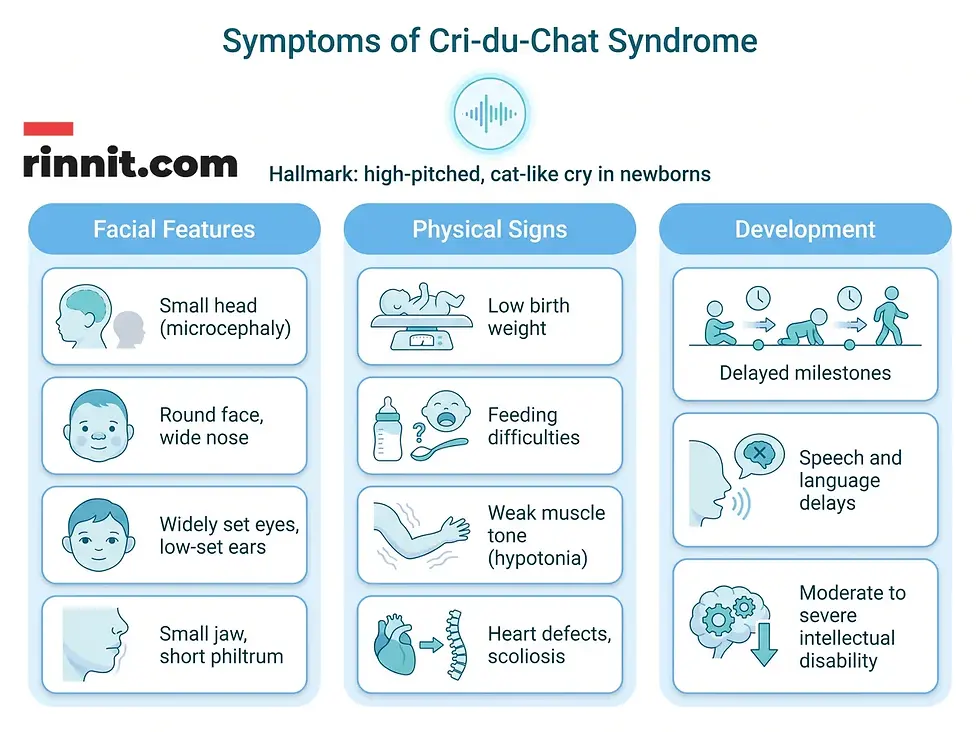
Symptoms of cri-du-chat syndrome can vary widely from child to child. The most common sign is the distinct, high-pitched, shrill cry. It sounds like a cat's cry and is usually present during the first few weeks of a baby's life [1]. The cry becomes less noticeable as the baby grows older [1] [2].
Facial Features
Babies with cri-du-chat often share a recognizable set of facial features, including an unusually small head [1] (microcephaly; see our microcephaly guide).
Feature | What it looks like |
Microcephaly | An unusually small head [1] |
Round face | An abnormally round face shape [1] |
Nose | Wider than average [1] |
Hypertelorism | Widely set eyes [1] |
Strabismus | Crossed eyes [1] |
Eyelid folds | Downward slanting eyelid folds [1] |
Inner eye fold | An extra fold of skin over the inner corner of the eyes (monolid eyes) [1] |
Ears | Low-set ears [1] |
Micrognathia | An abnormally small jaw [1] |
Short philtrum |
As the baby grows, the face may lose its plumpness and become abnormally long and narrow [1].
Other Physical and Developmental Symptoms
Symptom | How it appears |
Low birth weight | Babies are often born smaller than average [1] |
Delayed growth | Growth proceeds more slowly than typical [1] |
Feeding difficulties | Poor sucking, difficulty swallowing (dysphagia), and GERD [1] |
Hypotonia | Weak muscle tone [1] |
Scoliosis | Curvature of the spine [1] |
Heart defects | Congenital heart problems may be present [1] |
Developmental delays | Slower milestones such as head control, sitting up, and walking [1] |
Speech delays | Speech and language develop more slowly [1] |
Intellectual disability | Moderate to severe in most cases |
Causes and Inheritance
Cri-du-chat syndrome is a chromosomal disorder. The cause is a deletion of part of the short arm (the p arm) of chromosome 5 [1] [2]. This deletion most often happens randomly during the formation of reproductive cells (eggs or sperm) in early fetal development [1]. The parents of a child with a random deletion usually have completely normal chromosomes [1].
Is It Dominant or Recessive?
Most cases of cri-du-chat syndrome are not inherited, so the condition is neither dominant nor recessive. People with 5p- syndrome typically have no biological family history of the disorder [1]. However, about 10% of people with the disorder inherit the chromosome abnormality from an unaffected parent [1]. In those cases, the parent carries a chromosomal rearrangement called a balanced translocation [1]. The parent loses or gains no genetic material and usually has no medical problems, but balanced translocations can become unbalanced when a parent passes them on to a child [1].
How Cri-Du-Chat Is Diagnosed
Healthcare providers can usually diagnose cri-du-chat syndrome at birth [1]. They see and hear the typical symptoms, including the cat-like cry, then perform a complete physical exam and evaluate the child's symptoms. Most likely, the provider will then recommend chromosomal testing to confirm the diagnosis [1]. Three genetic tests are used.
Test | What it does |
Karyotype | Maps the child's chromosomes to show whether something is missing or added [1] |
FISH testing | Fluorescence in situ hybridization; looks for specific gene changes or parts of genes in the child's cells [1] |
Chromosome microarray analysis | Compares the child's DNA to a control group; identifies deletions and duplications across whole chromosomes, chromosome parts, and specific locations [1] |

Treatment and Management
There is no cure for cri-du-chat. But with prompt diagnosis and early intervention, a child may be capable of reaching their fullest potential and leading a meaningful life [1]. Treatment varies with each child's specific symptoms and most likely requires ongoing care from a team of healthcare providers [1]. The most common form of treatment is rehabilitation through physical therapy, occupational therapy, and speech therapy [1].
Therapy | What it helps with |
Physical therapy | Started right away for feeding difficulties; teaches sucking and swallowing; helps the child sit, stand, and improve fine motor skills [1] |
Occupational therapy | Builds fine motor, visual, self-care, and sensory skills to help the child interact with the world [1] |
Speech therapy | Teaches communication methods such as sign language and technology-assisted communication; helps with feeding issues from an early age [1] |
In addition to supportive therapies, a healthcare provider may recommend surgery to treat a variety of symptoms. Surgery can correct congenital heart defects, strabismus (crossed eyes), and scoliosis [1].
Outlook and Life Expectancy
The outlook for most children with cri-du-chat syndrome is variable, and the size and location of the chromosome 5 deletion is a major factor in prognosis [1]. Children will have noteworthy limitations in their physical and mental development [1]. Even so, most children with cri-du-chat have a normal life expectancy [1].
Some children are born with life-threatening health issues, and the statistics for that group are sobering. Of these children, about 75% will die during their first month of life [1], and about 90% of deaths occur during the first year [1]. Rates of death decrease after the first few years of life [1]. One of the most important factors in the prognosis is a prompt diagnosis [1]. Early diagnosis unlocks early intervention and therapeutic methods that help the child succeed.
Prevention: Can Cri-Du-Chat Be Prevented?
You cannot prevent cri-du-chat syndrome because it is a genetic condition [1]. However, if you plan on becoming pregnant, you can talk to your healthcare provider about genetic counseling. Counseling can help you understand your risk of having a child with a genetic condition [1].
When to Talk to Your Provider
Because the cat-like cry and distinctive facial features are usually noticed at birth, diagnosis typically starts in the newborn period. If your baby's cry sounds unusually high-pitched, feeding is persistently difficult, or early developmental milestones seem significantly delayed, ask your pediatrician about an evaluation and genetic testing. A prompt diagnosis opens the door to the therapies that make the biggest difference.
Conclusion
Cri-du-chat syndrome is a rare chromosomal disorder caused by a deletion on the short arm of chromosome 5, affecting roughly 70 to 240 babies born in the U.S. each year [1]. Its hallmark is a high-pitched, cat-like cry in the newborn period, supported by distinctive facial features, feeding difficulties, weak muscle tone, and developmental delays. There is no cure, but early and ongoing physical, occupational, and speech therapy, plus surgery for specific symptoms, can help children reach their fullest potential. Most children have a normal life expectancy [1], and a prompt diagnosis is one of the most powerful tools a family has.
If your newborn has an unusual high-pitched cry, feeding difficulties, or distinct facial features, ask your pediatrician about genetic evaluation. Related reading: our microcephaly guide.
Frequently Asked Questions
1. What is cri-du-chat syndrome?
Cri-du-chat syndrome is a rare genetic disorder caused by a deletion of part of the short arm (p arm) of chromosome 5. It is also called cat cry syndrome or 5p- syndrome, named for the high-pitched, cat-like cry infants typically make.
2. How rare is cri-du-chat syndrome?
Cri-du-chat syndrome occurs in 1 in 15,000 to 1 in 50,000 live births in the U.S., roughly 70 to 240 babies per year. Though rare, it is one of the most commonly seen chromosomal anomalies.
3. Why do babies with cri-du-chat sound like cats?
The syndrome's hallmark is a distinct high-pitched, shrill cry that resembles a cat's mewing. It is usually present in the first few weeks of life and becomes less noticeable as the baby grows.
4. What are the main symptoms of cri-du-chat syndrome?
Symptoms include the cat-like cry, a small head (microcephaly), round face, wide nose, widely set eyes, low-set ears, small jaw, low birth weight, feeding difficulties, weak muscle tone, heart defects, and moderate to severe intellectual disability.
5. What causes cri-du-chat syndrome?
A deletion of part of the short arm of chromosome 5 causes it. The deletion most often occurs randomly when eggs or sperm form, so most cases are not inherited and parents usually have normal chromosomes.
6. Is cri-du-chat syndrome inherited?
Most cases are not inherited and there is typically no family history. About 10% of cases are passed on by an unaffected parent who carries a balanced translocation that becomes unbalanced in the child.
7. How is cri-du-chat syndrome diagnosed?
Providers usually suspect it at birth from the cry and facial features, then confirm with chromosomal testing: karyotype, FISH testing, or chromosome microarray analysis.
8. Is there a cure for cri-du-chat syndrome?
No. There is no cure, but prompt diagnosis and early intervention can help a child reach their fullest potential and lead a meaningful life.
9. How is cri-du-chat syndrome treated?
Treatment centers on rehabilitation: physical therapy for feeding and motor skills, occupational therapy for daily living skills, and speech therapy for communication. Surgery may correct heart defects, crossed eyes, and scoliosis.
10. What is the life expectancy for cri-du-chat syndrome?
Most children with cri-du-chat have a normal life expectancy. Children born with life-threatening health issues face higher risk, and about 90% of deaths occur in the first year, but death rates fall after the first few years.
11. Can cri-du-chat syndrome be prevented?
No, because it is a genetic condition. Prospective parents can speak with a healthcare provider about genetic counseling to understand their risk before pregnancy.
References
Cleveland Clinic. Cri du Chat Syndrome. Cleveland Clinic. August 30, 2022. https://my.clevelandclinic.org/health/diseases/24084-cri-du-chat-syndrome
Rodríguez-Caballero A, Torres-Lagares D, Rodríguez-Pérez A, Serrera-Figallo MA, Hernández-Guisado JM, Machuca-Portillo G. Cri du chat syndrome: a critical review. Med Oral Patol Oral Cir Bucal. 2010;15(3):e473-e478. doi:10.4317/medoral.15.e473. PMID: 20038906.
Corcuera-Flores JR, Castellanos-Cosano L, Torres-Lagares D, Serrera-Figallo MÁ, Rodríguez-Caballero Á, Machuca-Portillo G. A systematic review of the oral and craniofacial manifestations of cri du chat syndrome. Clin Anat. 2016;29(5):555-560. doi:10.1002/ca.22654. PMID: 26457586.
Holland P, Wildhagen M, Istre M, Reiakvam OM, Dahl JA, Søraas A. Cri du chat syndrome patients have DNA methylation changes in genes linked to symptoms of the disease. Clin Epigenetics. 2022;14(1):128. doi:10.1186/s13148-022-01350-3. PMID: 36242045.
Medical Disclaimer
This article is for informational purposes only and does not constitute medical advice. Always seek the advice of your physician or other qualified health provider with any questions you may have regarding a medical condition. Never disregard professional medical advice or delay in seeking it because of something you have read here.



Comments