Congenital Rubella Syndrome: Symptoms, Causes & Prevention — Complete Guide

Updated: 2 days ago
Medically reviewed by Dr. Baraa Alnahhal, MD · Last reviewed: October 2026
Quick Answer
Congenital rubella syndrome (CRS) is a condition that occurs when a pregnant person infected with rubella passes the virus through the placenta to the baby. It can cause cataracts, congenital heart disease, hearing loss and developmental delays, and is more severe with early-pregnancy infection. CRS is preventable with the rubella vaccine taken before pregnancy.
What the research says
CRS is the leading cause of vaccine-preventable congenital anomalies, and the burden without vaccination is high. A systematic review with transmission modeling for Bangladesh, based on 10 studies, found rubella seropositivity of 81% among women of childbearing age and estimated a pre-vaccination CRS incidence of 0.99 per 1,000 live births — about 3,292 cases a year — before routine rubella immunization began in 2012. (Chan et al., Infect Disord Drug Targets, 2020) [3]
Protecting adults of childbearing age is what closes the gap. In Costa Rica, vaccinating 1-year-olds with MMR shifted susceptibility to people of childbearing age, so in 2001 the country ran a national campaign for men and women aged 15–39 years, followed by postpartum vaccination of women who were pregnant during the campaign, alongside stronger surveillance of rubella and CRS cases. (Morice et al., Expert Rev Vaccines, 2009) [2]
At a Glance
Aspect | Summary |
What it is | Rubella infection during pregnancy passed to the baby; "congenital" = present at birth |
How common | Rare in the U.S. (rubella eliminated in 2004); ~100,000 cases worldwide each year |
Risk by timing | First 12 weeks: up to 85%; weeks 13–16: 50%; second half of 2nd trimester: 25% |
At-birth signs | Low weight, blueberry muffin rash, purpura, small head |
Later signs | Cataracts, heart disease, hearing loss, developmental delay, intellectual disability |
Contagious? | Yes — until at least 1 year of age (unless cleared by tests) |
Treatment | No cure; symptom-based care plan for each health problem |
Prevention | Rubella (MMR) vaccine before pregnancy; wait 28 days after vaccination to conceive |
What Is Congenital Rubella Syndrome?
The word congenital means "present at birth." Congenital rubella syndrome (CRS) develops when a pregnant person becomes infected with rubella (German measles) and passes the virus to the fetus through the placenta.
The virus disrupts normal fetal development. These disruptions cause a variety of problems after birth — cataracts, congenital heart disease and intellectual disability are among the most well known. CRS ranges widely in severity, and it is typically more severe when the infection happens earlier in pregnancy, especially before the 13th week.
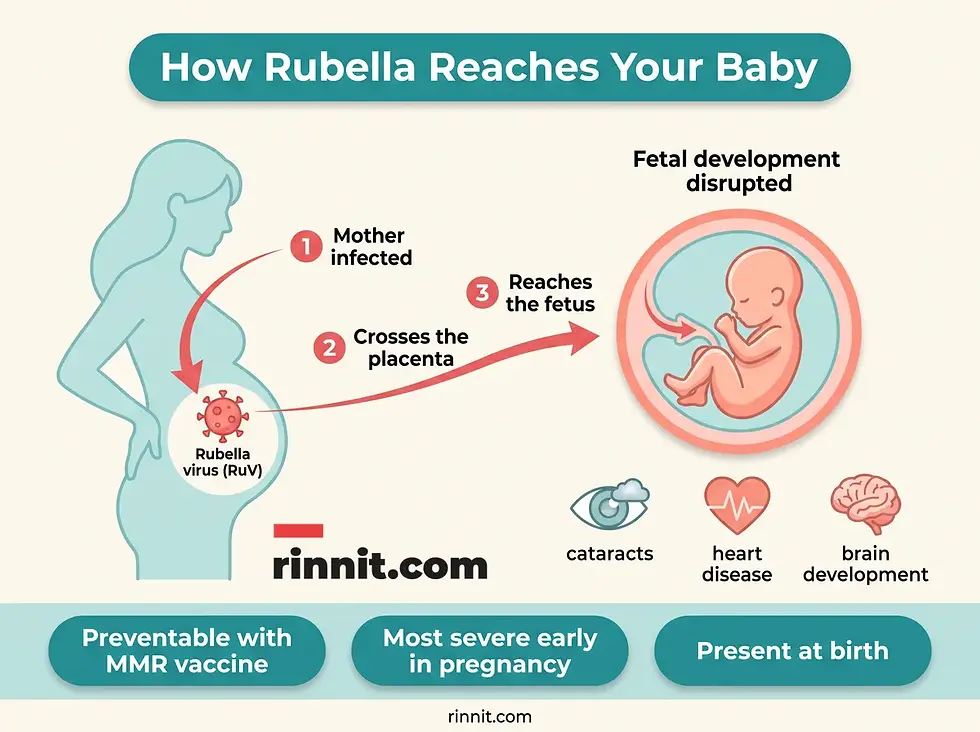
The good news is that CRS is rare in the United States, thanks to the widespread use of the rubella vaccine. However, roughly 100,000 cases occur worldwide each year, and rubella still circulates in other parts of the world.
How common is congenital rubella syndrome (CRS), and why does timing matter?
The single most important fact about CRS is this: the earlier in pregnancy the rubella infection happens, the more likely the baby is to have severe features of the syndrome. A baby with a mild form may have few or no obvious signs at birth.
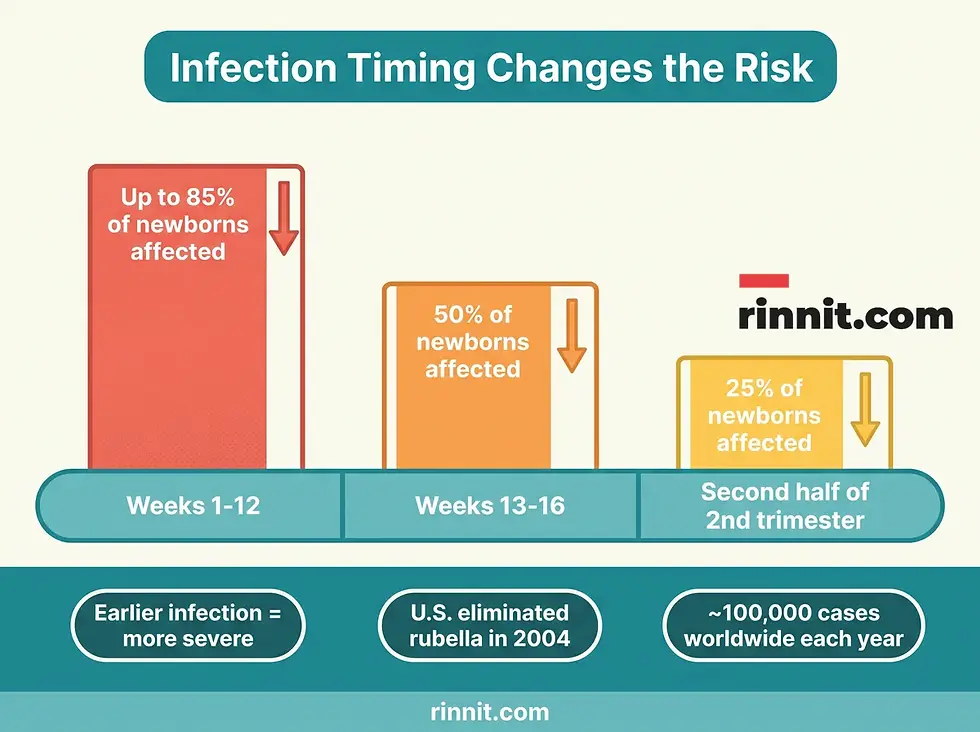
When rubella infection occurs | Babies affected by congenital health issues |
First 12 weeks of pregnancy | Up to 85% |
Weeks 13–16 | 50% |
Second half of the second trimester | 25% |
Rubella itself is a contagious illness caused by the RuV virus. It typically produces a rash that starts on the face and moves down the body. The United States eliminated rubella (meaning it is no longer continuously spread) in 2004 — but travelers and people in other parts of the world remain at risk.
What are the signs and symptoms of congenital rubella syndrome (CRS)?
The symptoms — sometimes called features — of congenital rubella syndrome vary greatly from baby to baby. They fall into two groups: signs visible right after birth, and features that become apparent later.
Signs Visible at Birth
Sign | What it looks like |
Low birth weight | Baby is smaller than expected |
"Blueberry muffin" rash | Multiple blue or purple circle-shaped marks or bumps on the skin |
Purpura | Purple, red or brown spots and patches on the skin |
Microcephaly | Unusually small head size |
Features That Appear Later
Feature | Body system affected |
Congenital cataracts and glaucoma | Eyes |
Congenital heart disease — patent ductus arteriosus (PDA), peripheral pulmonary artery stenosis, ventricular septal defects (VSD), atrial septal defects (ASD) | Heart |
Hearing loss | Ears |
Developmental delay | Development |
Intellectual disability | Brain |
Pigmentary retinopathy | Eyes |
Enlarged liver or spleen (hepatosplenomegaly) | Digestive organs |
Hemolytic anemia | Blood |
Pneumonia | Lungs |
Meningoencephalitis | Brain and spinal cord |
Bone disease | Skeleton |
Swollen lymph nodes | Immune system |
Beyond these early-life features, babies born with CRS also carry an increased risk of developing insulin-dependent diabetes and thyroid disease later in life. (Learn more about congenital heart disease, one of the most common CRS features, in our complete guide to congenital heart disease.)
Are babies with congenital rubella syndrome (CRS) contagious?
This surprises many parents: healthcare providers consider babies with congenital rubella syndrome contagious until at least 1 year of age. The only way to remove that status is two negative test results for rubella taken one month apart after 3 months of age. This has real implications for childcare, family gatherings and hospital precautions during the first year.
How Is CRS Diagnosed?
Diagnosis can happen at three points — during pregnancy screening, during pregnancy after a known infection, and after birth.
Diagnostic path | How it works |
Pregnancy screening | Tests that screen for rubella and other infections are standard in early pregnancy in the U.S. If rubella-like symptoms appear during pregnancy, your provider orders confirmatory tests and discusses the likelihood that the baby will be born with CRS. |
Fetal diagnosis during pregnancy | If you get rubella during pregnancy, your provider may recommend amniocentesis, chorionic villus sampling (CVS), or fetal blood sampling to see whether the virus reached the fetus. |
Diagnosis after birth | A blood test (using ELISA) checks for rubella antibodies in the baby. The provider may also test a urine sample, saliva, or a swab from inside the nose for the rubella virus itself. |
If your baby has rubella, the care team will likely order several additional tests to check overall health and look for the specific health issues related to CRS — the heart, hearing, eyes and development are the usual focus areas.
How is congenital rubella syndrome (CRS) managed and treated?
There is no cure and no direct treatment for congenital rubella syndrome itself. Some features — such as hearing loss and intellectual disability — are permanent. Other features are manageable or treatable, including hemolytic anemia and interstitial pneumonia.
The care team develops a treatment plan based on each baby's specific symptoms and needs. That typically means a coordinated group of specialists — cardiology for heart defects, ophthalmology for cataracts and glaucoma, audiology and speech services for hearing loss, and developmental support for delays — working together with the family.
What is the outlook for congenital rubella syndrome (CRS)?
CRS affects each baby differently and ranges widely in severity. It may take several assessments and tests before the full impact on your baby becomes clear. Your baby's healthcare team will guide you through what CRS means for your baby and your family's future, and they will help you advocate for the care that gives your child the best possible quality of life.
How does the vaccine prevent congenital rubella syndrome (CRS)?
You can prevent CRS by having immunity to the rubella virus before becoming pregnant. In the United States, this protection comes through the combined measles, mumps and rubella (MMR) vaccine, given to children in two doses — the first at 12 to 15 months of age and the second at 4 to 6 years.
The prevention checklist for planning a pregnancy is simple:
Check your vaccine history — if you didn't receive the MMR vaccine as a child, talk to your healthcare provider about getting it now.
Time the vaccine correctly — if you receive the vaccine as an adult, wait 28 days after vaccination before trying to become pregnant.
Confirm immunity before conceiving — a quick conversation with your provider can confirm you are protected against rubella and other infectious diseases.

What should you ask your healthcare team about congenital rubella syndrome?
Questions about congenital rubella syndrome (CRS) can cover rubella immunity and the MMR vaccine, testing during pregnancy, signs to watch for after birth and how long a baby is contagious.
Am I immune to rubella, and should I get the MMR vaccine before trying to conceive?
I got rubella while pregnant — what tests can tell me if the virus reached the baby?
What signs of CRS should we watch for right after birth?
Which specialists should evaluate my baby, and when?
How long will my baby be contagious, and what precautions does our family need?
What long-term health risks (such as diabetes or thyroid disease) should we monitor?
Frequently Asked Questions
What is congenital rubella syndrome?
Congenital rubella syndrome happens when a pregnant person is infected with rubella (German measles) and passes the virus to the developing baby through the placenta. The virus disrupts fetal development and can cause health problems present at birth.
What are the first signs of CRS in a newborn?
The initial signs right after birth may include low birth weight, a "blueberry muffin" rash (blue or purple circle-shaped marks on the skin), purpura, and an unusually small head. Some babies with mild CRS have few or no obvious signs at birth.
How does rubella damage the baby during pregnancy?
The virus passes from the mother to the placenta and then to the fetus, where it interferes with normal growth and development. The risk is highest — affecting up to 85% of babies — when infection occurs in the first 12 weeks of pregnancy.
Can congenital rubella syndrome be cured?
There is no cure or direct treatment for CRS. Some features, like hearing loss and intellectual disability, are permanent, while others, such as hemolytic anemia and pneumonia, can be treated and managed.
Is a baby born with CRS contagious?
Yes. Babies with CRS are considered contagious until at least 1 year of age, unless they have two negative rubella test results taken one month apart after 3 months of age.
How can congenital rubella syndrome be prevented?
CRS is preventable through immunity to the rubella virus before pregnancy, usually via the MMR vaccine. Adults who weren't vaccinated as children should get the vaccine and wait 28 days before trying to conceive.
Why is CRS rare in the U.S. but still common elsewhere?
The United States eliminated rubella in 2004 thanks to widespread vaccination, making CRS very rare here. But about 100,000 cases occur worldwide each year, so travelers and people in other regions remain at risk.
Conclusion
Congenital rubella syndrome is one of the clearest stories in all of preventive medicine — a serious condition that vaccines have pushed to the edge of elimination. Three takeaways matter most:
Timing drives severity — infection in the first 12 weeks affects up to 85% of babies, while later infection carries a much lower risk.
The signs span many body systems — from the telltale "blueberry muffin" rash at birth to cataracts, heart defects and hearing loss that follow.
Prevention is simple and powerful — the MMR vaccine before pregnancy prevents CRS almost entirely.
This guide covered what CRS is, when the risk is highest, the signs to watch for, how it's diagnosed, and how babies are cared for — everything a parent or planning family needs for informed conversations with their care team. To explore a related topic, read our complete guide to congenital heart disease, one of the most common features of CRS, or browse more expert health guides at rinnit.com.
This article is for general information only and is not a substitute for professional medical advice, diagnosis or treatment. Always consult a qualified healthcare provider for medical decisions.
References
Cleveland Clinic. Congenital Rubella Syndrome. Cleveland Clinic. Last updated February 21, 2024. https://my.clevelandclinic.org/health/diseases/congenital-rubella-syndrome
Morice A, Ulloa-Gutierrez R, Avila-Agüero ML. Congenital rubella syndrome: progress and future challenges. Expert Rev Vaccines. 2009;8(3):323-331. PMID 19249974. https://doi.org/10.1586/14760584.8.3.323
Chan J, Wu Y, Wood J, et al. Burden of congenital rubella syndrome (CRS) in Bangladesh: systematic review of existing literature and transmission modelling of seroprevalence studies. Infect Disord Drug Targets. 2020;20(3):284-290. PMID 30289078. https://doi.org/10.2174/1871526518666181004092758



Comments