Congenital Muscular Dystrophy (CMD): Symptoms, Types, Causes, Diagnosis, and Treatment

Updated: 2 days ago
Medically reviewed by Dr. Baraa Alnahhal, MD · Last reviewed: October 2026
Quick Answer
Congenital muscular dystrophy (CMD) is a rare group of genetic muscle diseases present from birth. Babies typically show weak muscle tone, minimal limb movement, a weak cry and feeding difficulties. It is diagnosed with exams, blood tests, EMG, genetic testing and biopsy. There is no cure, but therapy, corticosteroids, mobility aids and heart and respiratory care improve quality of life.
What the research says
CMD involves many genes, and gene panels reach a diagnosis in about 60% of cases. A review of recent advances notes that at least 35 genes are responsible for CMD phenotypes, with variable involvement of the heart and lungs, brain, and eyes, and that comprehensive gene panels reach a final diagnosis in around 60% of cases, so new genes or unusual mutations probably account for the rest ( (Zambon & Muntoni, Neuromuscular Disorders, 2021) [2].
Breathing and spine problems are common in SEPN1-related myopathy. In a multicentre cohort of 60 patients, 46 (77%) presented before age 2 with low muscle tone, poor head and neck control, and developmental delay; 50 needed ventilatory support (started at a median age of 13 years), 45 developed scoliosis, and forced vital capacity fell by about 2 percentage points per year in the longitudinal group ( (Silwal et al., Annals of Clinical and Translational Neurology, 2020) [3].
What Is Congenital Muscular Dystrophy?
Congenital muscular dystrophy (CMD) refers to a group of muscular dystrophies that become apparent at or near birth. The word "congenital" means "present from birth."
Muscular dystrophies are chronic genetic (inherited) conditions that cause muscle weakness and other symptoms. That muscle weakness generally becomes more severe over time.
CMD is rare. Researchers estimate it affects 6 to 9 children per 1 million worldwide.
Key Fact | Detail |
Definition | Group of muscular dystrophies apparent at or near birth |
Nature of condition | Chronic, genetic (inherited) |
Course | Muscle weakness generally worsens over time |
Prevalence | Estimated 6 to 9 children per 1 million worldwide |
Cure status | No cure currently; researchers are actively looking |
What are the types of congenital muscular dystrophy (CMD)?
Healthcare providers diagnose the CMD subtype according to the affected gene or genes. Some of the most common subtypes are described below.
Laminin-alpha 2-related dystrophies (LAMA2) represent 10% to 37% of CMD cases. Children with early-onset LAMA2-related muscular dystrophy often never develop the ability to walk. They may also have difficulty speaking because of facial muscle weakness and an enlarged tongue (macroglossia). Seizures affect about one-third of children with this subtype.
Dystroglycanopathies (DGPs) represent 12% to 25% of CMD cases. In addition to muscle weakness, DGPs often affect the brain, causing seizures and cognitive disabilities. They can also cause eye issues. Types within this group include Walker-Warburg syndrome, muscle-eye-brain disease, and Fukuyama CMD (FCMD). FCMD is the most common form of CMD in Japan.
Collagen VI-related dystrophies (COL6-RDs) represent 12% to 19% of CMD cases. Types within this group range from mild to severe and include Bethlem muscular dystrophy, intermediate COL6-RD, and Ullrich congenital muscular dystrophy (UCMD).
Selenoprotein N-related myopathies (SEPN1-RM) represent about 11% of CMD cases. They involve early-onset muscle weakness of the axial muscles (head and trunk), which leads to early respiratory insufficiency.
CMD Subtype | Share of Cases | Key Features |
LAMA2-related dystrophies | 10%–37% | Often never walk; speech difficulty; enlarged tongue; seizures in about 1/3 of children |
Dystroglycanopathies (DGPs) | 12%–25% | Brain involvement, seizures, cognitive disabilities, eye issues; includes Walker-Warburg syndrome and Fukuyama CMD |
Collagen VI-related dystrophies (COL6-RDs) | 12%–19% | Range from mild to severe; includes Bethlem muscular dystrophy and Ullrich CMD |
Selenoprotein N-related myopathies (SEPN1-RM) | About 11% | Axial (head and trunk) muscle weakness; early respiratory insufficiency |

The four main types of congenital muscular dystrophy and their share of cases.
What are the symptoms of congenital muscular dystrophy (CMD)?
The main symptom of congenital muscular dystrophy is muscle weakness. At birth or shortly after, CMD can look like the following.
Symptom | What It Looks Like |
Poor muscle tone (hypotonia) | Often called "floppy infant syndrome" |
Minimal spontaneous movement | Arms and legs move very little on their own |
Weak cry | The baby's cry is notably feeble |
Feeding difficulties | Weakened suck mechanism makes feeding hard |
Contractures | Tightness of muscles and joints |
Developmental delays | Significant gross motor skill delays after birth |
The severity of muscle weakness and other symptoms can vary from baby to baby. Depending on the specific type of CMD, a child may also develop additional symptoms.
Additional Symptom | Examples |
Eye issues | Myopia (nearsightedness), glaucoma |
Eyelid drooping | Ptosis (drooping upper eyelid) |
Brain abnormalities | Lissencephaly, cerebellar malformations |
Seizures | More common in LAMA2 and DGP subtypes |
Intellectual disability | Varies by subtype and severity |
When should you see a doctor about congenital muscular dystrophy?
If your newborn or infant shows signs of poor muscle tone, minimal movement of the arms and legs, a weak cry, or trouble feeding, contact a healthcare provider promptly. Significant gross motor skill delays later in infancy are also a sign that warrants evaluation.
Early assessment matters because CMD symptoms can resemble other conditions, such as certain myopathies (muscle disorders) or metabolic conditions like glycogen storage diseases and mitochondrial diseases. An accurate diagnosis is important so your child receives the right care.
Signs that should prompt urgent attention include breathing difficulty, feeding failure, or sudden weakness.
What Causes Congenital Muscular Dystrophy?
Mutations (changes) in the genes responsible for healthy muscle structure and function cause congenital muscular dystrophy. Those mutations mean the cells that would normally maintain your baby's muscles can no longer fulfill that role. The result is progressive muscle weakness over time.
There are several genes and possible genetic mutations that play a role in muscle function. This is why there are so many different forms of muscular dystrophy, including CMD.
Genetic Concept | What It Means for CMD |
Gene mutations | Changes in genes responsible for muscle structure and function cause CMD |
Cellular effect | Muscle-maintaining cells can no longer do their job |
Result | Progressive muscle weakness over time |
Inheritance pattern | Majority of CMDs are autosomal recessive |
Autosomal recessive | Mutation inherited from both biological parents |
De novo mutation | Some cases happen spontaneously and are not inherited |
The majority of CMDs result from an autosomal recessive inheritance pattern, meaning the child inherited a disease-causing mutation from both biological parents. Some cases develop spontaneously when a mutation happens randomly and is not inherited; this is called a de novo mutation.
What are the complications of congenital muscular dystrophy (CMD)?
The possible complications of CMD depend on the type. In general, they could include the following.
Complication Category | What Can Happen |
Mobility issues | Some children never develop the ability to walk and need a wheelchair; others use braces or a walker |
Respiratory complications | Chronic respiratory failure from weak breathing muscles; mechanical ventilation is often needed; risks atelectasis (lung collapse) and pneumonia |
Cardiac complications | Cardiomyopathy is common and can lead to chronic heart failure |
Musculoskeletal complications | Scoliosis from immobility; osteopenia; bone fractures; bedsores (pressure ulcers); joint contractures |
Neurological complications | Higher risk of depression and/or anxiety from living with a chronic condition |
Respiratory complications are relatively common because weakness in the muscles used to breathe can cause chronic respiratory failure. Children who need mechanical ventilation can then develop atelectasis and pneumonia.
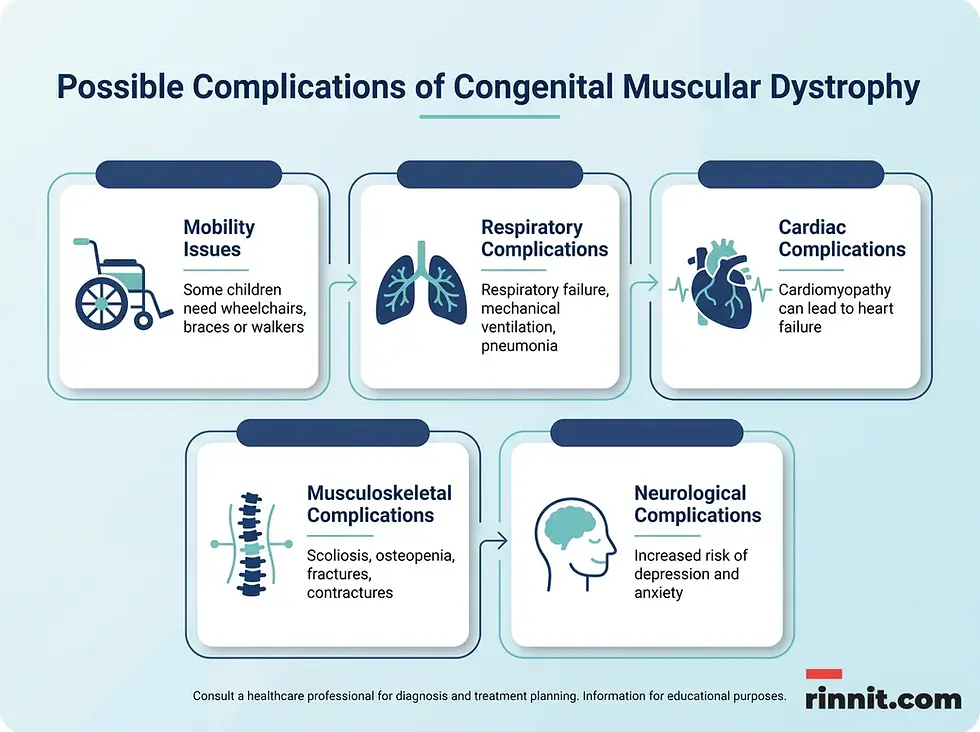
Possible complications of congenital muscular dystrophy.
How is congenital muscular dystrophy (CMD) diagnosed?
If a baby shows symptoms of CMD, with poor muscle tone being the main sign, a healthcare provider will likely perform a physical exam, neurological exam, and muscle exam. The baby may need to see a pediatric neurologist for more advanced exams.
If CMD is suspected, the provider may recommend several diagnostic tests.
Test | What It Shows |
Creatine kinase (CK) blood test | Muscle damage releases CK; elevated levels may indicate muscular dystrophy |
Electromyography (EMG) | Measures electrical activity of muscles and nerves |
Genetic tests | Identify gene mutations linked to muscular dystrophy; comprehensive gene panels confirm the specific CMD type in about 60% of cases |
Muscle biopsy | A small muscle tissue sample is examined under a microscope for signs of muscular dystrophy |
Echocardiogram and EKG | Check whether CMD is affecting the heart muscles |
Brain MRI | Many CMD types are linked to specific abnormalities in different brain areas |
This may seem like a lot of tests, and it can be emotionally difficult to watch your baby go through them. Providers order them to reach an accurate diagnosis, because CMD symptoms can resemble other myopathies, glycogen storage diseases, and mitochondrial diseases. Getting the correct diagnosis makes the best care possible.
How is congenital muscular dystrophy (CMD) treated?
Congenital muscular dystrophy (CMD) currently has no cure, so treatment aims to manage symptoms and improve your child's quality of life. The main goal of treatment is to manage symptoms and improve your child's quality of life. Treatments vary depending on the CMD type.
Treatment | What It Involves |
Physical and occupational therapy | Strengthen and stretch muscles; maintain movement function |
Corticosteroids | Prednisolone and deflazacort may delay muscle weakness, improve lung function, delay scoliosis, slow cardiomyopathy progression, and prolong survival |
Mobility aids | Canes, braces, walkers, and wheelchairs improve mobility and help prevent falls |
Surgery | Relieves tension on contracted muscles; corrects spine curvature (scoliosis) |
Heart care | ACE inhibitors and/or beta-blockers may slow cardiomyopathy and prevent heart failure; pacemakers treat rhythm problems and heart failure |
Speech therapy | Helps children with speech and/or swallowing difficulty |
Respiratory care | Cough-assist devices and respirators support breathing; tracheostomy and assisted ventilation may be needed in respiratory failure |
A child may also be able to participate in a clinical trial for CMD. Families should talk with the healthcare team about whether this is an option.

Treatment options for congenital muscular dystrophy.
Who is on the care team for congenital muscular dystrophy (CMD)?
A child with CMD will likely have a team of healthcare providers managing care. That team may include the specialists listed below.
Specialist Role | Focus |
Pediatricians | Overall child health and coordination |
Pediatric neurologists | Brain and nerve-related aspects of CMD |
Pediatric physiatrists | Physical medicine and rehabilitation |
Geneticists | Genetic diagnosis and counseling |
Pediatric orthopaedists | Bones, joints, and contractures |
Pediatric physical therapists | Movement and muscle strengthening |
Pediatric occupational therapists | Daily function and independence |
Pediatric speech-language pathologists | Speech and swallowing |
Pediatric cardiologists | Heart muscle and rhythm monitoring |
Pediatric pulmonologists | Breathing and respiratory support |
Child psychologists | Emotional well-being |
Social workers | Family support and resources |
What is the prognosis and life expectancy for congenital muscular dystrophy?
The prognosis of congenital muscular dystrophy is hard to predict with certainty, but it tends to be more severe and progress faster than muscular dystrophies starting later. Your child's healthcare team will provide as much insight as possible about what to expect.
In general, congenital muscular dystrophies tend to be more severe and progress more quickly than muscular dystrophies that begin in late childhood or adulthood.
Life expectancy depends on how quickly the condition progresses and which muscles are affected. The most common causes of death in these conditions are respiratory or cardiac complications due to muscle weakness.
Can Congenital Muscular Dystrophy Be Prevented?
Because congenital muscular dystrophy is a genetic condition, there is nothing you can do at the present time to prevent it.
If you are concerned about the risk of passing on muscular dystrophy or other genetic conditions before trying to have a biological child, talk to a healthcare provider about genetic counseling. In some situations, prenatal testing may be able to diagnose the condition in early pregnancy.
How can people live well with congenital muscular dystrophy (CMD)?
If your child has CMD, it is important to advocate for them to ensure they get the best medical care and as much access to therapy as possible. Advocating for care can help your child have the best possible quality of life.
You and your family may also want to consider joining a support group to meet others who can relate to your experiences. If your child has CMD, they will need to see their team of healthcare providers regularly to receive treatment and monitor symptoms.
It may be helpful to ask the following questions after a CMD diagnosis.
Question to Ask | Why It Matters |
What type of CMD does my child have? | The subtype guides treatment and expectations |
What treatment do you recommend? | Sets the immediate care plan |
What is the complete list of specialists my child should see? | Ensures no aspect of care is missed |
Will you be in contact with the other specialists? | Coordinates team-based care |
What can I do at home to help? | Improves daily quality of life |
Is there new research on CMD? | Keeps the family informed |
Are there clinical trials my child may qualify for? | May offer access to emerging treatments |
Can you recommend a support group? | Connects the family with peer support |
Conclusion: Caring for a Child With CMD
A congenital muscular dystrophy diagnosis can feel overwhelming. Understanding the subtype, watching for respiratory and heart complications, and staying connected with a coordinated team of pediatric specialists all help protect your child's quality of life. There is no cure yet, but therapy, medications, mobility support, and heart and breathing care give families real tools for managing the condition, and clinical trials continue to explore new options.
If your baby shows signs of poor muscle tone, weak movement, a weak cry, or feeding difficulties, talk to a healthcare provider right away. An early, accurate diagnosis is the foundation of the best possible care.
Frequently Asked Questions
What is congenital muscular dystrophy?
Congenital muscular dystrophy (CMD) is a group of rare muscular dystrophies that become apparent at or near birth. "Congenital" means present from birth. These are chronic genetic conditions that cause muscle weakness that generally becomes more severe over time.
How rare is congenital muscular dystrophy?
CMD is rare. Researchers estimate it affects 6 to 9 children per 1 million worldwide.
What are the first signs of CMD in a newborn?
Early signs include poor muscle tone (hypotonia, sometimes called "floppy infant syndrome"), minimal spontaneous movement of the arms and legs, a weak cry, feeding difficulties from a weakened suck, muscle and joint tightness, and significant gross motor skill delays.
What are the four most common types of congenital muscular dystrophy?
The most common subtypes are LAMA2-related dystrophies (10%–37% of cases), dystroglycanopathies (12%–25%), collagen VI-related dystrophies (12%–19%), and selenoprotein N-related myopathies (about 11%). Each has distinct features, such as seizures in LAMA2 or early respiratory insufficiency in SEPN1-RM.
Is congenital muscular dystrophy inherited?
The majority of CMDs result from an autosomal recessive inheritance pattern, meaning the child inherited a disease-causing mutation from both biological parents. Some cases occur spontaneously through a de novo mutation that is not inherited.
Can congenital muscular dystrophy be cured?
There is currently no cure for congenital muscular dystrophy, though researchers are actively looking for one. Treatment focuses on managing symptoms and improving quality of life through therapy, medications, mobility aids, surgery, and heart and respiratory care.
How is congenital muscular dystrophy diagnosed?
Diagnosis involves a physical, neurological, and muscle exam, a creatine kinase blood test, electromyography (EMG), genetic testing, and sometimes muscle biopsy. Echocardiogram, EKG, and brain MRI may also be used to check heart and brain involvement.
What role do genetic tests play in diagnosing CMD?
Genetic tests identify gene mutations linked to muscular dystrophy. Comprehensive gene panels can confirm the specific type of congenital muscular dystrophy in about 60% of cases.
What medications are used to treat CMD?
Corticosteroids such as prednisolone and deflazacort may delay muscle weakness, improve lung function, delay scoliosis, slow the progression of cardiomyopathy, and prolong survival. ACE inhibitors, beta-blockers, and pacemakers may be used for heart involvement.
What is the life expectancy for a child with CMD?
Life expectancy depends on how quickly the condition progresses and which muscles are affected. CMDs tend to be more severe and progress more quickly than dystrophies that begin in late childhood or adulthood. The most common causes of death are respiratory or cardiac complications.
Can congenital muscular dystrophy be prevented or detected before birth?
Because CMD is genetic, it cannot currently be prevented. However, genetic counseling before pregnancy can help families understand their risk, and in some situations prenatal testing may diagnose the condition in early pregnancy.
References
Cleveland Clinic. Congenital Muscular Dystrophy (CMD). Cleveland Clinic. Medically reviewed; last updated February 15, 2024. https://my.clevelandclinic.org/health/diseases/congenital-muscular-dystrophy-cmd
Zambon AA, Muntoni F. Congenital muscular dystrophies: what is new? Neuromuscular Disorders. 2021;31(10):931-942. PMID 34470717. https://doi.org/10.1016/j.nmd.2021.07.009
Silwal A, Sarkozy A, Scoto M, et al. Selenoprotein N-related myopathy: a retrospective natural history study to guide clinical trials. Annals of Clinical and Translational Neurology. 2020;7(11):2288-2296. PMID 33037864. https://doi.org/10.1002/acn3.51218
Medical disclaimer
This article is for general educational purposes only and is not a substitute for professional medical advice, diagnosis or treatment. Always seek the guidance of your healthcare professional with any questions about your or your child's health. In a medical emergency, call 911 or your local emergency number.



Comments