Complex Lymphatic Anomalies (Lymphangiomatosis): What It Is, Why It Happens, and How It's Treated

Updated: 2 days ago
Medically reviewed by Dr. Baraa Alnahhal, MD · Last reviewed: October 17, 2026
Quick Answer: What is lymphangiomatosis?
Complex lymphatic anomalies (CLAs), formerly called lymphangiomatosis, are rare congenital conditions in which children develop benign cysts in the lymphatic system that can grow into and damage bones and organs [4]. Symptoms vary by the organ affected. There is no cure or prevention; treatment is symptom-focused and may include sclerotherapy, surgery, nutrition support, and radiation or chemotherapy in severe cases [4].
What the research says
These are congenital lymphatic diseases with significant illness and early mortality, and care is not standardized. According to PubMed, a 2022 clinical review covering Gorham-Stout disease, generalized lymphatic anomaly, kaposiform lymphangiomatosis and central collecting lymphatic anomaly notes that diagnostic approach and medical management are not standardized (Ricci and Iacobas, Pediatric Blood and Cancer, 2022 [1]).
Gene changes in growth-signaling pathways may explain the disease, and sirolimus has shown benefit. Somatic mutations in genes of the PI3K pathway were found in lymphatic malformation tissue, and studies showed the mTOR inhibitor sirolimus is effective for these diseases. Kaposiform lymphangiomatosis is described as having an aggressive course and poor prognosis, and no standard therapy exists (Ozeki and Fukao, Advances in Wound Care, 2019 [2]).
Diagnosis and local treatment need care. Biopsy may be needed, but rib biopsy is best avoided because it can cause chronic pleural effusion. Resection, laser therapy and sclerotherapy target local control, and outcomes include recurrent effusion, infection, pain, fracture and mortality (Trenor and Chaudry, Seminars in Pediatric Surgery, 2014 [3]).
Study details are from PubMed abstracts.

What Is Complex Lymphatic Anomalies (Lymphangiomatosis)?
Complex lymphatic anomalies (CLAs) are rare conditions that are present at birth [1] [4]. Children with CLAs develop noncancerous (benign) fluid-filled cysts called lymphatic malformations, also known as lymphangiomas, in their lymphatic system. These cysts can grow into bones, connective tissue, and organs and damage them over time [4].
The disease affects every child differently [5]. Healthcare providers recommend surgeries or other treatments based on each child's unique diagnosis.
Key terms, defined simply
Term | Plain-Language Meaning |
Congenital | Present at birth |
Lymphatic malformation (lymphangioma) | A benign, fluid-filled cyst that forms in the lymphatic system |
Lymph | The clear fluid that lymphatic vessels collect and filter from body tissues |
Hereditary gene mutation | A DNA change passed from parents to children |
Somatic gene mutation | A DNA change that happens after birth |
Multidisciplinary approach | A care team of different specialists working together |
What Is the Lymphatic System?
Your lymphatic system is part of your immune system, and it helps your body fight off diseases. It is made up of a network of lymphatic vessels and tissues, glands like your lymph nodes, and organs like your spleen [4].
Lymphatic vessels are small tubes. They collect and filter lymphatic fluid (called lymph) from tissues in your body. The vessels then circulate the cleansed lymph back into your bloodstream [4].
"Lymphangiomatosis" vs. "Complex Lymphatic Anomalies": What's the Difference?
"Complex lymphatic anomalies" is the current, updated term. Healthcare providers used to call this condition "lymphangiomatosis." So you may hear both terms used interchangeably — they refer to the same group of conditions [4].

What Are the Types of Complex Lymphatic Anomalies?
Complex lymphatic anomalies are either isolated or systemic.
Isolated CLAs affect only one area of your child's body. Children with isolated CLAs most commonly develop cysts in their chest cavity. This usually affects their lungs and the soft tissue of their chest, called the mediastinum [4].
Systemic CLAs affect multiple areas of your child's body. Children with systemic CLAs usually have cysts in several areas, including their bones, chest, and abdomen [4].
Type | Where It Occurs | What Happens |
Isolated CLA | One area of the body | Most commonly cysts in the chest cavity, affecting the lungs and chest's soft tissue (mediastinum) |
Systemic CLA | Multiple areas | Usually cysts in several areas, including bones, chest, and abdomen |
What Are the Four Types of CLAs?
There are four different types of CLAs [4]. Though they share many of the same symptoms, they are different diseases with different presentations and unique gene mutations.
Type | Where It Affects the Body | What Makes It Distinct |
Generalized lymphatic anomaly (GLA) | Bone, spleen, liver, lungs, and mediastinum | Usually affects multiple areas of the body |
Kaposiform lymphangiomatosis (KLA) | Vessels throughout the body | The most aggressive CLA; vessels that carry lymphatic fluid expand and invade and damage surrounding organs, bones, and tissues |
Central conduction lymphatic anomaly (CCLA) | Mostly the torso | Enlarged lymphatic vessels can lead to an impaired digestive system, so your child is unable to effectively clear lymph from their system |
Gorham-Stout disease (GSD) | Bones (often ribs, skull, collarbone, cervical spine) | Lymphatic vessels form inside bone, causing excessive bone loss; also called "vanishing bone disease" |
How Common Are Complex Lymphatic Anomalies?
CLAs are rare. Because these conditions are so uncommon, healthcare providers sometimes have a difficult time diagnosing them [4].
What Causes Complex Lymphatic Anomalies?
Experts are currently learning more about what causes complex lymphatic anomalies. Recent research reveals that two kinds of gene changes cause the condition: hereditary gene mutations (passed from parents to children) and somatic gene mutations (changes that happen after birth) [2] [4].
Who Is at Risk?
Complex lymphatic anomalies can affect anyone. Signs of the disease don't typically appear until later in childhood or during the teenage years [4]. Children are born with CLAs, but they usually develop symptoms only as they get older.
What Are the Symptoms?
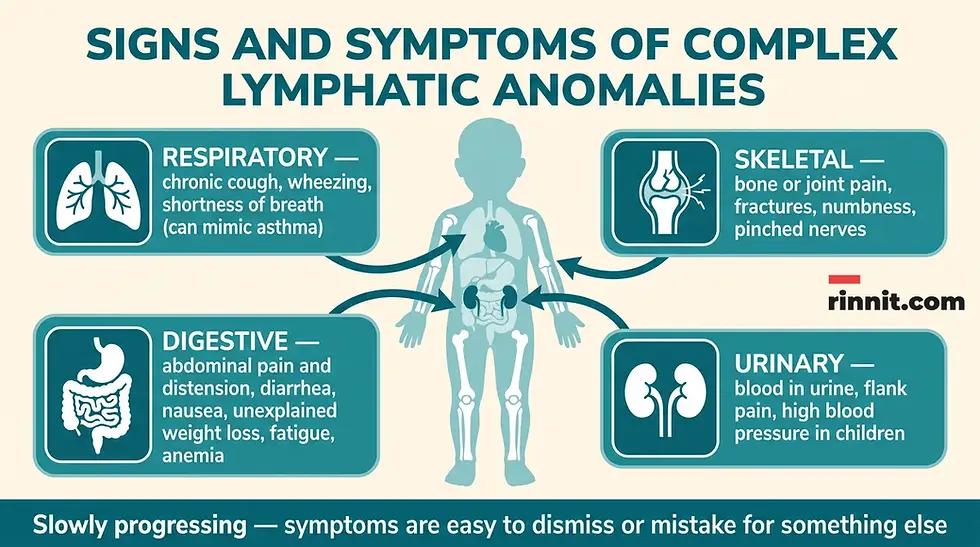
Symptoms of complex lymphatic anomalies vary depending on the affected organ system and the severity of the disease [4]. The condition tends to progress slowly, causing symptoms that are easy to dismiss or mistake for something else [4].
When CLAs affect the respiratory system, symptoms can look similar to asthma, such as a chronic cough, shortness of breath (dyspnea), and wheezing [4] [6].
When CLAs affect the skeletal system, symptoms include bone or joint pain, fractures, numbness, and pinched nerves [4].
When CLAs affect the digestive system, symptoms may include abdominal distension and abdominal pain, anemia and fatigue, diarrhea, loss of appetite, nausea and vomiting, and unexplained weight loss [4].
When CLAs affect the urinary system, symptoms may include blood in the urine (hematuria), flank pain, and high blood pressure in children [4].
Affected System | Possible Symptoms |
Respiratory (lungs and airways) | Chronic cough, shortness of breath (dyspnea), wheezing — can mimic asthma |
Skeletal (bones and joints) | Bone or joint pain, fractures, numbness, pinched nerves |
Digestive (stomach and intestines) | Abdominal distension and pain, anemia and fatigue, diarrhea, loss of appetite, nausea and vomiting, unexplained weight loss |
Urinary (kidneys and bladder) | Blood in urine (hematuria), flank pain, high blood pressure in children |
How Are Complex Lymphatic Anomalies Diagnosed?
CLAs are rare, and the symptoms vary. This makes it a challenge to get an accurate diagnosis. Because the disease most commonly affects children's lungs and bones, your child's healthcare provider may order several tests [4].
Test | What It Checks |
Bronchoscopy | Rules out infection as a cause or checks for abnormalities in your child's airways |
Pulmonary function testing | Measures the degree of lung dysfunction |
Whole-body MRI | Looks for affected organs, bone lesions, or fluid in your child's abdomen |
Bone X-rays | Targets any bones that look suspicious or show lesions on the whole-body MRI |
Chest X-rays | Checks for abnormalities in your child's lungs |
Biopsy | Removes lymphatic vessels and tissue to examine under a microscope |
Healthcare providers sometimes remove lymphatic vessels and tissue to examine under a microscope. While this type of biopsy can definitively diagnose complex lymphatic anomalies, it can sometimes cause lymph to collect around the lung (a condition called chylothorax) or other complications [4] [6]. For this reason, providers often rely on less invasive tests to make a diagnosis.
How Do Providers Treat Complex Lymphatic Anomalies?
Because CLAs affect multiple areas of your child's body, healthcare providers use a multidisciplinary approach to meet their needs [4]. Treatments focus on managing your child's symptoms.
Treatment | How It Helps |
Bone grafting | Supports and repairs bones weakened or damaged by cysts |
High-protein diet or IV nutrients | Provides nutrition through total parenteral nutrition (TPN) when the digestive system is affected |
Sclerotherapy | Shrinks or collapses cysts or lymphatic vessels |
Surgery | Removes cysts or places shunts that allow lymph fluid to drain |
Radiation therapy or chemotherapy | Shrinks noncancerous cysts — used only in severe, life-threatening cases |
Healthcare providers often use therapies that target the underlying genetic mutations. This approach is increasingly successful when used as front-line therapy for CLAs [4].
What Are the Complications?
CLAs increase your child's risk of several complications [4].
Complication | Plain-Language Meaning |
Ascites | Fluid buildup in your child's abdomen |
Bone fractures | Broken bones, more likely when cysts weaken the bone |
Chylothorax and chylopericardium | Chyle (a milky fluid containing lymph and fat) collecting in the chest cavity or the pericardium, the sac that holds the heart |
Collapsed lung (pneumothorax) | Lung tissue pulls away from the chest wall |
Liver failure | The liver stops working properly |
Paralysis | Loss of movement, which can occur if cysts press on nerves |
Pericardial effusion | Fluid in the pericardium, the sac holding the heart |
Pleural effusion and cardiogenic pulmonary edema | Fluid in or around your child's lungs |
What Is the Outlook?
There's no cure for complex lymphatic anomalies. Your child's outlook depends on their affected body systems and the severity of their symptoms [4].
The leading cause of death in people with CLAs is pleural effusions (fluid around the lungs) [4].
Can You Prevent Complex Lymphatic Anomalies?
No. CLAs occur for unknown reasons while your baby forms in the womb [4]. There isn't anything you can do to prevent your child from developing these conditions.
What should parents know about a complex lymphatic anomaly diagnosis?
Parents facing a complex lymphatic anomaly (CLA) diagnosis can take comfort that nothing could have prevented it and that, while there is no cure yet, treatments can help. Like most of us, you've probably never heard of it before, and there's nothing you could have done to prevent it.
Learning more about the disease, including its symptoms and treatments, is a good first step to helping your child. See a specialist who has experience treating lymphatic system disorders. They can answer your questions and provide the type of specialized medical care your child needs. While there's not yet a cure for CLAs, treatments can help your child get the most enjoyment from life.
When to call the doctor: Contact your provider if your child has abdominal or flank pain, blood in their urine, chronic cough, wheezing or shortness of breath, or unexplained nausea, fatigue, or weight loss.
What is the bottom line on complex lymphatic anomalies?
Complex lymphatic anomalies (lymphangiomatosis) are rare conditions present from birth in which benign cysts form in the lymphatic system and can damage bones, tissue, and organs. There is no cure, but a multidisciplinary care team can manage symptoms with surgery, sclerotherapy, nutrition support, and therapies targeting the gene mutations behind the disease.

Frequently Asked Questions
What is complex lymphatic anomalies (lymphangiomatosis)?
Complex lymphatic anomalies (CLAs), formerly called lymphangiomatosis, are rare congenital (present at birth) conditions. Children develop noncancerous (benign) fluid-filled cysts called lymphatic malformations, or lymphangiomas, in their lymphatic system. The cysts can grow into bones, connective tissue, and organs and damage them.
Is lymphangiomatosis the same thing as complex lymphatic anomalies?
Yes. "Complex lymphatic anomalies" is the current, updated term. Healthcare providers used to call this condition "lymphangiomatosis," so you may hear both terms used interchangeably.
What is the lymphatic system?
The lymphatic system is part of your immune system, and it helps your body fight off diseases. It is made up of a network of lymphatic vessels and tissues, glands like your lymph nodes, and organs like your spleen. The vessels collect and filter lymphatic fluid (lymph) from tissues, then circulate the cleansed lymph back into your bloodstream.
Are the cysts in lymphangiomatosis cancer?
No. The cysts, called lymphatic malformations or lymphangiomas, are noncancerous (benign). However, they can grow into and damage bones, connective tissue, and organs.
Is lymphangiomatosis present at birth?
Yes. Children with complex lymphatic anomalies are born with it, but symptoms usually don't appear until they get older. Signs typically don't show until later in childhood or during the teenage years.
What causes complex lymphatic anomalies?
Experts are still learning more, but recent research reveals that both hereditary gene mutations (passed from parents to children) and somatic gene mutations (changes that happen after birth) cause the condition.
Who is at risk for complex lymphatic anomalies?
The condition can affect anyone. There is nothing parents can do to prevent it, because CLAs occur for unknown reasons while the baby forms in the womb.
How common is lymphangiomatosis?
CLAs are rare. Because they are so uncommon, healthcare providers sometimes have a difficult time diagnosing them.
What is the difference between isolated and systemic CLAs?
Isolated CLAs affect only one area of your child's body — most commonly the chest cavity, affecting the lungs and the soft tissue of the chest (mediastinum). Systemic CLAs affect multiple areas, usually including the bones, chest, and abdomen.
What are the four types of complex lymphatic anomalies?
The four types are generalized lymphatic anomaly (GLA), kaposiform lymphangiomatosis (KLA), central conduction lymphatic anomaly (CCLA), and Gorham-Stout disease (GSD). They share many symptoms but are different diseases with different presentations and unique gene mutations.
Which type of CLA is the most aggressive?
Kaposiform lymphangiomatosis (KLA) is the most aggressive of the CLAs. It causes the vessels that carry lymphatic fluid to expand, and the vessels invade and damage surrounding organs, bones, and tissues.
What is Gorham-Stout disease?
Gorham-Stout disease (GSD), also called "vanishing bone disease," causes lymphatic vessels to form inside bone, leading to excessive bone loss. It can affect any bone, but children with GSD often develop bone loss in their ribs, skull, collarbone, and cervical spine (the neck area).
What is central conduction lymphatic anomaly (CCLA)?
Children with CCLA develop enlarged lymphatic vessels, mostly in the torso. This can lead to an impaired digestive system, so your child is unable to effectively clear lymph from their system.
What does generalized lymphatic anomaly (GLA) affect?
GLA usually affects multiple areas of your child's body, including their bone, spleen, liver, lungs, and mediastinum (the soft tissue of their chest).
What are the respiratory symptoms of CLAs?
CLAs that affect the respiratory system can cause symptoms similar to asthma, such as chronic cough, shortness of breath (dyspnea), and wheezing.
What are the skeletal symptoms of CLAs?
When CLAs affect the skeletal system, symptoms include bone or joint pain, fractures, numbness, and pinched nerves.
What are the digestive symptoms of CLAs?
CLAs that affect the digestive system may cause abdominal distension and abdominal pain, anemia and fatigue, diarrhea, loss of appetite, nausea and vomiting, and unexplained weight loss.
What are the urinary symptoms of CLAs?
CLAs that affect the urinary system may cause blood in urine (hematuria), flank pain, and high blood pressure in children.
How are complex lymphatic anomalies diagnosed?
Because CLAs most commonly affect children's lungs and bones, providers may order bronchoscopy, pulmonary function testing, whole-body MRI, X-rays of suspicious bones, and chest X-rays. A biopsy can definitively diagnose CLAs but can cause complications, so providers often rely on less invasive tests.
What is a bronchoscopy?
A bronchoscopy rules out infection as a cause or checks for abnormalities in your child's airways.
Can a biopsy diagnose lymphangiomatosis?
A biopsy — removing lymphatic vessels and tissue to examine under a microscope — can definitively diagnose complex lymphatic anomalies. But it can sometimes cause lymph to collect around the lung (chylothorax) or other complications, so providers often rely on less invasive tests.
Is there a cure for lymphangiomatosis?
There's no cure for complex lymphatic anomalies. Treatment focuses on managing your child's symptoms through a multidisciplinary approach.
What treatments are available for CLAs?
Treatments include bone grafting, a high-protein diet or IV nutrients (total parenteral nutrition, or TPN), sclerotherapy to shrink or collapse cysts or lymphatic vessels, surgery to remove cysts or place drainage shunts, and radiation therapy or chemotherapy to shrink noncancerous cysts in severe, life-threatening cases only.
What is sclerotherapy?
Sclerotherapy is a treatment used to shrink or collapse cysts or lymphatic vessels.
What is total parenteral nutrition (TPN)?
TPN delivers IV nutrients when the digestive system can't provide enough nutrition on its own. A high-protein diet may also be recommended.
Are radiation and chemotherapy used for benign cysts?
Yes, but only in severe, life-threatening cases. Radiation therapy or chemotherapy can be used to shrink the noncancerous cysts.
What are targeted therapies for CLAs?
Healthcare providers often use therapies that target the underlying genetic mutations. This approach is increasingly successful when used as front-line therapy for CLAs.
What complications can CLAs cause?
CLAs increase the risk of ascites (fluid buildup in the abdomen), bone fractures, chylothorax and chylopericardium, collapsed lung (pneumothorax), liver failure, paralysis, pericardial effusion, and pleural effusion and cardiogenic pulmonary edema (fluid in or around the lungs).
What is the leading cause of death in people with CLAs?
The leading cause of death in people with CLAs is pleural effusions (fluid around the lungs).
What is the outlook for a child with complex lymphatic anomalies?
There's no cure, and the outlook depends on the affected body systems and the severity of symptoms. Treatments can help your child get the most enjoyment from life.
Can you prevent complex lymphatic anomalies?
No. CLAs occur for unknown reasons while your baby forms in the womb. There isn't anything you can do to prevent your child from developing these conditions.
When should I call the doctor about my child's symptoms?
Call your provider if your child has abdominal or flank pain, blood in their urine, chronic cough, wheezing or shortness of breath, or unexplained nausea, fatigue, or weight loss.
What questions should I ask my provider?
You may want to ask: What parts of my child's body does the condition affect? What are my child's treatment options? Does my child need surgery? Should I look for signs of complications?
What specialist should my child see for lymphangiomatosis?
See a specialist who has experience treating lymphatic system disorders. They can answer your questions and provide the specialized medical care your child needs.
Related Reading
References
Ricci KW, et al. How we approach the diagnosis and management of complex lymphatic anomalies. Pediatr Blood Cancer. 2022;69 Suppl 3:e28985. PMID 33844431. https://doi.org/10.1002/pbc.28985
Ozeki M, et al. Generalized Lymphatic Anomaly and Gorham-Stout Disease: Overview and Recent Insights. Adv Wound Care (New Rochelle). 2019;8(6):230-245. PMID 31236308. https://doi.org/10.1089/wound.2018.0850
Trenor CC, et al. Complex lymphatic anomalies. Semin Pediatr Surg. 2014;23(4):186-190. PMID 25241096. https://doi.org/10.1053/j.sempedsurg.2014.07.006
Cleveland Clinic. Complex Lymphatic Anomalies (Lymphangiomatosis): Types, Prognosis & Treatment. Cleveland Clinic. Last updated September 30, 2022. https://my.clevelandclinic.org/health/diseases/24216-lymphangiomatosis
Lymphatic Malformations Alliance (formerly Lymphangiomatosis and Gorham's Disease Alliance). What are Complex Lymphatic Anomalies. Lymphatic Malformations Alliance. Accessed October 15, 2026. https://lmalliance.org/about-the-disease/conditions/what-are-clas.html
National Organization for Rare Disorders. Diffuse Pulmonary Lymphangiomatosis - Symptoms, Causes, Treatment. NORD. Last updated August 7, 2023. https://rarediseases.org/rare-diseases/diffuse-pulmonary-lymphangiomatosis/
Medical Disclaimer
This article is for general informational purposes only and is not a substitute for professional medical advice, diagnosis, or treatment. Always seek the advice of your physician or other qualified health provider with any questions you may have regarding a medical condition or an infant or child's unusual medical symptoms. Never disregard professional medical advice or delay seeking it because of something you have read here. In a medical emergency, seek emergency care immediately.



Comments