Bullous Pemphigoid: Symptoms, Causes, and Treatment

Updated: 2 days ago
Medically reviewed by Dr. Baraa Alnahhal, MD · Last reviewed: October 2026

Quick answer
Bullous pemphigoid is a rare autoimmune skin condition that causes large, slow-breaking, fluid-filled blisters, often near skin creases such as the upper thighs and armpits. Itching can begin weeks or months before blisters appear. Seek care for unexplained blisters or signs of infection. Treatment usually involves corticosteroid creams or pills, certain antibiotics or immune-calming medicines. [1] [2]
What the research says
According to PubMed:
Clobetasol cream healed skin at least as well as oral prednisone. A Cochrane review of 14 randomized trials (1,442 participants) found that whole-body clobetasol propionate cream probably increases skin healing at day 21 compared with oral prednisone (99.8% vs 92.4%; RR 1.08, 95% CI 1.03 to 1.13; 341 participants; moderate-certainty evidence), with possibly lower one-year mortality (26.5% vs 36.3%; low-certainty evidence). (Singh et al., DOI)
Doxycycline controls blisters less quickly but was safer over the long term. In a randomized trial of 253 adults (mean age 77.7 years), 74% of those starting doxycycline had three or fewer blisters at 6 weeks versus 91% on prednisolone, while severe, life-threatening, or fatal treatment-related events at 52 weeks were 18% versus 36% (p=0.001). (Williams et al., DOI)
Some diabetes medicines are linked to bullous pemphigoid. A meta-analysis of 46 placebo-controlled trials (59,332 participants) found a higher risk of bullous pemphigoid with dipeptidyl peptidase-4 inhibitor treatment (OR 7.38, 95% CI 2.00 to 27.25), though the quality of evidence was very low. (Yang et al., DOI)
Study details are from PubMed abstracts.
What is bullous pemphigoid?
Bullous pemphigoid is a rare skin condition that causes large fluid-filled blisters. The word "bullous" refers to the blisters, which are the condition's most visible sign. [1]
The blisters often appear on the skin near creases, such as the upper thighs and armpits. Sometimes people develop a rash instead of full blisters. The affected areas may be painful and are usually very itchy. [1]
Small blisters or sores can also form in the mouth, although this is rare. It is the main symptom of an uncommon form of the condition called mucous membrane pemphigoid. [1]
When the blisters do break, they leave a sore that usually heals without a scar. This slower breaking is one feature that helps healthcare professionals tell the condition apart from similar disorders. [1]
What are the symptoms of bullous pemphigoid?
The most striking sign is itching. It can begin weeks or even months before any blisters form, so early itch with no visible cause deserves attention. [1]
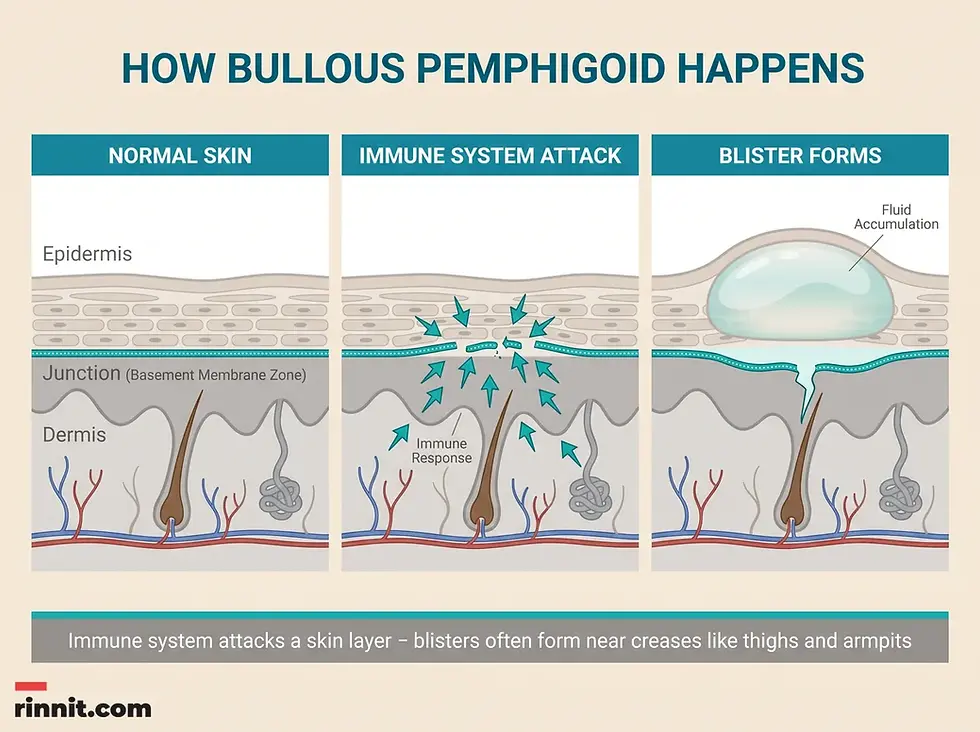
The blisters themselves are large and do not break easily. They most often line up along skin folds. Their color varies with skin tone, which matters for recognition. [1]
Sign | What it looks like |
Itching | Often starts weeks or months before blisters appear [1] |
Large blisters | Do not break easily; often found along skin folds [1] |
Blister color on brown and Black skin | May be dark pink, brown, or black [1] |
Blister color on white skin | May be yellow, pink, or red [1] |
Pain | Affected areas may hurt as well as itch [1] |
Rash | Sometimes appears instead of blisters [1] |
Mouth or mucous membrane sores | A symptom of the rare mucous membrane pemphigoid type [1] |
When to see a doctor
See a healthcare professional if you develop unexplained blisters. The same applies to blisters on your eyes, signs of an infection, or blisters that are opening up and leaking. [1]
What causes bullous pemphigoid?
Bullous pemphigoid occurs when the immune system attacks a layer of tissue in the skin. The exact reason for this immune response is not well understood. [1]
Trigger | Examples from reported cases |
Medicines | Diuretics such as furosemide; antibiotics such as amoxicillin, penicillin, and ciprofloxacin; NSAIDs such as aspirin and ibuprofen; diabetic medicines such as sitagliptin; cancer medicines such as nivolumab and pembrolizumab [1] |
Light and radiation treatments | Ultraviolet light therapy for certain skin conditions; radiation used to treat cancer [1] |
Medical conditions | Psoriasis, lichen planus, dementia, Parkinson's disease, stroke, and multiple sclerosis [1] |
One point brings real reassurance: the condition is not an infection, and it is not contagious. Nothing you catch from someone else causes it. [1]
What are the risk factors for bullous pemphigoid?
Bullous pemphigoid is most common in people over age 60, and the risk rises with age. For older people who have other health conditions at the same time, the condition can be life-threatening. [1]
What complications can bullous pemphigoid cause?
The main complications come from infection and from the treatments themselves, rather than from the blisters directly. [1]
Complication | What happens |
Infection | Open skin from broken blisters can become infected [1] |
Skin color changes | Healed areas may darken (post-inflammatory hyperpigmentation) or lose color (post-inflammatory hypopigmentation) [1] |
Long-term color changes | People with brown or Black skin have a higher risk of lasting skin color changes after healing [1] |
Medicine side effects | The drugs used to treat the condition carry their own risks, discussed below [2] |
How is bullous pemphigoid diagnosed?
Your healthcare professional will talk with you about your symptoms and your medical history, then conduct a physical exam. [2]
Tests may be needed to confirm the diagnosis. These may include blood tests, a skin biopsy, or both. A biopsy is a procedure that removes a small sample of tissue so it can be tested in a lab. [2]
You may be referred to a specialist in skin conditions, a doctor called a dermatologist. [2]
What are the treatment options for bullous pemphigoid?
Treatment aims to heal the skin, relieve itching and pain, and prevent new blisters from forming. Most people receive one medicine or a combination. [2]

Corticosteroids
Corticosteroid medicine is the main treatment, and it is usually applied directly to the affected area. A strong steroid cream such as clobetasol propionate is typically used. [2]
Long-term use of this type of cream carries the risk of skin thinning and easy bruising. A healthcare professional might also suggest a steroid medicine taken by mouth. [2]
Oral steroids come with the risk of harmful side effects, including weak bones, diabetes, stomach ulcers, and eye problems. Depending on how you respond to the first medicines tried, a different approach may be suggested instead of steroids. [2]
Antibiotics
Two oral antibiotics, dapsone and doxycycline, can help control the blisters. They offer an option for people who cannot take or do not respond to steroids. [2]
Medicines that target the immune system
Some medicines stop the immune system from attacking healthy tissues. Examples include azathioprine, rituximab, mycophenolate, and methotrexate. [2]
These medicines carry a risk of harmful side effects, including infection. People who take them need close follow-up and, at times, repeat blood tests to watch for side effects. [2]
Medicine group | How it works | Main risks to watch |
Corticosteroids (main treatment) | Creams applied to the skin reduce inflammation; oral versions work through the body [2] | Skin thinning and easy bruising with long-term creams; weak bones, diabetes, stomach ulcers, and eye problems with oral steroids [2] |
Antibiotics | Dapsone and doxycycline help control blisters [2] | Individual side effects depend on the drug [2] |
Immune-targeting medicines | Azathioprine, rituximab, mycophenolate, and methotrexate stop the immune system from attacking healthy tissue [2] | Infection and other side effects; close follow-up and repeat blood tests needed [2] |
Over time, bullous pemphigoid usually goes away on its own. Sores can take weeks to heal, and it is common for new ones to form along the way. [2]
Which lifestyle and home remedies help with bullous pemphigoid?
Self-care plays a real role in managing the condition day to day. [2]
Follow wound care advice. Follow your healthcare professional's guidance for the care of your blisters. [2]
Limit activities if needed. Blisters on the feet and hands can make walking or daily tasks difficult, and itching may make sleep hard. You may need to change your routine until the blisters are under control. [2]
Protect your skin. Try not to scratch the affected area. Protect your skin from too much heat and sun, even on cool, cloudy, or hazy days. [2]
Wear loose-fitting cotton clothes. This simple change helps protect your skin from friction and irritation. [2]
Watch what you eat. Avoid hard and crunchy foods if you have blisters in your mouth. [2]
How can people with bullous pemphigoid cope and find support?
Living with bullous pemphigoid may be difficult, especially when it affects daily activities, causes lost sleep, or adds stress. Many people find it helpful to talk with others who have or had the condition. [2]
Support groups meet in person and online. Your healthcare professional can offer suggestions for connecting with one. [2]
How should you prepare for a bullous pemphigoid appointment?
You are likely to first see your regular healthcare professional, who may then refer you to a dermatologist, a doctor who specializes in skin disorders. [2]
Before the visit, make a list of your symptoms and how long they have been happening, the name and contact information of any healthcare professional you have seen recently, all medicines, vitamins, and supplements you take including doses, and the questions you want to ask. [2]
Some useful questions include: What is the most likely cause of my symptoms? Do I need any tests? How long will it take for the blisters to heal, and will they leave scars? Will the blisters come back? What can I do for the pain? What side effects can I expect from treatment? [2]
Your healthcare professional will likely ask when the symptoms began, where the blisters are located, whether they itch, ooze, drain pus, or bleed, whether you have started any new medicines, and whether you have had a fever or a previous skin biopsy. [2]
Conclusion
Bullous pemphigoid is a rare but treatable skin condition. It causes large, itchy, slow-breaking blisters that favor skin creases like the thighs and armpits, and it most often affects people over 60. While the immune system's attack on a skin layer is not fully understood, several medicines, light treatments, and health conditions are known triggers. Treatment (usually steroid creams, certain antibiotics, or immune-targeting drugs) helps the skin heal and keeps new blisters from forming while the condition runs its course. With proper care and skin protection, most blisters heal without scars.
Next steps: Talk with your healthcare professional about any unexplained blisters, and get skin protection and wound care started early.
Frequently asked questions
Is bullous pemphigoid contagious?
No. Bullous pemphigoid is not an infection and it is not contagious. It happens when the immune system attacks a layer of tissue in the skin, not because of anything caught from another person. [1]
What does bullous pemphigoid look like on dark skin?
The blisters themselves can appear dark pink, brown, or black on brown and Black skin, while they may look yellow, pink, or red on white skin. Healing skin may also show lasting color changes more often on darker skin. [1]
What triggers bullous pemphigoid?
The exact cause is not well understood, but reported triggers include certain medicines (such as diuretics, some antibiotics, NSAIDs, some diabetes medicines, and some cancer drugs), ultraviolet light therapy, radiation treatment, and conditions such as psoriasis, lichen planus, dementia, Parkinson's disease, stroke, and multiple sclerosis. [1]
How long does bullous pemphigoid last?
The condition often goes away on its own in a few months, but it may take as many as five years to go away for good. Sores can take weeks to heal, and new ones commonly form in the meantime. [1] [2]
How do you treat bullous pemphigoid at home?
Follow your healthcare professional's wound care advice, avoid scratching, protect skin from heat and sun even on cloudy days, wear loose-fitting cotton clothing, avoid hard and crunchy foods if your mouth has blisters, and limit activities while blisters on the hands and feet are under control. [2]
This article is for general education and is not a substitute for professional medical advice, diagnosis, or treatment. Always consult a qualified healthcare professional about your individual situation.
Trusted external resources
References
Mayo Clinic Staff. Bullous pemphigoid - Symptoms and causes. Mayo Clinic. November 27, 2024. https://www.mayoclinic.org/diseases-conditions/bullous-pemphigoid/symptoms-causes/syc-20350414
Mayo Clinic Staff. Bullous pemphigoid - Diagnosis and treatment. Mayo Clinic. November 27, 2024. https://www.mayoclinic.org/diseases-conditions/bullous-pemphigoid/diagnosis-treatment/drc-20350419
Singh S, Kirtschig G, Anchan VN, et al. Interventions for bullous pemphigoid. Cochrane Database Syst Rev. 2023;8(8):CD002292. PMID 37572360. https://doi.org/10.1002/14651858.CD002292.pub4
Williams HC, Wojnarowska F, Kirtschig G, et al. Doxycycline versus prednisolone as an initial treatment strategy for bullous pemphigoid: a pragmatic, non-inferiority, randomised controlled trial. Lancet. 2017;389(10079):1630-1638. PMID 28279484. https://doi.org/10.1016/S0140-6736(17)30560-3
Yang W, Cai X, Zhang S, et al. Dipeptidyl peptidase-4 inhibitor treatment and the risk of bullous pemphigoid and skin-related adverse events: a systematic review and meta-analysis of randomized controlled trials. Diabetes Metab Res Rev. 2021;37(3):e3391. PMID 32741073. https://doi.org/10.1002/dmrr.3391
American Academy of Dermatology. Pemphigus: overview. American Academy of Dermatology. Accessed October 14, 2026. https://www.aad.org/public/diseases/a-z/pemphigus-overview
International Pemphigus & Pemphigoid Foundation. Pemphigoid. IPPF. Accessed October 14, 2026. https://www.pemphigus.org/pemphigoid/



Comments