Bronchogenic Cysts: The Chest Growth You're Born With, Explained

Updated: 2 days ago
Medically reviewed by Dr. Baraa Alnahhal, MD. Last reviewed October 13, 2026. This content is for educational purposes and is not medical advice.
Quick Answer
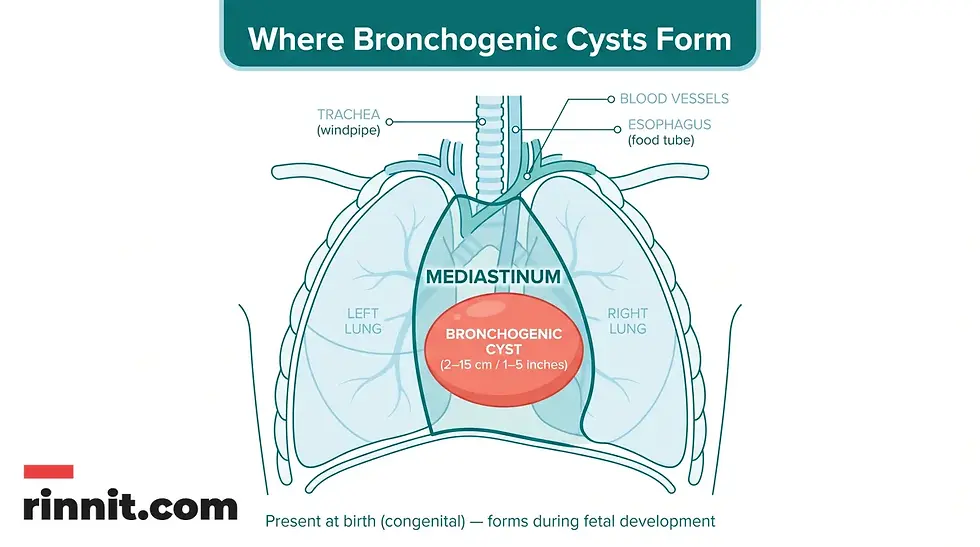
A bronchogenic cyst is a congenital abnormal tissue growth in the mediastinum, the chest area that separates the lungs [1]. Many are found by accident on imaging, and symptoms usually appear only when the cyst presses on the trachea or esophagus [1]. Cysts measure between 2 and 15 centimeters [1]. Treatment is often surgery, which lowers the risk of infection or cancer [1].
What the research says
Surgery to remove a mediastinal bronchogenic cyst was safe in an adult series, and the camera-assisted approach meant a shorter hospital stay. Among 38 adults, 76.3% had symptoms before surgery, there were no operative deaths, and 3 patients (7.9%) had postoperative complications. The average hospital stay was 3.2 days after VATS and 5.8 days after thoracotomy, and there were no recurrences over 1 to 8 years of follow-up (Kabiri et al., Port J Card Thorac Vasc Surg, 2022) [6].
Experts agree that symptomatic cysts should be removed, but the best plan for cysts without symptoms is still debated. A review noted that congenital lung malformations, including bronchogenic cysts, occur in about 4 of every 10,000 live births. Resection reduces the risk of infections and a collapsed lung and avoids the malignancy risk linked to bronchogenic cysts, though some surgeons favor watchful waiting because the true rate of malignancy is unknown (Pederiva et al., Nat Rev Dis Primers, 2023) [7].
Camera-assisted lung surgery in babies carries real, but mostly manageable, risks. In a systematic review of 9 case series covering 135 neonates and infants (treated for several lung conditions, including bronchogenic cysts), complications occurred in 14 patients (10.4%) and 11 cases (8.1%) needed conversion to open surgery. There were no deaths related to the technique (Zoeller et al., Eur J Pediatr Surg, 2018) [8].
What Is a Bronchogenic Cyst?
A bronchogenic cyst is an abnormal growth of tissue that forms in the mediastinum — the area of the chest cavity that separates the lungs. It is one type of mediastinal tumor, a growth that develops in the mediastinum, the space within the chest that holds certain blood vessels and organs such as the esophagus and trachea [1].
Bronchogenic cysts are congenital, which means you are born with them. They form during fetal development, though experts do not know exactly why they form [1].
You can have a bronchogenic cyst without having any symptoms at all. Providers often detect them during routine imaging tests. In fact, most people are in their 30s or 40s before a cyst grows large enough to cause symptoms [1], so learning you have one can come as an unwelcome surprise.
These cysts can range from 2 to 15 centimeters (about 1 to 5 inches) in diameter [1]. When a cyst gets large enough, it can make it hard to breathe.
What Are the Symptoms of Bronchogenic Cysts?
Because the cyst sits near the breathing tube and the food pipe, symptoms appear when the cyst pushes on them. Bronchogenic cyst symptoms may include the following.
Symptom | What it looks like |
Cough | A persistent cough that doesn't go away |
Dysphagia | Difficulty swallowing |
Fever | A raised temperature, often a sign of infection |
Hoarseness | A raspy or strained voice |
Tachypnea | Quick, shallow breathing |
Wheezing | A whistling sound when you breathe |

You can have bronchogenic cyst symptoms at any age. But you may not have symptoms unless the cyst puts pressure on your trachea (the windpipe) or your esophagus (the food tube). You may also develop symptoms if the cyst becomes infected [1].
What Causes Bronchogenic Cysts?
Bronchogenic cysts form during fetal development — that is, before you are born. The cyst is simply abnormal tissue that grew in the wrong place while the fetus developed. Experts don't know why the cysts form [1], and no behavior, habit, or exposure during pregnancy is known to cause them.
What Are the Complications of Bronchogenic Cysts?
A bronchogenic cyst can affect your ability to breathe or swallow, and it can become infected. But the most serious complication is if a cyst becomes cancerous [1]. That cancer risk is the main reason providers often recommend removing a cyst even when symptoms are mild.
Complication | What happens |
Breathing problems | The cyst presses on the trachea or airway |
Swallowing problems | The cyst presses on the esophagus |
Infection | The cyst becomes infected and can cause fever and cough |
Cancer | In the most serious cases, a cyst becomes cancerous |
How Are Bronchogenic Cysts Diagnosed?
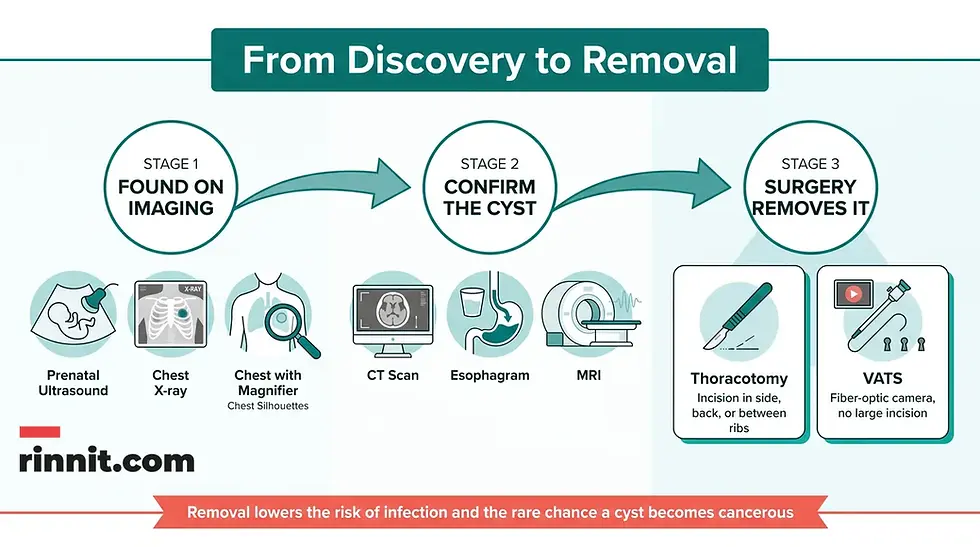
Bronchogenic cysts often show up during routine imaging tests. For example, a prenatal ultrasound may detect a bronchogenic cyst while a baby is still in the womb. The cyst may also show up on chest X-rays taken as part of a routine exam [1].
If an imaging test finds a cyst, what happens next depends on the situation. During pregnancy, an obstetrician will monitor the cyst throughout fetal development. If tests show you or your child has a cyst, a provider may order the following.
Test | What it does |
CT scan | Uses X-rays and a computer to make detailed images of the mediastinum |
Esophagram | Combines a series of X-rays after you swallow a contrast fluid, giving a detailed look at the esophagus |
MRI | Produces more detailed images of the mediastinum than X-ray-based tests |
How Is a Bronchogenic Cyst Treated?
Your healthcare provider may recommend surgery to remove a bronchogenic cyst, because removing it reduces the risk of complications [1]. But the plan depends on who has the cyst.
What happens if a cyst is found during pregnancy?
The obstetrician will monitor the cyst. If it is very large, they may perform a procedure in utero — before birth — to drain fluid from it [1]. Draining the fluid can help reduce the risk that the cyst will press on the fetus' heart.
Sometimes a cyst grows large enough to block a fetus's airway. This doesn't happen often, but if it does, the obstetrician may recommend an EXIT procedure instead of a vaginal delivery or C-section. EXIT stands for ex-utero intrapartum treatment. You receive anesthesia first. The surgeon makes a cut in the uterus to lift the fetus's head, neck, and torso through the incision. While the fetus still receives oxygen through the umbilical cord, the surgeon removes the cyst [1]. Then the umbilical cord is cut, and the baby is delivered through the same incision.
Do newborns always need treatment?
No. A newborn may not need treatment [1]. Instead, the pediatrician watches for symptoms that might mean the baby has a bronchogenic cyst, checking on the baby's overall health during well-baby care visits.
How are cysts treated in infants, children, and adults?
A provider may recommend one of two surgical options.
Procedure | How it works |
Thoracotomy | The surgeon makes an incision in the side, back, or between the ribs to reach and remove the cyst |
VATS (video-assisted thoracic surgery) | A thoracoscope — a fiber-optic camera — locates the cyst so it can be removed without a large incision |
What are the risks of surgery?
Surgery to remove a bronchogenic cyst may cause the following complications, which can differ depending on the type of surgery.
Complication | Details |
Arrhythmia | Abnormal heart rhythms; adults may experience this |
Blood clots and strokes | Affect adults more frequently than infants and children |
Bruising | Surface bruising around the surgical site |
Collapsed lung or atelectasis | Pneumothorax, or air sacs that don't properly inflate |
Damage to nearby structures | Nearby glands, organs, nerves, or blood vessels may be injured |
Hemorrhage | Bleeding, including internal bleeding |
Hypoxemia | Low blood oxygen |
Post-thoracotomy pain syndrome | Pain that persists months after the surgery |
Respiratory problems | Such as pneumonia |
Surgical site infection | Infection at the area of the incision |
Your surgeon will discuss potential complications before the surgery.
What Can I Expect if I Have a Bronchogenic Cyst?
Your healthcare provider will order periodic imaging tests to check on the cyst. If a cyst grows large enough to affect your or your child's health, the provider will recommend surgery to remove it [1].
Can Bronchogenic Cysts Be Prevented?
No, there is no way to prevent them. Bronchogenic cysts happen during fetal development [1], before you have any control over them.
When Should I See My Healthcare Provider?
Contact a healthcare provider if you or your child develops symptoms such as hoarseness that doesn't go away, difficulty swallowing, or trouble breathing [1]. The provider will order tests to see whether a bronchogenic cyst is causing the symptoms.
Go to the ER if: breathing trouble becomes severe or suddenly worsens, the chest feels tight or painful, or the child struggles to breathe. A cyst blocking the airway is a medical emergency.
Conclusion
A bronchogenic cyst is a tissue growth you are born with, sitting in the space between the lungs. Many people live with one for years without noticing, but because cysts can grow, become infected, or — most seriously — turn cancerous, it is worth getting persistent hoarseness, swallowing difficulty, or breathing trouble checked. If a cyst is confirmed, imaging pinpoints it, and modern surgery removes it and lowers the risk of future complications [1].
Learn more about chest and lung conditions at Rinnit.com.
Frequently Asked Questions
What is a bronchogenic cyst?
A bronchogenic cyst is an abnormal tissue growth that forms in the mediastinum, the area of the chest cavity that separates the lungs and holds the esophagus, trachea, and blood vessels. You are born with it.
Can you have a bronchogenic cyst without symptoms?
Yes. Many cysts are discovered on routine imaging and cause no symptoms unless they grow large enough to press on the trachea or esophagus.
At what age do symptoms usually appear?
Most people are in their 30s or 40s when a cyst grows large enough to cause symptoms, though symptoms can occur at any age.
How large can a bronchogenic cyst get?
Bronchogenic cysts may be 2 to 15 centimeters (about 1 to 5 inches) in diameter.
Are bronchogenic cysts cancerous?
Not usually, but the most serious complication is a cyst becoming cancerous, which is one reason providers often recommend surgical removal.
What causes bronchogenic cysts?
Bronchogenic cysts form during fetal development. Experts don't know why they form.
Can bronchogenic cysts be prevented?
No. They happen during fetal development, so there is no way to prevent them.
How are bronchogenic cysts diagnosed?
Bronchogenic cysts often show up on routine imaging such as prenatal ultrasound or chest X-rays. Providers may also order CT scans, esophagrams, or MRIs for detailed images of the mediastinum.
What are the symptoms of bronchogenic cysts?
Symptoms may include cough, dysphagia (difficulty swallowing), fever, hoarseness, tachypnea (quick shallow breathing), and wheezing.
What symptoms mean I should call a doctor?
Contact a provider if you or your child develops hoarseness that doesn't go away, difficulty swallowing, or trouble breathing.
How is a bronchogenic cyst treated?
Healthcare providers often recommend surgery to remove the cyst, which reduces the risk of complications such as infection or cancer.
What is the difference between a thoracotomy and VATS?
In a thoracotomy, the surgeon cuts in the side, back, or between the ribs to reach the cyst. In VATS (video-assisted thoracic surgery), a fiber-optic camera locates the cyst so it can be removed without a large incision.
Can a cyst be treated before a baby is born?
Yes. If a cyst is very large, an obstetrician may drain fluid from it in utero. If a cyst blocks the fetus's airway, an EXIT procedure may be used to remove it during delivery while the baby still receives oxygen through the umbilical cord.
Do newborns with bronchogenic cysts need surgery?
Not always. A newborn may need no treatment, with a pediatrician monitoring for symptoms during well-baby visits.
What are the risks of bronchogenic cyst surgery?
Risks include arrhythmia, blood clots, strokes, bruising, collapsed lung, atelectasis, damage to nearby organs or nerves, hemorrhage, hypoxemia, post-thoracotomy pain syndrome, pneumonia, and surgical site infection.
Related Reading
Explore more chest, lung, and airway health guides on Rinnit.com:
References
Cleveland Clinic. Bronchogenic Cysts. Cleveland Clinic. November 5, 2024. https://my.clevelandclinic.org/health/diseases/22107-bronchogenic-cysts
Almatrafi S. Intramural Bronchogenic Cysts in the Pediatric Population. Cureus. 2020;12(2):e7111. PMID 32257658. https://doi.org/10.7759/cureus.7111
Gross DJ, et al. Bronchogenic cysts: a narrative review. Mediastinum. 2023;7:26. PMID 37701638. https://doi.org/10.21037/med-22-46
Rahman NM. Mediastinal Masses. Merck Manual Professional Edition. July 2025. https://www.merckmanuals.com/professional/pulmonary-disorders/mediastinal-and-pleural-disorders/mediastinal-masses
Singer C, et al. Bronchogenic Cyst in Infants-Clinical and Histopathological Features. Current Health Sciences Journal. 2022;48(1):135-140. PMID 35911936. https://doi.org/10.12865/CHSJ.48.01.20
Kabiri EH, et al. Mediastinal Bronchogenic Cysts Resection in Adults: Results of Vats and Thoracotomy Procedures. Portuguese Journal of Cardiac Thoracic and Vascular Surgery. 2022;29(3):35-39. PMID 36197827. https://doi.org/10.48729/pjctvs.246
Pederiva F, et al. Congenital lung malformations. Nature Reviews Disease Primers. 2023;9(1):60. PMID 37919294. https://doi.org/10.1038/s41572-023-00470-1
Zoeller C, et al. Perioperative Complications of Video-Assisted Thoracoscopic Pulmonary Procedures in Neonates and Infants. European Journal of Pediatric Surgery. 2018;28(2):163-170. PMID 29510429. https://doi.org/10.1055/s-0038-1636917
Medical disclaimer
This article is for general informational purposes only and is not a substitute for professional medical advice, diagnosis, or treatment. Always consult a qualified healthcare provider with questions about a medical condition, including bronchogenic cysts and their treatment options. Never ignore professional medical advice or delay seeking it because of something you have read here. If you or your child has signs of a blocked airway — trouble breathing, chest pain, or severe respiratory distress — seek emergency medical care immediately.



Comments