Broken Hand: Symptoms, Causes, and Treatment

Updated: 3 days ago
Medically reviewed by Dr. Baraa Alnahhal, MD · Last reviewed: October 2026

Quick answer
A broken hand is an injury in which one or more hand bones break or crack. It causes severe pain that worsens with gripping, swelling, bruising and sometimes a crooked finger. Numbness, trouble moving the fingers or skin color change is an emergency. Treatment includes immobilization with a cast or splint and sometimes surgery. [1] [2]
What the research says
According to PubMed:
Hand fractures are very common, and most closed ones are treated without surgery. A review reported that finger and metacarpal fractures are the most common upper-limb fracture type, with an incidence of 114 to 1,483 per 100,000 people per year; surgery is advisable for comminuted fractures and those with torsional malposition, axis deviation, shortening, or joint involvement, and postsurgical complication rates were 32% to 36%. (Cavalcanti Kussmaul et al., DOI).
Moving early helps prevent stiffness. A review of metacarpal fractures noted that the majority are managed non-operatively and that early mobilization, especially after open reduction and internal fixation, is a critical part of treatment to prevent stiffness and restore function. (Lambi et al., DOI).
The evidence on the best treatment is still thin. A systematic review of metacarpal shaft fractures in adults identified 1,600 records, only 7 of which met the criteria; none was a randomized trial comparing surgery with nonsurgical treatment, so high-quality evidence to guide treatment is lacking. (Taha et al., DOI).
Study details are from PubMed abstracts.
What is a broken hand?
A broken hand occurs when one or more of the bones of the hand break or crack. A break or crack in one of the bones in the hand is called a metacarpal fracture. A break or crack in one of the bones in the fingers is called a phalangeal fracture [1].
When falling, people reach out their hands to catch themselves. This movement is instinctive, and it can lead to a break. A direct blow to the hand may also cause a break. And a motor vehicle crash can break hand bones, sometimes into many pieces. This type of injury often requires surgical repair [1].
The hand is made up of bones called metacarpals and phalanges. Each finger consists of one metacarpal bone and three phalanges. The thumb consists of one metacarpal bone and two phalanges [1].
Key fact | What it means |
What it is | One or more of the bones in the hand break or crack, called a fracture [1] |
Who gets it | Anyone, with higher risk in contact sports and with osteoporosis [1] |
Most common causes | Falls, sports injuries, and motor vehicle crashes [1] |
Typical diagnosis | Physical exam plus X-rays, with CT or MRI for more detail [2] |
Typical treatment | Pain relief, cast or splint immobilization, and surgery if needed [2] |
First step |
It is important to treat a broken hand right away. If not treated, the bones may not heal correctly. This makes everyday tasks, such as writing or buttoning a shirt, difficult. Early treatment also helps lessen pain and stiffness [1].
What are the symptoms of a broken hand?
Common symptoms of a broken hand include severe pain that may worsen when gripping or squeezing or moving the hand or wrist, swelling, tenderness, and bruising [1].
An obvious deformity, such as a crooked finger, may appear. You may also notice stiffness or an inability to move the fingers or thumb, or numbness in the hand or fingers [1].
Symptom | What you notice |
Pain | Severe pain, often worse when gripping, squeezing, or moving the hand or wrist [1] |
Swelling and tenderness | The hand looks puffy and is sore to the touch [1] |
Bruising | Discoloration around the injured area [1] |
Deformity | An obvious change in shape, such as a crooked finger [1] |
Stiffness | Trouble moving the fingers or thumb [1] |
Numbness | Loss of feeling in the hand or fingers [1] |

What causes a broken hand?
A strong impact or crushing injury can break any of the bones in the hands. Common causes include falls, sports injuries, and motor vehicle crashes [1].
Falls. Falling on an outstretched hand is one of the most common causes of a broken hand [1].
Sports injuries. Fractures often occur during contact sports or activities where falling on an outstretched hand is likely. These include activities such as pickleball, snowboarding, and in-line skating [1].
Motor vehicle crashes. Car crashes can cause severe fractures, sometimes breaking bones into multiple pieces and requiring surgery to repair [1].
What are the risk factors for a broken hand?
Participating in certain sports increases the risk of breaking bones in a hand. Football and hockey are examples of higher-risk sports [1].
Having a condition that weakens bones, called osteoporosis, also makes fractures more likely [1].
What complications can a broken hand cause?
Complications of a broken hand are rare, but they include ongoing stiffness, aching, or limited movement, osteoarthritis, and nerve or blood vessel damage [1].
While discomfort typically improves after a cast is removed or surgery is completed, some people have lasting pain or stiffness. Be patient with recovery. Talk to a healthcare professional about exercises or a referral to physical or occupational therapy [1].
Fractures that extend into the joint can cause arthritis years later. If the hand starts to hurt or swell long after a break, contact a healthcare professional [1].
A hand injury can affect nearby nerves and blood vessels. If there is numbness, swelling, or a change in the color of the skin, seek emergency medical care [1].
When should you seek care for a broken hand?
If you think you might have a broken hand, see a healthcare professional right away. If you have numbness, swelling, or trouble moving your fingers, seek medical care right away. Delaying diagnosis and treatment can lead to poor healing, reduced range of motion, and weaker grip strength [1].
How is a broken hand diagnosed?
Diagnosing a broken hand typically involves a physical exam of the injured area and X-rays [2].
Sometimes additional imaging tests can give more detail. A CT scan can detect hand fractures that X-rays may miss. It also helps identify injuries to soft tissues and blood vessels by combining multiple X-ray images to create detailed cross-sectional views of the injured area [2].
An MRI uses radio waves and a strong magnetic field to produce highly detailed images of bones and soft tissues. An MRI is much more sensitive than an X-ray and can detect tiny fractures and ligament injuries [2].
Test | What it shows |
Physical exam | The injured area is checked for pain, swelling, and deformity [2] |
X-ray | The first test used to look for broken bones [2] |
CT scan | Detailed cross-sectional views; finds fractures X-rays may miss [2] |
MRI | Highly detailed images of bones and soft tissues; detects tiny fractures [2] |
What are the treatment options for a broken hand?
Treatments for a broken hand vary depending on how the bone broke and whether the pieces line up. Whatever the treatment, it is important to move the fingers regularly while healing to prevent stiffness. Ask a healthcare professional about the best ways to move them. If you smoke, quitting helps, because smoking can delay or prevent bone healing [2].
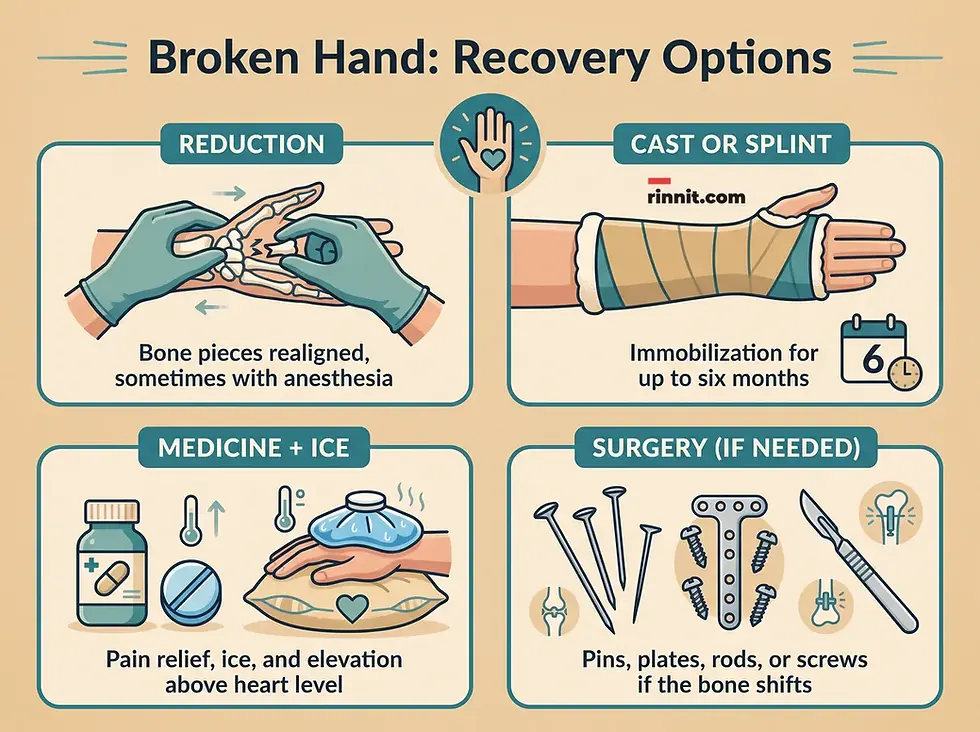
Reduction
If the broken bone ends are not aligned, there may be gaps between the pieces of bone or overlapping fragments. To correct this, a healthcare professional does a procedure called a reduction. A reduction repositions the bone pieces so they have the best chance to heal well [2].
Depending on the level of pain and swelling, anesthesia may be needed. Local anesthesia numbs a specific area of the body — you do not feel pain, but you remain alert and awake. General anesthesia puts you into a deep sleep. Often, a reduction may be done during surgery [2].
Immobilization
Limiting movement in a broken hand is called immobilization. Whether the treatment is surgical or nonsurgical, a cast or splint may be needed for up to six months for proper healing. To reduce pain and swelling, you will also be advised to keep the hand elevated above heart level as much as possible [2].
Medicines
To manage pain, a healthcare professional may recommend a pain reliever available without a prescription. For more severe pain, an opioid medicine may be prescribed [2].
Nonsteroidal anti-inflammatory drugs, also called NSAIDs, can help with pain relief but may slow bone healing, especially with long-term use. Talk to a healthcare professional before taking NSAIDs [2].
If there is an open fracture, an antibiotic will likely be given to prevent infection from reaching the bone. An open fracture happens when the bone breaks through the skin or when there is a wound near the fracture [2].
Therapy
After a cast or splint is removed, rehabilitation exercises or physical therapy will likely be needed to improve flexibility and restore movement in the hand. While rehab can help, full recovery may take several months or longer [2].
Surgical and other procedures
If immobilization is not an option, surgery may be needed to implant pins, plates, rods, or screws to hold the bones in place while they heal. A bone graft may also be used to help healing. These options may be needed for an open fracture, an unstable or displaced fracture, loose bone fragments that could enter a joint, damage to surrounding ligaments, nerves, or blood vessels, or fractures that extend into a joint [2].
Even after reduction and immobilization with a cast or splint, bones can shift. A healthcare professional will likely monitor progress with X-rays. If the bones move, surgery may be needed [2].
Treatment | What it involves |
Reduction | Bone pieces repositioned, sometimes with anesthesia or during surgery [2] |
Cast or splint | Immobilization for up to six months [2] |
Elevation and ice | Hand kept above heart level to reduce pain and swelling [2] |
Pain relief | Over-the-counter pain relievers; opioids for severe pain [2] |
Antibiotics | For open fractures to prevent infection [2] |
Therapy | Rehab exercises or physical therapy after the cast comes off [2] |
Surgery | Pins, plates, rods, screws, or a bone graft for severe breaks [2] |
How can you prevent a broken hand?
You cannot always prevent unexpected events that lead to a broken hand, but these steps may help reduce the risk [1].
To build strong bones, eat a nutritious diet with enough calcium and vitamin D, get plenty of weight-bearing exercise such as brisk walking, and quit smoking if you smoke [1].
To help prevent falls, wear sensible shoes, remove things you can trip over in the home such as throw rugs, and light up your living space. Have your vision checked and, if needed, corrected. Install grab bars in the bathroom, install handrails on stairways, and avoid slippery surfaces, if possible, such as walkways covered with snow or ice [1].
Prevention step | How it helps |
Calcium and vitamin D | Builds and maintains strong bones [1] |
Weight-bearing exercise | Brisk walking and similar activity strengthen bone [1] |
Quit smoking | |
Fall-proof the home | Grab bars, handrails, good lighting, and clear floors [1] |
Check your vision | Better vision means fewer trips and falls [1] |
How should you prepare for a broken hand appointment?
If you have a broken hand, you may first seek treatment in an emergency room or urgent care clinic. If the broken bones are not properly aligned for healing with immobilization, you may be referred to a specialist who treats bone and joint conditions, called an orthopedic surgeon [2].
What you can do. Write a list that includes a description of your symptoms and how, where, and when the injury occurred; information about your family's and your medical histories; all the medicines and dietary supplements you take, including doses; and questions you want to ask [2].
Questions to ask include: What tests do I need? What is the best course of action? Will I need surgery? Will I need to wear a cast, and if so, for how long? Will I need physical therapy when the cast comes off? Are there restrictions that I need to follow? Should I see a specialist [2]?
What to expect from your healthcare professional. Questions may include: What is your occupation? Was your wrist or hand bent backward or forward when the injury occurred? Are you right-handed or left-handed? Where does it hurt, and do certain movements make it hurt more or less? Have you had previous hand or wrist injuries or surgery [2]?
Conclusion
A broken hand is a painful but highly treatable injury. It most often comes from a fall on an outstretched hand, a sports injury, or a car crash. Severe pain, swelling, bruising, a crooked finger, or numbness are the signs to watch for.
Early care matters. Getting a diagnosis and treatment quickly gives the bones the best chance to heal in the right position, protecting grip strength and the ability to do everyday tasks. Treatment may range from a cast or splint to surgery, and full recovery can take several months.
Next steps: Keep the hand elevated, avoid gripping or squeezing, and see a healthcare professional right away — especially if there is numbness, swelling, or trouble moving the fingers.
Frequently asked questions
What does a broken hand feel like?
A broken hand typically causes severe pain that worsens when gripping, squeezing, or moving the hand or wrist, along with swelling, tenderness, bruising, stiffness, and sometimes a crooked finger or numbness [1].
How do I know if my hand is broken or just sprained?
Only an exam and X-rays can confirm a break. Pain, swelling, and bruising happen with both injuries, but a crooked finger, numbness, or an inability to move the fingers points more strongly toward a fracture [1] [2].
Can you still move your fingers with a broken hand?
Sometimes. Stiffness or an inability to move the fingers or thumb is common, but some people can still move them even with a fracture, which is why an X-ray is important [1] [2].
How long does it take for a broken hand to heal?
A cast or splint may be needed for up to six months for proper healing, and full recovery — including therapy after the cast comes off — may take several months or longer [2].
What happens if a broken hand is not treated?
Untreated breaks may not heal correctly, leading to poor healing, reduced range of motion, weaker grip strength, and difficulty with everyday tasks such as writing or buttoning a shirt [1].
This article is for general education and is not a substitute for professional medical advice, diagnosis, or treatment. Always consult a qualified healthcare professional about your individual situation.
References
Mayo Clinic Staff. Broken hand - Symptoms & causes. Mayo Clinic. September 15, 2025. https://www.mayoclinic.org/diseases-conditions/broken-hand/symptoms-causes/syc-20450240
Mayo Clinic Staff. Broken hand - Diagnosis & treatment. Mayo Clinic. September 15, 2025. https://www.mayoclinic.org/diseases-conditions/broken-hand/diagnosis-treatment/drc-20450277
Cleveland Clinic. Broken Hand. Cleveland Clinic. Last updated November 16, 2023. https://my.clevelandclinic.org/health/diseases/broken-hand
American Academy of Orthopaedic Surgeons. Scaphoid Fracture of the Wrist. OrthoInfo. Accessed October 15, 2026. https://www.orthoinfo.org/diseases--conditions/scaphoid-fracture-of-the-wrist/
Cavalcanti Kussmaul A, et al. The Treatment of Closed Finger and Metacarpal Fractures. Dtsch Arztebl Int. 2023;120(50):855-862. PMID 37963039. https://doi.org/10.3238/arztebl.m2023.0226
Lambi AG, et al. Metacarpal fractures. J Hand Surg Eur Vol. 2023;48(2_suppl):42S-50S. PMID 37704027. https://doi.org/10.1177/17531934231184119
Taha RHM, et al. A Systematic Review of Treatment Interventions for Metacarpal Shaft Fractures in Adults. Hand (N Y). 2022;17(5):869-878. PMID 33252278. https://doi.org/10.1177/1558944720974363



Comments