Black Lung Disease: The Miners' Condition That Turns Lungs Black Over Years — and What Treatment Can (and Can't) Fix

Updated: 3 days ago
Medically reviewed by Dr. Baraa Alnahhal, MD. Last reviewed October 13, 2026. This content is for educational purposes and is not medical advice.

Quick Answer
Black lung disease is inflammation and scarring (fibrosis) of the lungs caused by inhaling coal dust; about 16% of coal workers have it, and rates are increasing [1]. It often causes no early symptoms, then chest tightness, shortness of breath and a cough that may bring up black mucus [1]. There is no cure except lung transplant [1], but treatments help.
What the research says
The most severe form of black lung disease has made a comeback among U.S. coal miners. Among miners who filed federal black lung benefit claims, cases of progressive massive fibrosis fell to a low of 18 (0.6% of claimants) in 1988, then climbed to 353 cases (8.3% of claimants) in 2014. In Virginia, more than 17% of claimants received this determination in 2009 (Almberg et al., Ann Am Thorac Soc, 2018) [6].
Silica in the dust appears to play a growing role. Among 322 autopsy cases of progressive massive fibrosis, 43% were coal-type, 40% were mixed-type, and 17% were silica-type. The rates of coal-type and mixed-type disease declined in later birth cohorts, but the rate of silica-type disease did not (Go et al., Occup Environ Med, 2023) [7].
The disease can move quickly, which is why regular check-ups matter. Among 163 miners with a normal first chest X-ray who later developed progressive massive fibrosis, 27 (17%) progressed in less than 10 years. The authors recommended that working miners join X-ray surveillance at 5-year intervals (Laney et al., Occup Environ Med, 2017) [8].
What Is Black Lung Disease?
Black lung disease — also known as coal workers' pneumoconiosis (pronounced "new-moe-koh-knee-o-sis") or coal miners' lung — is inflammation (swelling and irritation) and fibrosis (thickening or scarring) in lung tissue brought about by inhaling dust particles in and around coal mines [1].
Many workplaces have occupational hazards. But unlike falling off a ladder, you won't feel black lung disease right away. It might be years after breathing in coal dust before you notice symptoms [1] [2]. Those tiny dust particles — and the irritation they cause — scar your lungs and lead to breathing problems.
There are two types of coal workers' pneumoconiosis, depending on how much dust you inhaled and how long you worked in the coal mine. Both affect your breathing.
Type | What happens in the lungs | What it means for you |
Simple | A little scarring that looks like small black spots on a chest X-ray or CT scan | Follow your provider's medication instructions, avoid further coal dust, get regular check-ups and lung imaging — the earlier it's found, the better |
Complicated | Severe scarring that covers more of the lung (also called progressive massive fibrosis) | The scarring can't be fixed, but treatments can help you feel better |
How Common Is Black Lung Disease?
Black lung disease is a form of interstitial lung disease, which itself is rare. But only people who work in coal mines develop black lung disease — and among coal miners, it is somewhat common.
Even after decades of knowing that coal mine dust can cause disease, black lung disease still affects about 16% of coal workers — roughly 1 in 6 [1]. And these rates are increasing [1].
What Are the Symptoms of Black Lung Disease?
Black lung disease symptoms may not appear until years after exposure, and they can include chest tightness, shortness of breath and a cough that may bring up black mucus [1]. At first, you might not have any symptoms at all. But with coal workers' pneumoconiosis, symptoms may get worse over time.
Symptoms include tightness in your chest, difficulty exercising, and feeling short of breath — sometimes even during routine tasks that never made you tired before. A cough that's sometimes productive can also occur, meaning you may cough up black mucus [1].

On a physical exam, your healthcare provider might hear wheezing or crackling when you breathe [1]. Although you can't see that your lungs are black, imaging reveals specific markers that tell your provider it's black lung and not another form of pulmonary disease.
What Causes Black Lung Disease?
You can't always see the particles you're inhaling. The tiny specs of dust in coal mines contain carbon, and depending on where your mine is and what types of rock you're drilling through, the dust may also contain silica [1].
When you take a breath in a coal mine, these small particles of dust can travel all the way to your lungs. Your immune system recognizes them as invaders (foreign bodies) and tries to get rid of them. This immune reaction leads to inflammation and scarring [1] — and eventually, the symptoms of black lung disease.
Does Weed Make Your Lungs Black?
Smoking any substance is bad for your lungs — whether you're smoking marijuana (weed or cannabis), cigarettes, or cigars. When you smoke, you inhale particles that contain toxins, irritants, and carcinogens into your airways.
Smoking can cause your lungs to scar and puts you at greater risk of breathing problems like chronic cough, bronchitis, COPD, and lung cancer. But it does not cause black lung disease [1]. Only coal causes this particular form of lung disease.
Does Vaping Make Your Lungs Black?
Just like smoking, vaping causes lung damage but doesn't make your lungs black. That said, vaping — and smoking — can make the symptoms of black lung disease worse [1].
Vaping carries unique risks. You use a vape pen (or e-cigarette) to heat a liquid into a vapor that you breathe in. The particles you inhale cause a similar immune reaction in your lungs, but it's not called black lung disease. It can cause lung scarring, organ damage, and a serious condition called e-cigarette or vaping use-associated lung injury (EVALI) [1].
Is Black Lung Disease Contagious?
Black lung disease isn't contagious. You can't catch it or give it to someone else. It's also not inherited or genetic [1]. The only way to get black lung disease is to mine coal.
Is It Viral or Bacterial?
Although you'll eventually feel sick from black lung disease, it's not a viral or bacterial infection. Just as your body responds to foreign invaders like viruses and bacteria, your immune system is activated by the particles you've inhaled in the coal mine. At first, this immune response might feel like you have a common cold or flu.
What Are the Complications?
Complications of black lung disease include tuberculosis (TB), heart failure, and lung cancer [1].
How Is Coal Workers' Pneumoconiosis Diagnosed?
If you're having problems breathing, your healthcare provider will ask about your medical history and your occupational (work) history. They'll conduct a physical exam and, if needed, perform medical tests.
Step | What happens |
History | Your provider asks about your medical history and work (occupational) history |
Physical exam | The provider listens for wheezing or crackling when you breathe |
Chest X-ray or CT scan | Shows possible black lung disease — small black spots from scarring |
Pulmonary function tests | Measure how well your lungs work and how the disease affects them; repeated later to check if treatment is working or the condition is worsening |
Arterial blood gas | A special blood test to see whether your oxygen levels are low; if you're being evaluated for black lung benefits, it may be done twice — once resting and once after exercising as hard as you can |
What Is the 413b Examination?
To qualify for black lung benefits, miners need to undergo a special test called the 413b examination — an examination and testing done by doctors specially trained in testing coal miners [1]. Disability in the United States is a legal issue, and the key question is whether you can perform the tasks you used to do when you worked as a coal miner. Your provider will need to report how much black lung disease you have, what your symptoms are, and how well they can be managed with medications.
How Is Black Lung Disease Treated?
Treatments for black lung disease aim to make you feel better, but they won't cure the condition — aside from a lung transplant, which may cure black lung disease [1].
Treatment | What it does |
Restricting coal exposure | Stops new dust from adding to the scarring |
Quitting smoking and vaping | Avoids further lung irritation |
Staying up to date on vaccines | Protects against infections that can aggravate the condition |
Bronchodilators | Medications that keep your airways open and soothe inflammation |
Pulmonary rehabilitation | Structured exercise and breathing training to improve daily function |
Oxygen | Helps when your blood oxygen levels are low |
Can I Prevent Black Lung Disease?
Yes — black lung disease is preventable. The U.S. Occupational Safety and Health Administration (OSHA) has standards to help prevent it [1].
If you're working in or around coal mines, the organization you work for should put into place methods to decrease the amount of coal mine dust in the area and improve the airflow where you're working. If you can, wearing a fit-tested mask — one that's been checked to make sure it protects you from dust — can help [1].
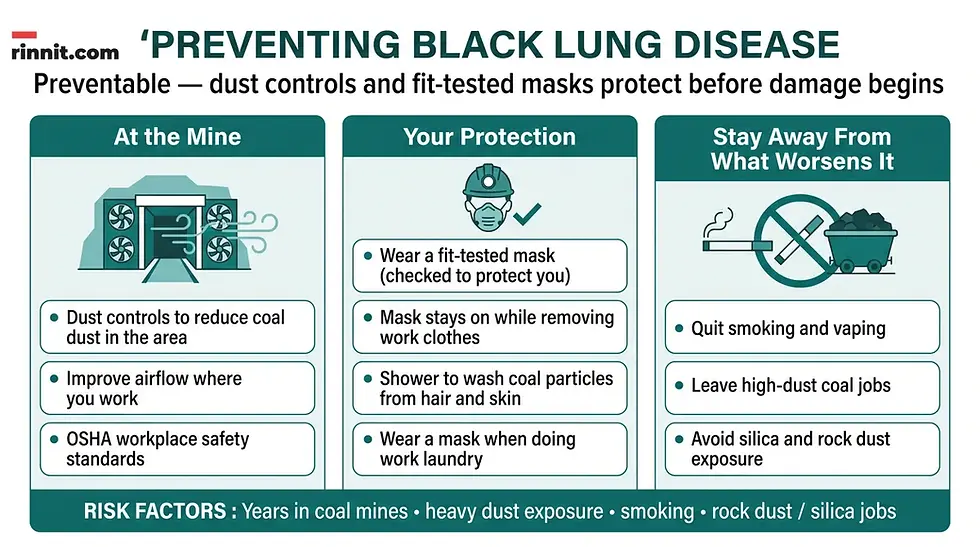
After work, keep that mask on while you remove your work clothes. You can remove your mask to take a shower, washing any coal particles from your hair and skin [1]. You may also want to wear a face mask when you do your work laundry.
What Are the Risk Factors?
The biggest risk factor is working in coal mines. You're at increased risk if you work (or worked) in coal mines and smoke, were exposed to a lot of dust on the job, worked in the coal mines for many years, or worked jobs in the mine where you were exposed to lots of rock dust or high levels of silica [1].
How Do I Take Care of Myself With Black Lung Disease?
If you have black lung disease, you'll want to limit exposure to anything that can further irritate your lungs. That starts with quitting smoking [1] — it's critical for your current and future health, even though it's not easy. Ask your provider about support to help you quit, and avoid environments where you might be exposed to secondhand smoke.
Staying away from the coal mine matters too: breathing in more coal and silica particles will worsen your condition.
Watch the air quality index (AQI) that's usually reported with the weather forecast. If the AQI is "unhealthy for sensitive groups" or worse, try to stay inside — or wear a face mask if you go out — until it improves [1].
Prevent infections, because a respiratory infection can aggravate your condition. Stay up to date on influenza, pneumococcal pneumonia, and COVID-19 vaccines [1] [4], and consider wearing a face mask in public during cold and flu season.
Exercise, but do so carefully. Talk with your provider about what exercises you can do, how hard to push yourself, and how to know when you're overdoing it.
Finally, plan for flare-ups. Nobody wants to think about feeling bad when they're feeling fine. But developing a plan for how you'll manage flare-ups means everything is in place so you're not scrambling to find medical care when you're not feeling your best.
When Should I See My Healthcare Provider?
Your healthcare provider will want to see you for regular check-ups. They're also the best person to ask about when and where you should seek care. Helpful questions to bring to your next visit include:
Question | Why it matters |
How severe is my condition? | Frames how aggressive your care plan needs to be |
What medications do I need? Do they have side effects? | Keeps you safe and comfortable on treatment |
Is there a way for me to exercise safely? | Protects your lungs while keeping you active |
How often do I need check-ups? | Makes sure the disease is monitored, not forgotten |
What should I do if I have a flare-up? | So you have a plan before you need it |
Do I need a lung transplant? | For advanced cases, the only cure on the table |
When Should I Go to the ER?
Medical emergency: Seek emergency medical care if you have new or more trouble breathing, or if your lips, hands, or feet turn blue (cyanosis) [1].
Is Black Lung Disease the Same as Tuberculosis?
No. Tuberculosis (TB) is an infection caused by the bacterium Mycobacterium tuberculosis. It's contagious (though it doesn't spread very easily in most people), while black lung disease is not an infection at all.
Having black lung disease does put you at higher risk of developing TB [1], because your immune system is weakened. Some symptoms of TB and black lung disease overlap — cough, chest pain, and coughing up sputum. But if you have black lung disease without TB, you won't likely have a fever or night sweats [1].
What is the bottom line on black lung disease?
Black lung disease is a miners' disease, full stop — only coal dust causes it, it can't be caught or inherited, and roughly 1 in 6 coal workers still develops it [1]. The scarring it leaves is permanent and there is no cure short of a lung transplant [1], but that doesn't mean nothing helps. Bronchodilators open the airways, oxygen compensates when blood levels drop, pulmonary rehabilitation rebuilds daily function [4], and vaccines and a smoke-free life keep infections from piling on. The real victory, though, is prevention: workplace dust controls, fit-tested masks, and careful decontamination after shifts keep the dust out of the lungs that matter most. If you work in or around coal and your breathing has started to change, talk to a healthcare provider — the earlier it's found, the better.
Do you or someone you love breathe differently after years in the mines? Plain answers start here — visit Rinnit.com for more clear, jargon-free health guides.
Frequently Asked Questions
What is black lung disease?
It is inflammation and scarring (fibrosis) of lung tissue caused by inhaling coal dust in and around coal mines. It's also called coal workers' pneumoconiosis or coal miners' lung.
What causes black lung disease?
Tiny coal dust particles containing carbon — and sometimes silica, depending on the rock you're drilling through — travel deep into the lungs. The immune system attacks them as invaders, and that reaction causes inflammation and scarring.
Is black lung disease contagious?
No. You can't catch it or give it to anyone. It's not inherited or genetic either. The only way to get it is to mine coal.
How common is black lung disease?
About 16% of coal workers — roughly 1 in 6 — have it, and those rates are increasing despite decades of knowing coal dust causes the disease.
What are the symptoms of black lung disease?
It can start with no symptoms at all. Over time it can cause chest tightness, difficulty exercising, shortness of breath (even in routine tasks), and a cough that may bring up black mucus. Providers may hear wheezing or crackling on exam.
Why does it take years to show symptoms?
Unlike an acute injury, the dust damage builds up slowly. It might be years after breathing in coal dust before you notice anything.
Does smoking cause black lung disease?
No. Smoking marijuana, cigarettes, or cigars damages lungs and raises the risk of bronchitis, COPD, and lung cancer, but only coal causes black lung disease.
Does vaping cause black lung disease?
No — but vaping and smoking can make black lung symptoms worse. Vaping carries its own risks, including lung scarring, organ damage, and EVALI.
What is complicated black lung disease?
It's the severe form, where scarring covers more of the lung. It's also called progressive massive fibrosis. The scarring can't be fixed, but treatments help you feel better.
Is black lung disease the same as tuberculosis?
No. TB is a contagious infection caused by the bacterium Mycobacterium tuberculosis. Black lung raises your risk of TB because your immune system is weakened, but black lung itself is not an infection.
How is black lung disease diagnosed?
A provider reviews your medical and work history, does a physical exam, and uses chest X-rays or CT scans to spot the scarring. Pulmonary function tests measure how much breathing is affected, and an arterial blood gas test checks oxygen levels.
Is black lung disease curable?
There is no cure aside from a lung transplant, which may cure it. Treatments focus on relieving symptoms and preventing further damage.
What treatments help with black lung disease?
Avoiding coal dust, quitting smoking and vaping, staying current on vaccines, bronchodilators that keep airways open, pulmonary rehabilitation, and oxygen therapy.
Does black lung disease shorten life expectancy?
Yes. CDC researchers found that people who died from coal workers' pneumoconiosis lost an average of 8.8 years of life compared with their life expectancy between 1999 and 2016, and that the average years of life lost per person rose from 8.1 to 12.6 between 1996 and 2016.
Can I prevent black lung disease?
Yes. OSHA sets workplace standards, employers should reduce dust and improve airflow, and a fit-tested mask — worn even while removing work clothes — plus showering off particles after shifts all help.
Related Reading
Pulmonary Fibrosis: Symptoms, Causes, Diagnosis, and Treatment Explained: the lung scarring that stiffens the lungs and makes every breath harder.
References
Cleveland Clinic. Black Lung Disease (Coal Workers' Pneumoconiosis). Cleveland Clinic. Updated July 17, 2023. https://my.clevelandclinic.org/health/diseases/25135-black-lung-disease
American Lung Association. Coal Workers’ Pneumoconiosis (Black Lung Disease). American Lung Association. Accessed October 14, 2026. https://www.lung.org/lung-health-diseases/lung-disease-lookup/black-lung
Mazurek JM, et al. Coal Workers' Pneumoconiosis-Attributable Years of Potential Life Lost to Life Expectancy and Potential Life Lost Before Age 65 Years - United States, 1999-2016. MMWR Morb Mortal Wkly Rep. 2018;67(30):819-824. PMID 30070982. https://doi.org/10.15585/mmwr.mm6730a3
Redlich CA, et al. Coal Worker Pneumoconiosis. Merck Manual Professional Edition. Updated May 2026. https://www.merckmanuals.com/professional/pulmonary-disorders/environmental-and-occupational-pulmonary-diseases/coal-worker-pneumoconiosis
U.S. Department of Labor, Employment Standards Administration. Regulations Implementing the Federal Coal Mine Health and Safety Act of 1969, as Amended. Federal Register. Published December 20, 2000. https://www.federalregister.gov/documents/2000/12/20/00-31166/regulations-implementing-the-federal-coal-mine-health-and-safety-act-of-1969-as-amended
Almberg KS, et al. Progressive Massive Fibrosis Resurgence Identified in U.S. Coal Miners Filing for Black Lung Benefits, 1970-2016. Ann Am Thorac Soc. 2018;15(12):1420-1426. PMID 30114941. https://doi.org/10.1513/AnnalsATS.201804-261OC
Go LHT, et al. Historical shift in pathological type of progressive massive fibrosis among coal miners in the USA. Occup Environ Med. 2023;80(8):425-430. PMID 37295943. https://doi.org/10.1136/oemed-2022-108643
Laney AS, et al. Radiographic disease progression in contemporary US coal miners with progressive massive fibrosis. Occup Environ Med. 2017;74(7):517-520. PMID 28408654. https://doi.org/10.1136/oemed-2016-104249
Medical disclaimer
The information in this article is for general informational purposes only and is not intended as professional medical advice, diagnosis, or treatment. Always seek the advice of your physician or other qualified health provider with any questions you may have regarding a medical condition. Never disregard professional medical advice or delay in seeking it because of something you have read here.



Comments