Bibliophobia: The Fear of Books That Makes the Most Common Object in the World Feel Impossible — and How Therapy Helps More Than 90% of People

Updated: 3 days ago
Medically reviewed by Dr. Baraa Alnahhal, MD. Last reviewed October 13, 2026. This content is for educational purposes and is not medical advice.
Quick Answer
Bibliophobia is an intense fear of books or reading, a specific phobia and type of anxiety disorder [1]. Being near or reading books can trigger panic symptoms such as trembling, sweating and a rapid heartbeat, plus avoidance of schools and libraries [1]. There is no cure, but therapy helps more than 90% of people who practice it regularly [1].
What the research says
Exposure-based therapy is the best-supported treatment for specific phobias. A meta-analysis of 33 randomized treatment studies found that exposure-based treatment produced large effects compared with no treatment, and outperformed placebo and other talk therapies. More sessions predicted better outcomes, and results did not depend on the type of phobia. The studies covered specific phobias in general rather than fear of books in particular (Wolitzky-Taylor et al., Clin Psychol Rev, 2008) [5].
CBT shows some of its largest effects in specific phobias, and people tend to stick with it. A 2025 series of meta-analyses covering 375 trials and 32,968 patients found that CBT effect sizes were larger than 1.0 for specific phobias compared with inactive control conditions, such as waitlists. Dropout from CBT was lowest for specific phobia, at 8% (Cuijpers et al., JAMA Psychiatry, 2025) [6].
What Is Bibliophobia?
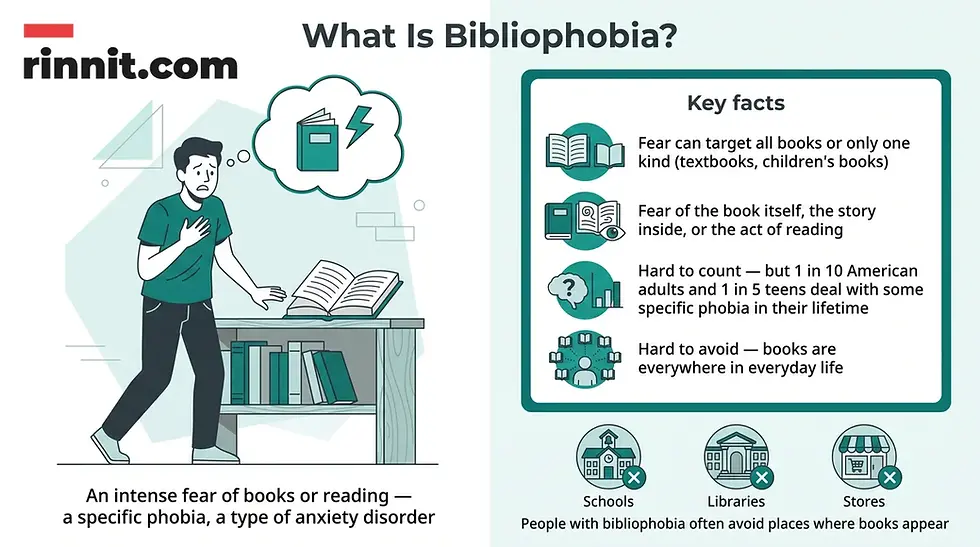
Bibliophobia is an intense fear of books [1]. The condition is a specific phobia (fear), which is a type of anxiety disorder [1].
It's important to understand what the fear actually targets. A person with bibliophobia might fear all books or only a specific kind, such as textbooks or children's books [1]. Someone with bibliophobia might be afraid of books themselves, the stories they contain, or the act of reading a book [1].
A person with bibliophobia may understand that the fear is extreme, but not be able to control it [1].
For context, National Institute of Mental Health data estimate that 12.5% of U.S. adults experience a specific phobia at some point in their lives [3], and 19.3% of adolescents aged 13 to 18 do [3].
Why Is Bibliophobia So Disruptive?
Books are almost everywhere, and it's difficult to avoid them in everyday life [1]. Bibliophobia can cause significant stress and even physical symptoms. The condition can affect a person's education, social experiences, and career path [1].
People with bibliophobia may avoid books and places where they might encounter books, such as schools, libraries, and stores [1]. They may experience shame or embarrassment about the fear, get nervous when they merely think about books, and panic when they have to hold a book or read a book [1]. Some skip educational, professional, or personal activities that involve books, and worry excessively about the possibility of having to read or be near books [1].
What Are the Symptoms of Bibliophobia?
A person with bibliophobia may experience symptoms of anxiety or panic about books and reading.
Symptom | What it looks like |
Chills | Sudden cold shivers at the sight or thought of books |
Dizziness and lightheadedness | Feeling faint when a book is nearby or expected |
Excessive sweating (hyperhidrosis) | Sweating more than the situation calls for |
Heart palpitations | Heart racing or pounding when books come up |
Nausea | Upset stomach connected to books or reading |
Shortness of breath (dyspnea) | Feeling unable to breathe comfortably around books |
Trembling or shaking | Visible shaking when holding or facing a book |
Upset stomach or indigestion (dyspepsia) | Digestive discomfort tied to reading situations |

The fear might also lead to certain behaviors, such as avoiding books — including schools, libraries, stores, or even friends' homes — refusing to participate in activities that may involve books, like going to the library or shopping, and skipping school [1].
How is it different from simply not liking to read?
Not wanting to read is a preference. Bibliophobia is an anxiety disorder: it causes real panic symptoms and avoidance so strong that it disrupts daily life, education, and work — and the person often knows the fear is out of proportion but can't control it.
What Causes Bibliophobia?
Mental health professionals aren't sure what causes specific phobias, such as bibliophobia. But most believe it's caused by a combination of factors [1].
Possible cause | How it may play a role |
Genetics | Some people have a family history of anxiety and specific fears |
Learning disability | Conditions like dyslexia or ADHD can cause stress and lead to fear of books |
Traumatic experiences associated with books | Reading a scary book at a young age or being shamed while reading aloud to other people |
Are There Different Types of Bibliophobia?
Bibliophobia may be related to other specific phobias, including arithmophobia (fear of numbers), hippopotomonstrosesquipedaliophobia (fear of long words), logophobia (fear of words), metrophobia (fear of poetry), mythophobia (fear of legends, which may be in written form), and scolionophobia (fear of school) [1].
How Is Bibliophobia Diagnosed?
Bibliophobia, or fear of books, cannot be diagnosed with any test [1], so diagnosis relies on a healthcare provider's assessment. Your healthcare provider can diagnose the condition based on discussions with you about your symptoms, how long they've been happening, and whether they're interfering in your life [1] [2].
Diagnosis criteria | What it means |
Causes extreme anxiety | The fear goes far beyond ordinary discomfort |
Significant stress or disrupted daily life | It interferes with school, work, or social life |
Lasts at least six months | Short-lived fears don't count as a phobia |
Out of proportion to any actual danger | Books pose no real threat, but the fear acts as if they do |
Avoidance of books or book situations | Skipping school, libraries, stores, or social events |
Physical symptoms of anxiety or panic attacks | Chills, trembling, palpitations, shortness of breath, and so on |
Your healthcare provider also might recommend testing for a learning disability, which may be at the root of the phobia [1].
What Are the Treatments for Bibliophobia?
People with mild bibliophobia may not need treatment [1]. But the fear can cause physical symptoms, disrupt daily life, and affect success in school and work. If that's the case, you should talk to your healthcare provider.
Treatment | How it works |
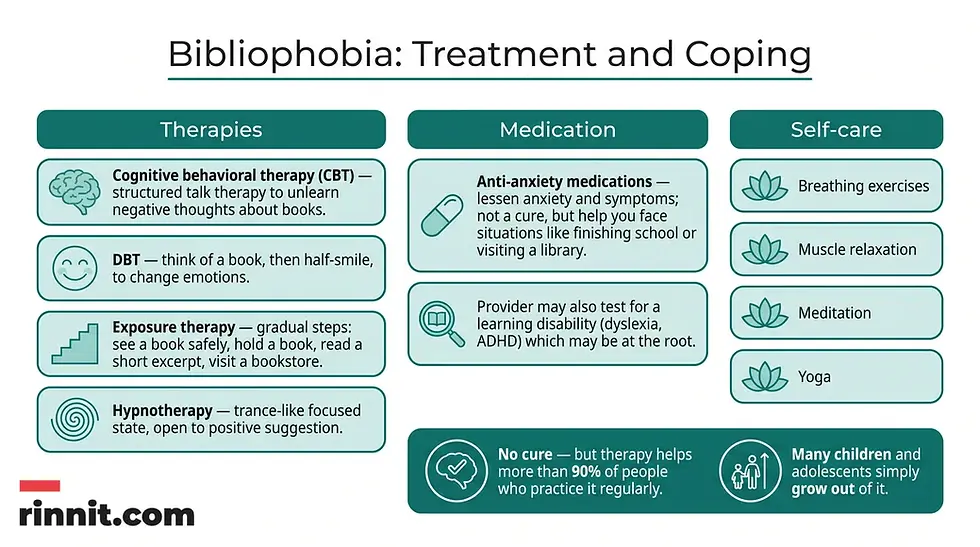
Cognitive behavioral therapy (CBT) | Structured psychotherapy that helps you understand and control thoughts and perceptions; unlearns the negative thoughts that happen when you think about or encounter books. One type of CBT is dialectical behavioral therapy (DBT), where your therapist asks you to think about a book and then half-smile — over time this may change your emotions associated with books |
Exposure therapy (desensitization) | Helps you confront your fears gradually; you're exposed to the idea of books over time in a controlled environment — starting with something less scary, like seeing a book in a safe place, then holding a book, reading a short excerpt, and eventually visiting a bookstore |
Hypnotherapy | Puts you in a trance-like but focused state where you're more open to suggestion and change; your hypnotist may convince you that you're less afraid of books or reading |
Medications | A variety of anti-anxiety medications can lessen anxiety and its symptoms; not a cure, but may help you face certain situations, such as finishing school or taking your children to the library |
Can Bibliophobia Be Cured?
Many children and adolescents grow out of bibliophobia [1], but the fear may last into adulthood. Although there's no cure, therapy helps more than 90% of people who practice it regularly [1].
How Can You Cope With a Fear of Books?
Many people can manage bibliophobia and other specific fears. It helps to work with a mental health professional and to practice techniques to manage anxiety, such as breathing exercises, muscle relaxation, meditation, and yoga [1].
Can You Prevent Bibliophobia?
Because mental health professionals don't fully understand the causes of bibliophobia, there's no proven way to prevent it [1].
Many people with one specific fear have multiple phobias, plus other anxiety disorders such as panic disorder or obsessive-compulsive disorder (OCD) [1]. It's important to work with a healthcare provider to manage any symptoms of the first anxiety disorder before you develop additional fears.
What's the Bottom Line?
Bibliophobia is an anxiety disorder — a specific phobia involving an intense fear of books or reading. It can target all books or just one kind, and it can center on the physical book, the stories inside it, or the act of reading itself. The symptoms are real: chills, trembling, sweating, racing heart, dizziness, nausea, and shortness of breath — plus avoidance of schools, libraries, bookstores, and social events. Because books are almost everywhere, the fear is hard to live around, and it can take a heavy toll on education, social life, and career. Experts point to a combination of genetics, learning disabilities like dyslexia and ADHD, and traumatic reading experiences as likely causes. There are no diagnostic tests — providers diagnose it through conversation, looking for a fear that's extreme, out of proportion to danger, lasting at least six months [1] [2], and disruptive to daily life. Treatment ranges from CBT (including DBT) and exposure therapy to hypnotherapy and anti-anxiety medication, and while there's no cure, therapy helps more than 90% of people who practice it regularly [1]. Many children grow out of it entirely. Coping skills like breathing exercises, muscle relaxation, meditation, and yoga help alongside professional care. If fear of books is steering a child away from school or an adult away from work, that's the signal to talk to a healthcare provider.
If fear of books or reading is holding you or your child back from school, work, or everyday life, you don't have to keep carrying it alone — explore Rinnit.com's library of clear, practical health guides and start the right conversation with your healthcare provider today.
Frequently Asked Questions
What is bibliophobia?
An intense fear of books — a specific phobia, which is a type of anxiety disorder. A person might fear all books or only a specific kind, such as textbooks or children's books.
Is bibliophobia a real phobia?
Yes. It's classified as a specific phobia, a recognized type of anxiety disorder that causes panic symptoms and avoidance that disrupt daily life.
What do people with bibliophobia fear?
The books themselves, the stories they contain, or the act of reading a book — or any combination of those.
How common is bibliophobia?
It's hard to count exactly, but about 1 in 10 American adults and 1 in 5 teenagers will deal with a specific phobia disorder at some point in their lives.
What are the physical symptoms?
Chills, dizziness and lightheadedness, excessive sweating, heart palpitations, nausea, shortness of breath, trembling or shaking, and upset stomach or indigestion.
Why does bibliophobia cause avoidance?
People may avoid books, schools, libraries, stores, and even friends' homes; refuse to participate in activities that involve books; or skip school entirely.
Can someone with bibliophobia tell their fear is unreasonable?
Yes — a person may understand the fear is extreme but still not be able to control it.
What causes bibliophobia?
Experts aren't sure, but most believe it's a combination of genetics (family history of anxiety), learning disabilities like dyslexia or ADHD, and traumatic experiences such as reading a scary book at a young age or being shamed while reading aloud.
How is bibliophobia diagnosed?
There are no tests. A provider diagnoses it through discussions, checking that the fear causes extreme anxiety, disrupts daily life, has lasted at least six months, is out of proportion to any actual danger, causes avoidance, and produces physical symptoms.
Why might a provider test for a learning disability?
Because dyslexia or ADHD may be at the root of the phobia.
What treatments work for bibliophobia?
Cognitive behavioral therapy (including DBT), exposure therapy (desensitization), hypnotherapy, and anti-anxiety medications.
How does exposure therapy work for fear of books?
Gradually and in a controlled setting — seeing a book in a safe place, holding a book, reading a short excerpt, and eventually visiting a bookstore.
Can bibliophobia be cured?
There's no cure, but many children and adolescents grow out of it, and therapy helps more than 90% of people who practice it regularly.
How can I cope with a fear of books day to day?
Working with a mental health professional and practicing anxiety-management techniques like breathing exercises, muscle relaxation, meditation, and yoga.
Can bibliophobia be prevented?
There's no proven way to prevent it, but treating an existing anxiety disorder early may help keep additional fears from developing.
Related Reading
Anxiety Disorders: Symptoms, Types, Causes, Treatment & Complete Guide: the broader group of conditions that includes specific phobias.
Dyslexia: Signs, Causes, Diagnosis & Treatment: a learning difference that can sit behind a fear of reading.
References
Cleveland Clinic. Bibliophobia (Fear of Books). Cleveland Clinic. Updated March 22, 2022. https://my.clevelandclinic.org/health/diseases/22616-bibliophobia-fear-of-books
Barnhill JW. Specific Phobias. Merck Manual Consumer Version. Updated April 2026. https://www.merckmanuals.com/home/mental-health-disorders/anxiety-and-trauma-and-stressor-related-disorders/specific-phobias
National Institute of Mental Health. Specific Phobia. National Institute of Mental Health. Accessed October 14, 2026. https://www.nimh.nih.gov/health/statistics/specific-phobia
MedlinePlus. Phobia - simple/specific. MedlinePlus Medical Encyclopedia. Reviewed May 15, 2026. https://medlineplus.gov/ency/article/000956.htm
Wolitzky-Taylor KB, et al. Psychological approaches in the treatment of specific phobias: a meta-analysis. Clin Psychol Rev. 2008;28(6):1021-37. PMID 18410984. https://doi.org/10.1016/j.cpr.2008.02.007
Cuijpers P, et al. Cognitive Behavior Therapy for Mental Disorders in Adults: A Unified Series of Meta-Analyses. JAMA Psychiatry. 2025;82(6):563-571. PMID 40238104. https://doi.org/10.1001/jamapsychiatry.2025.0482
Medical disclaimer
This article is for general informational purposes only and is not a substitute for professional medical advice, diagnosis, or treatment. Always seek the advice of a qualified healthcare provider with any questions about a medical condition. Never disregard professional medical advice or delay seeking it because of something you have read here.



Comments