Benign Brain Tumors: Symptoms, Causes, and Treatment

Updated: 2 days ago
Medically reviewed by Dr. Baraa Alnahhal, MD · Last reviewed: October 2026
The word "brain tumor" stops most conversations cold. But a benign brain tumor is not cancer. It is a growth of cells in or near the brain that does not spread to distant parts of the body the way cancerous tumors do. Many grow slowly, and many cause no symptoms at all.
That does not mean benign tumors can be ignored. Even a non-cancerous growth can become serious if it presses on brain tissue, nerves, blood vessels, or the pathways that carry cerebrospinal fluid, the liquid that surrounds the brain and spinal cord. Understanding the type, location, and behavior of the tumor is what decides whether the next step is simple monitoring, medicine, radiation, or surgery.

Quick Answer
A benign brain tumor is a non-cancerous growth of cells in or near the brain that generally does not spread but can still press on nerves and blood vessels. It may cause headaches, seizures, vision changes or balance problems. Diagnosis usually uses brain MRI. Many small tumors are simply watched, while others are treated with surgery, radiation, radiosurgery or medicines.
What the research says
Most benign tumors are meningiomas, and survival is high. In US data for 2017–2021, non-malignant brain tumors had an average annual age-adjusted incidence of 18.46 per 100,000, and meningioma made up 56.8% of non-malignant tumors. Five-year relative survival was 92.0% for non-malignant tumors versus 35.7% for malignant ones (Price et al., Neuro-Oncology, 2024) [3].
Small meningiomas can often be watched. A review of 22 studies (675 patients, median follow-up 4.6 years) found that few patients with tumors under 2 cm developed symptoms. For tumors of 2–2.5 cm, symptom progression was 42% when growth exceeded 10% per year and 0% when growth was 10% per year or less (Sughrue et al., J Neurosurg, 2010) [4].
Radiation controls grade 1 meningiomas well. A meta-analysis of 24 studies (4,673 patients) reported 5-year local control of 95.9% with proton therapy, 93.0% with conventional radiotherapy, 95.3% with Linac radiosurgery, and 89.8% with Gamma Knife, with no significant association between modality and local control (Nitta et al., Cancers, 2026) [5].
Study details are from PubMed abstracts.
What is a benign brain tumor?
Benign brain tumors form in or near the brain. Some start inside the brain itself. Others start in nearby structures, such as the membranes that cover the brain, the pituitary gland, or the nerves involved in hearing and balance.
Two facts matter most. First, benign tumors generally do not spread to distant parts of the body the way cancer does, and many grow slowly. Second, they can still be serious, because a growth in the skull presses against brain tissue, nerves, blood vessels, or the channels that drain cerebrospinal fluid (CSF).
Symptoms and treatment depend on five things: the tumor's type, its size, its location, its growth rate, and its molecular features, along with the person's overall health. [1]
What are the main types of benign brain tumors?
The type depends on where the tumor starts and which cells make it up. The most common types are listed below.
Tumor type | Where it forms | What it may affect |
Meningioma | The membranes (meninges) covering the brain and spinal cord | Pressure symptoms; the most common benign brain tumor in adults |
Pituitary adenoma | The pituitary gland at the base of the brain | Hormone levels; vision, if it presses on the optic nerves |
Vestibular schwannoma | The balance (vestibular) nerve, next to the hearing nerve | Hearing loss, ringing in the ear, balance problems, dizziness |
Craniopharyngioma | Near the pituitary gland and optic nerves | Hormones, growth, vision, and other functions |
Hemangioblastoma | Often the brain or spinal cord (rare) | Local pressure effects; sometimes part of a genetic condition |
Low-grade glioma | Glial cells, the supportive tissue around nerve cells | Slow growth, but needs long-term follow-up because it can change or return |
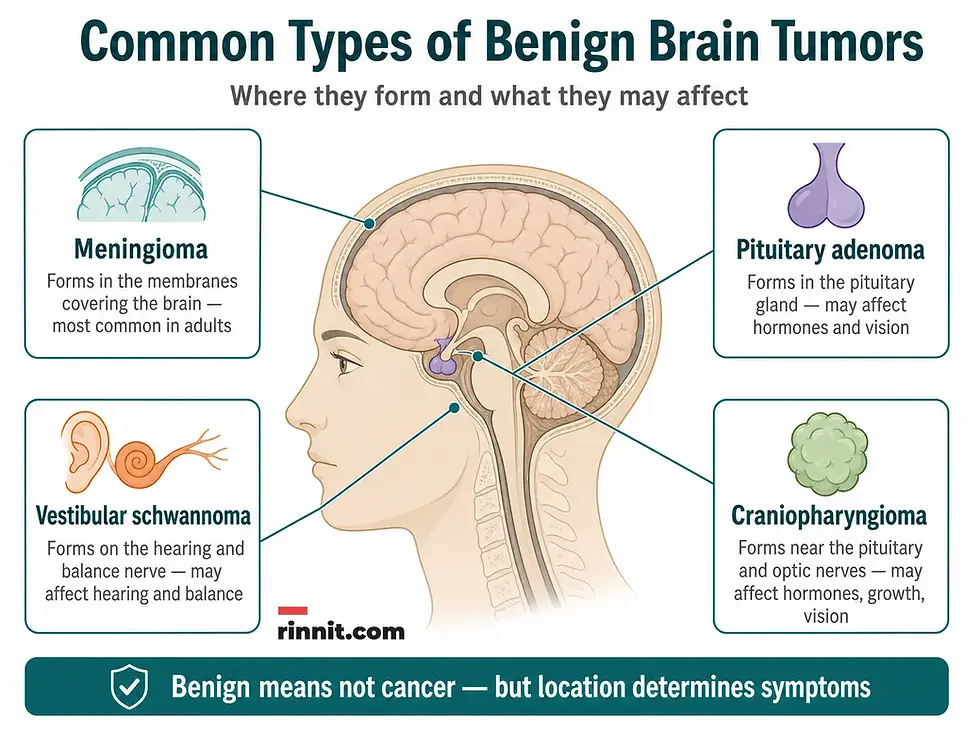
A few details are worth knowing. Pituitary adenomas come in two sizes: microadenomas are small, and macroadenomas are larger. If a pituitary tumor presses on the optic chiasm, the spot where the optic nerves cross, it can affect vision. Vestibular schwannomas were formerly called acoustic neuromas. And even slow-growing gliomas may need long-term follow-up, because they can grow, come back after treatment, or change over time.
What are the symptoms of a benign brain tumor?
Some benign brain tumors cause no symptoms right away and are found during imaging done for another reason. When symptoms do appear, they depend on the tumor's size, location, and growth rate. Even a benign tumor can cause serious symptoms because of where it sits and how it affects nearby brain structures.
Common symptoms include headache or pressure in the head, nausea or vomiting, seizures, vision changes, hearing changes, balance problems or dizziness, weakness or numbness in part of the body, trouble speaking or understanding language, changes in memory, thinking, mood, or personality, and fatigue. Hormone changes can add menstrual changes, changes in sexual function, excessive thirst or urination, or unexplained weight changes.
Certain tumors cause specific patterns. The table below summarizes them.
Tumor type | Typical symptoms |
Pituitary tumor | Hormone level changes and vision changes |
Vestibular schwannoma | Hearing loss, ringing in the ear, balance problems, dizziness |
Tumor near the cerebellum | Coordination problems and trouble walking |
Symptoms in children
Children may not describe symptoms clearly. A child with a benign brain tumor may seem unusually tired, struggle at school, act differently, or lose skills they already had. Infants may have an increasing head size. Nausea and vomiting, vision changes, balance problems, or a seizure may also occur.
When to seek medical care
Make an appointment for symptoms that are new, do not go away, or get worse over time.
Seek emergency care for a first seizure, sudden weakness or numbness, sudden trouble speaking, sudden vision loss, confusion, repeated vomiting, or a severe headache that comes on suddenly or keeps getting worse.
What causes benign brain tumors?
The cause of most benign brain tumors is not known. Most primary brain and central nervous system tumors happen sporadically, meaning without a known inherited cause. Some tumor types have been linked to changes in genes or chromosomes that affect how cells grow and behave.
Some benign brain tumors are linked to genetic conditions that can run in families.
Genetic condition | Linked tumor types |
Neurofibromatosis type 1 | Optic pathway gliomas, meningiomas, nerve tumors (neurofibromas) |
NF2-related schwannomatosis (neurofibromatosis type 2) | Vestibular schwannomas, meningiomas, ependymomas |
Von Hippel-Lindau disease | Hemangioblastomas |
Tuberous sclerosis | Subependymal giant cell astrocytoma, a rare slow-growing brain tumor |
Multiple endocrine neoplasia, type 1 | Pituitary adenomas |
What raises the risk of a benign brain tumor?
Risk factors depend on the tumor type, and for many people there is no clear risk factor at all. The known ones are summarized below.
Risk factor | What it means |
Age | Some tumors become more common with age; meningiomas rise especially after age 65 |
Sex | Meningiomas are more common in women than in men |
Family history | Some inherited conditions raise the risk of certain benign brain tumors |
Radiation exposure | Ionizing radiation has been linked to meningiomas, gliomas, and nerve sheath tumors |
One reassuring point deserves emphasis. Research has not shown a convincing link between brain tumors and head injury, occupation, cell phone use, diet, or electromagnetic fields.
Can a benign brain tumor cause complications?
A benign brain tumor is not cancer, but it can still cause serious health issues. Complications depend on the tumor's type, size, location, and growth rate. Prompt evaluation and ongoing follow-up can help reduce the risk of serious complications.
Complication | How it happens |
Seizures | The tumor irritates nearby brain tissue |
Pressure in the brain | The tumor blocks cerebrospinal fluid flow, causing fluid buildup, nausea, headaches, and sometimes vomiting |
Vision problems | Tumors near the optic nerves, optic chiasm, or pituitary gland change or block vision |
Hearing and balance problems | Vestibular schwannomas can reduce hearing and disrupt balance; larger tumors raise the risk of hearing loss |
Hormone problems | Pituitary tumors cause too much or too little of certain hormones, affecting growth, sex hormones, thyroid function, stress hormones, periods, fertility, and energy |
Changes in movement, speech, thinking, or memory | Tumors affect nearby brain areas that control these functions |
Growth or recurrence | Some tumors grow over time or come back after treatment, requiring long-term imaging follow-up |
Can benign brain tumors be prevented?
Most benign brain tumors cannot be prevented because many happen sporadically, but genetic counseling may help people with an inherited condition in the family.
If an inherited condition such as neurofibromatosis, von Hippel-Lindau disease, tuberous sclerosis, or multiple endocrine neoplasia type 1 runs in your family, genetic counseling may help you understand your risk and whether screening is recommended.
How are benign brain tumors found and diagnosed?
If a healthcare professional suspects a brain tumor, a combination of exams, imaging, and sometimes tissue testing is used to confirm the diagnosis. [2]
Neurological exam
A neurological exam tests the brain and nervous system by checking vision, hearing, balance, coordination, strength, and reflexes. It does not detect a brain tumor on its own, but it helps identify which part of the brain or nervous system may be causing symptoms.
Imaging tests
Imaging is the workhorse of diagnosis. The main tools are summarized below.
Test | What it does |
Head CT | X-ray pictures; used for quick imaging, when MRI is unavailable or cannot be done; can show bleeding, fluid buildup, or calcium deposits; if it suggests a tumor, an MRI usually follows |
Brain MRI | Strong magnets make detailed brain pictures; the main test for brain tumors; contrast given through a vein makes some tumors easier to see |
Functional MRI | Shows brain areas involved in speech and movement; helps plan surgery |
Magnetic resonance spectroscopy | Measures certain chemicals in tissue |
Magnetic resonance perfusion | Measures blood flow in different parts of the tumor |
PET scan | A radioactive tracer makes brain pictures; used as an added test when MRI or CT results need clarification |
Angiography | Shows blood vessels and blood flow; helps plan surgery when the tumor affects nearby vessels |
PET scans and angiography are not needed for everyone. PET is more likely to help identify high-grade tumors than low-grade ones.
Hormone, vision, and hearing tests
Blood tests may be used if a pituitary tumor is suspected, to check whether the gland is making too much or too little of certain hormones. A visual field test may be used if the tumor is near the optic nerves or optic chiasm. Hearing tests may be used if a vestibular schwannoma is suspected.
Biopsy
A tissue sample may be needed to confirm the diagnosis. It is often taken during surgery to remove the tumor. If surgery is not possible or the tumor sits in a hard-to-reach area, a needle biopsy may be used instead, guided by imaging.
Studied under a microscope, the sample shows whether the cells are cancer, identifies the tumor type, and for some tumors identifies the tumor grade, a description of how the cells look and behave. Some tumors are also tested for molecular changes in their genes or cell features. These results guide treatment and follow-up.
How are benign brain tumors treated?
Treatment depends on the tumor type, size, location, growth rate, symptoms, test results, molecular features, the person's age and overall health, and whether the tumor affects important brain functions. Not every tumor needs treatment right away.

Monitoring
Some benign brain tumors do not need treatment right away. This approach goes by several names: observation, watchful waiting, or active monitoring. The healthcare team checks the tumor over time with imaging such as MRI and watches for new symptoms or growth.
Monitoring is an option when the tumor is small, not causing symptoms, and not pressing on important brain structures. It may also be used when treatment risks outweigh the likely benefit. If the tumor grows or symptoms develop, treatment may then be recommended.
Surgery
Surgery may be recommended if the tumor is causing symptoms, growing, pressing on important structures, or needs removal to confirm the diagnosis. The goal is to remove as much of the tumor as safely possible while protecting brain and nerve function. Surgery also provides tissue for lab testing, which confirms the tumor type and reveals molecular changes that guide treatment.
Approach | How it works |
Craniotomy | A section of skull bone is removed to reach the tumor; special tools, and sometimes lasers, remove tumor tissue; the skull bone is put back afterward; awake brain surgery is sometimes used to protect important brain areas |
Endoscopic transnasal transsphenoidal surgery | An endoscope and tools pass through the nose and sinuses to reach the pituitary area; used for some pituitary tumors |
Sometimes the whole tumor cannot be removed safely, especially near areas that control movement, speech, vision, or hearing. In those cases, the surgeon may remove part of the tumor to lower pressure, improve symptoms, or obtain tissue, and a biopsy may be done for hard-to-reach areas. Some people need no further treatment after removal, while others need ongoing imaging or more treatment if part of the tumor remains, it grows, or it comes back.
Radiation therapy
Radiation therapy uses high-energy beams to damage tumor cells. It may be used when surgery is not possible, when part of the tumor remains after surgery, when a tumor comes back, or when surgery could put important brain or nerve functions at too much risk. It is typically given in multiple treatments over time.
Radiosurgery
Stereotactic radiosurgery is an intense form of radiation that involves no skin cut. Beams of radiation are aimed at the tumor from many angles. Each beam alone is not very powerful, but where they meet, the dose is large enough to kill tumor cells.
Radiosurgery may be used for some benign tumors, including some meningiomas and vestibular schwannomas. It suits small tumors, hard-to-reach tumors, tumors that remain after surgery, and tumors that come back.
Technology | How it works |
Gamma Knife radiosurgery | Many small beams of gamma radiation aimed at the tumor |
Linear accelerator radiosurgery | Carefully shaped X-ray beams aimed from different angles |
Proton beam therapy | Proton beams that limit radiation to nearby tissue; the newest type, becoming more common but not available at all hospitals |
Medicines
Medicines treat symptoms caused by the tumor or hormone problems related to it.
Medicine type | How it is used |
Antiseizure medicines | Used for people who have seizures; not typically used to prevent seizures in people who never had one |
Dopamine agonists | Treat prolactinomas (prolactin-secreting pituitary tumors); lower prolactin levels and may shrink the tumor |
Chemotherapy and targeted therapy | Considered for some low-grade gliomas and tumors with specific molecular changes, such as papillary craniopharyngioma; decisions depend on type, grade, molecular features, age, and remaining tumor |
Targeted therapy uses medicines that act on specific changes in tumor cells, called mutations.
Rehabilitation and supportive care
Some people need help recovering after treatment or managing ongoing symptoms. Support may include physical therapy for strength, movement, or balance; occupational therapy for daily activities; speech therapy for speech, language, or swallowing; vision and hearing support; help with memory, thinking, or learning changes; and school or workplace support for children or adults. For some vestibular schwannomas, vestibular rehabilitation before surgery may help with movement and balance afterward.
Recovery after surgery
Recovery depends on the tumor's type, size, and location, the type of surgery, whether the whole tumor was removed, and whether the tumor affected brain function beforehand. Some people go home after a short hospital stay, while others need more time in the hospital or rehabilitation first. Enhanced recovery programs help people prepare for planned craniotomy and recover afterward, and they may shorten hospital stays and lower costs without increasing complications.
Follow-up care is important. Some tumors need regular imaging to watch for growth or recurrence, with schedules set by tumor type, how much was removed, and how the tumor changes over time.
Coping and support
A brain tumor diagnosis can feel overwhelming and frightening. Three steps help. First, learn enough about the specific tumor and the treatment options to make informed decisions. Second, keep friends and family close for practical and emotional support. Third, find someone to talk with, whether a friend, family member, counselor, or medical social worker, and ask about local brain tumor support groups.
On alternative treatments: little research has been done on complementary and alternative brain tumor treatments, and none have been proven to cure brain tumors. Complementary approaches such as art therapy, exercise, meditation, music therapy, and relaxation exercises may help with coping with stress.
How do I prepare for my appointment?
If symptoms are new, persistent, or worsening, make an appointment with a healthcare professional. You may be referred to a neurologist, a specialist in brain and nervous system conditions, and possibly a neurosurgeon, radiation oncologist, endocrinologist, vision specialist, hearing specialist, or rehabilitation specialist depending on the tumor and symptoms.
Before the visit, gather a list of symptoms with start dates and changes, a list of all medicines, vitamins, and supplements, your personal and family medical history including genetic conditions, and copies of any imaging tests or reports. Bring a family member or friend to help remember the information, and write your questions down in advance.
Useful questions include: What type of brain tumor do I have? Is it benign? Where is it located? Is it growing or pressing on nearby structures? What tests do I need? Do I need treatment now, or can it be watched with imaging? What are the risks and benefits of each option? How often will I need follow-up imaging? Which symptoms should make me seek care right away? Are genetic counseling or clinical trials options for me?
Expect the healthcare professional to ask about headaches, seizures, vision and hearing changes, balance problems, and changes in memory, thinking, mood, speech, or movement, along with when symptoms started, prior imaging or treatment, and any family history of brain tumors, genetic conditions, or head radiation.
What is the bottom line on benign brain tumors?
Hearing "brain tumor" is frightening, but benign changes the picture considerably. A benign brain tumor is not cancer, and it does not spread to distant parts of the body. Many never cause symptoms at all and are found by chance on scans done for other reasons.
What matters next comes down to a small set of questions: What type is it? Where is it? Is it growing, and is it pressing on anything important? Those answers decide whether the right plan is quiet monitoring with periodic MRI scans, or whether surgery, radiation, radiosurgery, or medicines should step in.
Even benign tumors deserve respect. A growth in the skull can press on nerves, blood vessels, and fluid pathways, which is why new or worsening symptoms, especially seizures, sudden weakness, speech trouble, vision loss, or a severe sudden headache, warrant urgent evaluation.
Next steps: If you or a loved one is facing a possible brain tumor, the first step is a medical evaluation with imaging. A neurologist or neurosurgeon can explain the tumor type, the realistic options, and the follow-up schedule.
FAQ
Is a benign brain tumor cancer?
No. Benign means the growth is not cancerous and generally does not spread to other parts of the body, although it can still press on brain structures and cause symptoms.
What is the most common benign brain tumor in adults?
Meningioma, a tumor that starts in the membranes covering the brain and spinal cord.
Do benign brain tumors cause symptoms right away?
Not always. Some cause no symptoms and are found during imaging done for another reason. When symptoms occur, they depend on the tumor's size, location, and growth rate.
Do all benign brain tumors need surgery?
No. Many small, symptom-free tumors are managed with monitoring, using repeat MRI scans to watch for growth. Treatment is recommended when the tumor grows, causes symptoms, or presses on important structures.
Can a benign brain tumor come back after treatment?
Yes, some benign brain tumors grow over time or return after treatment, which is why long-term follow-up imaging is often needed even after successful removal.
Disclaimer: This article is for general informational purposes only and does not constitute medical advice. Always consult a qualified health care provider for individual questions.
References
Mayo Clinic Staff. Benign brain tumor - Symptoms and causes. Mayo Clinic. August 14, 2026. https://www.mayoclinic.org/diseases-conditions/benign-brain-tumor/symptoms-causes/syc-20605241
Mayo Clinic Staff. Benign brain tumor - Diagnosis and treatment. Mayo Clinic. August 14, 2026. https://www.mayoclinic.org/diseases-conditions/benign-brain-tumor/diagnosis-treatment/drc-20605258
Price M, et al. CBTRUS Statistical Report: Primary Brain and Other Central Nervous System Tumors Diagnosed in the United States in 2017-2021. Neuro Oncol. 2024;26(Suppl 6):vi1-vi85. PMID 39371035. https://doi.org/10.1093/neuonc/noae145
Sughrue ME, et al. Treatment decision making based on the published natural history and growth rate of small meningiomas. J Neurosurg. 2010;113(5):1036-1042. PMID 20433281. https://doi.org/10.3171/2010.3.JNS091966
Nitta H, et al. Radiotherapy Strategies for WHO Grade 1 Meningioma: A Systematic Review and Meta-Analysis Comparing Proton Therapy, Conventional Radiotherapy, and Radiosurgery. Cancers (Basel). 2026;18(15). PMID 42588721. https://doi.org/10.3390/cancers18152506
National Cancer Institute. Meningioma: Diagnosis and Treatment. National Cancer Institute. Updated August 20, 2024. https://www.cancer.gov/rare-brain-spine-tumor/tumors/meningioma
National Cancer Institute. Pituitary Tumors. National Cancer Institute. Accessed October 14, 2026. https://www.cancer.gov/types/pituitary
National Library of Medicine. Neurofibromatosis. MedlinePlus. Updated December 8, 2025. https://medlineplus.gov/neurofibromatosis.html



Comments