Behcet Disease: Symptoms, Causes, and Treatment

Updated: 3 days ago
Medically reviewed by Dr. Baraa Alnahhal, MD · Last reviewed: October 2026
Quick Answer
Behcet disease, also called Behcet syndrome, is a rare condition in which blood vessels of all sizes become inflamed throughout the body. Painful mouth sores are the most common sign, along with skin and genital sores and eye inflammation. Diagnosis relies mainly on symptoms. There is no cure, but creams, colchicine, corticosteroids and immune-suppressing medicines manage it.
What the research says
Apremilast reduces mouth ulcers, even in hard-to-treat cases, but the evidence base is small. A systematic review of four clinical studies found that apremilast led to a significant reduction in oral ulcers, including in patients whose disease had not responded to several systemic drugs. The authors note the limited literature and call for longer follow-up and an active comparator (Mahajan and Patil, Indian Dermatol Online J, 2025) [3].
TNF blockers and apremilast worked about equally for refractory mouth ulcers, with different trade-offs. In a retrospective study of 78 patients split equally between the two treatments, both groups had a significant reduction in oral ulcers at 3 months (P < 0.001) and 6 months (P = 0.01), with no significant difference between them. TNF inhibitors were more effective for joint involvement, while apremilast had a corticosteroid-sparing effect but a higher discontinuation rate because of gastrointestinal side effects (Lopalco et al., Rheumatology (Oxford), 2025) [4].
Expert guidance tailors treatment to the organ involved. The 2018 European League Against Rheumatism (EULAR) update, built by a multispecialty task force, revised the recommendations for mucocutaneous, joint, eye, vascular, neurological, and gastrointestinal disease, and added five overarching principles plus a new recommendation on surgical management of vascular involvement (Hatemi et al., Ann Rheum Dis, 2018) [5].
What is Behcet disease?
Behcet (beh-CHET) disease, also called Behcet syndrome, is a rare condition that causes blood vessel swelling, called inflammation, throughout the body. Because it can produce mouth sores, eye irritation, skin rashes, and genital sores, its symptoms can seem unrelated at first, and many people do not realize these problems share one underlying cause.
This guide explains what Behcet disease is, the symptoms it produces across the body, who is most at risk, how it is diagnosed without a confirmatory test, and the range of treatments, from topical creams for mild flares to immune-modulating medicines for more serious cases.
Behcet disease symptoms can seem like they are not related at first. They can include mouth sores, eye irritation and swelling, skin rashes and sores, and genital sores.
Treatment involves medicines to ease symptoms of Behcet disease and to prevent serious complications, such as blindness.

What are the symptoms of Behcet disease?
Behcet disease symptoms vary from person to person. Symptoms can come and go or become less serious over time. Symptoms depend on which parts of the body the condition affects.
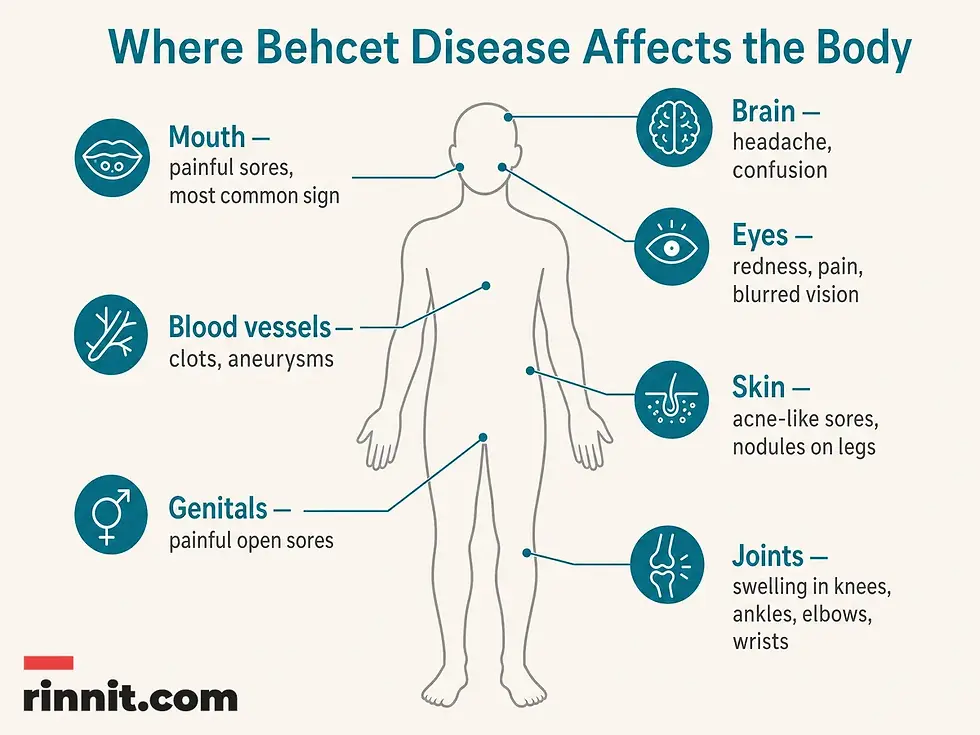
Behcet disease most often affects the following areas:
Mouth. Painful mouth sores that look like canker sores are the most common sign of Behcet disease. They begin as raised, round sores in the mouth and quickly turn into painful ulcers. The sores most often heal in 1 to 3 weeks, but they often come back.
Skin. Some people get sores that look like acne on their bodies. Others get raised and tender growths called nodules on their skin, mainly on the lower legs.
Genitals. Open sores can happen on the scrotum or the vulva. The sores are most often painful and can leave scars.
Eyes. Irritation and swelling, called inflammation, in the eye causes redness, pain, and blurred vision. Called uveitis, this inflammation most often affects both eyes. In people with Behcet disease, these symptoms can come and go.
Joints. Joint swelling and pain often affect the knees in people with Behcet disease. The ankles, elbows, or wrists also might be involved. Symptoms can last 1 to 3 weeks and go away on their own.
Blood vessels. Swelling, called inflammation, in veins and arteries can cause redness and pain. It can cause a blood clot, which leads to swelling in the arms or legs. Inflammation in the large arteries can lead to complications. These include bulges in the artery that can burst, called aneurysms, and narrowed or blocked blood vessels.
Digestive system. Several symptoms can affect the network of organs that digest food, called the digestive system. Symptoms may include belly pain, diarrhea, and bleeding.
Brain. Swelling, called inflammation, in the brain and nervous system can cause headache, fever, confusion, poor balance, or stroke.
Body part | What Behcet disease can cause | Notes |
Mouth | Painful sores that look like canker sores, quickly turning into painful ulcers | Most common sign; heals in 1 to 3 weeks but often returns |
Skin | Acne-like sores; raised, tender nodules, mainly on the lower legs | — |
Genitals | Open sores on the scrotum or vulva | Most often painful and can leave scars |
Eyes | Redness, pain, blurred vision (uveitis, inflammation of the eye) | Most often affects both eyes; symptoms can come and go |
Joints | Swelling and pain, most often in the knees | Ankles, elbows, or wrists may be involved; lasts 1 to 3 weeks |
Blood vessels | Redness and pain; blood clots with arm or leg swelling; aneurysms; narrowed or blocked vessels | Aneurysms are bulges that can burst |
Digestive system | Belly pain, diarrhea, bleeding | — |
Brain | Headache, fever, confusion, poor balance, or stroke | From inflammation of the brain and nervous system |
Who is most at risk for Behcet disease?
Factors that might increase your risk of Behcet disease include age, where you are from, sex assigned at birth, and genes.
Behcet disease most often affects people in their 20s and 30s, but children and older adults also can have the condition. People from countries in the Middle East and East Asia, including Turkey, Iran, Japan, and China, are more likely to get it. The disease can happen to anyone, but it is most often worse in people assigned male at birth. Certain genes may be linked with a higher risk of getting Behcet disease.
Risk factor | What it means |
Age | Most often affects people in their 20s and 30s; children and older adults can have it too |
Country | More common among people from the Middle East and East Asia, including Turkey, Iran, Japan, and China |
Sex assigned at birth | Can happen to anyone; most often worse in people assigned male at birth |
Genes | Certain genes may be linked with a higher risk |
When should you see a doctor?
Make an appointment with your health care professional if you have symptoms that might be Behcet disease. If you have been diagnosed with the condition, see your health professional if you get new symptoms.
The eye form of the disease deserves special attention: untreated uveitis can lead to loss of vision or blindness. If you have eye symptoms of Behcet disease, see an eye specialist, called an ophthalmologist, regularly. Treatment can help prevent this complication.
What causes Behcet disease?
Behcet disease might be an autoimmune disorder, which means the body's immune system attacks some of its own healthy cells by mistake. It is likely that gene changes and factors in the environment play a role.
Experts believe that swelling of the blood vessels, called vasculitis, causes the symptoms of Behcet disease. The condition can involve arteries and veins of all sizes. Vasculitis can damage blood vessels all through the body.
Some genes might make people more likely to get Behcet disease. Some researchers think that a germ can trigger the disease in people who have these genes.
How is Behcet disease diagnosed?
No tests can show that you have Behcet disease. So your health care professional mainly makes the diagnosis based on your symptoms.
Nearly everyone with the condition gets mouth sores. So mouth sores that come back at least three times in 12 months often are needed for a diagnosis of Behcet disease. Also, a diagnosis of Behcet disease needs at least two other symptoms, such as genital sores that keep coming back, swelling and irritation, called inflammation, of the eye, or skin sores.
Tests to help diagnose Behcet disease include lab tests and the pathergy test. Blood tests or other lab tests might rule out other conditions. For a pathergy test, your health care professional puts a sterile needle into your skin and looks at the area 1 to 2 days later. If the test is positive, a small bump forms under your skin where the needle was put in. This shows that your immune system reacts too much to a minor injury.
Diagnostic element | How it works |
Symptom pattern | Mouth sores recurring at least three times in 12 months, plus at least two other symptoms (recurring genital sores, eye inflammation, or skin sores) |
Lab tests | Blood or other lab tests might rule out other conditions |
Pathergy test | A sterile needle is placed in the skin and checked after 1 to 2 days; a small bump under the skin is a positive result, showing the immune system overreacts to minor injury |
What complications can Behcet disease cause?
Complications of Behcet disease depend on symptoms. Untreated uveitis can lead to loss of vision or blindness, which is why regular checkups with an ophthalmologist matter for anyone with eye symptoms.
Blood vessel involvement can also be serious. Inflammation in the large arteries can lead to aneurysms, which are bulges that can burst, and to narrowed or blocked blood vessels. A blood clot in the veins can cause swelling in the arms or legs. Inflammation of the brain and nervous system can cause confusion, poor balance, or stroke.
How are Behcet disease symptoms treated?
Behcet disease has no cure, but medicines can manage symptoms, from topical treatments during flares to whole-body medicines for more severe disease. If you have a mild form, your health care professional might suggest medicines to manage the pain and swelling of flares. You might not need medicine between flares. For some people, symptoms get better over time.
For worse symptoms, you might take medicines to manage Behcet disease throughout your body. Plus you might take medicines for flares.
Treatments for symptoms during flares
Medicines to manage symptoms during flares might include topical corticosteroid creams, gels, and ointments that you put on skin and genital sores. Special mouthwashes that have corticosteroids and other agents might reduce the pain of mouth sores. For mild swelling and irritation, eye drops that have corticosteroids or other medicines might help.
Whole-body treatments
If topical medicines do not help, you might take a medicine by mouth called colchicine (Colcrys, Mitigare, others). This is for mouth and genital sores that come back. Colchicine also might ease joint swelling.
More recently, the U.S. Food and Drug Administration approved apremilast (Otezla) for the treatment of mouth sores caused by Behcet disease. Side effects may include weight loss and depression.
If you have more-serious Behcet disease, you may need treatments to lessen damage from the disease between flares. Your health care professional might prescribe corticosteroids to manage inflammation, medicines that make the immune system less active, or medicines that change how the immune system responds.
Corticosteroids, such as prednisone (Rayos), ease the inflammation caused by Behcet disease. Health care professionals often prescribe corticosteroids with another medicine to make the immune system less active. Side effects of corticosteroids include weight gain, heartburn, high blood pressure, and bone thinning, called osteoporosis.
Medicines that make the immune system less active include azathioprine (Azasan, Imuran), cyclosporine (Gengraf, Neoral, others), and cyclophosphamide (Cytoxan). These medicines can increase the risk of infection. They also can affect the liver and kidneys and cause low blood counts and high blood pressure.
Medicines that change how the immune system responds include interferon alfa-2b (Intron A), which may be used alone or with other medicines to help manage skin sores, joint pain, and eye irritation. Side effects include flu-like symptoms, such as muscle pain and fatigue. People who have worse symptoms or symptoms that resist treatment might take a medicine that blocks a substance called tumor necrosis factor, such as infliximab (Remicade) or adalimumab (Humira). Side effects might include headache, skin rash, and a higher risk of infections.
Treatment level | Medicines | Used for |
Flares (topical) | Corticosteroid skin creams, gels, and ointments | Skin and genital sores |
Flares (topical) | Corticosteroid mouth rinses | Mouth sore pain |
Flares (topical) | Corticosteroid or other eye drops | Mild eye swelling and irritation |
Moderate (oral) | Colchicine | Recurring mouth and genital sores; may ease joint swelling |
Moderate (oral) | Apremilast | FDA-approved for Behcet mouth sores; side effects may include weight loss and depression |
More serious | Corticosteroids such as prednisone | Ease inflammation; side effects include weight gain, heartburn, high blood pressure, osteoporosis |
More serious | Immune-suppressing medicines (azathioprine, cyclosporine, cyclophosphamide) | Lessen damage between flares; risks include infection, liver and kidney effects, low blood counts |
More serious | Interferon alfa-2b | Skin sores, joint pain, eye irritation; flu-like side effects |
More serious | TNF blockers (infliximab, adalimumab) | Worse or treatment-resistant symptoms; side effects include headache, rash, infection risk |

How do you cope with Behcet disease?
No one can predict the course of Behcet disease. And not knowing might be hard. Taking good care of yourself might help you cope.
Rest during flares. When symptoms appear, take time for yourself. Make time in your day to rest when you need to, and try to lower stress.
Be active when symptoms improve. Moderate exercise, such as walking or swimming, can make you feel better between Behcet disease flares. Exercise can strengthen your body, help keep your joints moving, and improve your mood.
Connect with others. Because Behcet disease is rare, it may be hard to find others with the disease. Ask your health care team about support groups in your area. If you cannot connect with someone close, the American Behcet's Disease Association offers message boards and chat rooms where you can connect with other people who have the condition.
How do you prepare for your appointment?
You are likely to start by seeing your primary health care professional. Your health professional might send you to a specialist who treats arthritis and other rheumatic illnesses, called a rheumatologist. Depending on your symptoms, you also might need to see an ophthalmologist for eye problems, a gynecologist or urologist for genital sores, a dermatologist for skin problems, a gastroenterologist for digestive troubles, or a neurologist for symptoms that involve the brain or central nervous system.
Before the visit, make a list of your symptoms, including when they began and how bad they are, key personal information such as major stresses and recent life changes, all medications, vitamins, and supplements you take including doses, and questions to ask your health care team. Ask a family member or friend to go with you to help remember the information you receive.
Questions to ask your health care team include: What tests do I need and how do I prepare for them? Is my condition likely to be brief or long lasting? What treatments are there, and which do you advise? If you have another medical condition, how can you best manage these conditions together? And do you have brochures, other printed material, or suggested websites?
Your health care team is likely to ask questions such as: Do you have your symptoms all the time, or do they come and go? What, if anything, seems to make your symptoms better or worse? Does anyone in your family have an illness like yours?
What is the bottom line on Behcet disease?
Behcet disease is a rare condition that can look like a collection of unrelated problems: painful mouth sores, eye inflammation, skin sores, genital sores, and joint pain, with the potential to reach the blood vessels, the digestive system, and the brain. The mouth sores are usually the first and most reliable clue, and they almost always return.
There is no single test that proves it. Diagnosis rests on a pattern: mouth sores recurring at least three times in 12 months, plus at least two other typical symptoms, supported by lab tests and, when useful, a simple pathergy test.
There is no cure, but the disease is manageable, and some people improve over time. Mild flares are handled with creams, mouth rinses, and eye drops; moderate disease often responds to colchicine or apremilast; and more serious disease calls for corticosteroids, immune-suppressing medicines, or TNF blockers. The most important complications to guard against are the ones treatment can actually prevent: regular eye care protects your vision, and prompt attention to new symptoms keeps the whole care team on the same page.
If you are living with the condition, pacing yourself through flares, staying active between them, and connecting with others through support groups and patient communities can make a real difference alongside medication.
Next steps: If you have recurring mouth sores plus eye, skin, genital, or joint symptoms, start with your primary health care professional and ask about Behcet disease. If you have eye symptoms, ask about seeing an ophthalmologist — treatment can help protect your vision.
FAQ
What is the most common sign of Behcet disease?
Painful mouth sores that look like canker sores are the most common sign. They begin as raised, round sores that quickly turn into painful ulcers, heal in 1 to 3 weeks, and often come back.
How is Behcet disease diagnosed?
There is no confirmatory test. Diagnosis is mainly based on symptoms: mouth sores that return at least three times in 12 months plus at least two other symptoms, such as recurring genital sores, eye inflammation, or skin sores. Lab tests may rule out other conditions, and a pathergy test — a small skin bump forming after a sterile needle prick — can show the immune system overreacts to minor injury.
Is Behcet disease curable?
There is no cure. Treatment focuses on easing symptoms during flares and preventing complications. Some people find their symptoms improve over time, and many with mild disease do not need medicine between flares.
Why does Behcet disease affect so many different parts of the body?
Experts believe the cause is vasculitis, inflammation of the blood vessels, which can involve arteries and veins of all sizes and damage blood vessels throughout the body. Where the inflammation occurs determines the symptoms.
Who is most likely to get Behcet disease?
Behcet disease most often affects people in their 20s and 30s and is more common among people from the Middle East and East Asia, including Turkey, Iran, Japan, and China. It can happen to anyone, but it is most often worse in people assigned male at birth, and certain genes may raise the risk.
Disclaimer: This article is for general informational purposes only and does not constitute medical advice. Always consult a qualified health care provider for individual questions.
References
Mayo Clinic Staff. Behcet disease - Symptoms and causes. Mayo Clinic. April 25, 2025. https://www.mayoclinic.org/diseases-conditions/behcet-disease/symptoms-causes/syc-20351326
Mayo Clinic Staff. Behcet disease - Diagnosis and treatment. Mayo Clinic. April 25, 2025. https://www.mayoclinic.org/diseases-conditions/behcet-disease/diagnosis-treatment/drc-20351331
Mahajan V, et al. Effectiveness and Safety of Oral Apremilast in the Management of Oral Ulcers in Behcet's Disease: A Systematic Review. Indian Dermatol Online J. 2025;16(5):755-759. PMID 40847663. https://doi.org/10.4103/idoj.idoj_779_24
Lopalco G, et al. Exploring relief for Behçet's disease refractory oral ulcers: a comparison of TNF inhibitors versus apremilast. Rheumatology (Oxford). 2025;64(3):1302-1308. PMID 38814802. https://doi.org/10.1093/rheumatology/keae274
Hatemi G, et al. 2018 update of the EULAR recommendations for the management of Behçet's syndrome. Ann Rheum Dis. 2018;77(6):808-818. PMID 29625968. https://doi.org/10.1136/annrheumdis-2018-213225



Comments