Balanoposthitis: The Common Foreskin and Penile Head Infection That Most Often Starts With Skipped Washes — and How to Clear It

Updated: 2 days ago
Medically reviewed by *Dr. Baraa Alnahhal, MD*. Last reviewed October 17, 2026. This content is for educational purposes and is not medical advice.
Quick Answer
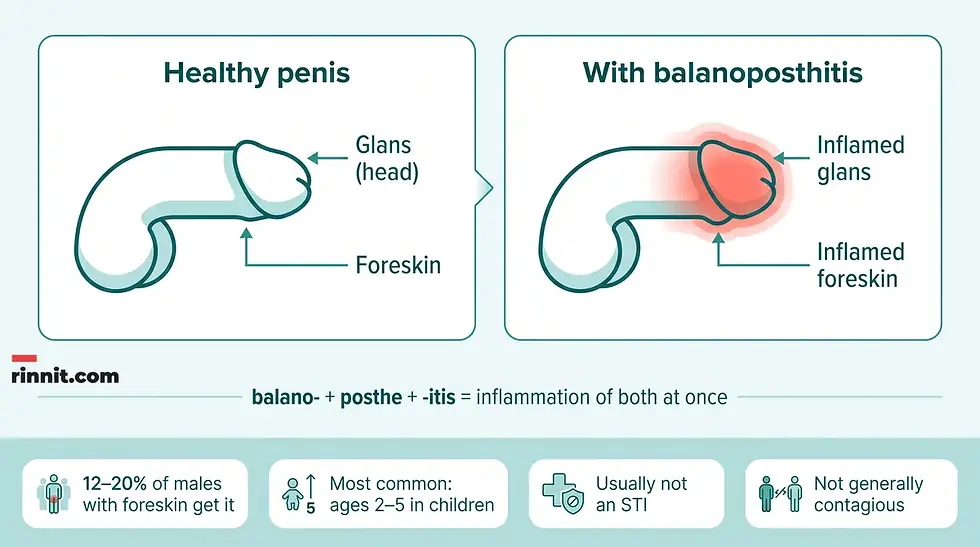
Balanoposthitis is inflammation of both the glans and the foreskin at the same time, affecting 12% to 20% of males with a foreskin [1] [2]. The top cause is not washing and drying the penis regularly, often with Candida overgrowth [1]. Symptoms include pain, swelling, itching and discharge [1] [3]. Wash and dry the area daily; a foreskin stuck back is a medical emergency [1].
What the research says
Circumcision is linked to far less balanitis. Pooling data from meta-analyses, a systematic review found that circumcised males had a 68% lower prevalence of balanitis than uncircumcised males, which is why circumcision is considered when the condition keeps coming back (Morris and Krieger, Int J Prev Med, 2017) [5].
A “stubborn infection” may be something else. A 2025 systematic review screened 978 records and found 15 studies of infective balanitis or balanoposthitis that included clinical photos; all 19 images showed features consistent with male genital lichen sclerosus, and many cases did not fully clear after antimicrobial treatment (Barry et al., Int J STD AIDS, 2026) [6]. This is one reason to see a provider if symptoms last longer than a week or keep returning.
What Is Balanoposthitis?
Balanoposthitis (bal-eh-noh-pahs-thite-es) is a skin infection that affects the foreskin and the head of the penis, called the glans or prepuce. It happens when you have balanitis (infection of the glans) and posthitis (infection of the foreskin) at the same time [1].
The name breaks down into three parts: balano- means glans penis, posthe means foreskin, and -itis means inflammation [1].
The condition causes inflammation and pain, and it can make peeing, orgasming, and ejaculating uncomfortable. In most cases it usually isn't serious [1]. It most often isn't a sexually transmitted infection (STI), and it isn't generally contagious [1]. It often goes away on its own or after treatment [1].
How common is it?
Balanoposthitis is a common condition. Between 12% and 20% of males who have a foreskin get it at some point [1] [2]. Children most often get it between the ages of 2 and 5 [1] [2].
Key fact | Detail |
|---|---|
Who gets it | Males who still have their foreskin |
How common | 12% to 20% of males with foreskin, at some point |
Most common age in children | Ages 2 to 5 |
Is it serious? | Usually isn't serious |
Is it an STI? | Most often isn't |
Is it contagious? | Not generally |
What Does Balanoposthitis Feel and Look Like?
Balanoposthitis looks and feels like irritation affecting both the head of the penis and the foreskin. Symptoms include:
Symptom | How it appears |
|---|---|
Pain and irritation | On the foreskin and the head of the penis |
Tenderness | The area feels sore to the touch |
Swelling | The glans and foreskin puff up |
Itching | Persistent itch in the area |
Discharge | Foul-smelling discharge |
Discoloration | Red, purple, or slightly darker than your usual skin color, and it may look like a rash |
Sores | Sores on the head of the penis |

What Causes Balanoposthitis?
Not washing and drying your penis regularly is the main cause [1] [2]. This can allow bacteria and fungi to build up and cause inflammation.
Some types of common bacteria that may cause balanoposthitis include Streptococcus, Haemophilus parainfluenzae, Klebsiella, and Staphylococcus epidermidis [1]. An overgrowth of fungi such as Candida albicans is the most common cause [1] [2].
Other common causes include scabies, psoriasis, eczema, dermatitis, and allergies [1]. Allergy triggers include latex condoms, personal lubricants, spermicides, harsh soaps, and corticosteroids [1].
Cause type | Examples |
|---|---|
Most common cause | Overgrowth of fungi such as Candida albicans |
Common bacteria | Streptococcus, Haemophilus parainfluenzae, Klebsiella, Staphylococcus epidermidis |
Main trigger | Not washing and drying the penis regularly |
Skin conditions | Scabies, psoriasis, eczema, dermatitis |
Allergies | Latex condoms, personal lubricants, spermicides, harsh soaps, corticosteroids |
Can an STI cause it?
Healthcare providers don't consider balanoposthitis an STI [1]. But STIs may be a cause. Some STIs that may cause balanoposthitis include chlamydia, gonorrhea, human papillomavirus (HPV), syphilis, and trichomoniasis [1].
Who is at higher risk?
Balanoposthitis typically affects males who still have their foreskin [1] [2]. If you had a circumcision, then you don't still have a foreskin, so this condition doesn't apply to you.
You're also at a higher risk if you:
Risk factor | Why it raises your risk |
|---|---|
Lots of exposure to pee | Happens if you wear diapers or absorbent pads |
Poor washing and drying habits | Not thoroughly washing and drying your penis and the area under your foreskin regularly |
Diabetes | A known risk factor |
BMI greater than 25 | Overweight or obesity raises risk |
Having an STI | Increases the chance of balanoposthitis |
Latex or chemical allergies | Allergens irritate the skin |
Can't pull back your foreskin | This condition (phimosis) traps moisture and bacteria |
What complications can develop?
Untreated balanoposthitis can result in recurrent infections, which means it goes away and comes back several times. Recurrent balanoposthitis may be a sign that you have diabetes [1].
Without treatment, it can also cause paraphimosis. This is when you can't pull your foreskin back down over the head of your penis [1]. It can cut off blood flow to the tip of your penis and cause a lot of pain. This is a medical emergency [1].
Warning sign | What it means |
|---|---|
Infection keeps returning | May be a sign of diabetes: see a provider |
Foreskin stuck pulled back | Paraphimosis: cuts off blood flow; medical emergency, go to the ER |
How Do Doctors Diagnose It?
Your healthcare provider will review your health history, ask about your symptoms, and perform a physical exam of your penis [1] [3]. It's often pretty easy to diagnose based on your symptoms and a physical exam. But they may recommend tests to determine its cause [1].
Test | How it works | What it finds |
|---|---|---|
Skin test | A provider gently rubs a cotton swab on your foreskin and glans and sends it to a lab | Identifies bacteria, viruses, and fungi |
Urethral discharge swab | A cotton swab is inserted about 0.75 inches (2 cm) into the urethra, rotated, and sent to a lab | Identifies bacteria and viruses |
Pee test (urinalysis) | You pee into a special cup and the sample goes to a lab | Identifies bacteria and high glucose (a sign of diabetes) |
A1c blood test | A small blood sample from a vein or a fingertip drop; results in minutes | Detects prediabetes and diagnoses diabetes |
How Is Balanoposthitis Treated?
Balanoposthitis treatment depends on its cause [1] [3], and a provider can help find that cause and choose the right option. Your treatment options may include:
Treatment | When it's used | Examples |
|---|---|---|
Antibiotics | Bacterial and viral infections | Amoxicillin, clarithromycin, erythromycin |
Antifungal creams | Fungal infections; applied to the foreskin and glans as prescribed | Nystatin, clotrimazole, econazole, miconazole, sulconazole |
Antihistamines | When an allergic reaction causes it | Provider-recommended antihistamines |
Circumcision | If you get it a lot, or if you can't pull your foreskin back | A minor procedure to remove the foreskin |
Diabetes management | If diabetes is the underlying cause | Managing blood glucose, cholesterol and triglycerides, blood pressure, a food plan, and regular physical activity |
Regularly bathing | Every case | Wash and dry your foreskin, the head of your penis, and your genitals every day with soap and warm water |
When should you see a healthcare provider?
Talk to your healthcare provider if balanoposthitis causes problems peeing or ejaculating. You should also reach out if your discomfort or pain lasts longer than a week [1]. It's a good idea to schedule an STI test, too, if you think an STI is the cause [1].
If the foreskin gets stuck pulled back and you can't pull it back down (paraphimosis), that is a medical emergency [1]. Get care right away, because it can cut off blood flow to the tip of the penis.
What questions should you ask at your appointment?
During your appointment, you may wish to ask the following questions: What's the cause? What tests do you recommend to confirm the cause? If I don't have balanoposthitis, what other condition may I have? When is it safe for me to have sex? What's the best way to keep my penis, foreskin and genitals clean? Is there a medication you can prescribe? Should I see a dermatologist, urologist or another specialist?
What About Sex?
Healthcare providers don't consider balanoposthitis an STI. But an STI may sometimes be the cause [1]. You should avoid sexual intercourse until you know the cause [1].
Sex may also cause more irritation and discomfort. Avoiding sex and masturbation until it clears may help it go away faster [1].
Balanoposthitis can look like an STI, even if it's not the cause. It's a good idea to tell your partner(s) if you have balanoposthitis. If they have any questions, encourage them to talk to their provider before having sex. If you have sex while you have balanoposthitis, be sure to carefully wash and dry your penis afterward [1]. Be sure to pull your foreskin back and clean underneath. Reapply any medications after washing.
How Can You Feel Better and Prevent It?
Regular bathing and careful washing of the foreskin and head of the penis can ease balanoposthitis and is the best way to prevent it [1].
Habit | What to do |
|---|---|
Bathing every day | Wash under your foreskin and properly dry the whole area; teach children the importance of proper penile care |
Avoiding harsh soaps and lotions | Use products labeled “fragrance-free,” “hypoallergenic,” and “for sensitive skin”; avoid products with perfumes, dyes, and alcohol |
Wearing loose underwear and pants | Tight underwear and pants trap heat and moisture, which creates the perfect environment for fungi to grow |
Using mild laundry detergent | Use mild detergents and an extra rinse cycle, especially for underwear and pants |
Staying dry | Keep the area dry after bathing and swimming, and dry your foreskin and the skin under it after peeing |
Bathing regularly is the best way to help prevent balanoposthitis. Carefully wash your foreskin, the skin underneath your foreskin, and the head of your penis. It's also important to thoroughly clean the rest of your penis and overall genital area.
It's a good idea to wear condoms whenever you have sexual intercourse, as well. Wearing a condom can help prevent STIs that may cause balanoposthitis [1].

What's the Outlook?
The outlook for most people who have balanoposthitis is good [1] [2]. For many, symptoms go away within a week after regularly washing the area and treatment [1].
Balanoposthitis may come back if you don't regularly clean the area [1]. If you get it a lot, your provider may recommend circumcision [1] [2].
Though balanoposthitis is common if you have foreskin, it doesn't mean it isn't a shock when it occurs, especially because it's such a sensitive area of your body. In most cases, it goes away within a few days with a little extra care. But if it lasts longer than a few days or you get it regularly, reach out to your healthcare provider. They can figure out the cause and recommend the best treatment.
What is the bottom line on balanoposthitis?
Balanoposthitis is common, usually not serious, and usually clears within about a week once you wash and dry the area properly and treat the cause. The one red flag to never ignore is a foreskin stuck in the pulled-back position, which cuts off blood flow and needs emergency care.
Explore Rinnit.com's library of clear, practical health guides on infections, skin conditions, heart health, and more.
Frequently Asked Questions
Is balanoposthitis the same thing as balanitis?
No. Balanitis is inflammation of the head of the penis (the glans) only. Posthitis is inflammation of the foreskin only. Balanoposthitis is when you have both at the same time.
What does balanoposthitis mean?
The word breaks into three parts: balano- means glans penis, posthe means foreskin, and -itis means inflammation. It's pronounced bal-eh-noh-pahs-thite-es.
Is balanoposthitis contagious?
Not generally. It most often isn't a sexually transmitted infection, though an STI can sometimes be the underlying cause.
How common is balanoposthitis?
Between 12% and 20% of males who have a foreskin get it at some point. Children most often get it between the ages of 2 and 5.
What is the main cause?
Not washing and drying your penis regularly is the main cause. An overgrowth of the fungus Candida albicans is the most common specific culprit.
Can balanoposthitis go away on its own?
Yes. It often goes away on its own or after treatment, and for many people symptoms clear within about a week of regularly washing the area.
Should I avoid sex if I have balanoposthitis?
Yes. You should avoid sexual intercourse until you know the cause, and avoiding sex and masturbation until it clears may help it go away faster.
Can I still have sex if I really want to?
Balanoposthitis can look like an STI even when it isn't one, so it's a good idea to tell your partner(s). If they have questions, encourage them to talk to their provider. If you do have sex, wash and dry your penis carefully afterward, pull back the foreskin to clean underneath, and reapply any medications after washing.
What medications treat balanoposthitis?
It depends on the cause. Antibiotics (amoxicillin, clarithromycin, erythromycin) treat bacterial and viral causes; topical antifungal creams (nystatin, clotrimazole, econazole, miconazole, sulconazole) treat fungal causes; and antihistamines help when an allergic reaction is the cause.
Can diabetes cause balanoposthitis?
Having diabetes is a known risk factor, and recurrent balanoposthitis may be a sign that you have diabetes. Providers may run a pee test and an A1c blood test to check for high glucose levels.
Who is at higher risk?
Males who still have a foreskin, people with lots of exposure to pee (such as diaper or absorbent pad wearers), people who don't wash and dry the area regularly, people with diabetes, people with a BMI over 25, people with an STI, people with latex or chemical allergies, and people who can't pull back their foreskin.
What is paraphimosis and why is it an emergency?
Paraphimosis is when you can't pull your foreskin back down over the head of your penis. It can cut off blood flow to the tip of the penis and cause a lot of pain. It requires emergency medical care.
Can circumcision help?
Yes. If you get balanoposthitis a lot, your provider may recommend circumcision, a minor procedure to remove the foreskin. It's commonly recommended if you can't pull your foreskin back.
What everyday habits help it heal and prevent it from coming back?
Bathe daily (washing under the foreskin and drying the whole area), avoid harsh soaps and products with perfumes, dyes, and alcohol, wear loose underwear and pants, use mild laundry detergent with an extra rinse, and keep the area dry after bathing, swimming, and peeing. Wearing condoms during intercourse can also help prevent STI-related causes.
When should I see a healthcare provider?
If balanoposthitis causes problems peeing or ejaculating, if discomfort or pain lasts longer than a week, or if you suspect an STI. And if your foreskin gets stuck pulled back, go to the ER right away.
Related Reading
Diabetes: Symptoms, Types, Causes, Diagnosis & Treatment: Complete Guide: the underlying condition linked to recurrent cases
Sources
Cleveland Clinic. Balanoposthitis. Cleveland Clinic. Updated October 20, 2025. https://my.clevelandclinic.org/health/diseases/24117-balanoposthitis
Perkins OS, et al. Balanoposthitis. In: StatPearls [Internet]. StatPearls Publishing. Last updated May 6, 2024. PMID 31971711. https://www.ncbi.nlm.nih.gov/books/NBK553050/
Shenot PJ. Inflammation of the Penis. Merck Manual Consumer Version. Updated January 2026. https://www.merckmanuals.com/home/men-s-health-issues/penile-and-testicular-disorders/inflammation-of-the-penis
Shenot PJ. Balanitis, Posthitis, and Balanoposthitis. Merck Manual Professional Version. Updated September 2026. https://www.merckmanuals.com/professional/genitourinary-disorders/penile-and-scrotal-disorders/balanitis-posthitis-and-balanoposthitis
Morris BJ, et al. Penile Inflammatory Skin Disorders and the Preventive Role of Circumcision. Int J Prev Med. 2017;8:32. PMID 28567234. https://doi.org/10.4103/ijpvm.IJPVM_377_16
Barry R, et al. Male genital lichen sclerosus misreported as candidal or other infective balanitides: A systematic review of the literature. Int J STD AIDS. 2026;37(2):176-184. PMID 41026603. https://doi.org/10.1177/09564624251383956
Medical Disclaimer
The information in this article is for general informational purposes only and is not intended as professional medical advice, diagnosis, or treatment. Always seek the advice of your physician or other qualified health provider with any questions you may have regarding a medical condition. Never disregard professional medical advice or delay in seeking it because of something you have read here.



Comments