Atrophic Kidney: What a Shrinking Kidney Means, Why It Happens, and How to Protect the One You Have

Updated: 3 days ago
Medically reviewed by Dr. Baraa Alnahhal, MD · Last reviewed: October 17, 2026
Quick Answer
An atrophic kidney is a kidney that has shrunk below its normal 4–5 inch size, reducing its ability to filter blood [1]. Causes include chronic kidney disease, renal artery stenosis, urinary blockage and kidney infections [1] [2]. It often causes no symptoms [1] [2] and cannot be reversed [1], but the cause can be treated. If both kidneys fail, dialysis or transplant is necessary [1] [2].
What the research says
Kidney blood tests at diagnosis help predict how an atrophic kidney will do long term. In a single-center retrospective cohort of 199 adults with a unilateral atrophic kidney, the most common known cause was chronic kidney infection (chronic pyelonephritis, 17.1%). Of 166 patients followed for at least 3 months, 19 progressed to end-stage kidney disease (CKD stage 5) or a doubling of serum creatinine; higher baseline creatinine, lower serum albumin and renal artery stenosis were independent risk factors for this poor outcome (Istemihan et al., Turk J Med Sci, 2025) [3].
What Is an Atrophic Kidney?
An atrophic kidney is when your kidney is smaller than usual, which affects how well it works. Most people have two kidneys. Each kidney is about 4 to 5 inches (10 to 12 centimeters) long — about the size of your fist [1] [2]. But if you have an atrophic kidney, something affects it and causes it to shrink. An atrophic kidney is usually less than 3.5 to 4 inches (9 to 10 centimeters) [1].
The condition gets its name from "atrophy," the medical word for tissue shrinking when it loses its blood supply or cells. In the kidney, two main things drive that shrinkage:
Driving Force | What Happens |
Low blood supply | The kidney doesn't get enough blood to stay healthy, so it shrinks |
Loss of nephrons | Nephrons are the kidney's tiny filters — they reabsorb useful substances and remove waste products and excess water. When they're lost, the kidney shrinks |
The condition may affect one or both of your kidneys [1] [2]. If it affects one kidney, it's called a singular atrophic kidney. Having bilateral atrophic kidneys means both of your kidneys are smaller than usual.
You may also hear this condition called kidney atrophy, renal atrophy, or an atrophied kidney [1] (pronounced "ay-TROF-ik").

What Are the Types?
Healthcare providers may classify an atrophic kidney as one of two types:
Type | What It Means |
Congenital atrophic kidney | Your kidney is smaller than expected at birth |
Acquired atrophic kidney | A condition or disease causes your kidney to get smaller over time |
What Are the Symptoms of an Atrophic Kidney?
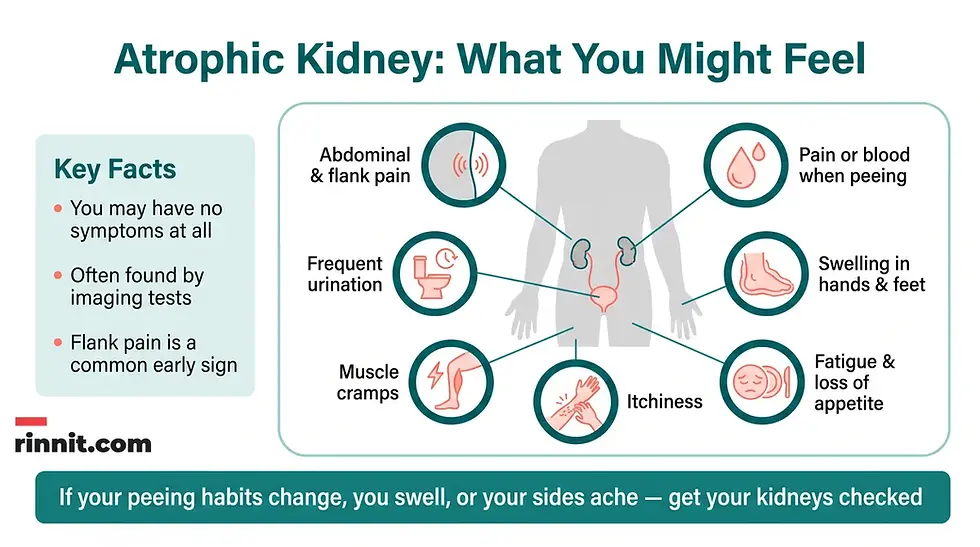
A person with an atrophic kidney may not have any symptoms at all [1] [2]. But if you do, atrophic kidney symptoms may include:
Symptom | What You Might Experience |
Abdominal pain | Aching in the belly area |
Flank pain | Pain in the side, between the ribs and hip |
Pain while peeing (dysuria) | Burning or discomfort when urinating |
Blood in your pee (hematuria) | Pee that looks pink, red, or cola-colored |
Frequent urination | Needing to pee more often than usual |
Fatigue | Feeling worn out or drained |
Loss of appetite | Less interest in food |
Muscle cramps | Sudden, painful muscle tightening |
Swelling | Especially around your hands and feet |
Itchiness | Skin that itches without a clear cause |
What Causes an Atrophic Kidney?
Four main conditions can cause an atrophic kidney, in which the kidney shrinks, and any complications depend on the cause and how much damage it creates.
Cause | How It Shrinks the Kidney |
Chronic kidney disease (CKD) | As your kidneys slowly lose their function, they develop scar tissue and shrink |
Renal artery stenosis | A blockage affects the arteries that supply blood to your kidneys — less blood flow causes them to shrink |
Obstructive uropathy | A blockage in your urinary system affects how well you can pee; extra pressure damages the nephrons |
Kidney infections | Long-lasting kidney infections can eventually cause your kidneys to shrink |
Who Is at Higher Risk?
You may have a greater chance of developing an atrophic kidney if you have:
Risk Factor | Why It Matters |
Diabetes | High blood sugar damages kidney filters over time |
Heart disease | Circulation problems reduce blood flow to the kidneys |
High blood pressure | Elevated pressure damages delicate kidney tissue |
Family history | A history of kidney disease in your biological family raises risk |
What Complications Can Develop?
Complications depend on the cause and how much damage it creates. They may include high blood pressure, chronic kidney disease, and kidney failure [1].
There's a reassuring detail if only one kidney is affected: if you have a unilateral atrophic kidney, you may not have any problems [1] [2]. If your other kidney is healthy, it'll work harder to help make up the work of your atrophied kidney [1].
How Is an Atrophic Kidney Diagnosed?
Diagnosing an atrophic kidney starts with a healthcare provider reviewing your medical history, asking about your symptoms and doing a physical exam. If they suspect a problem with your kidneys, they'll recommend further testing:
Test | What It Shows |
Imaging tests | An ultrasound, CT scan, or MRI gives a detailed look at your kidneys and the surrounding areas |
Blood tests | A sample shows how well your kidneys filter your blood — measured as the estimated glomerular filtration rate (eGFR) |
Pee tests (urinalysis) | A sample is checked for proteins and waste products in your pee, showing how well your kidneys work |
How Is an Atrophic Kidney Treated?
Atrophic kidney treatment depends on what caused the kidney to shrink and whether it affects one or both kidneys. An important point: you can't reverse renal atrophy [1]. But your healthcare provider can help you manage it. Depending on the cause, they may recommend:
Treatment | What It Addresses |
Managing blood glucose and blood pressure | Controls the two biggest drivers of kidney damage |
Medications for chronic kidney disease | Slows further loss of kidney function |
Medications to improve blood flow | Restores supply to kidneys affected by renal artery stenosis |
Procedure for a renal artery blockage | Treats the blockage directly |
Medications or a procedure for a urinary blockage | Removes the obstruction causing obstructive uropathy |
Antibiotics | Treats the underlying kidney infection |
If you have two atrophic kidneys and they both fail, you need dialysis or a kidney transplant to survive [1] [2].
Can Kidney Function Be Improved?
Not always. But you can help protect your kidneys with these habits:
Habit | Recommendation |
Hydration | Drink plenty of water |
Diet | Eat lots of whole grains and fresh fruits and vegetables |
Cut back | On alcohol, salt (sodium), sugar, and ultra-processed or fried foods |
Smoking | Avoid or quit smoking |
Exercise | At least 30 minutes of physical activity most days |
Monitoring | Keep tabs on your blood pressure |
Pain relievers | Limit how many NSAIDs (nonsteroidal anti-inflammatory drugs) you take |
Checkups | Schedule regular appointments with a healthcare provider |

What's the Long-Term Outlook?
If you have kidney atrophy, you can still live a long, healthy, and active life [1]. But it's important to take extra care of your kidney(s) to ensure the best possible outcome. That means following your treatment plan: taking your medications as prescribed, eating kidney-friendly foods, monitoring your blood pressure and blood sugar levels, and going to regular appointments with a nephrologist (a kidney specialist) to monitor your kidney function.
The scenarios differ depending on how many kidneys are affected:
Scenario | What Happens |
One atrophic kidney | Your other healthy kidney can still filter your blood, even if the atrophied one stops functioning |
Two atrophic kidneys that both fail | You need dialysis or a kidney transplant to survive |
When Should I See My Healthcare Provider?
Schedule an appointment with your provider as soon as you notice symptoms of kidney atrophy — changes to your peeing habits, swelling, and pain around your kidneys.
If you have only one kidney, it's a good idea to have your provider check your kidney health at least once a year [1]. Early detection of an atrophic kidney can help preserve kidney function [1] [2].
Conclusion: A Manageable Condition With the Right Care
It can be a shock to find out that one or both of your kidneys are smaller than expected. Some cases of atrophic kidney are mild. If it only affects one kidney and your other kidney is healthy, you may not have any symptoms or need any treatment. But if both kidneys are smaller than expected, they may not function at all.
The good news is that managing atrophic kidneys is possible. Many people can live for years with proper treatment. Reach out to your healthcare provider if you have any questions.
Your next step: If you notice changes to your peeing habits, unexplained swelling, or pain around your kidneys, schedule an appointment with your provider right away — early detection helps preserve kidney function.
Frequently Asked Questions
What is an atrophic kidney?
An atrophic kidney is a kidney that has shrunk below its normal size of 4 to 5 inches (about the size of your fist) to less than 3.5 to 4 inches, which affects how well it filters your blood. It may also be called kidney atrophy, renal atrophy, or an atrophied kidney.
What causes a kidney to shrink?
Causes include chronic kidney disease (scar tissue and shrinkage as function is lost), renal artery stenosis (blocked arteries reduce blood flow), obstructive uropathy (a urinary blockage creates pressure that damages nephrons), and long-lasting kidney infections.
Can you have an atrophic kidney with no symptoms?
Yes. You may not have any symptoms at all. Symptoms, when they appear, include abdominal or flank pain, pain or blood when peeing, frequent urination, fatigue, loss of appetite, muscle cramps, swelling around the hands and feet, and itchiness.
What are the types of atrophic kidney?
A congenital atrophic kidney means the kidney is smaller than expected at birth. An acquired atrophic kidney means a condition or disease causes the kidney to get smaller over time.
Who is at higher risk?
People with diabetes, heart disease, high blood pressure, or a family history of kidney disease in their biological family have a greater chance of developing an atrophic kidney.
What complications can occur?
Complications depend on the cause and the amount of damage, and may include high blood pressure, chronic kidney disease, and kidney failure.
How is an atrophic kidney diagnosed?
A provider reviews your medical history, asks about symptoms, and does a physical exam. If a kidney problem is suspected, they'll order imaging tests (ultrasound, CT scan, or MRI), blood tests to check the eGFR (how well kidneys filter blood), and pee tests (urinalysis) to look for proteins and waste products.
Can a shrunken kidney grow back to normal size?
No. You can't reverse renal atrophy. But treatment manages the underlying cause and protects the remaining kidney function.
How is an atrophic kidney treated?
Treatment depends on the cause and whether one or both kidneys are affected. Options include managing blood glucose and blood pressure, medications for chronic kidney disease, medications to improve blood flow to the kidneys, procedures to treat renal artery or urinary blockages, and antibiotics for kidney infections.
What if I only have one atrophic kidney?
You may not have any problems. If your other kidney is healthy, it'll work harder to make up for the atrophied kidney — and it can still filter your blood even if the atrophied one stops functioning.
What happens if both kidneys fail?
If you have two atrophic kidneys and they both fail, you need dialysis or a kidney transplant to survive.
Can kidney function be improved?
Not always. But you can protect your kidneys by drinking plenty of water, eating whole grains and fresh fruits and vegetables, cutting back on alcohol, salt, sugar, and ultra-processed foods, avoiding smoking, exercising 30 minutes most days, monitoring blood pressure, limiting NSAIDs, and having regular checkups.
Do I need to see a specialist?
Yes — regular appointments with a nephrologist (a kidney specialist) help monitor your kidney function and keep your treatment plan on track.
How often should I get my kidneys checked?
If you have only one kidney, have your provider check your kidney health at least once a year. Early detection of an atrophic kidney can help preserve kidney function.
Can I still live a normal life with an atrophic kidney?
Yes. With kidney atrophy, you can still live a long, healthy, and active life — provided you take extra care of your kidneys by following your treatment plan, taking medications as prescribed, eating kidney-friendly foods, and monitoring blood pressure and blood sugar.
Related Reading
Chronic Kidney Disease (CKD): Stages, Causes, and Treatment Guide — the condition that most commonly shrinks a kidney
Medical Disclaimer
This article is for general informational purposes only and is not a substitute for professional medical advice, diagnosis, or treatment. Always seek the advice of your physician or other qualified health provider with any questions you may have regarding a medical condition. Never disregard professional medical advice or delay seeking it because of something you have read here.
References
Cleveland Clinic. Atrophic Kidney. Cleveland Clinic. Updated July 17, 2026. https://my.clevelandclinic.org/health/diseases/atrophic-kidney
National Kidney Foundation. Kidney Atrophy. National Kidney Foundation. Updated April 1, 2024. https://www.kidney.org/kidney-topics/kidney-atrophy
Istemihan Z, et al. Prognostic factors for long-term outcomes of unilateral atrophic kidneys in adult patients: a single-center retrospective cohort study. Turk J Med Sci. 2025;55(3):687-695. PMID 40686716. https://doi.org/10.55730/1300-0144.6016



Comments