Athlete's Heart: Why Heavy Training Changes Your Heart and How Doctors Tell It Apart From Dangerous Disease

Updated: 2 days ago
Medically reviewed by Dr. Baraa Alnahhal, MD. Last reviewed October 17, 2026. This content is for educational purposes and is not medical advice.
Quick Answer
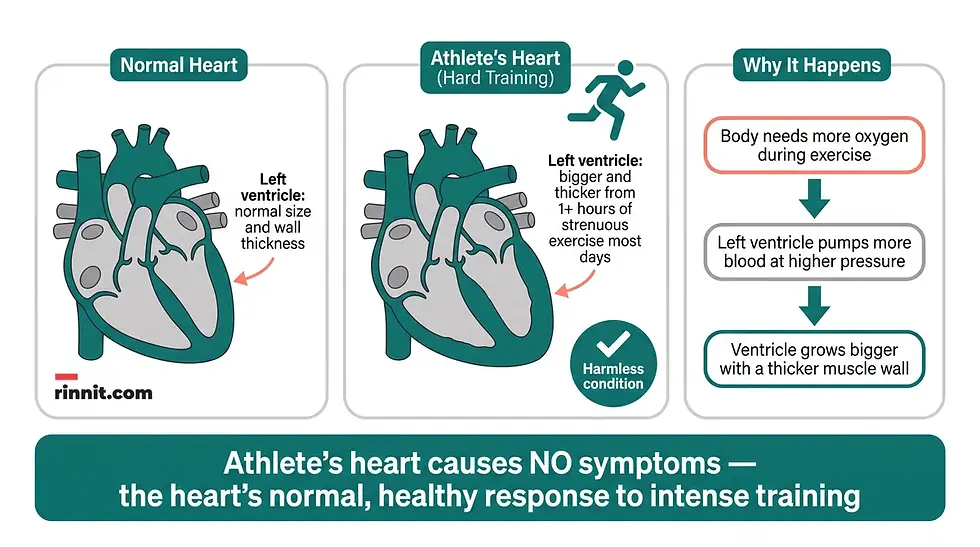
Athlete's heart is a harmless change in which the heart's left ventricle grows bigger and thicker in response to more than an hour of strenuous exercise on most days [2]. It causes no symptoms [2], so chest pain or palpitations point to another problem. [2] In most people the heart returns to normal within about three months of stopping intense training.
What the research says
Detraining shrinks the athlete's heart, but not always completely. In 40 elite male athletes with marked left ventricle enlargement or thickening, a mean of 5.6 years after stopping heavy training the cavity had shrunk by 7% (61.2 to 57.2 mm), maximum wall thickness by 15% (12.0 to 10.1 mm), and heart muscle mass by 28%. Wall thickness returned to normal in every athlete, but the cavity stayed enlarged (60 mm or more) in 9 athletes (22%), and none developed symptoms or heart dysfunction (Pelliccia et al., Circulation, 2002) [6].
The wall rarely gets as thick as in disease, even in big, strong athletes. In 64 male and 71 female rowers, the left ventricle's inner diameter exceeded 55 mm in 69% of the men and 23% of the women, yet wall thickness never went above 14 mm in men or 13 mm in women (Urhausen et al., Int J Sports Med, 1996) [7].
Wall pattern and chamber size help tell athlete's heart from hypertrophic cardiomyopathy. A clinical review found that athletes with hypertrophic cardiomyopathy are more likely than athletes with normal training-related thickening to have uneven (non-concentric) thickening, a higher relative wall thickness, side-wall EKG changes, and a smaller left ventricle cavity (Augustine and Howard, Curr Treat Options Cardiovasc Med, 2018) [8].
What Is Athlete's Heart?
Athlete's heart is the name for the changes that happen in your heart when you do strenuous exercise for more than one hour on most days of the week. [2] Most of the time, these changes aren't excessive. However, in some athletes, the changes can make your heart look similar to how it looks when you have a form of cardiomyopathy (a disease of the heart muscle). [2] [5] Because cardiomyopathy isn't harmless, your provider needs to know what makes athlete's heart different.
Athlete's heart increases the size and wall thickness of an athlete's left ventricle. [2] [5] Your left ventricle is the heart's main pumping chamber. It pumps oxygen-rich blood to the aorta (the body's largest artery), which sends it out to your body.
Athlete's heart is a harmless condition with no symptoms. [2] A provider can pick up unusual heart sounds through a stethoscope or testing, which is usually how it comes to light.
How Does Athlete's Heart Affect Your Body?
Your body needs more oxygen when you exercise. To meet this higher demand, your heart's left ventricle handles more blood and a higher pressure than normal.
After meeting your body's need for more blood and oxygen for a while, your left ventricle starts to get bigger and develop thicker heart muscle. [2] This is the heart's normal, healthy response to heavy training.
When you're not working out, your heart doesn't have to pump as much blood. It can pump what you need at a lower heart rate. This is why people with athlete's heart have a heart rate that's lower than a non-athlete's heart rate at rest. [2]
Who Does Athlete's Heart Affect?
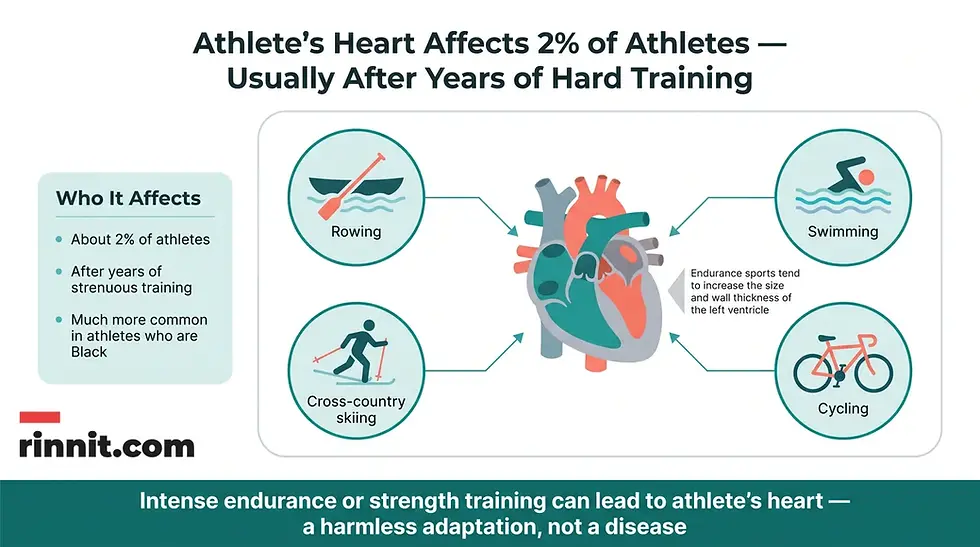
Athlete's heart affects 2% of athletes. This can happen after years of strenuous training. Athlete's heart is much more common in athletes who are Black than in people of other races.
Intense endurance training or strength training can cause athletic heart syndrome in some athletes. Endurance sports tend to increase the size and wall thickness of an athlete's left ventricle.
Sports that can lead to athlete's heart include:
Sport | Why it contributes |
Rowing [7] | Long-duration, high-output endurance effort |
Swimming | Sustained aerobic effort against water resistance |
Cross-country skiing | Full-body endurance effort |
Cycling | Prolonged, sustained aerobic training |
Does Athlete's Heart Cause Symptoms?
Athlete's heart does not cause symptoms [2] and is usually found during a routine checkup or on heart testing. You most likely have a different heart issue if you have chest pain or palpitations. [2]
The condition typically shows up in two ways. Sometimes a provider picks up unusual heart sounds during a routine check: a heart murmur heard through a stethoscope [2], extra heartbeat sounds that aren't normally there [2], a slow heart rate (bradycardia) [2], or lower blood pressure. And sometimes it appears on heart testing, such as an electrocardiogram. [2]
What Is the Difference Between Athlete's Heart and Hypertrophic Cardiomyopathy?
Some electrocardiogram (EKG) results appear similar for these two conditions. [4] [8] It's important to know the difference because one is dangerous and the other isn't.
Feature | Hypertrophic Cardiomyopathy | Athlete's Heart |
Is it dangerous? | Can cause sudden cardiac death in athletes [4] | Doesn't cause sudden cardiac death in athletes |
Space inside the left ventricle | ||
Left ventricle wall thickness | Thicker than in athlete's heart [4] | Thick, but not as thick [4] |
What it is | An inherited heart muscle disease | A harmless response to intense training [2] |

How Is Athlete's Heart Diagnosed?
A healthcare provider can diagnose you based on athlete's heart syndrome signs and symptoms, such as a heart murmur that a provider can hear through their stethoscope [2], extra heartbeat sounds that aren't normally there [2], slow heart rate (bradycardia) [2], or lower blood pressure.
Tests to diagnose athlete's heart include:
Test | What It Does |
Electrocardiogram (EKG) [2] | Records the heart's electrical activity; unusual results happen while at rest but not during exercise in people with athlete's heart |
Ultrasound of the heart that shows chamber size and wall thickness | |
Chest X-ray | Shows the size and shape of the heart |
Cardiopulmonary exercise testing [2] | Measures how the heart and lungs perform under exercise |
Heart MRI | Detailed heart imaging; rarely used for this [2] |
Stress test | Monitors the heart during exercise; rarely used for this [2] |
How Is Athlete's Heart Treated?
You don't need treatment for athlete's heart syndrome. [2] Because athlete's heart is the heart's normal response to intense, aerobic exercise, you don't need to reduce your risk because it's not a dangerous condition.
But your healthcare provider may ask you to stop training for three months and then reimage your heart to ensure you don't have cardiomyopathy. [2] [4] This "pause and recheck" approach is how doctors make the distinction when tests look ambiguous.
Does Athlete's Heart Go Away?
Yes. In most people, your heart returns to a normal size after you stop training so hard. [2] [6] Athlete's heart continues as long as you don't ease up on your training. After three months without training, your heart goes back to normal.
However, a study found that 20% of former athletes still had a large left ventricle five years later. [2] [6] So while the change is usually reversible, it doesn't disappear in every former athlete.
What's the Outlook for Athlete's Heart?
Exercise is good for your heart, and people with an athletic heart don't have problems from it later. [2] A study of high-level athletes found that their endurance training didn't cause heart issues in the future. [6]
When Should I See My Healthcare Provider?
See a healthcare provider for symptoms that could point to coronary artery disease or cardiomyopathy, since these are not caused by athlete's heart.
These symptoms aren't linked to athlete's heart, but they could mean you have coronary artery disease or cardiomyopathy, conditions that do need treatment.
When should you go to the ER? You should call 911 or emergency services if you think you may be having a heart attack. You should also call 911 if you see someone collapse and not respond.
What Questions Should I Ask My Doctor?
Questions to ask a doctor about athlete's heart include whether you need heart screening, how often to check your heart health and whether family members should be checked.
Do I need to be screened for heart issues?
How often should someone check my heart health?
Did you see anything in my test results that means my family should be checked for heart issues? [4]
How can athletes take charge of their heart health?
Athlete's heart is proof that your heart adapts to the demands you place on it: a bigger, stronger pumping chamber built by years of hard training, with no symptoms and no need for treatment. The real skill is knowing the difference between this harmless adaptation and hypertrophic cardiomyopathy, the inherited condition that can endanger athletes. Your provider can tell them apart with the right tests, and in most cases your heart returns to its usual size within a few months of easing off.
Your next step: If you train hard for more than an hour most days and notice fainting, chest pain, or heart palpitations, talk to your healthcare provider. Those symptoms aren't part of athlete's heart. If you're wondering whether your own training is changing your heart, explore Rinnit.com's library of heart health guides for clear, easy-to-understand answers.
Frequently Asked Questions
What is athlete's heart in simple terms?
Athlete's heart is the harmless set of changes that happens in your heart when you do strenuous exercise for more than an hour on most days of the week. Your heart's main pumping chamber (the left ventricle) gets bigger and its wall gets thicker.
Does athlete's heart cause symptoms?
No. There aren't any athlete's heart symptoms. If you have chest pain or palpitations, you most likely have a different heart issue.
Who gets athlete's heart?
Athlete's heart affects about 2% of athletes, usually after years of strenuous training. It is much more common in athletes who are Black than in people of other races.
What sports cause athlete's heart?
Sports that involve intense endurance training, such as rowing, swimming, cross-country skiing, and cycling. Endurance sports tend to increase the size and wall thickness of the left ventricle.
Why do athletes have a low resting heart rate?
When you're not working out, your heart doesn't have to pump as much blood. It can pump what you need at a lower heart rate, which is why people with athlete's heart have a resting heart rate lower than a non-athlete's.
How is athlete's heart found if it has no symptoms?
A provider may pick up a heart murmur through a stethoscope, hear extra heartbeat sounds that aren't normally there, or detect a slow heart rate (bradycardia) or lower blood pressure. Heart testing such as an EKG or echocardiogram can also show the changes.
What is the difference between athlete's heart and hypertrophic cardiomyopathy?
Hypertrophic cardiomyopathy can cause sudden cardiac death in athletes, shrinks the space inside the left ventricle, and makes the wall thicker than in athlete's heart. Athlete's heart doesn't cause sudden cardiac death, makes the inner space bigger, and the wall is thick but not as thick. Some EKG results look similar for both, which is why proper testing matters.
Is athlete's heart dangerous?
No. It's the heart's normal response to intense, aerobic exercise. You don't need to reduce your risk because it isn't a dangerous condition.
Does athlete's heart need treatment?
No. You don't need treatment for athlete's heart syndrome. But your provider may ask you to stop training for three months and then reimage your heart to make sure you don't have cardiomyopathy.
Does athlete's heart go away when you stop training?
In most people, yes. The heart returns to a normal size after you stop training so hard, typically within about three months. But one study found that 20% of former athletes still had a large left ventricle five years later.
Will athlete's heart cause heart problems later in life?
No. Exercise is good for your heart, and people with an athletic heart don't have problems from it later. A study of high-level athletes found their endurance training didn't cause heart issues in the future.
What tests diagnose athlete's heart?
When should I see a doctor about my heart as an athlete?
Contact a healthcare provider if you have fainting, chest pain, or heart palpitations. These aren't linked to athlete's heart but could mean coronary artery disease or cardiomyopathy.
When should an athlete go to the ER?
Call 911 or emergency services if you think you may be having a heart attack, or if you see someone collapse and not respond.
What questions should I ask my doctor about athlete's heart?
Ask whether you need to be screened for heart issues, how often your heart health should be checked, and whether anything in your test results means your family should be checked for heart issues.
Related Reading
Bradycardia: Slow Heart Rate, Symptoms, Causes, and Treatment: what a slow resting heart rate means and when it needs attention.
References
American College of Cardiology. The Athlete Grey Zone: Distinguishing Pathologic From Physiologic Left Ventricular Hypertrophy. American College of Cardiology. October 14, 2014. Original page removed; archived copy (Internet Archive, December 3, 2024). https://web.archive.org/web/20241203144844/https://www.acc.org/latest-in-cardiology/articles/2014/10/14/11/02/the-athlete-grey-zone-distinguishing-pathologic-from-physiologic-left-ventricular-hypertrophy
McKelvie RS. Athlete's Heart. Merck Manual Professional Version. Last updated September 2026. https://www.merckmanuals.com/professional/cardiovascular-disorders/sports-and-the-heart/athlete%E2%80%99s-heart
Pelliccia A, et al. European Association of Preventive Cardiology (EAPC) and European Association of Cardiovascular Imaging (EACVI) joint position statement: recommendations for the indication and interpretation of cardiovascular imaging in the evaluation of the athlete's heart. Eur Heart J. 2018;39(21):1949-1969. PMID 29029207. https://doi.org/10.1093/eurheartj/ehx532
Jering KS. Hypertrophic Cardiomyopathy. Merck Manual Professional Version. Last updated September 2026. https://www.merckmanuals.com/professional/cardiovascular-disorders/cardiomyopathies/hypertrophic-cardiomyopathy
Baba Ali N, et al. The Role of Cardiovascular Imaging in the Diagnosis of Athlete's Heart: Navigating the Shades of Grey. J Imaging. 2024;10(9):230. PMID 39330450. https://doi.org/10.3390/jimaging10090230
Pelliccia A, et al. Remodeling of left ventricular hypertrophy in elite athletes after long-term deconditioning. Circulation. 2002;105(8):944-9. PMID 11864923. https://doi.org/10.1161/hc0802.104534
Urhausen A, et al. Sports-specific adaptation of left ventricular muscle mass in athlete's heart. I. An echocardiographic study with combined isometric and dynamic exercise trained athletes (male and female rowers). Int J Sports Med. 1996;17 Suppl 3:S145-51. PMID 9119535. https://doi.org/10.1055/s-2007-972916
Augustine DX, et al. Left Ventricular Hypertrophy in Athletes: Differentiating Physiology From Pathology. Curr Treat Options Cardiovasc Med. 2018;20(12):96. PMID 30367318. https://doi.org/10.1007/s11936-018-0691-2
Medical disclaimer
This article is for general informational purposes only and is not a substitute for professional medical advice, diagnosis, or treatment. Always seek the advice of your physician or other qualified health provider with any questions you may have regarding a medical condition. Never disregard professional medical advice or delay seeking it because of something you have read here.



Comments