Asbestosis — Symptoms, Causes, Diagnosis, Treatment & Complete Guide

Updated: 2 days ago
Medically reviewed by Dr. Baraa Alnahhal, MD · Last reviewed: October 2026
Quick Answer: What is asbestosis?
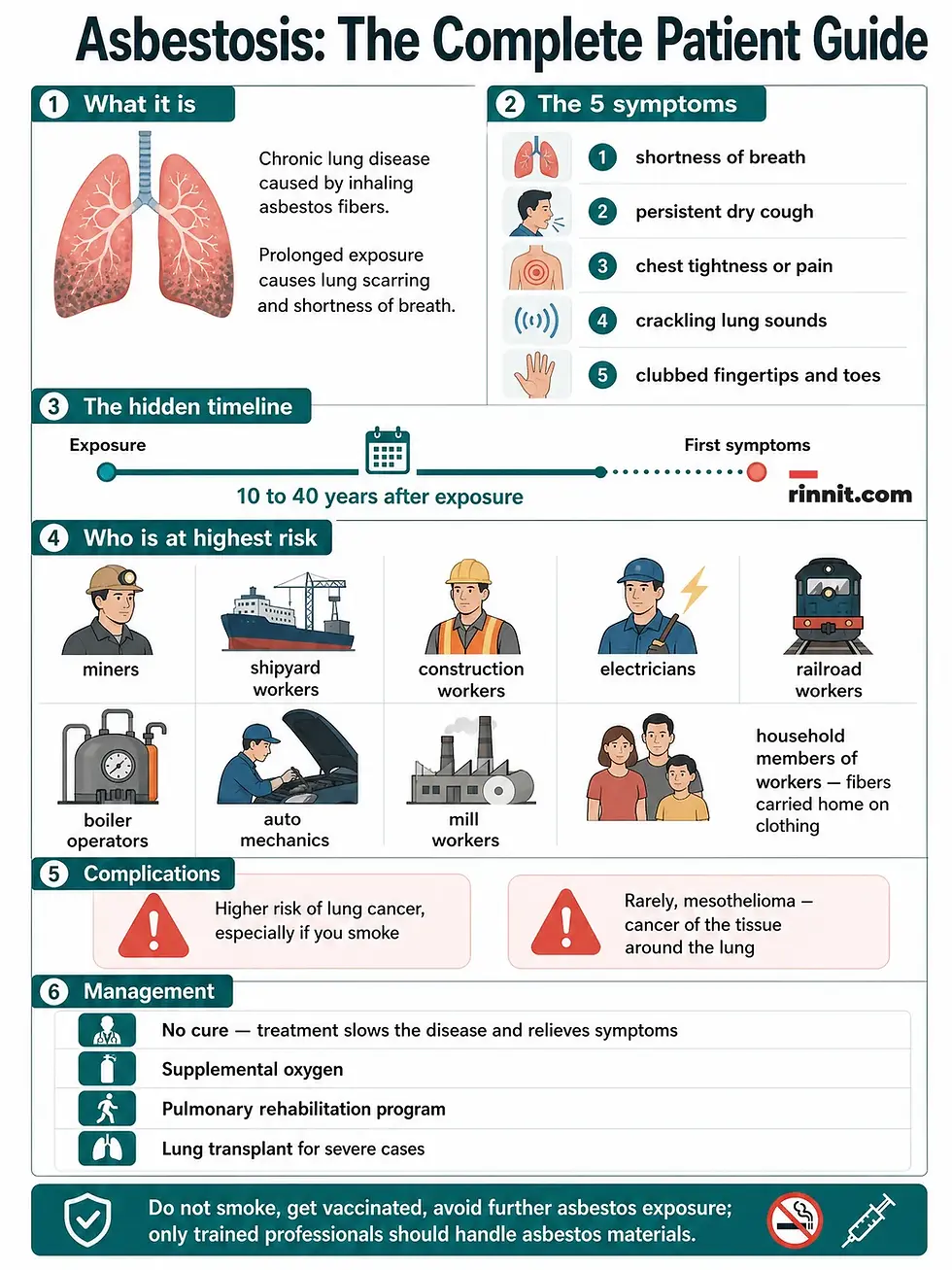
Asbestosis is a chronic lung disease caused by breathing in asbestos fibers over a long period, which scar the lung's air sacs and make the lungs stiff, causing shortness of breath [1]. Symptoms usually appear 10 to 40 years after first exposure [1]. There is no cure that reverses the damage, so treatment focuses on slowing disease and relieving symptoms [2].
What the research says
Asbestos still kills decades after bans. Although Switzerland banned asbestos in 1989, occupational exposure there is still responsible for about 135 deaths from mesothelioma and 930 deaths from lung cancer per year; for smokers, the risk of lung cancer rises through a synergistic effect of asbestos and tobacco. (Walther et al., Rev Med Suisse, 2023) [3]
Cases are not yet falling. A Danish review reports that asbestos was banned there in 1988, yet the prevalence of asbestosis and pleural plaques does not yet appear to be falling, and that typical high-resolution CT changes combined with relevant asbestos exposure are essential for the diagnosis. (Lauridsen et al., Ugeskr Laeger, 2018) [4]
The scarring is diffuse fibrosis seen on imaging. A radiology review describes asbestosis as the most important change in the lung tissue after asbestos exposure, characterized by diffuse interstitial pulmonary fibrosis, and notes that radiologic evaluation is necessary for diagnosis. (Cha et al., Korean J Radiol, 2016) [5]
At a Glance
Aspect | Summary |
Condition type | Chronic lung disease (type of pneumoconiosis) |
Cause | Inhaling asbestos fibers over a long period [1] |
Timeline | Symptoms appear 10 to 40 years after exposure [1] |
What happens | Fibers lodge in the alveoli → tissue scars → lungs become stiff → breathing gets harder [1] |
Highest-risk group | Workers with asbestos jobs before the late 1970s [1] |
Worsening factor | Smoking — increases fiber retention and faster progression [1] |
Diagnosis tools | Physical exam, chest X-ray, CT scan, pulmonary function tests, bronchoscopy, thoracentesis [2] |
Treatment goal | Slow progression, relieve symptoms, prevent complications [2] |
Cure? | No — damage to the alveoli cannot be reversed [2] |

What is the lung disease asbestosis?
Asbestosis (pronounced as-bes-TOE-sis) is a chronic lung disease caused by inhaling asbestos fibers [1]. Prolonged exposure to these fibers causes lung tissue scarring and shortness of breath [1]. Symptoms can range from mild to severe, and — critically — usually don't appear until many years after the initial exposure [1].
To understand the damage, it helps to picture how the lungs work. In your lungs, the main airways, called bronchi, branch off into smaller and smaller passageways. The smallest airways, called bronchioles, lead to tiny air sacs called alveoli — the places where oxygen is exchanged for carbon dioxide in your blood [1]. Asbestos damage happens right in these tiny sacs.
Asbestos itself is a natural mineral product that is resistant to heat and corrosion [1]. It was used extensively in the past in products such as insulation, cement, and some floor tiles [1]. Most people with asbestosis acquired it on the job before the federal government began regulating the use of asbestos and asbestos products in the 1970s [1]. Today its handling is strictly regulated, and getting asbestosis is extremely unlikely if your employer's safety procedures are followed [1]. Only trained and accredited asbestos professionals should manage asbestos products [1].
What are the symptoms of asbestosis, and why do they stay hidden for decades?
The defining feature of asbestosis is its long, silent gap. The effects of long-term exposure to asbestos typically don't show up until 10 to 40 years after initial exposure [1]. By the time symptoms appear, significant scarring has already taken place.
Asbestosis signs and symptoms may include:
Symptom | What to notice |
Shortness of breath | The most common symptom; gets worse over time |
Persistent, dry cough | A cough that doesn't go away [1] |
Chest tightness or pain | Pressure or discomfort in the chest [1] |
Crackling lung sounds | Dry, crackling sounds in the lungs when you inhale (heard by a doctor with a stethoscope) [1] |
Clubbing | Fingertips and toes that appear wider and rounder than usual [1] — often linked to heart or lung conditions |
When to see a doctor: If you have a history of exposure to asbestos and you're experiencing increasing shortness of breath, talk to your healthcare provider about the possibility of asbestosis [1]. Even if your exposure happened decades ago, it is worth mentioning.
How do asbestos fibers scar the lungs and cause asbestosis?
The mechanism is a slow, steady injury. If you are exposed to high levels of asbestos dust over a long period of time, some of the airborne fibers become lodged within your alveoli [1] — the tiny sacs inside your lungs where oxygen is exchanged for carbon dioxide in your blood.
The asbestos fibers irritate and scar lung tissue, causing the lungs to become stiff [1]. This makes it difficult to breathe. As asbestosis progresses, more and more lung tissue becomes scarred. Eventually, your lung tissue becomes so stiff that it can't contract and expand normally [1].
One important lifestyle factor: smoking appears to increase the retention of asbestos fibers in the lungs — and often results in a faster progression of the disease [1].
Which occupations carry a high risk of asbestosis?
Risk of asbestosis is generally related to the amount and duration of exposure to asbestos: the greater the exposure, the greater the risk of lung damage [1]. People who worked in mining, milling, manufacturing, and installation or removal of asbestos products before the late 1970s are at the highest risk [1].
High-risk occupation | How exposure happens |
Asbestos miners | Direct dust from mining |
Shipyard workers | Asbestos insulation on ships |
Building construction workers | Insulation, cement, building materials |
Electricians | Asbestos in older building wiring and panels |
Railroad workers | Asbestos parts and insulation |
Boiler operators | Asbestos insulation around boilers and steam pipes |
Aircraft and auto mechanics | Brake and clutch dust |
Refinery and mill workers | Milling and processing of asbestos products |
Workers removing asbestos insulation around steam pipes in older buildings | Disturbing old insulation releases fibers |
Two less obvious exposure routes also matter:
What are the complications of asbestosis?
Asbestosis raises the risk of two serious conditions, lung cancer (especially in people who smoke) and a rare cancer called malignant mesothelioma.
How is asbestosis diagnosed?
Asbestosis can be difficult to diagnose because its signs and symptoms are similar to those of many other types of respiratory diseases [2]. Diagnosis usually combines a careful history with tests:
1. Physical exam
Your healthcare provider discusses your health history, occupation, and exposure risk to asbestos. During the exam, a stethoscope is used to listen carefully to your lungs for a crackling sound while inhaling [2].
2. Imaging tests
Chest X-ray. Advanced asbestosis appears as excessive whiteness in your lung tissue [2]. If the asbestosis is severe, the tissue in both lungs might be affected, giving them a honeycomb appearance [2].
CT scan. These scans combine X-ray views from many angles to produce cross-sectional images of bones and soft tissues. They provide greater detail and might help detect asbestosis in its early stages, even before it shows up on a chest X-ray [2].
3. Pulmonary function tests
These measure how much air your lungs can hold and the airflow in and out of your lungs [2]. During the test, you blow as hard as you can into a device called a spirometer, which tracks how long it takes you to exhale completely after a deep breath. More-complete tests can measure how much oxygen is being transferred to your bloodstream [2].
4. Diagnostic procedures
In some situations, your provider might remove fluid and tissue for testing to identify asbestos fibers or abnormal cells [2]:
Bronchoscopy — a thin tube (bronchoscope) is passed through your nose or mouth, down your throat, and into your lungs. A light and small camera let the doctor look inside the airways and, if needed, get a fluid or tissue sample (biopsy) [2].
Thoracentesis — after a local anesthetic, a needle is inserted through the chest wall between the ribs and lungs to remove excess fluid for lab analysis and to help you breathe better. Ultrasound guidance may be used [2].
How is asbestosis treated if the damage can't be reversed?
There is no treatment to reverse the effects of asbestos on the alveoli [2]. Treatment focuses on three goals: slowing the progression of the disease, relieving symptoms, and preventing complications [2].
You'll need routine follow-up care — chest X-rays or CT scans and lung function tests at regular intervals, depending on the severity of your condition. Prompt treatment of respiratory infections can also help prevent complications [2].
Therapy
For breathing difficulty caused by advanced asbestosis, your healthcare provider might prescribe supplemental oxygen [2]. It is delivered by thin plastic tubing with prongs that fit into your nostrils, or by thin tubing connected to a mask worn over your nose and mouth [2].
Participating in a pulmonary rehabilitation program may help some people [2]. The program offers educational and exercise components, such as breathing and relaxation techniques, ways to improve physical activity habits, and education to improve overall health.
Surgery
If your symptoms are severe, you might be a candidate for a lung transplant [2].
What self-care steps help people with asbestosis?
Three self-care steps help people with asbestosis alongside medical treatment: not smoking, getting vaccinated and avoiding further asbestos exposure.
Don't smoke. Asbestosis increases the risk of lung cancer, and quitting smoking can reduce this risk [2]. Try to avoid secondhand smoke. Smoking also causes more damage to your lungs and airways, which further reduces your lung reserves [2].
Get vaccinated. Talk to your healthcare provider about the flu and pneumonia vaccines and the COVID-19 vaccine, which can help lower your risk of lung infections [2].
Avoid further asbestos exposure. Further exposure can worsen your condition [2].
How can asbestosis be prevented?
Reducing exposure to asbestos is the best prevention against asbestosis. In the United States, federal law requires employers in industries that work with asbestos products — such as construction — to take special safety measures [1].
Many homes, schools, and other buildings built before the 1970s have materials such as pipes and floor tiles that contain asbestos [1]. The good news: generally, there's no risk of exposure as long as the asbestos is enclosed and undisturbed [1]. The danger comes when materials containing asbestos are damaged, releasing fibers into the air [1]. Always have asbestos products inspected and repaired or removed by trained and accredited asbestos professionals — never attempt to remove them yourself.
Frequently Asked Questions
What is asbestosis?
Asbestosis is a chronic lung disease caused by inhaling asbestos fibers over a long period. The fibers lodge in the tiny air sacs of the lungs, irritate and scar the tissue, and make the lungs stiff — causing shortness of breath.
How long after asbestos exposure do symptoms appear?
Symptoms typically don't appear until 10 to 40 years after the initial exposure. The disease develops so slowly that most people feel fine for decades after exposure before signs such as shortness of breath and a persistent dry cough emerge.
What are the signs of asbestosis?
The main signs are shortness of breath, a persistent dry cough, chest tightness or pain, dry crackling sounds in the lungs when inhaling, and clubbing — fingertips and toes that become wider and rounder than usual.
Which jobs carry the highest asbestosis risk?
People who worked in mining, milling, manufacturing, and installation or removal of asbestos products before the late 1970s are at highest risk — including miners, shipyard workers, construction workers, electricians, railroad workers, boiler operators, and auto mechanics. Household members can also be exposed when fibers are carried home on clothing.
Can asbestosis be cured?
No. There is no treatment that reverses the damage asbestos causes to the lungs. Treatment focuses on slowing the disease, relieving symptoms with oxygen and pulmonary rehabilitation, preventing complications, and — in severe cases — lung transplantation.
Does smoking make asbestosis worse?
Yes. Smoking appears to increase the retention of asbestos fibers in the lungs and often results in a faster progression of the disease. Smoking also raises the already-elevated risk of lung cancer, making quitting one of the most important steps for anyone with asbestosis.
Conclusion
Asbestosis is a disease of delayed consequences — and understanding its slow timeline changes how it should be approached:
The timeline hides the disease. Exposure today can take 10 to 40 years to show symptoms, so anyone with past asbestos exposure and new shortness of breath should mention that history to a doctor.
The damage is scarring, not infection. Fibers lodged in the alveoli scar the lung tissue until the lungs can't expand normally — and no treatment reverses that.
Management is about control, not cure. Oxygen, pulmonary rehabilitation, vaccination, avoiding further exposure, and quitting smoking all slow the disease and protect what lung function remains.
This guide has walked you through the symptoms, the scarring mechanism, the nine high-risk occupations, secondhand exposure, complications, the full diagnostic workup, treatment options, self-care, and prevention — everything you need to understand asbestosis and have an informed conversation with your doctor.
Disclaimer: This article is for general informational purposes only and does not constitute medical advice. Always consult a qualified healthcare professional for diagnosis and treatment.
References
Mayo Clinic. Asbestosis — Symptoms & causes. Accessed October 12, 2026. https://www.mayoclinic.org/diseases-conditions/asbestosis/symptoms-causes/syc-20354637
Mayo Clinic. Asbestosis — Diagnosis & treatment. Accessed October 12, 2026. https://www.mayoclinic.org/diseases-conditions/asbestosis/diagnosis-treatment/drc-20354643
Walther D, Hunziker S, Boichat Burdy S, et al. Asbestos related cancers: burden and recognition as occupational diseases [article in French]. Rev Med Suisse. 2023;19(816):422-5. PMID 36876393. https://doi.org/10.53738/REVMED.2023.19.816.422
Lauridsen HL, Bønløkke JH, Davidsen JR, et al. Asbestosis and pleural plaques [article in Danish]. Ugeskr Laeger. 2018;180(25). PMID 29938630. https://pubmed.ncbi.nlm.nih.gov/29938630/
Cha YK, Kim JS, Kim Y, et al. Radiologic diagnosis of asbestosis in Korea. Korean J Radiol. 2016;17(5):674-83. PMID 27587956. https://doi.org/10.3348/kjr.2016.17.5.674



Comments