Articulation Disorder Explained: A Plain-Language Guide for Parents When Your Child Is Hard to Understand

Updated: 2 days ago
Medically reviewed by Dr. Baraa Alnahhal, MD. Last reviewed October 13, 2026. This content is for educational purposes and is not medical advice.

Quick Answer
An articulation disorder is a common speech impairment in which a child cannot pronounce or use certain sounds or words, by adding, distorting, omitting or substituting sounds. [1] Often there is no obvious cause. [1] A pediatrician checks hearing and often refers to a speech-language pathologist [1], and treatment is speech therapy using exercises that teach tongue and lip movements. [1]
What the research says
Some sound errors persist beyond the preschool years in a small share of children. In a population cohort (the Avon Longitudinal Study of Parents and Children), the estimated prevalence of persistent speech sound disorder at age 8 was 3.6%, and it was more common in boys. Early predictors included not often combining words at 24 months and being unintelligible to strangers at 38 months; school-age predictors included hearing impairment at age 7 and ear-tube (tympanostomy) insertion (Wren et al., Journal of Speech, Language, and Hearing Research, 2016) [6].
Speech sound difficulties often go hand in hand with language and reading difficulties. A meta-analysis found that children with speech sound difficulties had significantly lower language (Hedges' g -0.60) and reading (-0.58) skills than their peers. In longitudinal studies the gaps persisted or widened over time (-0.85 for language, -0.50 for reading), and the authors concluded that broader language assessment and early intervention are warranted (Walquist-Sørli et al., Journal of Speech, Language, and Hearing Research, 2024) [7].
Non-speech mouth exercises alone are not proven to fix speech sounds. A Cochrane review of three small studies (22 children in total) found no strong evidence that non-speech oral motor exercises, such as blowing or lip massage, help children with speech sound disorders. Two of the studies found no added benefit over conventional speech therapy alone, and the authors rated the evidence as low quality. It is reasonable to ask your child's SLP how each activity connects to the sounds being targeted (Lee and Gibbon, Cochrane Database of Systematic Reviews, 2015) [8].
What is articulation disorder, exactly?
Articulation disorder is a speech impairment. It makes it hard for your child to pronounce or use some sounds or words. [1] Specialists may say your child has a functional speech disorder or an articulation delay. [1]
It is a common condition in which your child can't pronounce specific sounds. For example, they may replace "r" with "w." [1] Some children stop using certain words or stop talking. [1] Often, the disorder happens for no obvious reason. [1] Other times, underlying conditions may cause this disorder. Speech therapy can help.
Articulation disorder may make it hard for others to understand what your child is trying to say. [1] It can affect your child's ability to learn or develop relationships. [1] Speech therapy may help your child speak more clearly.
What does articulation disorder sound like?
Articulation disorder involves four types of speech-sound issues that can make a child's speech hard to understand.
Type | What it sounds like | Example |
Addition | Your child may add extra sounds or syllables to words | The word "play" may sound like "puh-lay" [1] |
Distortion | A sound may come out sounding fuzzy. [1] You may recognize it, but feel like it's not quite right | "Th" sounds fuzzy |
Omission | Your child may not use certain sounds | "Hool" instead of "school" [1] because they don't use the "sc" sound |
Substitution | Your child may switch one sound for another | "Rascally rabbit" would sound like "wascally wabbit" [1] |
It's normal for a young child to substitute words or change sounds. Most children stop doing this by the time they're 4 or 5 years old. [1]
What causes articulation disorder?
The cause of articulation disorder is often unknown, as many children develop it for no obvious reason. [1] But experts believe several factors may increase the risk:
Risk factor | How it raises the risk |
Biological family history | Having other family members with speech disorders may increase the chance that your child will, too [1] |
Chronic ear infections | Children with frequent middle ear infections are more likely to have articulation disorder [1] |
Pregnancy issues | Infections and stress during pregnancy, early delivery, and low birth weight may increase the chance [1] |
Sex |
Less frequently, other medical issues can cause articulation disorder:
Underlying condition | What it is |
Dysarthria | A motor speech disorder that can happen if something damages your child's nervous system. [1] Examples are cerebral palsy, stroke, or traumatic brain injury |
Hearing loss | Children learn to talk by listening to others and imitating them, which is why hearing loss may lead to speech issues [1] |
Genetic syndromes | Down syndrome and fragile X syndrome are examples of genetic issues that cause developmental delay issues, including articulation disorder [1] |
Orofacial myofunctional disorders (OMD) | Occur when your child's facial movements affect their speech. Dental issues like severe overbite or underbite may cause OMD; children over 3 who use a pacifier or suck their thumbs may develop this condition [1] |
Physical differences |
How does it affect a child's daily life?
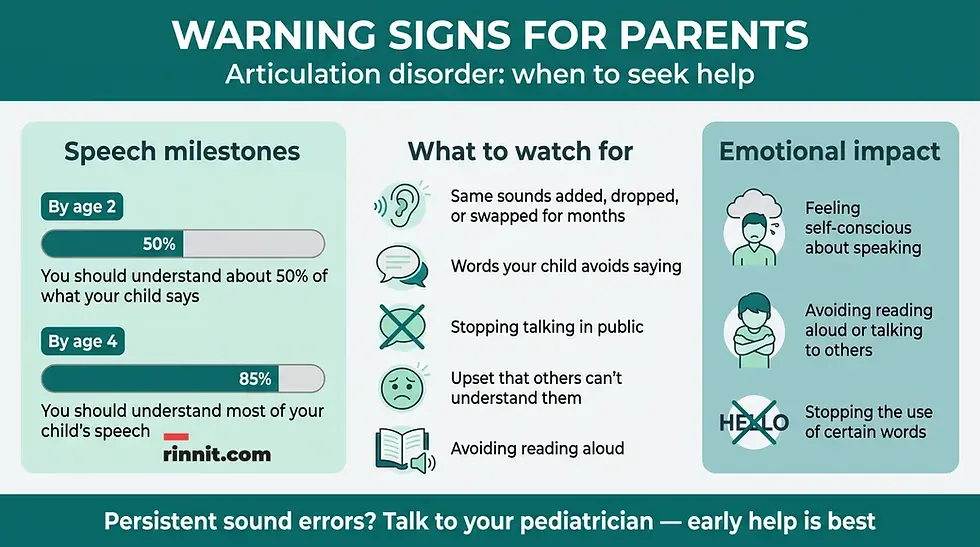
Articulation disorder can affect a child's quality of life [1], especially their confidence when speaking with others. As they get older, your child may become upset if people can't understand them. They may feel self-conscious about speaking. They may avoid reading aloud, talking to others, or saying certain words. [1]
How do doctors diagnose articulation disorder?
Your child's pediatrician will do a physical exam and hearing test. [1] Depending on your child's situation, their pediatrician may refer you to a speech-language pathologist (SLP). [1] This is a specialist who diagnoses and treats speech, language, and communication issues.
An SLP will check your child's mouth for issues with their teeth or palate. [1] They'll ask about your child's medical history, including risk factors like preterm birth or a family history of the condition. [1] They may:
What the SLP does | Why it helps |
Ask your child to make certain sounds and form specific words [1] | Tests which sounds the child can and can't produce |
Chat with your child | Shows whether they can carry on a conversation. The SLP may call this "connected speech" [1] |
Watch how your child moves their mouth when they speak [1] | Reveals whether tongue and lip movements are causing the problem |
Articulation disorder may be mild or severe. For example, the disorder may be mild if your child makes one or two sounds that are wrong. But they may have a severe form if they make many incorrect sounds. [1]
Specialists consider several factors to make a diagnosis, including how much they're able to understand what your child says, and the percentage of consonants your child can pronounce. [1] [5] They'll also rate your child's speech on an articulation disorder scale. [1] [4] The scale measures how children produce speech sounds, like how often a child substitutes words. Your child's SLP will use one of several standard tools to evaluate your child's speech. They'll explain the testing process and what the results mean.

When should you talk to your child's healthcare provider?
In general, you should be able to understand about 50% of what your child says by the time they're 2. [1] By age 4, you should understand most of your child's speech. [1]
How is articulation disorder treated?
Articulation disorder is treated by a speech-language pathologist (SLP), who first identifies the sounds a child can't make. [1] They'll develop exercises and activities that target your child's issues. For example, your child's SLP may:
What is the outlook for a child with articulation disorder?
In general, speech therapy can help most children to speak more clearly. [1] Your child's speech may improve after a few sessions. Another child may need more intensive or long-term therapy. [1] Ask your child's speech-language pathologist to explain how speech therapy may help your child.
Can a child outgrow articulation disorder?
Some children will outgrow the condition. [1] But the longer your child makes sound errors, the harder it can be to help them learn to speak correctly. [1]
How is it different from phonological disorder?
Disorder | What it looks like |
Articulation disorder | Trouble pronouncing some words or making certain sounds. For example, saying "fink" when they mean "think" [1] because they can't pronounce the "th" sound |
Phonological disorder | Difficulty using sounds in patterns, which can affect entire categories of sounds. For example, not saying any final consonants, so "hat" becomes "ha" and "bad" becomes "ba" [1] |
What is the bottom line on articulation disorder?
Articulation disorder is a common, treatable speech impairment in which a child can't pronounce specific sounds: swapping "r" for "w," dropping sounds, adding extra ones, or fuzzing sounds like "th." While most young children naturally outgrow sound mix-ups by age 4 or 5, persistent errors deserve attention, especially because the disorder can make a child self-conscious, hard to understand, and reluctant to read aloud or talk in public.
It often happens for no obvious reason, with family history, chronic ear infections, and pregnancy factors raising the risk, and less often it points to conditions like hearing loss or a cleft palate. Diagnosis is straightforward: a pediatrician's exam and hearing test, followed by an SLP evaluation that pinpoints exactly which sounds are affected. The takeaway is genuinely encouraging: speech therapy helps most children speak more clearly, some after just a few sessions.
Take the next step: If your child's speech is harder to understand than you'd expect (roughly half of their words by age 2, most of it by age 4), start with their pediatrician. They'll run a physical exam and hearing test, and refer you to a speech-language pathologist if needed. Don't wait hoping the child will outgrow it: the longer sound errors persist, the harder they become to correct. Meanwhile, celebrate every attempt to communicate, keep reading together, and let your child know it's safe to speak up. Therapy is not about fixing something "wrong," it's about giving your child the confidence to be heard.
Frequently Asked Questions
What is articulation disorder? A common speech impairment in which your child can't pronounce or use some sounds or words. Specialists may also call it a functional speech disorder or an articulation delay.
What does it sound like? There are four patterns: addition (extra sounds, like "play" becoming "puh-lay"), distortion (a fuzzy sound like "th"), omission (dropping sounds, like "hool" for "school"), and substitution (swapping sounds, like "wascally wabbit").
Is it normal for my child to make sound errors? Yes. It's normal for a young child to substitute words or change sounds. Most children stop doing this by the time they're 4 or 5 years old.
What causes it? Often it happens for no obvious reason. Risk factors include family history of speech disorders, chronic ear infections, infections or stress during pregnancy, early delivery, low birth weight, and being male. Less often, it's caused by hearing loss, dysarthria, genetic syndromes, orofacial myofunctional disorders, or a cleft lip or palate.
How is it diagnosed? The pediatrician does a physical exam and hearing test and may refer you to a speech-language pathologist (SLP). The SLP checks the mouth, listens to connected speech, watches mouth movements, and rates severity using a standardized scale.
How is it treated? Speech therapy. The SLP identifies the sounds your child can't make and creates exercises and activities to target them, including correcting how sounds are made, practicing difficult sounds, and teaching tongue and lip movements.
What's the outlook? Speech therapy can help most children speak more clearly. Some improve after a few sessions; others may need more intensive or long-term therapy.
Can my child outgrow it? Some children will. But the longer sound errors persist, the harder it can be to help them learn to speak correctly, so early help is best.
How do I know when to see a doctor? You should understand about 50% of what your child says by age 2, and most of their speech by age 4. If you don't reach these milestones, talk to your pediatrician.
Is articulation disorder the same as phonological disorder? No. With articulation disorder, your child has trouble pronouncing certain sounds (like "th"). With phonological disorder, your child has trouble using sounds in patterns, which can affect entire categories, like dropping all final consonants so "bad" becomes "ba."
Can it affect my child emotionally? Yes. As children get older, being hard to understand can make them feel self-conscious, avoid reading aloud, avoid talking to others, or stop saying certain words, which is one more reason to seek help early.
Related Reading
Understanding Speech Impairment: Types, Causes, and Support - The broader category that articulation disorder belongs to, and how the different types compare.
References
Cleveland Clinic. Articulation Disorder. Cleveland Clinic. Last updated May 13, 2026. https://my.clevelandclinic.org/health/diseases/23454-articulation-disorder
American Speech-Language-Hearing Association. Cleft Lip and Palate. ASHA Practice Portal. Accessed October 14, 2026. https://www.asha.org/practice-portal/clinical-topics/cleft-lip-and-palate/
Aprile M, et al. Malocclusion and Its Relationship with Sound Speech Disorders in Deciduous and Mixed Dentition: A Scoping Review. Dent J (Basel). 2025;13(1). PMID 39851603. https://doi.org/10.3390/dj13010027
Jing L, et al. Speech-Language Pathologists' Ratings of Speech Accuracy in Children With Speech Sound Disorders. Am J Speech Lang Pathol. 2021;31(1):419-430. PMID 34788553. https://doi.org/10.1044/2021_AJSLP-20-00381
Kim J, et al. Speech and Linguistic Features of Children With Articulation Disorder. Ann Rehabil Med. 2017;41(5):836-842. PMID 29201823. https://doi.org/10.5535/arm.2017.41.5.836
Wren Y, et al. Prevalence and Predictors of Persistent Speech Sound Disorder at Eight Years Old: Findings From a Population Cohort Study. J Speech Lang Hear Res. 2016;59(4):647-73. PMID 27367606. https://doi.org/10.1044/2015_JSLHR-S-14-0282
Walquist-Sørli L, et al. Are Speech Sound Difficulties Risk Factors for Difficulties in Language and Reading Skills? A Systematic Review and Meta-Analysis. J Speech Lang Hear Res. 2024;68(1):164-177. PMID 39626051. https://doi.org/10.1044/2024_JSLHR-24-00170
Lee AS, et al. Non-speech oral motor treatment for children with developmental speech sound disorders. Cochrane Database Syst Rev. 2015;2015(3):CD009383. PMID 25805060. https://doi.org/10.1002/14651858.CD009383.pub2
Medical Disclaimer
This guide is for general information only and is not a substitute for professional medical advice, diagnosis, or treatment. If you're concerned about your child's speech, consult their pediatrician or a speech-language pathologist. Early evaluation leads to the best outcomes. Always seek the advice of a physician or other qualified health provider with any questions about a medical condition. Never disregard professional medical advice or delay seeking it because of something you have read here.



Comments