Arthrogryposis Explained: A Plain-Language Guide for Parents of Babies Born With Stiff or Frozen Joints

Updated: 20 hours ago
Medically reviewed by Dr. Baraa Alnahhal, MD. Last reviewed October 13, 2026. This content is for educational purposes and is not medical advice.
Quick Answer
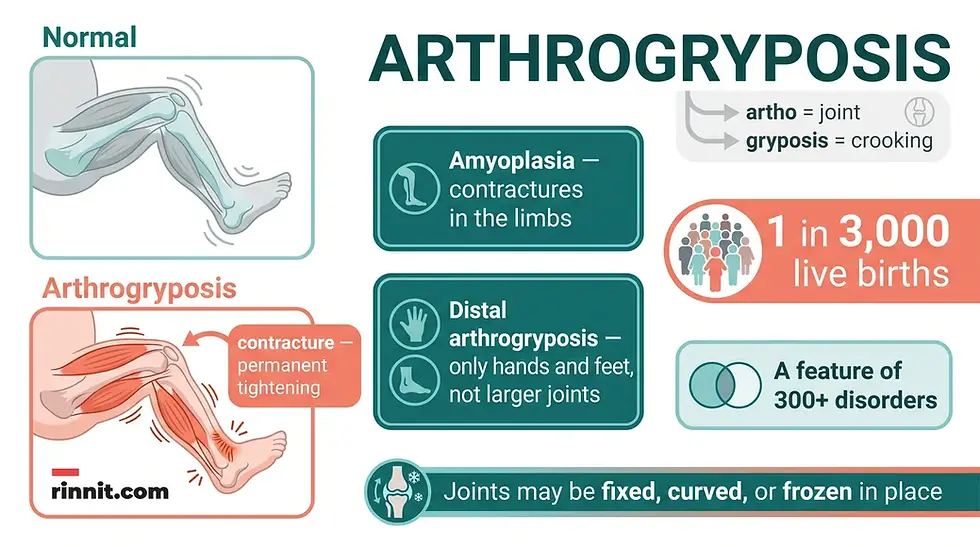
Arthrogryposis is a condition in which a baby is born with more than one stiff or frozen joint, seen in over 300 disorders and affecting about 1 in 3,000 live births [1] [4]. Its cause is often unknown but may involve limited fetal movement or genetic mutations [1] [3]. There is no cure, but therapy usually improves mobility, and most become independent adults [1].
What the research says
Expert consensus supports early, structured rehabilitation, even though high-quality evidence is limited. Because there is little robust scientific evidence to guide care, panels of clinicians, researchers, and people with lived experience from 10 countries developed consensus-based rehabilitation recommendations for children with AMC. After two rounds of review by international experts (41 in round 1 and 37 in round 2), the final 16 recommendations reached a mean agreement rate of 96.6% (Dahan-Oliel et al., Orphanet Journal of Rare Diseases, 2025) [6].
Starting treatment early can make later surgery less extensive. A report from an international hand surgery society committee concluded that manipulating the deformities soon after birth improves range of motion, which makes any operation less extensive, and sometimes surgery is not needed at all. Early one-stage corrective surgery between 3 and 12 months of age improved function, while late, piece-meal surgery gave disappointing results (Mennen et al., Journal of Hand Surgery, 2005) [7].
Surgery on the arms can improve everyday function. A systematic review of 32 studies covering 412 patients who underwent 589 upper limb procedures found that posterior elbow release consistently improved passive elbow flexion and hand-to-mouth reach, and that muscle transfers restored useful active elbow flexion in selected patients. The authors noted that the evidence is limited by retrospective designs and uneven outcome reporting (Jose Jerome et al., The Journal of Hand Surgery, 2026) [8].
Casting can straighten arthrogryposis clubfeet, but more surgery is common. In 177 children followed to about age 9, the Ponseti casting method improved foot position, but repeat surgery was needed in 44% of clubfeet linked to arthrogryposis versus 33% of typical clubfeet. Children with arthrogryposis also had more motor limitations (Church et al., Journal of Pediatric Orthopaedics, 2025) [15].
Walking ability is linked to stronger bones. In 30 children with arthrogryposis, 73% had below-average spine bone density. Bone density was lowest in those who walked only at home or not at all, and function scores rose with walking ability (Spencer et al., Journal of Pediatric Orthopaedics, 2010) [16].
What Is Arthrogryposis, and What Does the Name Mean?
Arthrogryposis, also called arthrogryposis multiplex congenita (AMC), is a characteristic of more than 300 disorders, including muscular dystrophy and trisomy 18 (Edwards syndrome). It refers to the occurrence of more than one contracture at birth [1] [3]. A contracture is a congenital (present from birth) anomaly that causes permanent tightening of the baby’s muscles, skin, and tendons, making their joints short and stiff [1].
The name itself tells the story: arthrogryposis means “crooking” or bending of the joint. “Arthro” means joint, and “gryposis” means crooking [1].
Babies with arthrogryposis are born with joints that are difficult to move. The joints might be fixed, curved, or straight joints frozen in place. (Joints are simply the places where two or more bones connect: your wrists, hips, knees, and neck are all joints.)
How Common Is Arthrogryposis?
A large multinational study covering 8.9 million births across 24 European congenital anomaly registries found a prevalence of 8.5 per 100,000 births (757 cases), with 67% of cases resulting in live birth, 26% ending in termination for fetal anomaly, and 7% in fetal death [9]. Other sources give a range of 1 in 3,000 to 1 in 5,000 births [10]. True amyoplasia, the classic and most common type, occurs in about 1 in 10,000 live births and accounts for roughly one-third of live cases [11] [12].
What Are the Two Main Types?
There are a couple of main types:
Type | What it means |
Amyoplasia | Contractures happen in the limbs |
Distal arthrogryposis | Contractures happen in the hands and feet, but not the larger joints |
Amyoplasia is the most common type, making up about one-third of live cases, and it is usually sporadic (not inherited) [1] [12]. Distal arthrogryposis is often genetic [1].
Is Arthrogryposis Genetic?
Arthrogryposis is congenital, meaning the symptoms begin before birth. The cause is often unknown, but genetic diseases might cause it [1]. Experts have identified more than 400 altered (mutated) genes that affect arthrogryposis, and it is linked to over 35 genetic disorders [1].
How is it different from a single stiff joint? Isolated congenital contractures happen only in one area of the body instead of two or more. One example of an isolated congenital contracture is clubfoot, whereas arthrogryposis involves joints in multiple areas [1].
What Causes Arthrogryposis?
In most cases, the exact underlying cause is unclear [1]. The most common possible causes include:
Possible cause | How it leads to stiff joints |
Limited fetal movement during development | Insufficient amniotic fluid, another fetus in the uterus, or an unusually shaped uterus can keep the baby from moving. If the fetus can’t move its joints, excess tissues form around those joints |
A disorder in the pregnant person | For example, multiple sclerosis |
A genetic disorder | For example, muscular dystrophy |
Diseases of the central nervous system | Including Moebius syndrome and spina bifida (meningomyelocele) |
Diseases of the neuromuscular system | Including myasthenia gravis |
Diseases of the connective tissues | Including dysplasia and metatropic dwarfism |
In some cases, the cause is likely a combination of genetic and environmental issues [1].
What Does Arthrogryposis Look Like at Birth?
Babies with arthrogryposis are born with several distinctive features:
What Are the Symptoms?
Symptoms vary from person to person. One person’s symptoms might be different or more severe than another’s, even within the same family.
Universal symptoms that everyone with arthrogryposis experiences:
Symptom | What it means |
Limited ability to move small and large joints | Joints can move, but not through their normal range |
Inability to move small and large joints | Some joints are frozen in place |
Underdeveloped muscles (hypoplastic muscles) | The muscles never fully grew during development |
Soft, tube-shaped limbs | Arms and legs look soft and lack normal muscle definition |
Soft tissue webbing over the joints | Extra tissue across the joint keeps it from moving |
Additional symptoms a majority of people experience:
Symptom | What it means |
Extra slender and fragile long bones | The long bones in the arms and legs are thinner and break more easily |
Undescended testes (cryptorchidism) | In boys, one or both testicles didn’t move into their normal position before birth |
Symptoms that a smaller percentage of people have:
Symptom | What it means |
Dislocated hips, elbows, or knees | A joint ball has slipped out of its socket |
Structural problems of the central nervous system | The brain and spine didn’t form typically |
Functional problems of the central nervous system | The way the brain and spine work is affected |

Which Joints Are Affected?
Leg joints are affected more than any other joint, with arms next in line [1]. Other commonly affected joints include the shoulders, knees, elbows, ankles, fingers, wrists, toes, hips, and jaw [1].
People with amyoplasia usually don’t have issues with their internal organs or cognitive function (thinking and learning) [1] [3]. But 10% have issues with the abdomen, including gastroschisis (a hole in the abdomen) and intestinal atresia (a blocked intestine) [1] [3].
How Long Does Arthrogryposis Last?
Arthrogryposis doesn’t go away, but treatments can improve quality of life [1]. Physical therapy helps with everyday tasks like getting dressed and drinking water.
How Is Arthrogryposis Diagnosed?
Arthrogryposis can sometimes be detected before birth on routine ultrasound, and after birth it is diagnosed by observing symptoms and performing tests, including imaging [1].
Can It Be Detected Before Birth?
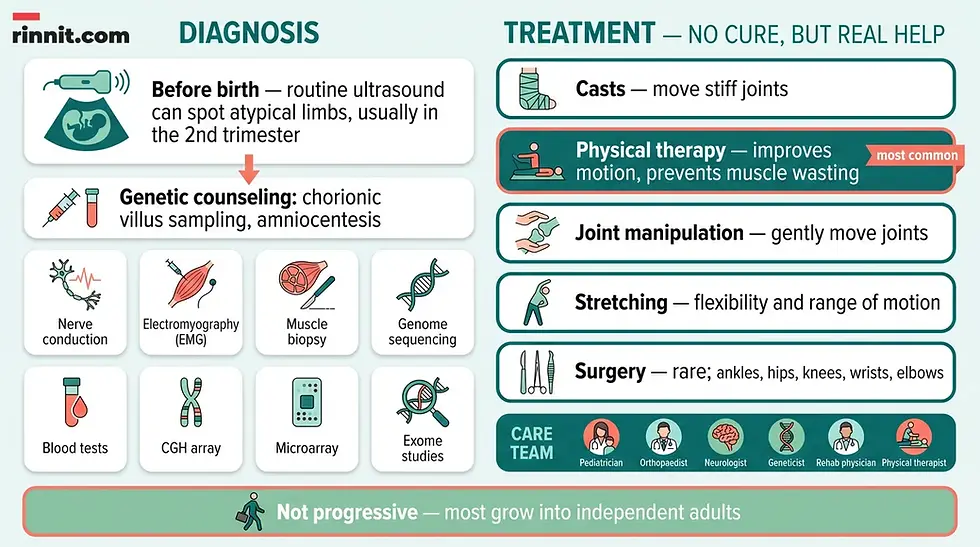
Sometimes. Routine ultrasounds can reveal atypical limbs that might mean the fetus has arthrogryposis [1] [3]. Usually, the healthcare provider discovers the contractures during the second trimester of pregnancy, and may recommend genetic counseling [1].
The genetic counselor provides information about the genetic conditions that might affect the fetus, interviews the family about their health history, and recommends genetic tests, including chorionic villus sampling (testing tissue from the placenta) and amniocentesis (testing the fluid around the baby) [1].
Prenatal ultrasound catches only a minority of cases. A 2024 study found the antenatal detection rate was just 37%, and 53% of mothers in that study later recalled decreased fetal movement during pregnancy [14].
How Is It Diagnosed After Birth?
Providers can also diagnose arthrogryposis after the baby is born by observing symptoms and performing tests like:
Test | What it measures |
Nerve conduction | How quickly nerves transport electrical impulses |
Electromyography (EMG) | Records electrical activity in the muscles |
Muscle biopsy | A small amount of muscle is removed and studied |
Genome sequencing | Identifies the altered genes |
Blood tests | Look for gene and chromosome abnormalities |
Comparative genomic hybridization (CGH) array | Detects chromosome changes |
Microarray | Analyzes thousands of genes at once |
Exome studies | Identify gene variations |
Providers sometimes also rely on imaging tests, including ultrasound and electromyography (EMG) [1]. Once a possible underlying cause is identified, the healthcare provider creates a treatment plan, and the family can help develop it.
How Is Arthrogryposis Treated?
Although there isn’t a cure for arthrogryposis, treatments can improve a child’s quality of life [1]. The treatments are different for each person because the probable causes differ for everyone.
Treatment | What it involves |
Casts | Move stiff joints |
Physical therapy | Improves joint motion and prevents muscle atrophy (when muscles waste away) |
Joint manipulation | A type of therapy where joints are gently moved |
Stretching exercises | Increase flexibility and range of motion |
Surgery | On ankles, hips, knees, wrists, or elbows; improves function by detaching bones from tissues that stop them from moving and forcing the muscles to flex and move. Surgery is rare |
Experts recommend a multidisciplinary approach [1] [4], so your child might need more than one type of treatment.
Which Specialists Are Involved?
You’ll need to see specialists who help with your child’s arthrogryposis. A pediatrician, orthopaedist, neurologist, medical geneticist, rehabilitation physician, and physical therapist might all be involved in the care of your child [1] [4].
Is There Anything I Can Do at Home?
Most people with arthrogryposis need to do physical therapy well into their teenage years [1]. There are exercises that physical therapists can teach you to do at home [1].
What Is the Outlook?
The long-term outlook depends on a few circumstances, including the severity of the arthrogryposis, the underlying cause, and how the child’s body responds to therapy [1].
The encouraging news: the majority of people with arthrogryposis grow up to be independent adults [1]. Treatment helps them improve their mobility to the point that they can lead lives similar to people who don’t have arthrogryposis.
For classic amyoplasia, life expectancy is normal for most survivors and 20-year survival is 94% [12] [13].
Does Arthrogryposis Get Worse?
Arthrogryposis isn’t progressive. It doesn’t get worse [1] [3]. However, the underlying condition that causes it might [1] [3]. Once providers confirm the possible cause, it helps to learn about it.
Can It Be Prevented?
Preventing arthrogryposis is out of your hands. There’s nothing a parent could have done to reduce the child’s risk of arthrogryposis [1].
What questions should you ask your healthcare provider about arthrogryposis?
Asking questions can help you understand the diagnosis better. Consider asking:
Question | Why it helps |
What type of arthrogryposis does my child have? | Shapes the whole care plan |
How long will my baby have to be in a cast? | Sets expectations for daily life |
What’s the best treatment for my child? | Targets the most likely underlying cause |
What specialists should my child see? | Builds the care team |
When do we start physical therapy? | Starts mobility work early |
Are there medications my child should take? | Covers the full treatment picture |
How can I best help my child? | Turns parents into part of the care team |
What is the bottom line on arthrogryposis?
Arthrogryposis means a baby is born with multiple stiff or “frozen” joints. It is a birth condition showing up as part of more than 300 disorders, seen in about 1 in 3,000 live births [1]. The cause is usually unknown, pointing to limited movement in the womb, genetic mutations, or muscle, nerve, or connective-tissue conditions, and it is emphatically not anything a parent could have prevented.
At birth, you may notice sloped shoulders, extended elbows and knees, curled wrists and fingers, dislocated hips, feet pointed down and inward, and a sideways-curved spine, along with underdeveloped muscles and soft, tube-shaped limbs. There is no cure, but the treatment toolbox is real and effective: casts, physical therapy, joint manipulation, stretching, and, rarely, surgery [1]. Leg joints are affected most often, with arms next, followed by the shoulders, ankles, fingers, wrists, toes, hips, and jaw.
The outlook is genuinely hopeful: the condition does not progress [1] [3], and the majority of people with arthrogryposis grow up to be independent adults who lead lives similar to anyone else’s. Early diagnosis, a multidisciplinary care team, and steady therapy make all the difference.
Take the Next Step
If ultrasound or a newborn exam suggests arthrogryposis, take a breath. The most important fact to hold onto is that there is nothing you could have done differently. The next steps are practical: ask for genetic counseling to understand the possible cause, start assembling a specialist team (pediatrician, orthopaedist, neurologist, medical geneticist, rehabilitation physician, and physical therapist), and begin gentle movement-based care (casts, joint manipulation, stretching, and physical therapy) as early as your care team recommends, since most children benefit from therapy well into their teenage years.
Ask about home exercises you can do yourself, and don’t hesitate to talk to your provider about counseling and support groups if the diagnosis feels overwhelming. You’re not alone: other families are walking the same path.
Frequently Asked Questions
What is arthrogryposis? Arthrogryposis (arthrogryposis multiplex congenita, or AMC) is a condition in which a baby is born with more than one contracture: joints that are permanently tightened by the surrounding muscles, skin, and tendons, making them short and stiff. It’s a characteristic of over 300 disorders.
How common is it? Arthrogryposis is uncommon, occurring in 1 in 3,000 live births.
What causes it? In most cases the exact cause is unclear. Common possibilities include limited fetal movement in the womb (from low amniotic fluid, another fetus, or an unusually shaped uterus), disorders in the pregnant person, genetic disorders like muscular dystrophy, central nervous system diseases like Moebius syndrome and spina bifida, neuromuscular diseases like myasthenia gravis, and connective tissue diseases. Experts have found more than 400 mutated genes linked to it.
Can it be detected before birth? Sometimes. Routine ultrasounds can reveal atypical limbs, and the contractures are usually discovered during the second trimester of pregnancy. Providers may then recommend genetic counseling and testing.
What does it look like at birth? Sloped shoulders rotated toward the body’s center, extended elbows and knees, curled wrists and fingers, dislocated hips, feet pointed downward and inward, a sideways-curved spine, underdeveloped muscles, soft tube-shaped limbs, and soft tissue webbing over joints.
Which joints are affected? Leg joints are affected more than any other joint, with arms next. The shoulders, knees, elbows, ankles, fingers, wrists, toes, hips, and jaw are also commonly affected.
Is it progressive? Does it get worse? No. Arthrogryposis isn’t progressive. The joint stiffness itself doesn’t worsen over time, though the underlying condition causing it might.
Is there a cure? No, but treatments can significantly improve quality of life. Casts, physical therapy, joint manipulation, and stretching exercises improve joint motion, and surgery on the ankles, hips, knees, wrists, or elbows is occasionally used, though it is rare.
What is the outlook for my child? The majority of people with arthrogryposis grow up to be independent adults. Treatment improves mobility to the point that they can lead lives similar to people without the condition. The outlook depends on severity, the underlying cause, and how the child responds to therapy.
What specialists does my child need? A pediatrician, orthopaedist, neurologist, medical geneticist, rehabilitation physician, and physical therapist might all be involved. Experts recommend a multidisciplinary approach.
Can I prevent it? No. Preventing arthrogryposis is out of a parent’s hands. There is nothing you could have done to reduce the risk.
Will my child need surgery? Usually not. Surgery is rare. It’s reserved for ankles, hips, knees, wrists, or elbows when other treatments aren’t enough, and aims to improve function by detaching bones from tissues that block movement.
References
Cleveland Clinic. Arthrogryposis. Cleveland Clinic. Last updated May 18, 2022. https://my.clevelandclinic.org/health/diseases/23190-arthrogryposis
Bamshad M, et al. Arthrogryposis: a review and update. J Bone Joint Surg Am. 2009;91 Suppl 4:40-6. PMID 19571066. https://doi.org/10.2106/JBJS.I.00281
Pellegrino J. Arthrogryposis Multiplex Congenita. Merck Manual Professional Version. Last updated April 2025. https://www.merckmanuals.com/professional/pediatrics/congenital-craniofacial-and-musculoskeletal-abnormalities/arthrogryposis-multiplex-congenita
National Organization for Rare Disorders. Arthrogryposis Multiplex Congenita. National Organization for Rare Disorders. Last updated November 12, 2024. https://rarediseases.org/rare-diseases/arthrogryposis-multiplex-congenita/
National Center for Advancing Translational Sciences. Arthrogryposis multiplex congenita. Genetic and Rare Diseases Information Center. Last updated September 2026. https://rarediseases.info.nih.gov/diseases/777/arthrogryposis-multiplex-congenita/
Dahan-Oliel N, et al. Consensus-based recommendations for the rehabilitation of children with arthrogryposis multiplex congenita: an integrated knowledge translation approach. Orphanet J Rare Dis. 2025;20(1):168. PMID 40205440. https://doi.org/10.1186/s13023-025-03671-x
Mennen U, et al. Arthrogryposis multiplex congenita. J Hand Surg Br. 2005;30(5):468-74. PMID 16061316. https://doi.org/10.1016/j.jhsb.2005.06.004
Jose Jerome JT, et al. Upper Limb Reconstruction in Arthrogryposis Multiplex Congenita: A Systematic Review. J Hand Surg Am. 2026;51(9):984-998. PMID 42313045. https://doi.org/10.1016/j.jhsa.2026.05.010
Hoff JM, et al. Arthrogryposis multiplexa congenita: an epidemiologic study of nearly 9 million births in 24 EUROCAT registers. European Journal of Obstetrics, Gynecology, and Reproductive Biology. 2011;159(2):347-350. PMID 22005589. https://doi.org/10.1016/j.ejogrb.2011.09.027
Leao MB, et al. Prenatal Diagnosis and Prognostic Factors in Fetuses With Arthrogryposis Multiplex Congenita-A Systematic Review. Journal of Clinical Ultrasound. 2025;53(5):1131-1139. PMID 40152138. https://doi.org/10.1002/jcu.23983
Nationwide Children's Hospital. Arthrogryposis (AMC). Nationwide Children's Hospital. Accessed October 3, 2026. https://www.nationwidechildrens.org/conditions/arthrogryposis
van Bosse HJP, Zlotolow DA. The Orthopaedic Management of Arthrogryposis Multiplex Congenita. Journal of the Pediatric Orthopaedic Society of North America. 2021;3(2):277. Not indexed in PubMed. https://doi.org/10.55275/JPOSNA-2021-277
Ferguson J, Wainwright A. Arthrogryposis. Orthopaedics and Trauma. 2013;27(3):171-180. Not indexed in PubMed. https://doi.org/10.1016/j.mporth.2013.03.004
Lemin S, et al. Prenatal diagnosis (or lack thereof) of arthrogryposis multiplex congenita and its impact on the perinatal experience of parents: A retrospective survey. Prenatal Diagnosis. 2024;44(5):614-622. PMID 38578615. https://doi.org/10.1002/pd.6569
Church C, et al. The 10-year functional outcome of Ponseti treatment of idiopathic and arthrogrypotic clubfeet with an age-matched control. Journal of Pediatric Orthopaedics. 2025;45(9):552-558. PMID 40396381. https://doi.org/10.1097/BPO.0000000000003007
Spencer HT, et al. Bone mineral density and functional measures in patients with arthrogryposis. Journal of Pediatric Orthopaedics. 2010;30(5):514-518. PMID 20574273. https://doi.org/10.1097/BPO.0b013e3181df6185
Medical disclaimer
This guide is for general information only and is not a substitute for professional medical advice, diagnosis, or treatment. If your baby has been born with stiff joints, consult a pediatrician or pediatric specialist promptly, because early diagnosis and treatment lead to the best outcomes. Always seek the advice of a physician or other qualified health provider with any questions about a medical condition. Never disregard professional medical advice or delay seeking it because of something you have read here.



Comments