What Is Arterial Insufficiency? A Plain-Language Guide to Reduced Blood Flow and What It Means for Your Health

Updated: 2 days ago
Medically reviewed by Dr. Baraa Alnahhal, MD. Last reviewed October 17, 2026. This content is for educational purposes and is not medical advice.

Quick Answer
Arterial insufficiency is reduced blood flow through one or more arteries caused by narrowed or blocked vessels, most often from atherosclerosis or blood clots. [1] Warning signs include leg pain during activity that stops with rest [1] [2], skin changes and ulcers. [1] Chest pain, fainting or slurred speech need immediate 911 care. [1] Treatment includes lifestyle changes, medications, angioplasty, stents and bypass surgery. [1]
What the research says
Reduced blood flow in the leg arteries (peripheral artery disease) affects hundreds of millions of people. A systematic review and analysis of 118 articles estimated that 236.62 million people aged 25 and older were living with peripheral artery disease worldwide in 2015, a global prevalence of 5.56% (95% CI 3.79 to 8.55). Smoking, diabetes, high blood pressure, and high cholesterol were the major risk factors (Song et al., The Lancet Global Health, 2019) [6].
Supervised exercise improves walking in people with leg pain from reduced blood flow. In a meta-analysis of 17 randomized trials with 936 patients with intermittent claudication, supervised exercise training improved maximum walking distance (weighted mean difference 139.04; 95% CI 48.64 to 229.44) and pain-free walking distance (weighted mean difference 40.02; 95% CI 23.85 to 56.18). It also lowered systolic blood pressure (weighted mean difference −7.40; 95% CI −10.69 to −4.11) (Xiao et al., Clinical Research in Cardiology, 2024) [7].
Procedures open arteries more, but they carry trade-offs. A meta-analysis of 11 randomized trials with 1,379 patients with intermittent claudication compared invasive treatment (such as angioplasty and open revascularization) with noninvasive care. Invasive treatment gave greater gains in maximum walking distance (mean difference 64.94; 95% CI 10.77 to 115.12) and ankle-brachial pressure index (mean difference 0.15; 95% CI 0.04 to 0.26), but it was linked to a higher rate of complications, including a higher amputation risk that was not statistically significant (odds ratio 2.46; 95% CI 0.44 to 13.94) (Elmahi et al., Cochrane Evidence Synthesis and Methods, 2025) [8].
What Is Arterial Insufficiency?
Arterial insufficiency is reduced blood flow through one or more of your arteries. [1] It happens when your artery becomes narrowed or blocked. Atherosclerosis (plaque buildup) is the most common cause. [1] [2]
Your arteries are the blood vessels that carry oxygen-rich blood from your heart to the rest of your body. [1] Your organs and tissues rely on this supply of blood to function. So, when your arteries can’t send enough blood to your body, you’re at risk of serious complications.
There are two main forms of arterial insufficiency:
Form | What happens | Why it matters |
Acute arterial insufficiency | Something, usually a blood clot, suddenly slows or stops blood flow [1] | A medical emergency that needs immediate care |
Chronic arterial insufficiency | An underlying condition, usually atherosclerosis, gradually slows blood flow [1] | Over time, symptoms get worse and you face a higher risk of complications |
Early diagnosis and treatment of arterial insufficiency can lower your risk of complications. [1]
How Does Arterial Insufficiency Affect My Body?
Arterial insufficiency reduces blood flow to many different parts of your body, including your major organs and limbs. How it affects you depends on which arteries are narrowed or blocked:
Artery affected | Related condition | Body part affected |
Carotid or vertebral arteries | Carotid artery disease | Brain [1] |
Aorta | Abdominal aortic aneurysm, thoracic aortic aneurysm | Chest, back, and belly [1] |
Coronary arteries | Coronary artery disease | Heart [1] |
Superior mesenteric artery | Mesenteric artery stenosis | Small intestine [1] |
Renal artery | Renal artery disease | Kidneys [1] |
Arteries in your legs | Peripheral artery disease (PAD) | |
Pulmonary arteries | Pulmonary embolism | Lungs [1] |
Keep in mind that arterial insufficiency ultimately affects every part of your body. [1] You may notice symptoms in the part of your body closest to the most-blocked artery, but the same process may be happening elsewhere. For example, if you have chronic arterial insufficiency in your leg from atherosclerosis, you’re at higher risk of having it in your heart as well. [1]
Every part of your body needs oxygen to survive. When an organ or tissue is suddenly deprived of oxygen, as with acute arterial insufficiency, it can fail within a matter of hours. [1] That’s why arterial insufficiency can lead to life-threatening emergencies:
Arterial insufficiency can be fatal if not treated. [1] That’s why it’s important to learn the signs and symptoms and talk with your provider about your risks.
What Is the Difference Between Arterial and Venous Insufficiency?
Arterial insufficiency refers to blood flow problems in your arteries. Venous insufficiency refers to blood flow problems in your veins. Your arteries carry oxygen-rich blood away from your heart to the rest of your body. Your veins carry oxygen-poor blood back to your heart. [1]
Both conditions affect blood flow, but they have different causes. Plaque buildup in your arteries causes arterial insufficiency. [1] Damage to the veins in your legs causes venous insufficiency. [1] Arterial insufficiency can happen anywhere in your body, while venous insufficiency affects your legs. [1]
Both conditions can cause pain or discomfort in your legs. If your legs feel achy, heavy, swollen, or tired, see your provider to discuss your symptoms and their cause. [1]
What Are the Signs and Symptoms of Arterial Insufficiency?
Some people have no symptoms at all until the condition progresses far or leads to a medical emergency. [1] Others have signs and symptoms that include:
Symptom | What it feels like |
Dizziness [1] | Feeling off-balance |
Intermittent claudication | |
Pain in your feet or toes | A burning or aching sensation when you’re resting [1] |
Skin color and texture changes | Flaking, itching, or discolored skin on your legs and feet [1] |
Stomach pain | Discomfort that consistently begins 15 to 20 minutes after finishing a meal and lasts a couple of hours before going away [1] |
Ulcers | |
Weight loss [1] | Unplanned drop in your weight |
You may have narrowed or blocked arteries in more than one part of your body. For example, people who have peripheral artery disease (PAD) are more likely than others to have coronary artery disease. [1] [4] So, you may have a combination of symptoms that points to a range of problems. That’s why it’s essential to tell your provider about any symptoms as soon as you notice them, even if they seem mild.

When Should I Call 911?
Call 911 or your local emergency number immediately if you have any of the following symptoms. These are signs of a medical emergency: [1]
Chest pain or tightness [1]
Double vision or loss of vision [1]
Fainting [1]
Gangrene [1]
Pale, clammy, or blue skin [1]
Rapid pulse [1]
Slurred speech [1]
Sudden, sharp pain in your chest, arm, shoulder, neck, or jaw [1]
Sudden, unexplained shortness of breath [1]
Sudden pain or discomfort in your shoulders, neck, belly, and/or back with no other clear cause [1]
Some symptoms may prevent you from making a call. Consider having a medical alert device (like a necklace) with you at all times. [1] Also, tell your family and friends about the signs and symptoms so they can notice them right away and call 911 for you. [1]
What Causes Arterial Insufficiency?
The most common causes of arterial insufficiency are:
Who Is at Risk?
Arterial insufficiency can happen to anyone, but some people face a higher risk. You’re more likely to develop it if you have these medical conditions:
Medical risk factor | What it is |
Atrial fibrillation [1] | An irregular heart rhythm |
A condition that affects blood sugar levels | |
High cholesterol | |
High blood pressure | |
Protein C deficiency [1] | A blood-clotting disorder |
Protein S deficiency [1] | A blood-clotting disorder |
Thrombophilia [1] | A tendency to form blood clots |
Trousseau syndrome [1] | Cancer-associated thrombosis |
Other risk factors include being over age 60, pregnancy, smoking and tobacco use, and estrogen-based birth control medication. [1]
How Is Arterial Insufficiency Diagnosed?
Providers diagnose arterial insufficiency through a medical history and physical exam. [1] Your provider will ask you many questions to learn as much as possible about your condition:
Your provider will also talk with you about your medical history, the medical history of your biological family members, other conditions you have now, and medications you’re taking. [1]
During your physical exam, your provider may ask you to smile to check for any facial drooping, check your pulse in multiple spots throughout your body (this may include your chest, wrists, and ankles), draw blood to check many different levels that could indicate artery disease, examine your eyes and vision, look for changes in your skin color or texture, look for ulcers on your skin, and measure your blood pressure in both arms. [1]
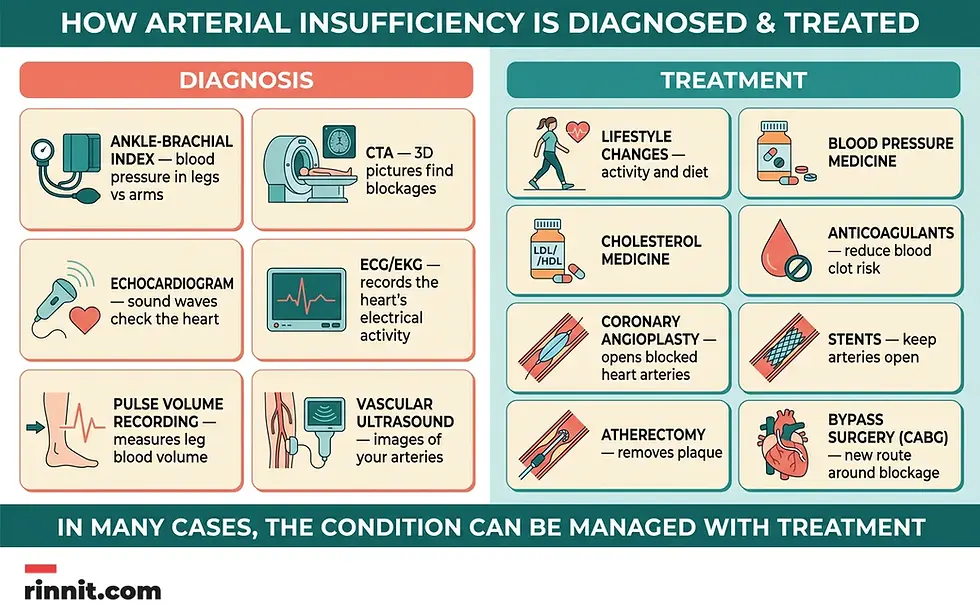
Your provider will learn a lot from this exam. But they may also order tests to learn even more about your arteries:
Test | What it does |
Ankle-brachial index (ABI) | |
Computed tomography angiogram (CTA) | Creates 3D pictures of the blood supply to your heart (coronary arteries), arms, legs, or gut to help find blockages [1] |
Echocardiogram (echo) | Uses sound waves to check your heart function [1] |
Electrocardiogram (ECG/EKG) | Records your heart’s electrical activity to find problems with blood flow or heart rhythm [1] |
Pulse volume recording | Measures blood volume changes in your legs to find blockages [1] |
Vascular ultrasound | Uses sound waves to create images of your arteries, including your carotid arteries, to find blockages [1] |
What Is the Treatment for Arterial Insufficiency?
Treatment for arterial insufficiency depends on the cause and the level of severity. [1] Talk with your provider about the treatment that’s best for you. Treatments include:
Treatment | What it involves |
A procedure that removes plaque from the artery | |
Carotid endarterectomy [1] | Surgery that clears the carotid artery |
Coronary angioplasty [1] | A procedure that opens blocked heart arteries |
Coronary artery bypass grafting (CABG) [1] | Surgery that creates a new route for blood to flow around a blocked heart artery |
Lifestyle changes | Changes related to physical activity and what you eat [1] |
Blood pressure, cholesterol, and glucose medications | Medication to control blood pressure, cholesterol, and blood glucose levels [1] |
Anticoagulants | Medication to reduce your risk of blood clots [1] |
Small mesh tubes that help keep arteries open |
What Can I Expect If I Have Arterial Insufficiency?
In many cases, you can manage arterial insufficiency with treatment. [1] Your outlook depends on your specific condition and how far it’s progressed. Talk with your provider about your prognosis and how best to manage your condition.
What Are the Risk Factors, and How Can I Prevent It?
You’re more likely to develop arterial insufficiency if you have conditions like atrial fibrillation, diabetes, high cholesterol, high blood pressure, protein C or S deficiency, thrombophilia, or Trousseau syndrome, or if you’re over age 60, pregnant, smoke or use tobacco, or take estrogen-based birth control.
Lifestyle factors can make a huge difference in lowering your risk. Things you can do include:
Prevention step | What to aim for |
Physical activity | Walk 30 minutes a day, five days a week. [1] Talk with your provider before starting a new exercise routine |
No smoking or tobacco | This includes vaping and smokeless tobacco [1] |
Heart-healthy diet [1] | Follow a heart-healthy eating pattern |
Limit alcohol | Males: no more than two drinks per day. Females: no more than one drink per day [1] |
Manage your weight [1] | Talk with your provider about what weight is healthy for you |
Take medications as prescribed [1] | Keep up with prescribed medicines |
Regular check-ups | Visit your provider at least once a year [1] |
How Do I Take Care of Myself If I Have Arterial Insufficiency?
Tips for living with arterial insufficiency include creating a physical activity plan. [1] There’s no one-size-fits-all approach, so find an activity you enjoy (it could be dancing, ice skating, or walking in the park) [1], find ways to add more steps to your daily routine, and always check with your provider about what types of exercise are safe for you.
Explore healthier food options, checking into the Mediterranean and DASH diets. [1] Practice good skin hygiene. This is especially important if you have PAD, diabetes-related neuropathy, or any other peripheral neuropathy: wash and moisturize your legs and feet every day, and check for signs of color changes, cracks, or ulcers. [1] Quit smoking and using tobacco, and ask your provider for resources to help you quit. [1] Wear comfortable shoes that are supportive and fit well. [1]
Keep all your appointments and follow-ups. Your provider will let you know how often you need to come in. Also, call your provider right away if you notice any new or changing symptoms. [1] It may be helpful to print out a list of symptoms and keep them nearby. [1] In the hustle and bustle of daily life, it’s easy to miss a symptom or brush it off as no big deal. Stay aware of the things you should look out for, and share this information with your loved ones.
If you’ve learned you have arterial insufficiency, you might be wondering, “how can I fix it?” That’s often a person’s first reaction to any health problem. You may wish you could go back in time and do something differently. But this is a time to look forward, not back. Focus on the here and now. What changes can you make right away? Which ones are most important? Ask your provider for guidance on lifestyle changes and treatment. Most of all, remember that you don’t have to do this alone. Your provider and your entire care team are there to support you in improving the health of your arteries.
What is the bottom line on arterial insufficiency?
Arterial insufficiency is reduced blood flow through one or more arteries, the vessels that carry oxygen-rich blood from your heart to your entire body. Plaque buildup (atherosclerosis) and blood clots are the usual culprits, and the condition comes in two forms: acute (a sudden, emergency-grade blockage, usually from a clot) and chronic (a gradual narrowing that worsens over time).
Because your arteries feed every part of your body, symptoms depend on which arteries are blocked: leg pain during activity, burning feet at rest, skin changes, ulcers, post-meal stomach pain, unexplained weight loss, and dizziness. The same blockage process often affects multiple areas at once. Some symptoms demand immediate 911 care, including chest pain, fainting, gangrene, slurred speech, and pale or blue skin.
Diagnosis combines a thorough history and physical exam with tests like the ankle-brachial index, vascular ultrasound, CTA, echocardiogram, ECG, and pulse volume recording. Treatment spans lifestyle changes, medications for blood pressure, cholesterol, glucose, and clot prevention, and procedures such as angioplasty, stents, atherectomy, and bypass surgery. Many people manage the condition well with treatment, and prevention (no smoking, daily activity, a heart-healthy diet, weight management, and yearly check-ups) puts a lot of control back in your hands. If you notice new or changing symptoms, talk with your provider right away.
Take the Next Step: If you’ve been having leg pain that starts with activity and stops with rest, burning or aching feet at rest, skin changes or ulcers on your legs and feet, stomach pain after meals, or unexplained weight loss, schedule an appointment with your healthcare provider. If you develop chest pain, fainting, gangrene, pale clammy or blue skin, slurred speech, or sudden severe pain anywhere in your chest, arm, shoulder, neck, or jaw, call 911 immediately. Your provider can check your pulses, run simple tests like the ankle-brachial index, and put together a plan, from lifestyle changes and medications to procedures, that protects your heart, brain, legs, and every organ that depends on healthy blood flow.
Frequently Asked Questions
What is arterial insufficiency? It’s reduced blood flow through one or more of your arteries, the blood vessels that carry oxygen-rich blood from your heart to the rest of your body. It happens when your artery becomes narrowed or blocked, most often by atherosclerosis (plaque buildup).
What is the difference between acute and chronic arterial insufficiency? Acute arterial insufficiency happens when something, usually a blood clot, suddenly slows or stops blood flow. It’s a medical emergency that needs immediate care. Chronic arterial insufficiency happens when an underlying condition, usually atherosclerosis, gradually slows blood flow, and symptoms worsen over time with a higher risk of complications.
How does arterial insufficiency affect the body? It reduces blood flow to many different parts of your body, including major organs and limbs. How it affects you depends on which arteries are narrowed or blocked: the brain (carotid/vertebral), chest and belly (aorta), heart (coronary), small intestine (mesenteric), kidneys (renal), legs and feet (leg arteries/PAD), or lungs (pulmonary).
Can it cause a heart attack or stroke? Yes. Arterial insufficiency can lead to life-threatening emergencies: critical limb ischemia (blocked blood flow to hands, legs, or feet), heart attack (blocked flow to the heart), pulmonary embolism (blocked flow in the lungs), and stroke (blocked flow to the brain). An organ or tissue suddenly deprived of oxygen can fail within hours, and the condition can be fatal if not treated.
What are the warning signs? Dizziness; intermittent claudication (leg pain starting during activity and stopping with rest); burning or aching pain in feet or toes at rest; skin color and texture changes like flaking, itching, or discoloration; stomach pain that consistently begins 15 to 20 minutes after a meal and lasts a couple of hours; open sores (ulcers) on the legs and feet, often around the ankle; and unexplained weight loss. Some people have no symptoms at all until the condition progresses far.
What is intermittent claudication? Leg pain that starts during activity and stops when you rest. It’s a classic symptom of reduced blood flow to the legs.
Why does my stomach hurt after eating? If blood flow to the small intestine is reduced (as in mesenteric artery stenosis), you can feel discomfort that consistently begins 15 to 20 minutes after finishing a meal and lasts a couple of hours before going away.
What causes arterial insufficiency? The most common causes are atherosclerosis (plaque buildup in your arteries) and thrombosis (blood clots in your arteries).
What is the difference between arterial and venous insufficiency? Arterial insufficiency is a blood flow problem in the arteries, which carry oxygen-rich blood away from the heart, and is caused by plaque buildup. It can happen anywhere in the body. Venous insufficiency is a problem in the veins, which carry oxygen-poor blood back to the heart, caused by damage to the veins in the legs. Both can cause leg pain or discomfort.
Who is at higher risk? People with atrial fibrillation, diabetes, high cholesterol (hyperlipidemia), high blood pressure (hypertension), protein C deficiency, protein S deficiency, thrombophilia, or Trousseau syndrome (cancer-associated thrombosis). Other risk factors include being over age 60, pregnancy, smoking and tobacco use, and estrogen-based birth control medication.
How is it diagnosed? Through a medical history and physical exam (checking pulses in the chest, wrists, and ankles, drawing blood, examining the eyes and vision, looking for skin changes and ulcers, measuring blood pressure in both arms, and asking you to smile to check for facial drooping), plus tests such as the ankle-brachial index, computed tomography angiogram (CTA), echocardiogram, electrocardiogram (ECG/EKG), pulse volume recording, and vascular ultrasound.
What is the ankle-brachial index? A test that measures the blood pressure in your lower legs versus the blood pressure in your arms, checking how well blood is flowing in your leg arteries.
How is it treated? Treatment depends on the cause and severity. Options include atherectomy, carotid endarterectomy, coronary angioplasty, coronary artery bypass grafting (CABG), lifestyle changes related to physical activity and diet, medications to control blood pressure, cholesterol, and blood glucose, anticoagulants to reduce blood clot risk, and stents.
What can I expect in the long run? In many cases, you can manage arterial insufficiency with treatment. Your outlook depends on your specific condition and how far it has progressed, so talk with your provider about your prognosis and the best way to manage your condition.
How can I prevent it? Add physical activity to your routine (aim to walk 30 minutes a day, five days a week, and check with your provider first), don’t smoke or use tobacco (including vaping and smokeless), follow a heart-healthy diet, limit alcohol (no more than two drinks per day for males, one for females), manage your weight, take medications as prescribed, and visit your provider for regular check-ups at least once a year.
How do I take care of myself if I have it? Build a physical activity plan around activities you enjoy, explore Mediterranean and DASH diets, practice good skin hygiene by washing and moisturizing your legs and feet daily and checking for color changes, cracks, or ulcers (especially important with PAD or neuropathy), quit smoking, wear supportive comfortable shoes, keep all appointments, and call your provider right away for any new or changing symptoms.
References
Cleveland Clinic. Arterial Insufficiency. Cleveland Clinic. Last updated June 22, 2022. https://my.clevelandclinic.org/health/diseases/23356-arterial-insufficiency
Centers for Disease Control and Prevention. About Peripheral Arterial Disease (PAD). CDC. May 15, 2024. https://www.cdc.gov/heart-disease/about/peripheral-arterial-disease.html
Mukherjee D, et al. Mesenteric artery stenosis. In: Guide to Peripheral and Cerebrovascular Intervention. Remedica; 2004. NCBI Bookshelf. Accessed October 14, 2026. https://www.ncbi.nlm.nih.gov/books/NBK27423/
Jones WS. Peripheral Artery Disease. Merck Manual Professional Version. Last updated February 2026. https://www.merckmanuals.com/professional/cardiovascular-disorders/peripheral-artery-disorders/peripheral-artery-disease
Cleveland Clinic. Editorial Policy. Cleveland Clinic. Accessed October 14, 2026. https://my.clevelandclinic.org/about/website/editorial-policy
Song P, et al. Global, regional, and national prevalence and risk factors for peripheral artery disease in 2015: an updated systematic review and analysis. Lancet Glob Health. 2019;7(8):e1020-e1030. PMID 31303293. https://doi.org/10.1016/S2214-109X(19)30255-4
Xiao YC, et al. Effect of supervised exercise training on cardiovascular function in patients with intermittent claudication: a systematic review and meta-analysis of randomized controlled trials. Clin Res Cardiol. 2024;115(8):1255-1271. PMID 38451260. https://doi.org/10.1007/s00392-024-02423-4
Elmahi A, et al. Long-Term Outcomes of Invasive vs Noninvasive Treatment for Intermittent Claudication: A Systematic Review and Meta-Analysis. Cochrane Evid Synth Methods. 2025;3(6):e70053. PMID 41059075. https://doi.org/10.1002/cesm.70053
Medical Disclaimer
This guide is for general information only and is not a substitute for professional medical advice, diagnosis, or treatment. If you have symptoms of reduced blood flow, or any chest pain, fainting, slurred speech, or other emergency signs, seek medical care immediately. Always seek the advice of a physician or other qualified health provider with any questions about a medical condition. Never disregard professional medical advice or delay seeking it because of something you have read here.



Comments