Aphallia: The Rare Condition in Which a Baby Is Born Without a Penis, and How It Is Treated

Updated: 2 days ago
Medically reviewed by Dr. Baraa Alnahhal, MD · Last reviewed: September 2026
Aphallia (pronounced "uh-FAL-ee-uh"), also called penile agenesis, is an extremely rare congenital condition — present in about 1 out of every 10 million to 30 million births — in which the penis does not develop during fetal development. Babies typically have a scrotum and testicles, and the urethral opening often forms in the perineum instead of at the tip of the penis. Treatment first addresses any life-threatening associated problems, ensures the baby can urinate (sometimes via a vesicostomy), and later uses reconstructive surgeries such as phalloplasty and urethroplasty. A child with aphallia and no other complications has a good outlook, and in most cases can still have biological children later in life if the testicles function. Experts do not know what causes the condition, and nothing parents did caused it.
Quick Answer
Aphallia is a congenital condition present at birth in which the penis fails to develop during fetal development; it affects about 1 in 10 million to 30 million births.
Babies with aphallia usually have a scrotum and testicles, and the urethral opening often forms in the perineum rather than at the tip of the penis.
Treatment follows a clear order: first treat any serious congenital problems, then ensure the baby can urinate (sometimes with a vesicostomy), and then perform reconstructive surgery (phalloplasty and urethroplasty) in the first years of life.
If no other complications exist, the outlook is good, and most people with functioning testicles can still have biological children, sometimes with sperm-removal procedures such as microTESE.
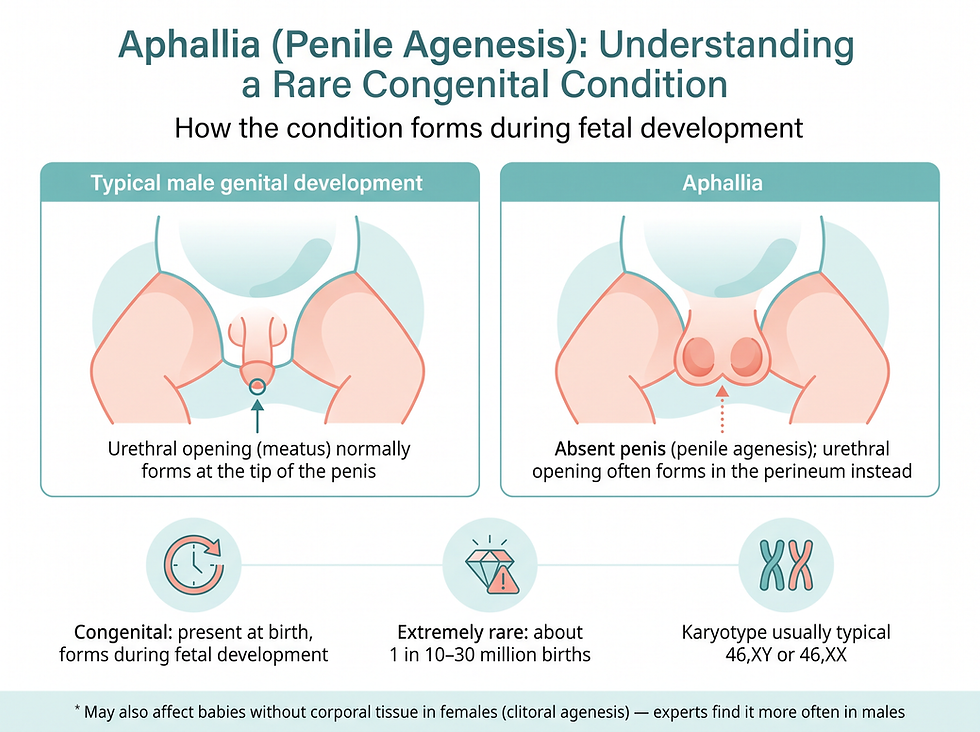
What Is Aphallia?
Aphallia is a congenital condition — one that is present at birth — in which the penis does not develop during fetal development. The word comes from Ancient Greek words that mean "absent" and "penis." It is also called penile agenesis.
The condition also affects the urethral opening (the meatus, where urine leaves the body). Normally, this opening forms at the tip of the penis. In aphallia, it is often located in the perineum — the space between the anus and the genitals.
Key Fact | Detail |
Other name | Penile agenesis |
When it forms | During fetal development (congenital) |
Prevalence | About 1 in 10 million to 30 million births |
Typical chromosomes | Karyotype usually 46,XY (male) or 46,XX (female) |
Urethral opening | Often forms in the perineum instead of the penile tip |
Can Females Have Aphallia?
Some experts believe that "aphallia" should refer to any baby born without corporal tissue — the spongy tissue that fills with blood during sexual arousal. Because both the penis and the clitoris contain this tissue, the condition could potentially affect babies recorded as male or female at birth. In practice, experts find it more often in males.
What Are the Signs and Symptoms of Aphallia?
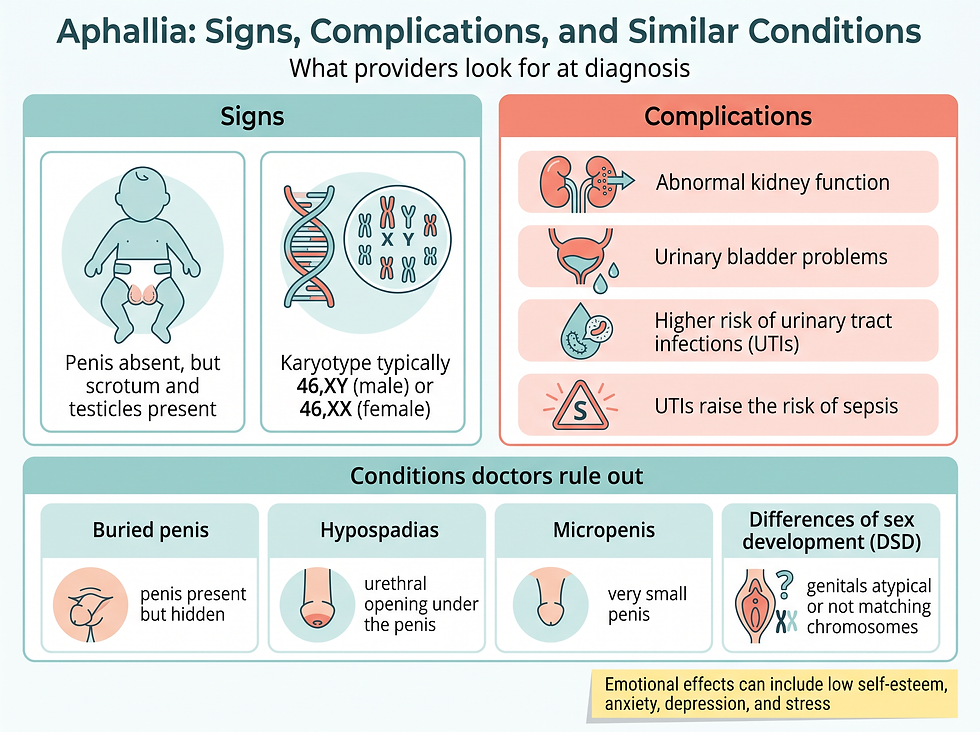
The physical signs of aphallia are evident at birth. Babies with the condition typically have a scrotum and testicles, but no penis. A karyotype test (a chromosome analysis) typically shows results that align with either male (46,XY) or female (46,XX) chromosomes.
Sign | What It Means |
No penis, with scrotum and testicles present | The defining physical feature of the condition |
Typical chromosome results | Karyotype usually shows 46,XY or 46,XX |
Perineal urethral opening | Urine exits from the perineum rather than a penile tip |
Beyond the physical features, aphallia can also affect emotional and mental well-being as a child grows. It may influence how a person sees themselves or interacts with others. Some people with aphallia experience low self-esteem, anxiety, depression, or stress.
What Causes Aphallia?
Experts are not sure what causes aphallia. It occurs during fetal development for reasons that are not yet understood. Importantly, nothing a parent did caused it.
What Complications Are Associated with Aphallia?
Babies with aphallia may have additional issues in the urinary system, including a higher likelihood of recurrent urinary tract infections (UTIs), which raise the risk of sepsis.
Complication | Why It Matters |
Abnormal kidney function | Part of the urinary tract may not develop normally |
Urinary bladder problems | The bladder may be affected alongside the genital difference |
Urinary tract infections (UTIs) | Higher likelihood of recurrent UTIs |
Sepsis | UTIs increase the risk of this life-threatening infection |
Other congenital problems | Some associated defects — such as breathing problems or missing essential organs — can be life-threatening |
How Is Aphallia Diagnosed?
Healthcare providers can diagnose aphallia before birth (prenatally), though the condition is sometimes missed this way. In some cases, a male baby may even be misclassified as female prenatally because of the absent penis.
Providers can also diagnose the condition during a physical examination after birth. To confirm the diagnosis, they may recommend blood tests or imaging tests.
Diagnostic Step | What It Contributes |
Prenatal ultrasound | Can detect the condition before birth, though not always |
Physical examination after birth | Confirms the absent penis and perineal opening |
Blood or imaging tests | Further confirmation of the diagnosis and related anatomy |
Karyotype test | Checks chromosomes; results typically 46,XY or 46,XX |
What Conditions Can Look Like Aphallia?
To diagnose aphallia correctly, providers rule out other conditions with similar appearances, including hypospadias, where the urethral opening is under the penis rather than at the tip.
Condition | How It Differs from Aphallia |
Buried penis | A penis exists but is not easy to see |
Hypospadias | The urethral opening is under the penis rather than at the tip |
Micropenis | The penis is present but very small |
Differences of sex development (DSD) | Genitals do not look typically male or female and/or do not match the chromosomal sex |
How Is Aphallia Treated?
Treatment follows a deliberate sequence, moving from the most urgent needs to reconstructive surgery in the first years of life.
Step 1: Treat Any Serious Congenital Problems
The first step is to look for and treat any other serious congenital problems. Some of these associated problems may be life-threatening.
Step 2: Make Sure the Baby Can Urinate
The next step is to make sure the baby can pee. Sometimes a surgeon may need to perform a vesicostomy — a procedure that creates a new way for urine to leave the body if the baby cannot drain urine on their own.
Step 3: Reconstructive Surgery in Early Childhood
During the first years of life, the child may have surgery to create a penis (phalloplasty) and a urethra (urethroplasty). A specialized urologist helps decide the best surgical methods, and a multidisciplinary team — a group of providers who specialize in different parts of the body — helps with all surgery decisions.
Treatment Stage | What Happens |
Immediately | Identify and treat life-threatening congenital problems (breathing issues, missing organs) |
Early infancy | Ensure urine drainage; vesicostomy if the baby cannot urinate independently |
First years of life | Phalloplasty (penis creation) and urethroplasty (urethra creation) |
Ongoing | Multidisciplinary team guidance and regular check-ups |

What Questions Should Parents Ask the Care Team?
Caring for a child with aphallia involves many big decisions. Experts advise taking one step at a time, since the child will go through many physical, emotional, and intellectual changes as they grow. Regular check-ups with the care team help guide families through these changes.
At appointments, parents may wish to ask: when and how should I talk to my child about aphallia? How should I discuss it with family and friends? How do I make decisions about my child's medical care? Can the team recommend a counselor or support groups?
What Can I Expect If My Child Has Aphallia?
The outlook depends on whether other complications are present. If a child has aphallia without any other complications, the outlook is good. But if other complications exist — such as problems breathing or missing essential organs — the situation can be very serious. The child's healthcare providers will give families a clearer picture of what to expect.
Scenario | Expected Outlook |
Aphallia without other complications | Good |
Aphallia with other complications (breathing problems, missing organs) | Can be very serious |
Can People with Aphallia Have Children?
In most cases, a person with aphallia can still have biological children if they have functioning testicles. However, they may need a procedure to remove sperm from the testicles, such as microTESE.
Can Aphallia Be Prevented?
Because experts do not know what causes aphallia and it develops during fetal development, there is no known way to prevent it. Parents should know that nothing they did caused the condition.
Conclusion
Aphallia — the congenital absence of the penis — is one of the rarest conditions in pediatric medicine, occurring in roughly 1 in 10 million to 30 million births. While the diagnosis is daunting for parents, the care path is well defined: address any life-threatening associated problems first, ensure the baby can urinate, and then pursue reconstructive surgery in the first years of life with a specialized multidisciplinary team. Children without other complications have a good outlook, and most can still have biological children later in life if the testicles function. Emotional support matters too — counseling and support groups help both children and parents navigate the years ahead.
Your next step: if your baby has been diagnosed with aphallia, take the decisions one step at a time and lean on a multidisciplinary pediatric urology team. Ask about counseling and support groups early, keep every follow-up appointment to monitor the urinary system, and raise any signs of urinary infection promptly, since UTIs carry a risk of sepsis.
FAQ
What does aphallia mean?
Aphallia (pronounced "uh-FAL-ee-uh") means "absent penis." It is a congenital condition in which the penis does not develop during fetal development. Another name for the condition is penile agenesis.
How rare is aphallia?
Aphallia is extremely rare. It occurs in about 1 out of every 10 million to 30 million births.
Why does aphallia happen?
Experts are not sure what causes aphallia. It occurs during fetal development for reasons that are not yet understood, and nothing a parent did caused it.
Does a baby with aphallia have testicles?
Typically yes. Babies with aphallia do not have a penis, but they have a scrotum and testicles, and chromosome (karyotype) results usually align with 46,XY or 46,XX.
Where does urine come from with aphallia?
The urethral opening (meatus) normally forms at the tip of the penis. With aphallia, it is often located in the perineum — the space between the anus and the genitals.
Can aphallia be detected before birth?
Yes, providers can sometimes diagnose aphallia prenatally, though it can be missed — and a male baby is occasionally misclassified as female prenatally because of the absent penis. It is also diagnosed by physical examination after birth, confirmed with blood or imaging tests.
What surgeries are used to treat aphallia?
In the first years of life, surgeons may perform phalloplasty (surgery to create a penis) and urethroplasty (surgery to create a urethra). If the baby cannot urinate on their own, a vesicostomy may be performed first. A specialized urologist and multidisciplinary team guide these decisions.
Can a person with aphallia have biological children?
In most cases, yes — if the testicles function. However, a sperm-removal procedure such as microTESE may be needed.
Related Reading
References
Aphallia overview and clinical guidance, medically reviewed patient health resource, last updated January 13, 2026.
Yuri P, Yunir PE, Utama ETP, et al. "Aphallia – Congenital Absence of the Penis: A Systematic Review." BMC Urol. 2024;24(1):75.
Friedman AA, Zelkovic PF, Reda EF, Franco I, Palmer LS. "Male and Female Aphallia Associated with Severe Urinary Tract Dysplasia." J Pediatr Urol. 2016;12(4):268.e1-7.
Qiang S, Li FY, Zhou Y, et al. "Congenital Absence of the Penis (Aphallia): A Rare Case Report." Medicine (Baltimore). 2019;98(15):e15129.
Palacios-Juárez J, Hanson-Viana E, Rodríguez-Quintero JH, et al. "Aphallia: Do Sociocultural Issues Affect Treatment Decisions?" BMJ Case Rep. 2018;2018:bcr2018226459.
Congenital Genitourinary Abnormalities. In: Cunningham F, Leveno KJ, Dashe JS, Hoffman BL, Spong CY, Casey BM, eds. Williams Obstetrics. 26th ed. McGraw Hill; 2022.
Medical disclaimer: This article is for general informational purposes only and is not a substitute for professional medical advice, diagnosis, or treatment. Always seek the advice of your physician or other qualified health provider with any questions you may have regarding a medical condition. Never disregard professional medical advice or delay seeking it because of something you have read here. If you think you may have a medical emergency, call your doctor, go to the emergency department, or call emergency services immediately.
Comments