Anorgasmia in Women: Symptoms, Causes, Treatment & Complete Guide

Updated: 2 days ago
Medically reviewed by Dr. Baraa Alnahhal, MD · Last reviewed: October 17, 2026
Anorgasmia means delayed, infrequent, absent, or less-intense orgasms despite sexual arousal and adequate stimulation [1]. It is a disorder only when it causes you significant distress, and it is highly treatable.
Quick Answer
Anorgasmia is delayed, infrequent, absent or significantly less-intense orgasm after adequate sexual arousal and stimulation, diagnosed only when it causes the woman significant distress [1]. It can stem from relationship issues, cultural factors, physical conditions or medicines [1]. Effective treatments include education, practice programs, devices, therapy and sometimes hormones.
What the research says
Mindfulness-based cognitive behavioral therapy (CBT) has the strongest evidence for orgasm problems. A 2026 systematic review of 36 studies in women with desire, arousal, or orgasm dysfunction (26 were randomized trials) found that mindfulness-based CBT significantly improved total Female Sexual Function Index scores and the desire, arousal, and orgasm subscales; no study compared CBT directly with medication (Toledo et al., Journal of Minimally Invasive Gynecology, 2026) [3].
Fixes for antidepressant-related orgasm problems rest on limited evidence. A Cochrane review of 23 trials (1,886 people) found that bupropion 150 mg twice daily beat placebo on sexual function ratings in three studies of men and women (SMD 1.60; 95% CI 1.40–1.81) and looked the most promising option for women, while it remained uncertain whether sildenafil works better than placebo in women (Taylor et al., Cochrane Database of Systematic Reviews, 2013) [4].
Even the best-studied drug option carries low-certainty evidence. A 2025 systematic review of 11 randomized trials (859 women), pooling 2 trials, found bupropion SR 150 mg twice daily improved the orgasm domain versus placebo (1.90; 95% CI 1.78–2.02) but did not improve depressive symptoms, and the evidence quality was rated low (de Aquino et al., Clinics, 2025) [5].
Anorgasmia at a Glance
Aspect | Summary |
Definition | Delayed, infrequent, absent, or significantly less-intense orgasms after arousal and adequate stimulation [1] |
Also called | Female orgasmic disorder (the spectrum of orgasm problems) [1] |
The distress rule | Only a disorder if it causes significant distress — occasional variation in orgasms is normal |
Four types | Lifelong, acquired, situational, generalized [1] |
Cause categories | Personal/psychological, relationship, physical/medical (conditions, surgeries, medicines, alcohol, smoking, menopause) |
Most common medication culprit | Antidepressants, particularly SSRIs, plus blood pressure medicines, antipsychotics, antihistamines [1] |
Diagnosis | Medical history, pelvic exam, questionnaires about sexual experiences [2] |
First-line treatments | Education, directed masturbation programs, sensate focus, position changes, sexual enhancement devices, cognitive behavioral therapy [2] |
Outlook | Highly treatable; treatment is tailored to what is contributing to the problem |
What Is Anorgasmia?
An orgasm is a peak feeling of intense pleasure in response to stimulating sexual activity. Anorgasmia is the medical term for experiencing any of the following in a significant way:
Delayed orgasm
Absence of orgasm
Fewer orgasms
Less-intense orgasms
These experiences count as anorgasmia when they occur after sexual arousal and adequate sexual stimulation and cause the woman significant distress [1]. This last part is crucial: among all women, the frequency and intensity of orgasms vary, and for any individual, orgasms can be different from one time to the next. The type and amount of stimulation needed to have an orgasm also varies. Women who do not always reach orgasm during sexual encounters but do not find it distressing do not have a disorder [1].
The term female orgasmic disorder refers to the broader spectrum of problems with orgasms, and anorgasmia is often used as shorthand for this group of conditions [1].
Multiple factors may lead to anorgasmia, including relationship or intimacy issues, cultural factors, physical or medical conditions, and medicines [1]. The good news is that treatments exist — education about sexual stimulation, sexual enhancement devices, individual or couple therapy, and medicines.
One fact helps normalize the experience: vaginal penetration during sex only indirectly stimulates the clitoris, and that may not be enough stimulation for orgasm [1]. Many women may also need direct manual or oral stimulation of the clitoris to reach orgasm.
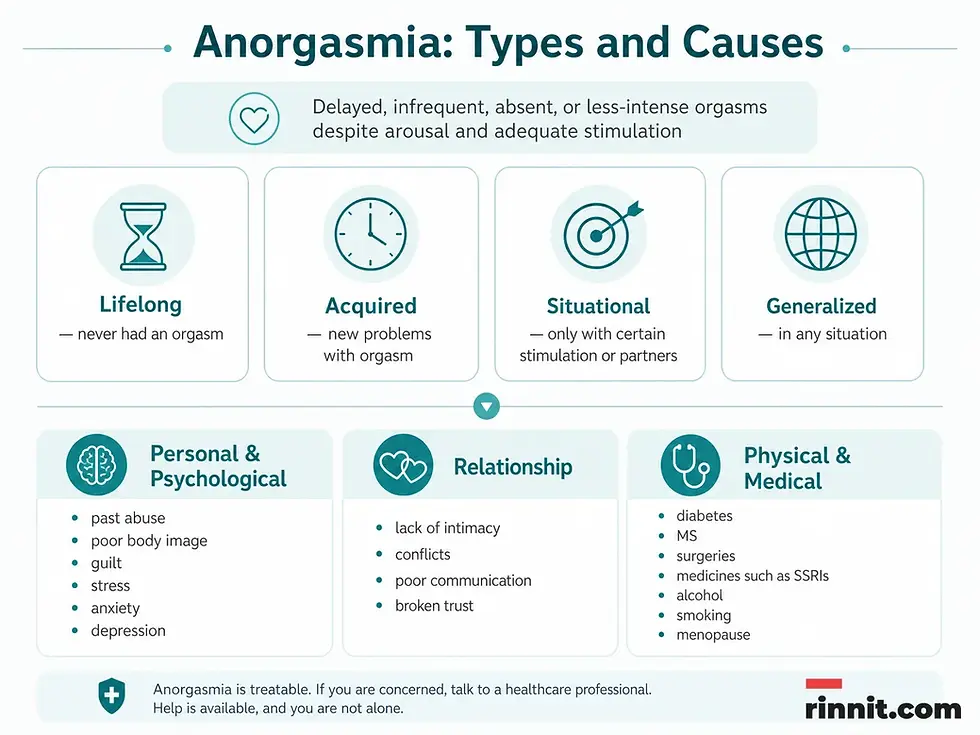
What are the four types of anorgasmia?
Understanding which type applies helps guide treatment, because the contributing factors often differ.
Type | Meaning |
Lifelong | You have never had an orgasm [1] |
Acquired | You have new problems with having orgasms after a period of normal function |
Situational | You have problems with orgasm only in certain situations, with certain kinds of stimulation, or with certain partners [1] |
Generalized | You have problems with orgasm in any situation [1] |
When should women see a doctor about anorgasmia?
The guidance is simple: talk to your healthcare professional if you have concerns about your sex life, especially if you are concerned about your ability to have an orgasm [1]. Anorgasmia is treatable, and a primary care professional or gynecologist can identify contributing conditions and walk you through the options.
What causes anorgasmia in women?
Sexual arousal and orgasms are complex reactions to various physical, emotional, sensory and psychological factors. Difficulties in any of these areas can affect your ability to have an orgasm. The causes fall into three broad groups.
Personal and Psychological Factors
Past experiences, behaviors, background, and mental well-being may all contribute to problems with orgasms.
Factor | Examples |
Trauma | Past sexual or emotional abuse [1] |
Knowledge gaps | Lack of knowledge about sexual stimulation or interactions [1] |
Self-image | Poor body image |
Guilt | Guilt or embarrassment about sex |
Beliefs | Cultural or religious beliefs about sex [1] |
Stress | Financial problems, loss of a loved one |
Mental health | Anxiety or depression |
Relationship Factors
Problems with a sex partner may be contributing factors. These include lack of emotional intimacy, unresolved conflicts, poor communication of sexual needs and preferences, infidelity or breach of trust, intimate partner violence, and a partner's own sexual dysfunction — for example, a male partner with erectile dysfunction [1].
Physical Causes
A wide range of illnesses, physical changes, and medications can interfere with orgasms.
Physical cause | How it interferes |
Health conditions | Long-term conditions such as diabetes, overactive bladder, or multiple sclerosis may be contributing or complicating factors [1] |
Gynecological treatments | Tissue damage from gynecologic surgeries, such as hysterectomy or cancer surgery, may affect the ability to have an orgasm [1] |
Medicines | Many prescription and nonprescription medications can inhibit orgasm, including blood pressure medicines, antipsychotic medicines, antihistamines, and antidepressants — particularly selective serotonin reuptake inhibitors (SSRIs) |
Alcohol and smoking | Alcohol suppresses the nervous system and may hamper the ability to have an orgasm; smoking can limit blood flow to the sexual organs [1] |
Age-related changes | Changes to the body after menopause or later in life may contribute to various types of sexual dysfunction [1] |
Related Sexual Disorders
Women experiencing anorgasmia may have one or more related sexual problems that contribute to or complicate the difficulty with orgasms:
Problems with sexual arousal
Little or no desire for sex
Pain from sexual intercourse or other sexual stimulation
Dryness of the vagina or vulva
Involuntary tightening of the vagina, called vaginismus [1]
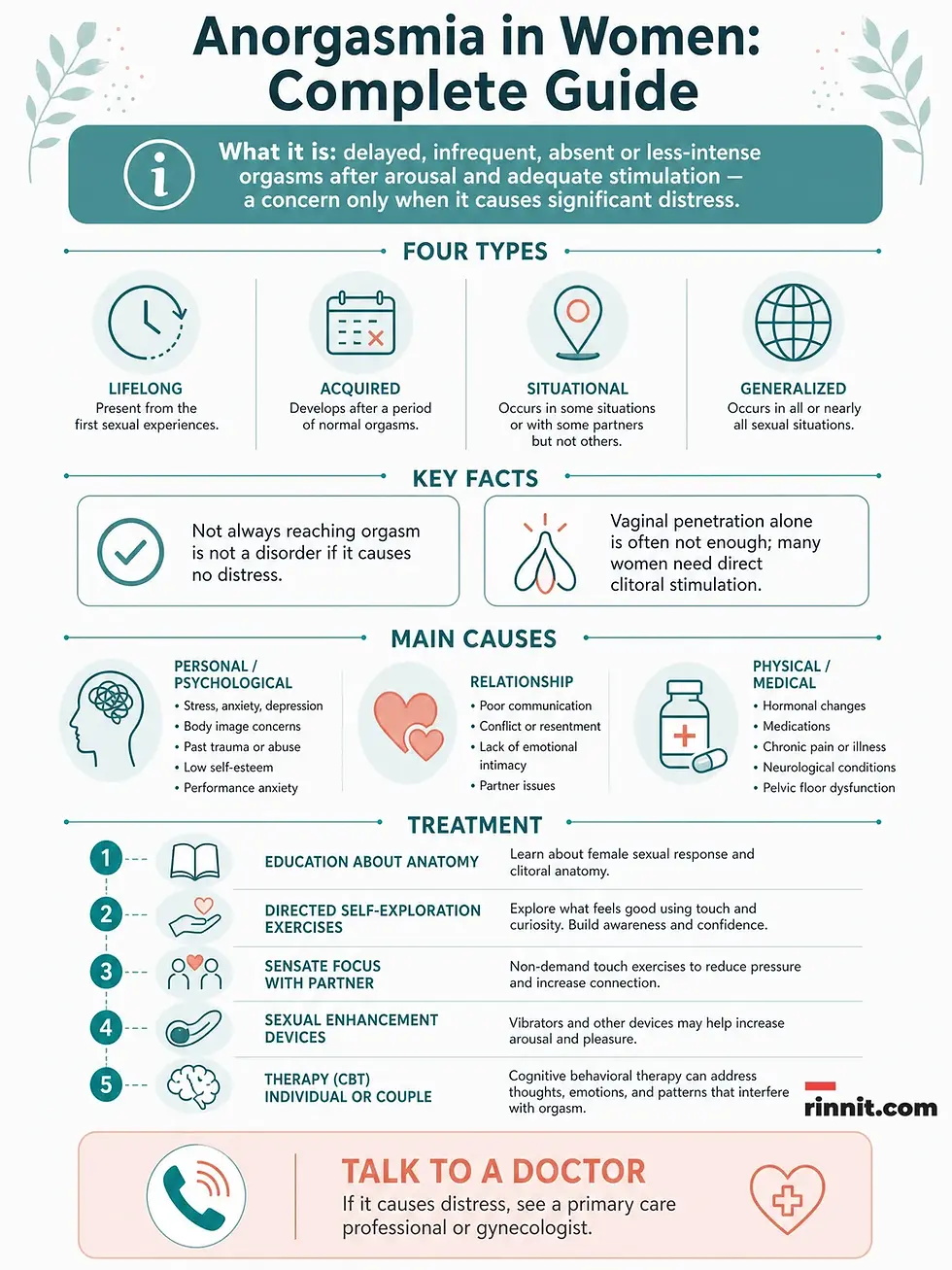
What are the risk factors for anorgasmia in women?
Anorgasmia is linked to a number of risk factors that make it harder to have an orgasm [1].
Risk factor | Note |
Low education level | A social determinant associated with higher risk |
Low income | A social determinant associated with higher risk |
Poor health | Overall poor health raises risk |
Depression and other mental health conditions | Anxiety and depression are both risk factors and possible causes |
History of trauma | Such as sexual abuse |
How is anorgasmia diagnosed?
Your primary care professional or gynecologist will review your medical history and conduct a general medical exam and pelvic exam. These exams may identify physical conditions that contribute to problems having orgasms [2].
Your care professional may ask questions about your experiences with orgasms and other related issues, and you may receive a questionnaire covering the same ground. Expect questions about your recent and past sexual experiences, your partner or partners, how you feel about your sexual experiences, and the types of stimulation or sexual activity you engage in. In some cases, your healthcare professional may want to talk with both you and your partner, or meet with your partner separately [2].
How do lifestyle changes and therapy treat anorgasmia?
Treatment for anorgasmia depends on what is contributing to the problem. It usually begins with approaches that help you understand your body better, learn what works for you, and change behaviors. If an underlying medical condition is contributing, your healthcare professional will recommend appropriate treatment for it [2].
Approach | What it involves |
Education | A discussion of female sexual anatomy and how different parts respond to stimulation; addresses questions, clears up misunderstandings, and explains other recommended treatments; educational materials may be recommended [2] |
Directed masturbation | A program of instruction and at-home exercises that helps you become familiar with your own body and explore self-directed sexual stimulation; after learning to bring yourself to orgasm, that knowledge is practiced with your partner [2] |
Sensate focus | A couples approach with instruction and at-home exercises that begins with non-erotic touch and gradually introduces more intimate touch and sexual stimulation; the goal is for each partner to understand the other's needs and learn to communicate and direct each other in order to reach orgasms [2] |
Changes in sexual positions | Positions that increase stimulation of the clitoris during vaginal sex [2] |
Sexual enhancement devices | Vibrators and air-pulsating devices that stimulate the clitoris, plus a device held over the clitoris that creates mild suction to increase blood flow; typically used alone first to understand what works, then with a partner [2] |
Cognitive behavioral therapy | Individual or couples therapy that addresses thinking about sex in general or with a partner, and builds behaviors that promote good sexual relations — such as learning ways to talk with your partner about sex or communicate needs during sex [2] |
What medical treatments are available for anorgasmia?
Although some medicines have been tested for treating anorgasmia, there is not enough evidence to support their use. Hormone replacement therapies may have some benefit, but they carry risks that require careful monitoring [2].
Hormone therapy | Potential benefit | Caveats |
Estrogen therapy | Treatment for menopausal symptoms may also improve the sexual experience; a low-dose vaginal estrogen (cream or suppository) can improve blood flow to the genitals and vaginal lubrication [2] | Long-term use of estrogen pills is associated with a risk of breast cancer and cardiovascular disease [2] |
Testosterone therapy | For some women in menopause with testosterone levels lower than typical for women, replacement may improve arousal and orgasms [2] | Side effects may include acne, excess body hair, a decline in HDL ("good") cholesterol, and risks similar to estrogen replacement therapy [2] |
Should women with anorgasmia try alternative medicine?
Natural products, such as those made with L-arginine or Russian olive tree extract, are marketed for improving women's sex lives. They have been studied only in very small trials using multiple herbal products or combined with other drugs or lifestyle management programs — there is not enough data to know if they have any treatment effect [2]. Talk with your healthcare professional before trying natural therapies, which can cause side effects and interact with other medicines [2].
How should you prepare for an anorgasmia appointment?
If a lack of orgasm distresses you, make an appointment with your primary care professional or gynecologist and prepare a list of what matters most. Before you go, make a list of what matters most:
Your symptoms: when you first began having problems with orgasms and under what circumstances the problems occurred.
Your sexual history: relationships and experiences since you became sexually active, and any history of sexual trauma or abuse.
Medical conditions you have, including mental health conditions.
Medicines, vitamins, and supplements you take, including doses.
Questions about sexual activities or healthy sexual relationships.
Questions your healthcare professional may ask:
Are you sexually active now? How many partners do you have now?
Does your partner identify as a man, woman, or nonbinary?
What kind of sexual activities do you engage in?
Do you become sexually aroused during sexual interactions with your partner?
How satisfied are you with your sexual relationship with your partner? Has your satisfaction changed over time? How satisfied were you with a previous partner?
Have you been able to have orgasms in the past? Is difficulty having an orgasm only with certain activities?
Are you able to have an orgasm with masturbation?
Do you have pain with vaginal penetration or other sexual activity?
Do you use protection during sex? Have you had a sexually transmitted disease?
Are you currently trying to get pregnant or have concerns about becoming pregnant? Do you use birth control?
Do you use alcohol or recreational drugs? How much?
What messages about sex did you receive growing up?
How satisfied are you overall with your current relationship?
Candid answers make the difference here — these conversations are confidential, and the more your healthcare professional knows, the better tailored your treatment will be.
Conclusion
Distress defines the disorder. Anorgasmia is defined by distress, not by the occasional missed orgasm — normal variation in frequency, intensity, and stimulation needs is part of healthy sexuality.
It is treatable. There is a clear ladder of options, from education and self-exploration to devices, therapy, and hormones.
Causes are identifiable. They range from relationship dynamics and past trauma to medicines like SSRIs and chronic conditions — which is exactly why the first step is a candid conversation with a healthcare professional.
If this guide gave you language for a conversation you have been avoiding, let it be the push you needed. Talking openly with a primary care professional or gynecologist is the quickest route to answers and relief.
Frequently Asked Questions
What is anorgasmia?
Anorgasmia is delayed, infrequent, or absent orgasms — or significantly less-intense orgasms — after sexual arousal and adequate sexual stimulation. It is diagnosed only when the problem causes significant distress; the word is also used as shorthand for female orgasmic disorder, the broader spectrum of orgasm problems.
Is it normal to not always have an orgasm?
Yes. Among all women, the frequency and intensity of orgasms vary, and orgasms can differ for one person from one time to the next. If you do not always reach orgasm and are not distressed by it, the lack of an orgasm is not considered a disorder.
Why might penetration alone not be enough?
Vaginal penetration during sex only indirectly stimulates the clitoris, and that may not be enough stimulation for orgasm. Many women may also need direct manual or oral stimulation of the clitoris to reach orgasm.
What causes anorgasmia?
Causes span personal and psychological factors (abuse history, body image, guilt, stress, anxiety, depression), relationship factors (poor communication, lack of intimacy, broken trust, a partner's sexual dysfunction), and physical causes (diabetes, multiple sclerosis, gynecological surgeries, medicines like SSRIs, alcohol, smoking, and age-related changes after menopause).
Which medicines can interfere with orgasm?
Many prescription and nonprescription medications can inhibit orgasm, including blood pressure medicines, antipsychotic medicines, antihistamines, and antidepressants — particularly selective serotonin reuptake inhibitors (SSRIs). Never stop a prescribed medicine without talking to your healthcare professional.
How is anorgasmia treated?
Treatment depends on the cause and usually begins with lifestyle approaches: education about anatomy, directed masturbation programs, sensate focus with a partner, changes in sexual positions, sexual enhancement devices, and cognitive behavioral therapy. Hormone therapy may help some women but carries risks that require careful monitoring.
Is there a pill that fixes anorgasmia?
Although some medicines have been tested for treating anorgasmia, there is not enough evidence to support their use. Natural products like L-arginine also lack sufficient data. The most reliable treatments are education, practice programs, devices, therapy, and — for some women in menopause — carefully monitored hormone therapy.
References
Mayo Clinic Staff. Anorgasmia in women - Symptoms and causes. Mayo Clinic. Feb. 29, 2024. https://www.mayoclinic.org/diseases-conditions/anorgasmia/symptoms-causes/syc-20369422
Mayo Clinic Staff. Anorgasmia in women - Diagnosis and treatment. Mayo Clinic. Feb. 29, 2024. https://www.mayoclinic.org/diseases-conditions/anorgasmia/diagnosis-treatment/drc-20369428
Toledo RG, Winkelman WD, Reyes-Gonzalez D, et al. Female sexual desire, arousal, and orgasmic dysfunctions: a systematic review and meta-analysis of treatment options. J Minim Invasive Gynecol. 2026;33(1):16-33.e3. PMID: 40543759. https://doi.org/10.1016/j.jmig.2025.06.004
Taylor MJ, Rudkin L, Bullemor-Day P, et al. Strategies for managing sexual dysfunction induced by antidepressant medication. Cochrane Database Syst Rev. 2013;(5):CD003382. PMID: 23728643. https://doi.org/10.1002/14651858.CD003382.pub3
de Aquino ACQ, Sarmento ACA, Teixeira RLA, et al. Pharmacological treatment of antidepressant-induced sexual dysfunction in women: a systematic review and meta-analysis of randomized clinical trials. Clinics (Sao Paulo). 2025;80:100602. PMID: 39985829. https://doi.org/10.1016/j.clinsp.2025.100602
Medical disclaimer
This article is for general informational purposes only and is not a substitute for professional medical advice, diagnosis, or treatment. Always seek the advice of a qualified healthcare provider with any questions about a medical condition.



Comments