Anorexia Nervosa: Symptoms, Causes, Treatment & Complete Guide

Updated: 2 days ago
Medically reviewed by Dr. Baraa Alnahhal, MD · Last reviewed: October 17, 2026
Quick Answer
Anorexia nervosa is a treatable eating disorder in which a person maintains a low body weight, driven by a strong fear of gaining weight [1]. It is not a choice; poor nutrition changes the brain, so people often cannot see how serious it is. It carries the second-highest death rate of any mental illness, yet proven treatment can restore healthy weight [1].
What the research says
Anorexia nervosa carries a much higher risk of death than the general population. A meta-analysis of 36 studies found a death rate of 5.1 per 1,000 person-years and a standardized mortality ratio of 5.86 for anorexia nervosa; about 1 in 5 people with anorexia who died had died by suicide. (Arcelus et al., Arch Gen Psychiatry, 2011) [3]
Family-based therapy helps adolescents regain weight. A meta-analysis of 18 randomized trials (23 publications) found that adolescents who received eating disorder–focused family therapy gained significantly more weight by the end of treatment than those who received individual psychotherapy; no other outcomes differed significantly at the end of treatment or follow-up. (Austin et al., Int J Eat Disord, 2025) [4]
No medicine has been shown to treat the illness itself. Of 19 randomized trials of psychiatric drugs in acute-phase anorexia nervosa, 8 could be pooled, and the 5 of those that reported body mass index showed no significant difference between olanzapine and placebo for weight recovery, and no drug showed a clear benefit for eating-disorder thinking, depression or anxiety. (Cassioli et al., J Psychopharmacol, 2020) [5]
At a Glance
Aspect | Summary |
Definition | Eating disorder with low body weight based on personal weight history and intense fear of weight gain [1] |
Core mechanism | Malnutrition changes the brain — the risky behavior is not a choice [1] |
Who it affects | All genders, races, ages, incomes, and body types; more common in teenagers [1] |
Key physical signs | Irregular heart rhythms, low blood pressure, dehydration, dizziness, blue fingers, hair loss, bone loss, stopped periods [1] |
Key behavioral signs | Skipping meals, rigid "safe" food rules, hidden eating, excessive exercise, repeated weighing, mirror checking [1] |
Seriousness | Second-highest death rate of any mental illness, surpassed only by opioid overdoses [1] |
First treatment goal | Returning to a healthy weight based on personal growth history |
Proven treatment for teens | Family-based treatment (FBT) — the only proven outpatient treatment for teenagers [2] |
Outlook | Recovery is possible with proven treatment; relapse risk is higher during stress [2] |
What Is Anorexia Nervosa?
Anorexia nervosa (pronounced an-o-REK-see-uh), often simply called anorexia, is a treatable eating disorder in which people have a low body weight based on their personal weight history [1]. While many people with anorexia look very thin, some may not look thin at all — and others may even look overweight — because they have actually lost weight or failed to gain the weight they needed [1].
People with anorexia often carry a strong fear of gaining weight and may believe they are overweight even when they are thin [1]. To prevent weight gain or keep losing weight, they limit the amount or type of food they eat [1]. They place a high value on controlling their weight and shape and use extreme efforts that can greatly harm their lives.
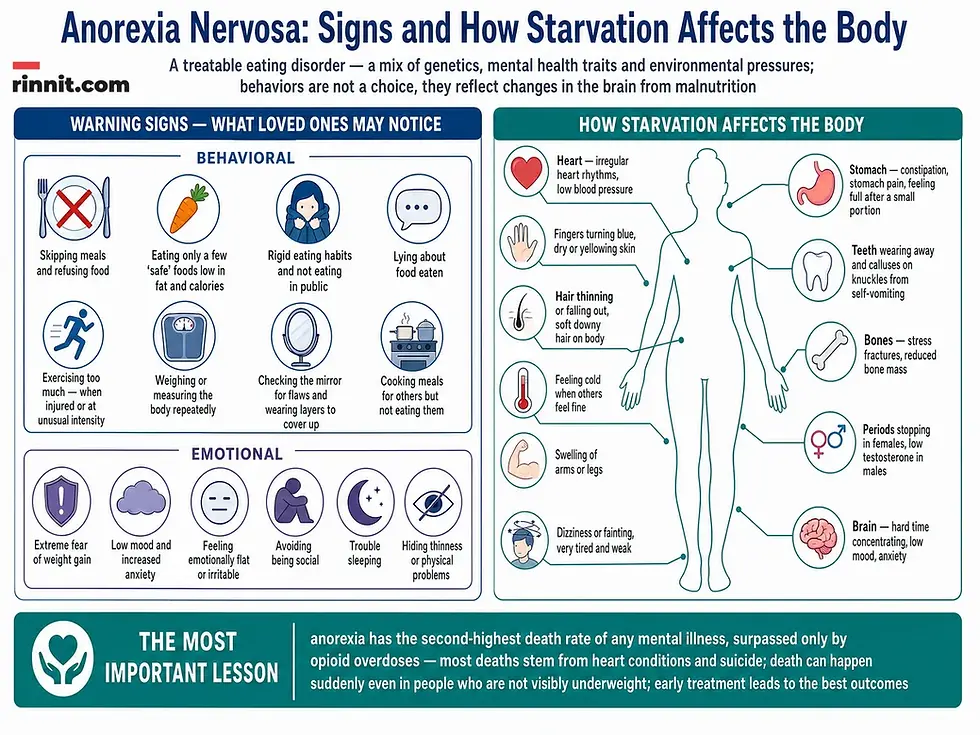
How does malnutrition from anorexia nervosa change the brain?
Malnutrition changing the brain is the single most important fact to know about anorexia nervosa. Anorexia causes changes in the brain due to very poor nutrition [1] — also called malnutrition, which happens when the body does not get the nutrients it needs to stay healthy.
Because anorexia is related to changes in the brain, the risky and damaging behaviors are not choices [1]. The illness is not really about food or looking a certain way.
The practical consequence is sobering: because malnutrition affects the brain, a person with anorexia may not want to be treated [1]. A core feature of the condition is that people with it usually do not see how serious their symptoms are [1]. That is not stubbornness — it is the disorder affecting the brain.
And the stakes are real. If left untreated, weight loss can reach a point where serious physical harm or death becomes likely. Anorexia has the second-highest death rate of any mental illness, surpassed only by opioid overdoses [1]. Most deaths related to anorexia stem from heart conditions and suicide [1].
The hopeful side: with proven treatment, people with anorexia can return to a healthy weight, develop more-balanced eating habits, and reverse some of the serious medical and mental health complications [1].
What are the physical symptoms of anorexia nervosa?
The physical symptoms of anorexia nervosa relate to how starvation affects the brain. They can be hard to notice, because what counts as a low body weight differs for each person, and people with anorexia often hide their thinness, eating habits, or physical problems.
Physical Sign | What It Looks Like |
Weight changes | Extreme weight loss, or not making expected weight gains for age [1] |
Heart and circulation | Irregular heart rhythms, low blood pressure, dehydration; fingers may look blue [1] |
Skin and hair | Dry skin, yellowing skin, hair that thins or falls out, soft downy hair covering the body [1] |
Energy | Very tired and weak; dizziness or fainting [1] |
Digestion | Hard time passing stool, stomach pain, stomachaches; never feeling hungry, or getting full right away after a very small portion [1] |
Temperature | Not able to stand the cold, or feeling cold when others feel fine [1] |
Fluid retention | Swelling of the arms or legs [1] |
Teeth and hands | Wearing away of the teeth and calluses on the knuckles from causing oneself to vomit [1] |
Bones | Stress fractures or reduced bone mass [1] |
Focus and mood | Hard time concentrating or focusing; low mood; increased anxiety [1] |
Menstruation | Females not taking a contraceptive may stop having menstrual periods [1] |
What are the emotional and behavioral symptoms of anorexia nervosa?
The emotional and behavioral symptoms are often what loved ones notice first — sometimes long before the physical signs appear.
Behavioral Sign | What It Looks Like |
Extreme focus on food | Sometimes cooking meals for others but not eating those meals [1] |
Avoiding food | Skipping meals, refusing to eat, severely limiting food through dieting or fasting, not admitting hunger, making excuses [1] |
"Safe" food lists | Eating only a few certain safe foods — often low in fat and calories [1] |
Extreme "clean" eating | Focusing too much on eating clean or healthy and dropping whole food types without professional guidance |
Rigid eating rules | Spitting out food after chewing, avoiding eating in public, lying about how much food was eaten [1] |
Too much exercise | Exercising while injured, instead of valued activities, or at an intensity notably different from others [1] |
Fear of weight gain | Repeatedly weighing or measuring the body [1] |
Appearance focus | Checking the mirror for perceived flaws, wearing layers to cover up, concern about being fat [1] |
There is also a binge-purge type of anorexia, where a person binge eats and purge like in bulimia. Binges are periods when a person cannot control what or how much they eat — sometimes involving large amounts of food. Purges include making oneself vomit or misusing enemas, laxatives, diuretics, diet aids, or herbal products to get rid of food [1]. Even so, people with this type still eat much less than they need and remain at a very low body weight compared with their personal weight history [1].
Emotional symptoms can include feeling emotionally flat, withdrawing socially, anger or irritability, little interest in sex, and trouble sleeping (insomnia) [1]. A person may also hurt themselves, or think, talk about, or attempt suicide.

When should you see a doctor about anorexia nervosa?
Because malnutrition affects the brain, the person with anorexia is often the last to see the danger. The guidance is clear: take action even if you think it could be an overreaction. Early treatment of eating disorders leads to the best outcomes [1].
If a loved one shows signs of anorexia, urge them to talk to a healthcare professional. If you are a parent or caregiver concerned about a child's eating habits, weight, or body image, share your concerns with the child's healthcare professional.
If you think you have an eating disorder, get help. If you are thinking about suicide, contact a suicide hotline. In the U.S., call or text 988 to reach the 988 Suicide & Crisis Lifeline, available 24 hours a day, seven days a week, free and confidential. A Spanish language line is available at 1-888-628-9454 [1].
What causes anorexia nervosa?
The causes of anorexia nervosa are not known [1]. As with many diseases, it is probably a mix of factors working together.
Factor | How It May Contribute |
Genetics | Unclear which genes are involved, but genetic changes may make someone more likely to develop anorexia — including traits like feeling the need to be perfect or being very sensitive |
Mental health | Obsessive-compulsive personality traits make it easier to stick to strict diets and not eat even when hungry; some people try to be perfect in everything they do [1] |
Environmental | Modern Western culture puts a lot of focus on being thin, and social media plays a big role. Peer pressure to be thin, lean, or muscular, and a constant push toward very strict "healthy" eating, can turn into eating disorders |
What are the risk factors for anorexia nervosa?
Anorexia nervosa affects all gender identities, races, ages, incomes, and body types [1] — it is not limited to any single group.
The disorder is more common among teenagers, although people of any age can develop it [1]. Teens may be more at risk because of the changes their bodies go through during puberty, and because they may face more peer pressure and be more sensitive to criticism — even casual comments — about weight or body shape.
Risk Factor | Details |
Family history | Having a first-degree relative (parent, sibling, or child) who had anorexia raises the risk [1] |
Weight bullying | People teased or bullied about their weight — by peers, family members, coaches, or others who shamed them for weight — are more likely to develop eating disorders [1] |
A history of dieting | Dieting behaviors raise risk; people who are always dieting, with weight going up and down as they start and stop diets, can develop an eating disorder |
Transitions | Major changes bring emotional stress and raise risk: a new school, home, or job; a relationship breakup; or the death or illness of a loved one [1] |
What complications can anorexia nervosa cause?
At its most severe, anorexia can be fatal — and death may happen suddenly, even when a person is not visibly underweight [1]. Irregular heart rhythms (arrhythmias) can lead to death, and an imbalance of electrolytes — minerals such as sodium, potassium, and calcium that maintain the body's fluid balance — can also be deadly.
Complication | What Happens |
Sudden death | Arrhythmias or electrolyte imbalance can be fatal even without visible underweight |
Heart conditions | Anemia; mitral valve prolapse (the valve between the heart's upper and lower left chambers not closing properly); heart failure [1] |
Bone loss | Osteoporosis raises the risk of fractures [1] |
Muscle loss | The body loses muscle mass |
Stomach problems | Constipation, bloating, or nausea [1] |
Kidney problems | Kidney function can be impaired |
Hormone changes | Females may stop having periods; males may see decreased testosterone [1] |
Organ damage | Severe malnutrition can damage every organ system — and the damage may not be fully reversible, even when the anorexia is under control [1] |
Mental health | Depression and other mood disorders; anxiety [1] |
How is anorexia nervosa diagnosed?
If a healthcare professional suspects anorexia nervosa, several exams and tests are used to pinpoint the diagnosis, rule out other medical causes of weight loss, and check for complications [2].
Test | What It Checks |
Physical exam | Height and weight; vital signs (heart rate, blood pressure, temperature); skin and nails; heart and lungs; stomach area [2] |
Lab tests | Complete blood count (CBC); specialized blood tests for electrolytes, protein, and liver, kidney, and thyroid function; a urine test [2] |
Mental health evaluation | Questions about thoughts, feelings, and eating habits, often including a written health questionnaire |
Other studies | X-rays to check bone density, stress or broken bones, pneumonia, or heart problems; an electrocardiogram (ECG/EKG) to look for heart issues [2] |
How does a team approach treat anorexia nervosa?
Anorexia nervosa is best treated using a team approach — doctors, mental health professionals, and other healthcare professionals, all with experience treating eating disorders [2].
Hospital Stays and Specialized Programs
If a person's life is in immediate danger — from a heart rhythm problem, dehydration, electrolyte imbalance, or a mental health emergency — treatment may begin in a hospital emergency department. A hospital stay may be needed for medical complications, severe mental health problems, severe malnutrition, or continued refusal to eat [2].
Specialized eating disorder clinics may offer day treatment or residential programs instead of a hospital stay, providing more-intensive treatment over longer periods [2]. These programs pursue two goals: making eating patterns more typical and promoting behaviors that support weight gain, and changing the distorted beliefs and thoughts that maintain limited eating.
Restoring a Healthy Weight Is the First Goal
There is no recovery from anorexia without returning to a healthy weight and good eating habits [2]. The team involved usually includes:
Team Member | Role |
Healthcare professional | Provides medical care and supervises weight gain [2] |
Psychologist or mental health professional | Trained in eating disorders; works on changing behaviors to reach a healthy weight |
Dietitian | Specially trained in eating disorders; guides a return to regular eating patterns with meal plans that meet calorie needs and weight goals |
Family | Helps keep good eating habits going — especially important for children and teenagers [2] |
In severe cases, feeding may temporarily be delivered through a nasogastric tube — a tube placed in the nose that goes to the stomach — while the person is monitored for vital signs, hydration, electrolytes, and related physical conditions [2].
Family-Based Treatment (FBT) for Teenagers
Family-based treatment — sometimes called FBT — is the only proven outpatient treatment for teenagers with anorexia [2]. Because a person with anorexia cannot make good choices about eating and health due to the disorder's impact on the brain, this therapy helps parents help their child eat right and reach a healthy weight until the child can make good choices about health independently.
Medicines: Food Is Truly the Medicine
Unfortunately, no medicines have been found to treat anorexia nervosa itself [2]. Being underweight may even interfere with how well medicines for other conditions — including depression and anxiety — work [2].
Some people may need supplements to reverse the effects of malnutrition (for example, vitamin D) [2], but most people should get the nutrients they need through food by returning to regular eating habits and a healthy weight. Any supplement should be discussed with a healthcare professional to make sure the right things are taken in the right way.
Treatment Challenges and Relapse Risk
One of the biggest challenges in treating anorexia is that the person may not want treatment. Common barriers include believing treatment is not needed or that they are not sick enough, fearing weight gain, and seeing anorexia as a lifestyle choice rather than an illness [2].
Recovery is possible with proven treatment that includes reaching a healthy weight. However, the risk of anorexia returning is higher during periods of high stress or triggering situations [2] — ongoing therapy or periodic appointments during stressful times can help a person stay healthy.
What self-care at home supports recovery from anorexia nervosa?
Self-care that supports anorexia nervosa recovery includes staying with your treatment plan, discussing supplements with your professional, staying connected and resisting frequent weighing.
Stay with your treatment plan. Do not skip therapy sessions, and try not to stray from meal plans — even when they feel uncomfortable.
Discuss supplements with your healthcare professional. Most people get vitamins and minerals from food, but if eating is poor, the body may be missing nutrients such as vitamin D or iron [2].
Do not isolate yourself. Stay connected with caring family members and friends who want to see you get healthy.
Resist urges to weigh yourself outside of medical appointments or to check yourself in the mirror frequently — these actions fuel the drive to keep unhealthy habits.
A note of caution on alternative approaches: some people with anorexia misuse dietary supplements, herbal weight-loss products, stimulants, or even insulin. All of these can have serious side effects, interact badly with other medicines, and are very dangerous when underweight — they can greatly increase the risk of death from complications [2]. Methods that lower anxiety, such as massage, yoga, and meditation, may raise well-being and help a person relax as a complement to — never a replacement for — treatment.
How can people cope with anorexia nervosa?
Coping with anorexia is harder when media, culture, and sometimes family or friends send mixed messages about what a person should look like. Whether you have anorexia or a loved one does, ask your healthcare professional for advice on coping strategies and emotional support around the diet culture and weight stigma that are so common. Learning effective coping strategies and getting support from family and friends are vital to successful treatment [2].
How should you prepare for an anorexia nervosa appointment?
Bringing a family member or friend to an anorexia nervosa appointment helps, because they can remember details you missed and describe home life more fully. For children, bringing a copy of their growth curve history is very helpful so the professional can see how weight and growth have changed.
Before the appointment, make a list of any symptoms (including ones that seem unrelated and when they began), key personal information such as major stresses or recent life changes, and all medicines, vitamins, herbal products, over-the-counter medicines, and supplements with their doses, plus questions to ask.
Questions to ask your healthcare professional:
What kinds of tests do I need, and do I need to prepare for them?
Is this condition temporary or long-lasting?
What treatments do you recommend?
Are there brochures or other printed material I can have? What websites do you recommend?
Questions your healthcare professional may ask:
How long have you been worried about your weight?
How often do you exercise?
What ways have you used to lose weight?
Are you having any physical symptoms?
Have you ever vomited because you were uncomfortably full?
Do you think about food often?
Do you ever eat in secret?
Have others expressed concern that you are too thin?
Have any family members had symptoms of, or a diagnosis of, an eating disorder?
Being ready to answer these questions makes sure there is time to cover everything you want to focus on.
Frequently Asked Questions
What is anorexia nervosa?
Anorexia nervosa is a treatable eating disorder in which a person maintains a body weight that is low for their personal weight history, with a strong fear of gaining weight and a high value placed on controlling weight and shape. Not everyone with anorexia looks thin — some do not look thin and others may even look overweight, because they have lost weight or failed to gain needed weight.
Is anorexia nervosa a choice?
No. Anorexia causes changes in the brain from malnutrition (very poor nutrition), so the risky and damaging behaviors are not choices. The illness is not really about food or looks, which is also why people with it often cannot see how serious their symptoms are.
What are the first signs of anorexia?
Early signs include extreme weight loss or not gaining expected weight for age, skipping meals or refusing to eat, eating only a few "safe" foods low in fat and calories, exercising too much, and repeatedly weighing or measuring the body. Physical signs such as blue fingers, dry skin, hair loss, feeling cold when others feel fine, dizziness, and constipation often follow.
How dangerous is anorexia nervosa?
Very dangerous: it has the second-highest death rate of any mental illness, surpassed only by opioid overdoses, with most deaths stemming from heart conditions and suicide. Death can happen suddenly even in someone who is not visibly underweight, through irregular heart rhythms or electrolyte imbalance [1].
How is anorexia nervosa diagnosed?
Diagnosis involves a physical exam (height, weight, vital signs, skin, nails, heart, lungs, stomach), lab tests (blood count, electrolytes, protein, liver, kidney, and thyroid function, plus a urine test), a mental health evaluation, and sometimes X-rays for bone density and an ECG for the heart. These tests also rule out other medical causes of weight loss.
Is there a medicine for anorexia nervosa?
No medicines have been found to treat anorexia nervosa itself [2] — for people with anorexia, food is truly the medicine. Supplements such as vitamin D may help reverse malnutrition effects, and treatment is delivered by a team that restores a healthy weight and changes the beliefs that keep eating limited.
Can a person fully recover from anorexia?
Recovery is possible with proven treatment that includes returning to a healthy weight, and many serious medical and mental health complications can be reversed. However, relapse risk is higher during periods of high stress or triggering situations, so ongoing therapy or periodic check-ins during stressful times help a person stay healthy.
Conclusion
The main lessons of this guide deserve to be repeated: anorexia nervosa is a treatable eating disorder, malnutrition physically changes the brain so the behavior is never "just a choice," and early action by loved ones leads to the best outcomes — even if it feels like an overreaction. This guide covered what anorexia is, the physical and emotional warning signs, how starvation affects nearly every organ system, the causes and risk factors, the complications, the tests that lead to a diagnosis, and the team-based treatment path from emergency care to family-based treatment and long-term recovery support.
If you or someone you love is struggling, the most important next step is the simplest one: talk to a healthcare professional. Early treatment changes the outcome.
Medical disclaimer: This article is for informational purposes only and is not a substitute for professional medical advice, diagnosis, or treatment. Always seek the advice of a qualified healthcare professional with any questions you may have regarding a medical condition. If you or a loved one is in crisis, in the U.S. call or text 988 to reach the 988 Suicide & Crisis Lifeline (24/7, free, confidential).
References
Mayo Clinic. Anorexia nervosa — Symptoms & causes. Accessed October 12, 2026. https://www.mayoclinic.org/diseases-conditions/anorexia-nervosa/symptoms-causes/syc-20353591
Mayo Clinic. Anorexia nervosa — Diagnosis & treatment. Accessed October 12, 2026. https://www.mayoclinic.org/diseases-conditions/anorexia-nervosa/diagnosis-treatment/drc-20353597
Arcelus J, Mitchell AJ, Wales J, et al. Mortality rates in patients with anorexia nervosa and other eating disorders: a meta-analysis of 36 studies. Arch Gen Psychiatry. 2011;68(7):724-31. PMID 21727255. https://doi.org/10.1001/archgenpsychiatry.2011.74
Austin A, Anderson AG, Lee J, et al. Efficacy of eating disorder focused family therapy for adolescents with anorexia nervosa: a systematic review and meta-analysis. Int J Eat Disord. 2025;58(1):3-36. PMID 39041682. https://doi.org/10.1002/eat.24252
Cassioli E, Sensi C, Mannucci E, et al. Pharmacological treatment of acute-phase anorexia nervosa: evidence from randomized controlled trials. J Psychopharmacol. 2020;34(8):864-873. PMID 32448045. https://doi.org/10.1177/0269881120920453



Comments