Angelman Syndrome: Symptoms, Causes, Treatment & Complete Guide

Updated: 2 days ago
Medically reviewed by Dr. Baraa Alnahhal, MD · Last reviewed: October 2026
Quick Answer
Angelman syndrome is a rare genetic condition affecting the nervous system that occurs when the maternal UBE3A gene on chromosome 15 does not work as expected [1]. It causes delayed development, speech difficulty, balance and movement problems, intellectual disability and seizures [1]. There is no cure, but people tend to live close to a typical lifespan, and treatment supports development [1].
What the research says
Angelman syndrome is rare, and most cases come from a maternal chromosome 15 deletion. A clinical review estimates it occurs in about 1 in 20,000 to 1 in 12,000 people and accounts for roughly 6% of children with severe intellectual disability and epilepsy; maternal deletions of 15q11-13 explain 65–70% of cases. (Kyllerman, Handb Clin Neurol, 2013) [3]
The type of genetic change shapes how severe symptoms are. A review of genotype–phenotype studies found that people with a maternal 15q11-13 deletion tend to have poorer development, more ataxia and more autistic features than other genotypes, while children with a UBE3A mutation have milder features and a nearly normal development quotient. (Yang et al., Genes, 2021) [4]
Seizure emergencies are not rare. In a retrospective analysis of 510 people with genetic epilepsy syndromes, 6 of 19 people with Angelman syndrome (32%; 95% CI 13–57) had nonconvulsive status epilepticus, a prolonged seizure state without obvious convulsions. (Donnan et al., Neurology, 2023) [5]
Angelman Syndrome at a Glance
Aspect | Summary |
Type of condition | Rare genetic condition affecting the nervous system [1] |
Genetic cause | The maternal UBE3A gene on chromosome 15 does not work as expected [1] |
First signs | Developmental delays between 6–12 months (no crawling or babbling) [1] |
Seizure onset | Often between ages 2 and 3 [1] |
Speech | No speech or very limited speech [1] |
Signature behavior | Frequent smiling and laughing; easily excited [1] |
Life expectancy | Close to a typical lifespan [1] |
Cure | |
Diagnosis | Genetic tests (DNA methylation, chromosomal microarray, UBE3A sequencing) + EEG [2] |
Treatment | Antiseizure medicine, therapies (physical, occupational, speech, behavior), sleep and feeding management [2] |
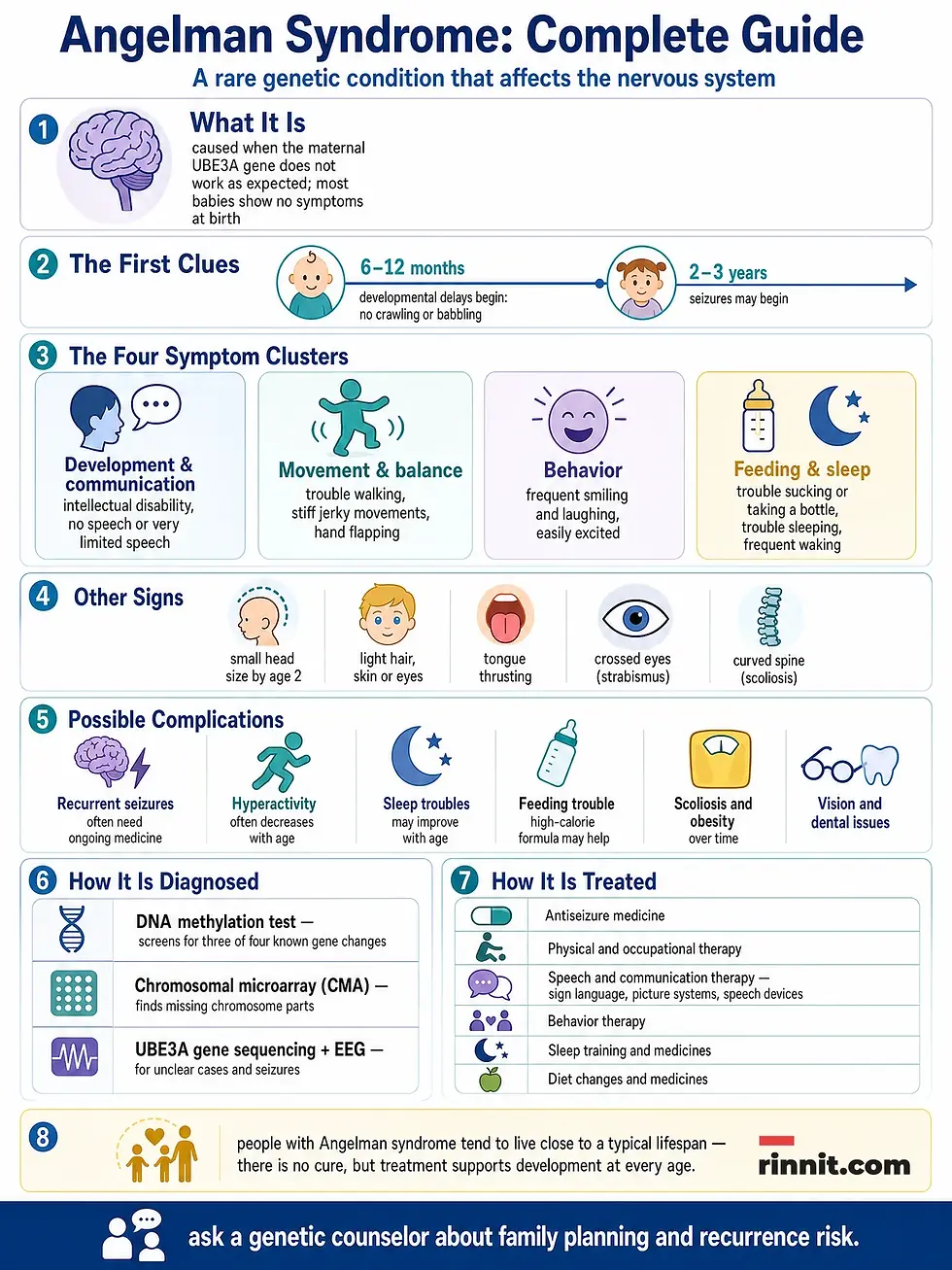
What Is Angelman Syndrome?
Angelman syndrome is a rare genetic condition that affects the nervous system. It leads to delayed development, trouble with speech, challenges with balance and movement, and intellectual disability. Seizures are also common [1].
Most babies with Angelman syndrome show no symptoms at birth. Early signs can be subtle at first, then become clearer as children grow. The delays in maturing — called developmental delays — usually begin between about 6 and 12 months of age, and these delays are often the first signs of the condition [1].
Here is a fact families often want to hear early: people with Angelman syndrome tend to live close to a typical lifespan [1]. The condition cannot be cured, so treatment focuses on supporting development, building communication skills, and managing medical, sleep, and developmental issues [1].
What are the symptoms of Angelman syndrome?
Angelman syndrome symptoms can affect development, movement, behavior, and overall health — and they often appear in clusters. Understanding the clusters helps families and care teams recognize the whole picture rather than isolated signs.

The Four Symptom Clusters
Cluster | What It Looks Like |
Development and communication | Developmental delays — no crawling or babbling by 6 to 12 months; intellectual disability; no speech or very limited speech [1] |
Movement and balance | Trouble walking, moving or balancing; stiff or jerky movements; patterns such as hand flapping or lifting the arms while walking [1] |
Behavior | Frequent smiling and laughing; seeming very happy or easily excited [1] |
Feeding and sleep | Feeding challenges in babies — trouble sucking or taking a bottle; trouble going to sleep and staying asleep; frequent waking [1] |
The Signature Behavior Trait
One feature stands apart: many children with Angelman syndrome smile or laugh often and appear easily excited [1]. These behavior traits may be early clues for families and care teams — a happy demeanor combined with delayed milestones is exactly the pattern that prompts investigation.
Other Physical Signs
Sign | Description |
Seizures | Often starting between ages 2 and 3 |
Small head size | Noticeable by age 2 [1] |
Light-colored hair, skin or eyes | Pigmentation is often lighter than the family norm |
Tongue thrusting | The tongue pushes forward frequently |
Crossed eyes (strabismus) | The eyes do not align |
Curved spine (scoliosis) | A side-to-side curve that can develop over time |
When to See a Doctor
The first signs of Angelman syndrome most often are developmental delays — including a lack of crawling or babbling between 6 and 12 months [1]. If your child seems to have developmental delays or shows other symptoms listed above, make an appointment with your child's healthcare professional.
What causes Angelman syndrome, and what role does the UBE3A gene play?
Angelman syndrome is caused by changes in a gene — a genetic change — most often in a gene on chromosome 15 called the ubiquitin protein ligase E3A (UBE3A) gene [1]. Understanding why it matters requires a short detour into how gene copies work.
You receive your pairs of genes from your parents: one copy from your mother (the maternal copy) and one from your father (the paternal copy). Your cells most often use information from both copies. But in a small number of genes, such as UBE3A, only the copy from the mother is active [1].
Most often, the maternal copy of the UBE3A gene helps the brain develop. Angelman syndrome happens when part of the maternal copy is missing or damaged — so the brain cannot get the information it needs to develop and to control speech and movement [1]. Rarely, the condition is caused when two paternal copies of the gene are passed down instead of one from each parent [1].
The source describes it with a helpful analogy:
Think of each gene as an instruction card. For most genes, children get one instruction card from their mother and one from their father — the body usually reads both cards. But the UBE3A gene works differently in the brain: only the mother's card is readable; the father's card is there, but it stays turned off. In Angelman syndrome, the mother's card is missing, damaged or unreadable — so the brain is left without instructions from UBE3A.
Without those instructions, parts of brain development — such as movement, learning, speech and coordination — do not happen in the typical way. All of the different genetic changes lead to the same problem: the brain doesn't receive the working UBE3A instructions it needs.
What are the risk factors for Angelman syndrome?
Angelman syndrome is rare, and researchers often do not know what causes the genetic changes that result in the condition. Most people with Angelman syndrome don't have a family history [1].
In rare situations, the condition can be passed down from a parent. This happens when the parent carries a specific UBE3A gene change or an imprinting condition [1]. In these families, the chance of having another child with Angelman syndrome may be higher — but not all types of genetic changes can be passed on. Only a few specific ones carry a higher recurrence risk [1].
What complications can Angelman syndrome cause?
Angelman syndrome affects the nervous system, which produces complications across daily life that families and care teams manage one by one. The table below organizes them with what families and care teams typically do about each:
Complication | What Happens | Typical Management |
Trouble feeding | Trouble sucking and swallowing together causes feeding problems in infants | High-calorie formula to help the baby gain weight [1] |
Hyperactivity | Moving quickly between activities, short attention span, keeping hands or a toy in the mouth | Often decreases with age; medicine often isn't needed [1] |
Seizures | Most affected children experience recurrent seizures [1] | Ongoing management with medicines; sometimes difficult to control |
Dental problems and vision issues | Includes nearsightedness or crossed eyes [1] | Dental care and vision support |
Sleep troubles | Changes in sleep-wake patterns; may need less sleep than most people | May improve with age; medicine and behavior therapy may help [1] |
Scoliosis | Side-to-side spinal curve over time | Monitoring and treatment of the curve |
Obesity | Common in older children [1] | Nutritional guidance and monitoring |
How Is Angelman Syndrome Diagnosed?
A healthcare professional may suspect Angelman syndrome if a child has developmental delays, talks little or not at all, has seizures, has trouble with movement and balance, or has a small head size [2].
One challenge shapes the diagnostic journey: Angelman syndrome can be hard to diagnose because it shares symptoms with other conditions, such as autism spectrum disorder, cerebral palsy, and other genetic differences [2].
The Genetic Tests That Confirm It
A genetic test can usually confirm Angelman syndrome [2]. A mix of gene tests can show the changes linked to the condition:
Test | What It Looks For |
DNA methylation test | The parental DNA pattern — screens for three of the four known gene changes that cause Angelman syndrome [2] |
Chromosomal microarray (CMA) | Whether parts of chromosomes are missing [2] |
UBE3A gene sequencing | Ordered when DNA methylation results are typical but the child still has Angelman features — it finds the rare change where the maternal copy is active but altered [2] |
EEG (electroencephalogram) | Measures the electrical activity of the brain, performed because of the link between Angelman syndrome and seizures [2] |
How is Angelman syndrome treated with a team approach at every age?
There is no cure for Angelman syndrome. Research is looking at targeting specific genes, including ways to restore UBE3A activity in the brain [2]. Current treatment focuses on managing symptoms and supporting development at every age.
A team of healthcare professionals from different areas works with you to manage your child's condition. Depending on your child's symptoms, treatment may involve:
Treatment | What It Addresses |
Antiseizure medicine | Helps control seizures [2] |
Physical or occupational therapy | Supports walking, movement and daily activities |
Communication and speech therapy | May include sign language, picture communication or speech-generating devices [2] |
Behavior therapy | Helps with hyperactivity, short attention span and behavioral development [2] |
Medicines and sleep training | Manages sleep issues [2] |
Diet changes and medicines | Helps with feeding troubles and constipation [2] |
Coping and Support
Finding out that your child has Angelman syndrome can be hard. You may not know what to expect, and you may worry about whether you can care for your child's medical needs and developmental disabilities. There are resources that can help.
Working with a team matters: find a team of healthcare professionals, including therapists, that you trust to help you make decisions about your child's care and treatment — these professionals can also help you find local resources. Support groups connect you with other families facing issues like yours, which may help you feel more connected; ask your child's healthcare professional about local support groups and other helpful organizations.
How should you prepare for an Angelman syndrome appointment?
Call your healthcare professional if your baby or child is not developing as expected or has other symptoms of Angelman syndrome. Your healthcare professional may then refer you to a doctor who specializes in conditions that affect the brain and nervous system, called a neurologist [2].
What You Can Do
Write down symptoms you've seen in your child, and when they began
Bring baby books and development records to the appointment — photos and video recordings can be helpful
List your child's key medical information, including other conditions being treated and all medicines, vitamins and supplements with doses
Ask a family member or friend to join — they can offer support and help you remember the information you're given
Write down questions to ask
Questions to Ask
Questions for the first visit:
What is likely causing my child's symptoms?
Are there other possible causes for these symptoms?
What tests does my child need?
Should my child see a specialist?
Questions for the specialist:
Does my child have Angelman syndrome?
What are the possible complications of this condition?
What therapies are there?
What treatment do you suggest?
What is the long-term outlook for my child?
Should my child or I be tested for the gene changes linked to this condition?
What other specialists should my child see?
How can I find other families who are coping with Angelman syndrome?
What Your Doctor Will Ask
Does your child have trouble eating?
Is your child reaching the expected, age-related physical milestones?
Have you seen issues with balance or movement?
Does your child laugh, smile or get excited more often than peers?
Does your child have odd behaviors, such as hand flapping?
Does your child communicate in words?
How well does your child sleep?
Has your child had seizures? If so, how often?
Have any first-degree relatives (a parent or sibling) been diagnosed with Angelman syndrome?
Can Angelman syndrome be prevented, and how does family planning help?
Rarely, Angelman syndrome may be passed from an affected parent to a child through changed genes. If you're concerned about a family history of Angelman syndrome, or if you have a child with the condition, seek medical advice. Your healthcare professional or a genetic counselor can help you plan future pregnancies [1].
Genetic testing can find the exact gene condition in a person. This is very important for knowing whether the condition might happen again and for helping families plan future pregnancies [1].
Frequently Asked Questions
What is Angelman syndrome?
Angelman syndrome is a rare genetic condition that affects the nervous system. It happens when the maternal UBE3A gene does not work as expected, leading to delayed development, trouble with speech, challenges with balance and movement, and intellectual disability.
What are the first signs of Angelman syndrome?
Most babies show no symptoms at birth. The first signs are usually developmental delays beginning between 6 and 12 months of age, such as no crawling or babbling. Frequent smiling and laughing may also be an early clue.
Why do children with Angelman syndrome smile and laugh so often?
Many children with the condition smile or laugh often and appear easily excited. These behavior traits are part of the condition's characteristic pattern and may be early clues for families and care teams.
What causes Angelman syndrome?
Angelman syndrome is caused by genetic changes, most often in the UBE3A gene on chromosome 15. In the brain, only the mother's copy of this gene is active. When the maternal copy is missing or damaged, the brain does not receive the UBE3A instructions it needs, and movement, learning, speech and coordination do not develop in the typical way.
Is Angelman syndrome inherited from parents?
Usually not — most people with Angelman syndrome do not have a family history. Rarely, it can be passed down when a parent carries a specific UBE3A gene change or an imprinting condition, which raises the chance of another affected child in that family.
Can Angelman syndrome be cured?
No, there is no cure at this time, though research is exploring ways to restore UBE3A activity in the brain. People with Angelman syndrome tend to live close to a typical lifespan, and treatment supports development at every age.
How is Angelman syndrome treated?
A team manages symptoms: antiseizure medicine, physical or occupational therapy, communication and speech therapy (including sign language and speech-generating devices), behavior therapy, medicines and sleep training, and diet changes or medicines for feeding troubles.
Conclusion
The three lessons to carry away from this guide:
The first clue is a missed milestone, not a smile: no crawling or babbling by 6 to 12 months — sometimes alongside a child who laughs easily — is the pattern that warrants evaluation, and early referral to a neurologist and genetic testing make the difference.
One quiet gene explains it all: only the mother's UBE3A copy is active in the brain, and when it is missing or damaged, the brain develops without the instructions for speech, movement, learning and coordination.
Treatment is a team sport, and the outlook is hopeful: no cure exists, but seizure control, communication therapy, and development support at every age let people with Angelman syndrome live close to a typical lifespan.
This guide has walked you through what Angelman syndrome is, the four symptom clusters and their signature traits, the UBE3A gene mechanism, the complications families manage, how genetic testing confirms the diagnosis, and the full team-based treatment approach.
Disclaimer: This article is for informational purposes only and is not a substitute for professional medical advice, diagnosis, or treatment. Always seek the advice of your physician or other qualified health provider with any questions you may have regarding a medical condition.
References
Mayo Clinic. Angelman syndrome — Symptoms & causes. Accessed October 12, 2026. https://www.mayoclinic.org/diseases-conditions/angelman-syndrome/symptoms-causes/syc-20355621
Mayo Clinic. Angelman syndrome — Diagnosis & treatment. Accessed October 12, 2026. https://www.mayoclinic.org/diseases-conditions/angelman-syndrome/diagnosis-treatment/drc-20355627
Kyllerman M. Angelman syndrome. Handb Clin Neurol. 2013;111:287-90. PMID 23622177. https://doi.org/10.1016/B978-0-444-52891-9.00032-4
Yang L, Shu X, Mao S, et al. Genotype-phenotype correlations in Angelman syndrome. Genes (Basel). 2021;12(7):987. PMID 34203304. https://doi.org/10.3390/genes12070987
Donnan AM, Schneider AL, Russ-Hall S, et al. Rates of status epilepticus and sudden unexplained death in epilepsy in people with genetic developmental and epileptic encephalopathies. Neurology. 2023;100(16):e1712-e1722. PMID 36750385. https://doi.org/10.1212/WNL.0000000000207080



Comments