Amnesia: Symptoms, Causes, Treatment & Complete Guide

Updated: 3 days ago
Medically reviewed by Dr. Baraa Alnahhal, MD · Last reviewed: October 2026
Quick Answer
Amnesia, also called amnestic syndrome, is the loss of memories, including facts, information and experiences [1]. People with amnesia typically know who they are but struggle to form new memories [1]. It is caused by damage to brain structures vital for memory and can be permanent [1]. There's no specific treatment, but underlying causes can be treated and memory strategies help.
What the research says
Evidence for thiamine dosing in Wernicke-Korsakoff syndrome is thin. A Cochrane review found only two eligible randomized trials; the one with usable data (107 participants) favored 200 mg/day over 5 mg/day of intramuscular thiamine, with fewer trials needed to reach criterion on a delayed alternation memory test (mean difference -17.90; 95% CI -35.4 to -0.40), and the authors concluded the evidence is insufficient to guide dose, route, or duration (Day et al., Cochrane Database Syst Rev, 2013) [3].
Early high-dose thiamine may help prevent lasting amnesia. In a systematic review of 46 people with kidney disease who developed Wernicke's encephalopathy, parenteral thiamine at 500 mg three times a day often led to full recovery, while Korsakoff's syndrome (the lasting amnestic syndrome) was found in those who received low doses (Oudman et al., J Ren Nutr, 2024) [4].
Amnesia at a Glance
Aspect | Summary |
What it is | Loss of memories — facts, information, experiences (amnestic syndrome) [1] |
Movie vs. reality | Rarely forgets who they are; struggles to form new memories [1] |
Type of memory affected | Short-term / recent memories most likely lost; older memories often stay [1] |
What stays intact | Intelligence, personality, identity, judgment, skill learning |
Can it be permanent? | Yes — unlike transient global amnesia (temporary) [1] |
Common causes | Stroke, inflammation, low oxygen, alcohol misuse, tumors, Alzheimer's, seizures, sedatives [1] |
Diagnosis | Medical history, cognitive tests, MRI/CT, blood tests, EEG [2] |
Treatment | Strategies and aids; medicines only for specific causes [2] |
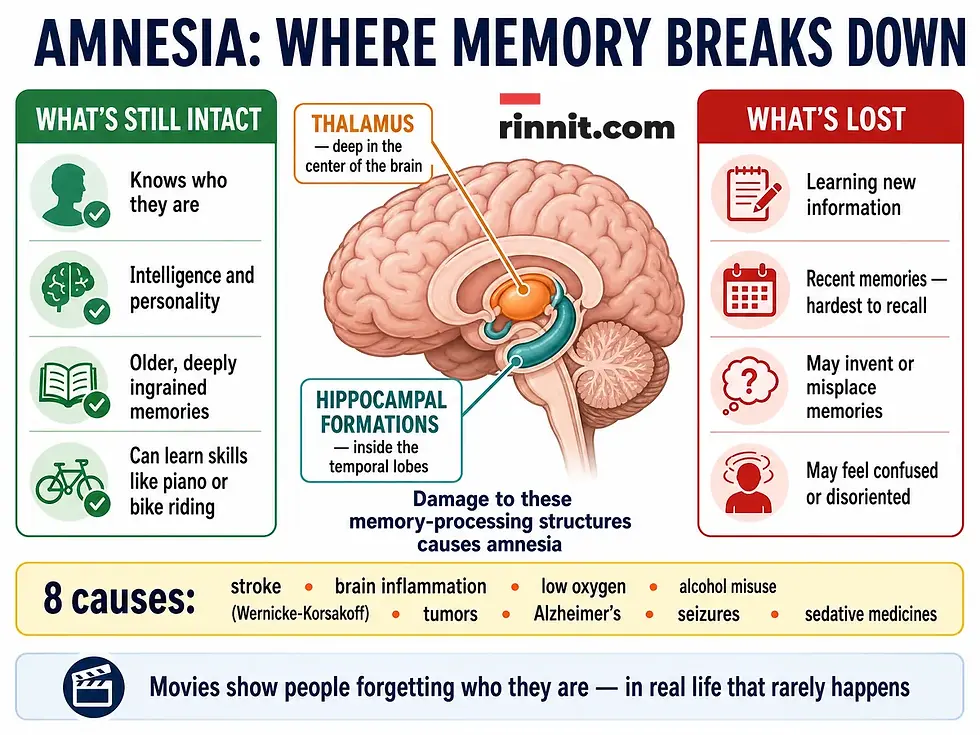
Where memory breaks down — the thalamus and hippocampal formations, what's lost vs. what remains intact, and the eight main causes. Source: rinnit.com
What Is Amnesia?
Amnesia, also called amnestic syndrome, refers to the loss of memories, including facts, information, and experiences [1].
Movies and television tend to show people with amnesia forgetting who they are. That's not generally the case in real life. Instead, people with amnesia typically know who they are — but they may have trouble learning new information and forming new memories [1].
Amnesia can be caused by damage to areas of the brain that are vital for memory processing [1]. Unlike a temporary episode of memory loss, called transient global amnesia, amnesia can be permanent [1].
There's no specific treatment for amnesia [1]. But if an underlying cause is found, treatment often can be directed at that condition. Using strategies to enhance memory and getting support can help people with amnesia and their families cope.
What are the symptoms of amnesia?
The two main features of amnesia are trouble learning new information and trouble remembering past events and information that used to be familiar [1].
Trouble learning new information.
Trouble remembering past events and information that used to be familiar.
Most people with amnesia have issues with short-term memory, so they can't remember new information [1]. Recent memories are most likely to be lost, but people with amnesia may remember older or deeply ingrained memories [1].
For example, people with amnesia may recall experiences from childhood or know the names of past presidents — but may not be able to name the current president, know the month, or remember what they ate for breakfast.
What memory loss affects | What it does NOT affect |
Recent memories and new information | Intelligence |
Familiar past events | General knowledge |
Learning new facts | Awareness and attention span |
Day-to-day recollection | Judgment, personality, and identity |
A key point: memory loss alone doesn't affect a person's intelligence, general knowledge, awareness, attention span, judgment, personality, or identity [1]. People with amnesia typically can understand written and spoken words, and they can learn skills such as bike riding or piano playing [1]. They may also understand that they have a condition that affects memory.
Amnesia Is Not Dementia
Amnesia isn't the same as dementia. Dementia often includes memory loss, but dementia also involves other changes in thinking that lead to a decline in daily functioning — such as trouble with language, judgment, and visual and spatial skills [1].
Memory loss is also a common symptom of mild cognitive impairment — a condition involving memory loss and other cognitive issues that aren't as serious as those experienced in dementia [1].
Additional Symptoms
Depending on the cause of the amnesia, other symptoms may include:
False memories — memories that are either completely invented or are real memories misplaced in time [1]
Confusion or disorientation
When should you see a doctor about amnesia?
Anyone who has unexplained memory loss, a head injury, or confusion needs medical attention right away [1].
People with amnesia may not know where they are or be able to seek medical care. If someone you know has symptoms of amnesia, help that person get medical attention.
What causes amnesia (memory loss)?
Typical memory function involves many parts of the brain, so any disease or injury that affects the brain can affect memory. Amnesia can result from damage to brain structures that form the limbic system, which controls emotions and memories. Those structures include the thalamus (found deep within the center of the brain) and the hippocampal formations (found within the temporal lobes) [1].
Amnesia caused by brain injury or brain damage is known as neurological amnesia [1]. Possible causes include:
Cause | What happens |
Stroke | Interrupts blood flow to memory structures |
Brain inflammation | May come from a virus such as herpes simplex virus [1], an autoimmune reaction to cancer, or an autoimmune reaction without cancer |
Not enough oxygen in the brain | Can follow a heart attack, breathing trouble, or carbon monoxide poisoning [1] |
Long-term alcohol misuse | Leads to too little vitamin B-1 (thiamin) — called Wernicke-Korsakoff syndrome [1] |
Tumors | In areas of the brain that control memory [1] |
Alzheimer's disease | And related diseases involving loss of brain cells important for memory |
Seizures | Disrupt memory circuits |
Medicine | Benzodiazepines and other sedatives [1] |
Head injuries that cause a concussion can lead to confusion and make it hard to remember new information — especially in the early stages of recovery [1]. Mild head injuries typically don't cause lasting amnesia, but more serious head injuries may cause permanent amnesia [1].
A rare type called dissociative amnesia comes from emotional shock or trauma, such as being the victim of a violent crime [1]. In dissociative amnesia, people may lose personal memories and information about their lives — and this type typically doesn't last long [1].

Amnesia in five sections — what it is, main symptoms, causes, diagnosis, and management & prevention. Source: rinnit.com
What are the risk factors for amnesia?
Brain surgery, head injury or head trauma, stroke, alcohol use disorder and seizures can raise the risk of developing amnesia [1].
Brain surgery, head injury, or head trauma
Stroke
Alcohol use disorder
Seizures
What are the possible complications of amnesia?
How much amnesia affects memory is different from person to person, but even mild amnesia takes a toll on daily activities and quality of life. Amnesia can make it hard to function at work, at school, and in social settings [1].
It may not be possible to recover lost memories. Some people with serious memory loss need to be supervised or need to live in a care facility [1].
How can amnesia be prevented?
Damage to the brain can be a root cause of amnesia, so it's important to take steps to minimize your chance of a brain injury. For example:
Don't drink large amounts of alcohol.
Wear a helmet when bicycling and a seat belt when driving [1].
Treat infections quickly so that they don't have a chance to spread to the brain [1].
Get medical treatment right away if you have symptoms that suggest a stroke or brain aneurysm, including a serious headache, feeling numb on one side of the body, or not being able to move one side of the body [1].
How is amnesia diagnosed?
A comprehensive evaluation is needed to diagnose amnesia. This evaluation can rule out other possible causes of memory loss, such as Alzheimer's disease, other forms of dementia, depression, or a brain tumor [2].
Medical History
The evaluation starts with a detailed medical history. Because the person with memory loss may not be able to provide thorough information, a family member, friend, or caregiver is often needed to help [2]. The evaluation may address:
The type of memory loss — recent or long-term
When it started and whether it has gotten worse over time
Possible triggers, such as a head injury, stroke, or surgery
Family history, especially of neurological disease
Drug and alcohol use
Other symptoms, such as confusion, language trouble, personality changes, or inability to perform self-care
History of seizures, headaches, depression, or cancer
Physical and Cognitive Exams
The physical exam may include a neurological exam to check reflexes, sensory function, and balance [2]. Cognitive tests examine thinking, judgment, and memory — you may be asked about general information (such as the name of the current president), personal information, and past events, or asked to repeat a list of words. This evaluation shows how serious the memory loss is and helps determine what kind of care may be needed [2].
Diagnostic Tests
How is amnesia treated?
Treatment focuses on strategies to make up for memory trouble and addressing any underlying diseases that could be causing amnesia [2].
Occupational Therapy
You may work with an occupational therapist to learn new information and replace information that has been lost — or to use the memories you still have as a basis for taking in new information [2]. Memory training includes strategies for organizing information so it's easier to remember and for communicating better with others.
Technological Assistance
Many people with amnesia find smart technology helpful. With some training and practice, even people with serious amnesia can use smartphones or tablets as electronic organizers — programmed to give reminders about important events or to take medicines [2]. Other helpful memory aids include:
Notebooks
Wall calendars
Pill minders
Photographs of people and places
Medicines or Supplements
No medicines currently are available for treating most types of amnesia [2]. Exceptions depend on the cause:
Research may one day lead to new treatments for conditions that affect memory, but the complexity of brain processes makes it unlikely that a single medicine will resolve memory trouble [2].
How can people with amnesia cope and find support?
Living with amnesia can be frustrating — for those with memory loss and for their family and friends. People with serious forms may require direct assistance from family, friends, or professional caregivers.
Talking with others who understand what you're going through can help. Ask your healthcare professional to recommend a support group in your community or online for people with amnesia and their loved ones.
If an underlying cause is found, national organizations can provide more information and support:
Organization | Phone (toll-free) |
Alzheimer's Association | 800-272-3900 |
Brain Injury Association of America | 800-444-6443 |
How should you prepare for an amnesia appointment?
You may start by seeing your primary healthcare professional, or you may be referred to a neurologist — a specialist in conditions of the brain and nervous system.
Before your appointment:
Ask if anything needs to be done in advance, such as not eating or drinking before a test.
Make a list of your symptoms (including any that don't seem related), key personal information (major stresses, recent life changes, family medical history), all medicines, vitamins, and supplements with doses, and questions to ask.
Take a family member or friend along, if possible, to help you remember the information you're given.
Questions to ask may include:
What's the most likely cause of my symptoms?
Are there other possible causes?
What kinds of tests do I need, and do they require special preparation?
Will my memory ever come back?
What treatments are available, and which do you recommend?
I have other health conditions. How can I best manage them together?
Do I need to restrict any activities?
Are there any brochures or printed material I can take home? What websites do you recommend?
What to expect from your doctor — questions such as: When did you first notice your memory loss? Did you experience other symptoms at that time? Were you involved in any trauma (a car accident, a violent collision in sports, an assault)? Did an illness or event trigger the memory loss? Does anything improve your memory, or make it worse? Does the memory trouble come and go or is it constant? Has it stayed the same or gotten worse? Did it come on suddenly or slowly?
Frequently Asked Questions
Do people with amnesia forget who they are?
Not usually. Movies suggest people with amnesia forget their identity, but in real life people with amnesia typically know who they are — the main difficulty is learning new information and forming new memories.
What's the difference between amnesia and dementia?
Dementia often includes memory loss, but it also involves broader declines in thinking that affect daily functioning, such as trouble with language, judgment, and visual-spatial skills. Amnesia is focused on memory.
Why are recent memories lost before older ones?
Most people with amnesia have issues with short-term memory. Recent memories are most likely to be lost, while older or deeply ingrained memories — like childhood experiences — may still be recalled.
Can a head injury cause permanent amnesia?
Mild head injuries typically don't cause lasting amnesia, though a concussion can cause confusion and trouble forming new memories during early recovery. More serious head injuries, however, may cause permanent amnesia [1].
Is there a medicine that cures amnesia?
No medicine is currently available for treating most types of amnesia [2]. Treatment focuses on memory strategies, technology aids, occupational therapy, and treating the underlying cause — such as replacing thiamin in Wernicke-Korsakoff syndrome.
Can lost memories ever come back?
It may not be possible to recover lost memories. That's why treatment emphasizes strategies to compensate for memory trouble and support for the person and their family.
How can I reduce my risk of amnesia?
Protect your brain: avoid heavy alcohol use, wear a helmet when bicycling and a seat belt when driving, treat infections quickly so they don't spread to the brain, and seek emergency care right away for stroke warning signs such as a severe headache or numbness on one side of the body.
Conclusion
The main lessons of this guide:
Amnesia is about forming new memories — not losing yourself. Unlike the movie stereotype, people with amnesia usually know who they are; their real challenge is learning new information while often retaining older, deeply ingrained memories.
The cause determines the path. Stroke, inflammation, low oxygen, alcohol misuse, tumors, Alzheimer's, seizures, and sedatives can all damage the brain's memory-processing centers — and finding the underlying cause directs treatment.
Protection starts before injury. Helmets, seat belts, moderated alcohol, fast treatment of infections, and rapid response to stroke signs are the most reliable ways to safeguard memory.
This guide has covered what amnesia really is (and isn't), the two main symptom patterns, the full list of neurological and trauma-related causes, the diagnostic evaluation, practical coping strategies, and prevention steps. If you or someone you know has unexplained memory loss after an injury or illness, don't wait — get medical attention right away.
For more complete health guides — including our in-depth guide to Alzheimer's disease, the most common memory-impairing condition — explore the full library at rinnit.com.
What are your next steps after learning about amnesia?
Read a related guide — explore more complete health guides on rinnit.com, starting with our Alzheimer's disease guide.
Share your thoughts — comment below with your questions or experiences; we read every one.
Stay updated — sign up on rinnit.com for new health guides and updates.
References
Mayo Clinic. Amnesia — Symptoms & causes. Accessed October 11, 2026. https://www.mayoclinic.org/diseases-conditions/amnesia/symptoms-causes/syc-20353360
Mayo Clinic. Amnesia — Diagnosis & treatment. Accessed October 11, 2026. https://www.mayoclinic.org/diseases-conditions/amnesia/diagnosis-treatment/drc-20353366
Day E, et al. Thiamine for prevention and treatment of Wernicke-Korsakoff Syndrome in people who abuse alcohol. Cochrane Database Syst Rev. 2013;2013(7):CD004033. PMID 23818100. https://doi.org/10.1002/14651858.CD004033.pub3
Oudman E, et al. Wernicke's Encephalopathy in Acute and Chronic Kidney Disease: A Systematic Review. J Ren Nutr. 2024;34(2):105-114. PMID 37838073. https://doi.org/10.1053/j.jrn.2023.10.003
Medical disclaimer
This content is provided for general informational purposes only and is not a substitute for professional medical advice, diagnosis, or treatment. Always seek the advice of a qualified healthcare provider with any questions about a medical condition.



Comments