Albinism Complete Guide: Types, Causes, Vision Problems, Skin Care & Treatment

Updated: 2 days ago
Medically reviewed by Dr. Baraa Alnahhal, MD. Last updated: October 2026.
Albinism is a group of inherited conditions in which the body makes little or no melanin, the pigment that colors skin, hair and eyes. Because melanin also helps the eyes develop, vision problems affect every type, and the lack of pigment raises the risk of sunburn and skin cancer [1].
Quick Answer: What is albinism?
Albinism is a group of inherited genetic conditions in which the body makes little or no melanin, the pigment that colors skin, hair and eyes. Because melanin is needed for eye development, vision problems are a key feature, and sunburn and skin cancer are major risks [1]. There is no cure; care focuses on sun protection and eye exams [1] [2].
What the research says
Sun damage and skin cancer are common in people with albinism. In a meta-analysis of 12 studies covering 1,747 people with albinism, about 38% had actinic keratosis (a sun-damage skin change) and about 19% had skin cancer. Squamous cell carcinoma made up roughly 55% of the skin cancers and basal cell carcinoma about 34%, although results varied widely between studies (Tranquillini et al., An Bras Dermatol, 2026) [3].
X-linked ocular albinism is rare, and its vision loss does not get worse over time. It affects about 1 in 60,000 males and involves only the eyes, with normal skin and hair color. The visual loss is permanent but non-progressive, and visual acuity stays stable throughout life (Chiang et al., Adv Exp Med Biol, 2025) [4].
Albinism at a Glance
Question | Answer |
What is it? | A genetic disorder in which the body makes little or no melanin |
Who does it affect? | Skin, hair, and eyes; passed down in families |
Is vision affected? | Yes. Vision problems are a key feature of all types |
Most common type | Oculocutaneous albinism (OCA) |
Main health risks | Sunburn, sun damage, skin cancer (melanoma) |
How is it diagnosed? | Physical exam, ophthalmologist eye exam, family comparison, medical history, genetic testing |
Is there a cure? | No. Treatment focuses on eye care and skin monitoring |
Can it be managed? | Yes. Sun protection, annual exams, prescription lenses, low vision aids, accommodations |
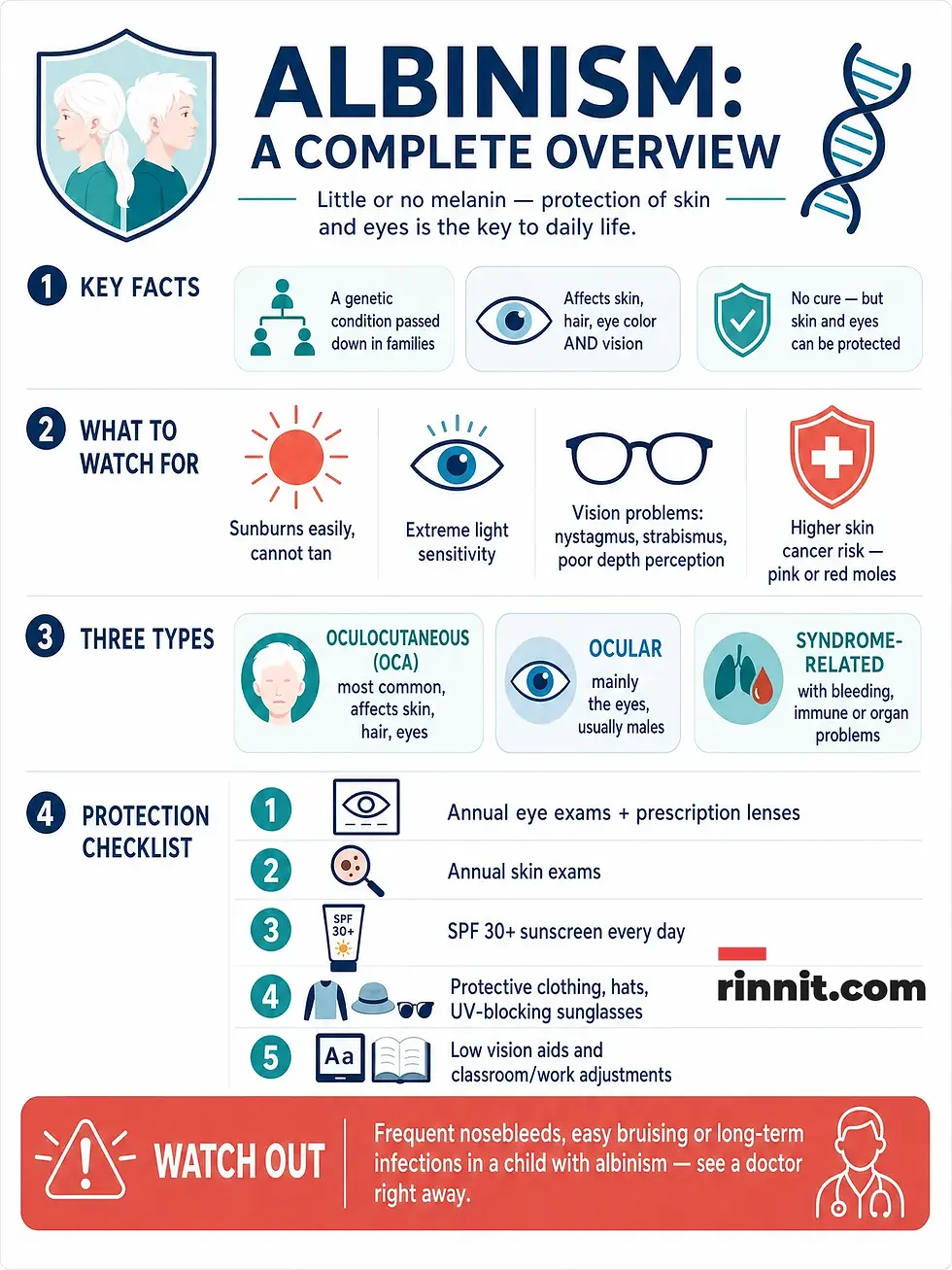
A one-page overview of albinism: what to watch for and how to protect skin and eyes. Source: rinnit.com
What Is Albinism?
The term albinism usually refers to oculocutaneous albinism (OCA), pronounced ok-u-low-ku-TAY-nee-us. OCA is a group of disorders passed down in families in which the body makes little or none of a substance called melanin. The type and amount of melanin in your body determines the color of your skin, hair, and eyes [1].
Here is the crucial connection many people miss: melanin does not just color the eyes. It also plays a role in the development and function of the eyes. That is why people with albinism have vision problems [1].
Symptoms of albinism are usually seen in a person's skin, hair, and eye color, but sometimes the differences are slight. People with albinism are also sensitive to the effects of the sun, so they are at higher risk of getting skin cancer [1].
Although there is no cure, people with the disorder can take steps to protect their skin and eyes and get proper eye and skin care.
What Causes Albinism?
Albinism is caused by a change in one of the genes that give instructions for making proteins involved in producing melanin, the pigment of skin, hair and eyes. Melanin is made by cells called melanocytes, which are found in your skin, hair, and eyes [1].
Albinism is caused by a change in one of these genes. Different types of albinism can occur, based mainly on which gene change caused the disorder. The gene change may result in no melanin at all or a big decrease in the amount of melanin [1].

Melanocytes and the inheritance pattern behind albinism: how changed genes lead to little or no melanin. Source: rinnit.com
What are the three types of albinism?
Types of albinism are grouped based on how they are passed down in families and on the gene that is affected.
Type | Inheritance | Who it affects | What it causes |
Oculocutaneous albinism (OCA) | Autosomal recessive: two changed gene copies, one from each parent | The most common type; affects anyone | Change in one of eight genes (OCA1 to OCA8); decreased pigment in skin, hair, and eyes plus vision problems; pigment amount varies by type |
Ocular albinism | X-linked recessive: gene change on the X chromosome; a mother carrying one changed X gene can pass it to her son | Usually only males; much less common than OCA | Mainly limited to the eyes, causing vision problems; the most common form is type 1 |
Albinism related to rare hereditary syndromes | Hereditary syndromes | Rare | Hermansky-Pudlak syndrome: a form of OCA plus bleeding and bruising problems, lung and bowel diseases. Chediak-Higashi syndrome: a form of OCA plus immune problems with recurrent infections, brain and nerve problems, bleeding disorders, and other serious issues |
Understanding the inheritance helps families plan ahead. In the autosomal recessive pattern behind OCA, each parent carries one changed gene but is rarely affected themselves. When two carriers have children, the odds for each pregnancy are a 25% chance of a child with albinism (two changed genes), a 50% chance of an unaffected child who is a carrier (one changed gene), and a 25% chance of an unaffected child with no changed genes [1].
What are the symptoms of albinism?
Symptoms involve skin, hair, and eye color, as well as vision.
Skin
The easiest form of albinism to see results in white hair and very light-colored skin compared with siblings or other blood relatives. But skin coloring (pigmentation) and hair color can range from white to brown. People of African descent who have albinism may have skin that is light brown or red brown and have freckles. For some people, skin color may be nearly the same as that of parents or siblings without albinism [1].
With exposure to the sun, some people may develop:
Freckles.
Moles, with or without color, which are sometimes pink.
Large freckle-like spots, called solar lentigines.
Sunburn and no ability to tan [1].
For some people with albinism, skin coloring never changes. For others, melanin production may begin or increase during childhood and the teen years, resulting in slight changes in color [1].
Hair
Hair color can range from very white to brown. People of African or Asian descent who have albinism may have hair that is yellow, red, or brown. Hair color may also darken by early adulthood, or it may stain from contact with minerals in water and the environment, making hair appear darker with age [1].
Eye Color
Eyelashes and eyebrows are often pale. Eye color can range from very light blue to brown and may change with age [1].
With albinism, the colored parts of the eyes, called the irises, usually do not have enough pigment. This allows light to shine through the irises and makes the eyes extremely sensitive to bright light. Because of this, very light-colored eyes may appear red in some lighting [1].
Vision
Vision problems are a key feature of all types of albinism [1]. Here is the full picture:
Vision problem | What it means |
Nystagmus | Rapid, back-and-forth movement of the eyes that can't be controlled |
Uncommon head position | Tilting the head to reduce eye movements and see better |
Strabismus | Eyes that can't look in the same direction at the same time, or appear crossed |
Farsightedness / nearsightedness | Problems seeing far objects or near objects |
Photophobia | Extreme sensitivity to light |
Astigmatism | A difference in the curve of the front surface of the eye or the lens inside the eye, causing blurred vision |
Retina development differences | Differences in the thin layer of tissue on the inside back wall of the eye, resulting in reduced vision |
Misrouting of the optic nerve | Nerve signals from the retina to the brain that don't follow the usual nerve pathways |
Poor depth perception | Not being able to see things in three dimensions and judge how far away an object is |
Legal blindness or complete blindness | Vision less than 20/200, or complete loss of vision |
When to See a Doctor
At your child's birth, the health care provider may notice a lack of color in hair or skin that affects the eyelashes and eyebrows. The provider will likely order an eye exam and closely follow any changes in your child's skin color and vision [1]. If you observe signs of albinism in your baby, talk to your health care provider.
Important warning: Contact your health care provider if your child with albinism experiences frequent nosebleeds, easy bruising, or long-term infections. These symptoms may suggest rare but serious hereditary conditions that include albinism (such as Hermansky-Pudlak or Chediak-Higashi syndromes) [1].
What are the risk factors for albinism?
Risk factors depend on whether one or both parents carry an affected gene. Different types of albinism have different inheritance patterns. The two carriers of an OCA gene each have one changed gene (rarely affecting their own health), while ocular albinism follows an X-linked pattern that mostly affects males [1].
What are the complications of albinism?
Albinism can include skin and eye complications, as well as social and emotional challenges.
Eye Complications
Problems with vision can impact learning, employment, and the ability to drive [1].
Skin Complications
People with albinism have skin that is very sensitive to light and sun. Sunburn is one of the most serious complications of albinism. Sun exposure can cause sun damage, which may result in rough and thickened skin, and sunburn can increase the risk of developing skin cancer [1].
Because of the lack of skin pigment, a type of skin cancer called melanoma may appear as pink or red growths or moles, rather than the usual black or brown color [1]. This can make skin cancer harder to identify at an early stage. Without careful and regular skin exams, melanoma may not be diagnosed until it is advanced.
Social and Emotional Challenges
Some people with albinism may experience discrimination. The reactions of other people can have a negative impact. People with albinism may experience bullying, teasing, or unwanted questions about their appearance, eyewear, or visual aid tools. They may look different from members of their own families or ethnic groups, so they may feel like outsiders or be treated like outsiders. These experiences may cause social isolation, poor self-esteem, and stress [1].
Using the term "person with albinism" is preferred to avoid the negative impact of other terms.
Can albinism be prevented, and how does genetic counseling help?
If a family member has albinism, a genetic counselor can help you understand the type of albinism and the chances of having a future child with albinism [1]. The counselor can explain the available genetic tests.
How is albinism diagnosed?
Albinism is diagnosed with a physical exam of skin and hair pigmentation, a thorough eye exam usually done by an ophthalmologist and comparison with family members' pigmentation [2].
A physical exam that includes checking skin and hair pigmentation.
A thorough eye exam. A specialist in vision and eye disorders called an ophthalmologist usually should do your child's eye exam. The exam includes an assessment using tools to look at the retina and determine if there are signs of problems with eye development or function [2].
Comparison of your child's pigmentation to that of other family members.
Review of medical history, including whether there has been bleeding that doesn't stop, frequent or large bruises, or unexpected infections [2].
Genetic testing can help determine the type of albinism and the risk of passing down the gene change to children [2].
What are the treatment options for albinism?
Albinism is a genetic disorder, and there is currently no cure. Treatment focuses on getting proper eye care and monitoring skin for problems [2]. Your care team may include your primary care provider, an ophthalmologist (eye care specialist), and a dermatologist (skin care specialist). A specialist in genetics can help identify the specific type of albinism. This information can help guide care, identify possible complications, and determine the risk of the condition in future children.
Eye Care
Treatment usually includes eye care that involves receiving an eye exam at least every year by an ophthalmologist. You will likely need prescription lenses to help with vision problems [2]. Although surgery is rarely part of treatment for eye problems related to albinism, your ophthalmologist may recommend:
Skin Care and Prevention of Skin Cancer
This includes receiving a skin exam at least every year to screen for skin cancer or spots that can lead to cancer. An aggressive form of skin cancer called melanoma can appear as pink or red moles or growths. Moles or growths, with or without color, especially ones that are pink or red and keep changing, should be checked by a skin specialist right away [2].
People with Hermansky-Pudlak or Chediak-Higashi syndromes usually need regular specialized care for medical problems and to prevent complications [2].
What lifestyle and home remedies help with albinism?
Self-care for albinism includes using low vision aids such as magnifiers and always wearing sunscreen with an SPF of 30 or greater that protects against UVA and UVB light [2].
Use low vision aids, such as a hand-held magnifying glass, a telescope, or a magnifier that attaches to glasses [2]. Another aid is a tablet connected to a digital whiteboard in the classroom, an interactive electronic board with a touch screen.
Always use sunscreen with a sun protection factor (SPF) of 30 or greater that protects against both UVA and UVB light [2].
Strictly avoid high-risk or lengthy sun exposure. Examples include being outside for long periods of time or in the middle of the day, at high altitudes, on or near water, and on sunny days with thin cloud cover [2].
Wear protective clothing, including clothes with color: long-sleeve, collared shirts, long pants and socks, broad-brimmed hats, and special UV-protection clothing [2].
Protect eyes by wearing dark, UV-blocking sunglasses. Another option is transition lenses called photochromic lenses, which darken in bright light [2].
How can people with albinism cope and find support?
Coping with albinism includes working early with teachers on classroom changes, such as front-row seating and large-print textbooks, and helping your child handle other people's reactions.
Making School or Work Changes
If your child has albinism, begin early to work with teachers and school leaders to find ways to help your child adapt to classroom learning. If necessary, start with educating the school staff about albinism and how it affects your child. Ask what services the school offers to assess and meet needs [2]. Classroom changes that may help include:
A seat near the front of the classroom.
Large-print textbooks or a tablet computer.
A tablet computer synced to an interactive whiteboard at the front of the room, if your child wants to sit farther back.
Handouts of the content written on boards or overhead screens.
High-contrast printed documents: black type on white paper, rather than colored print or paper.
A bigger font size on a computer screen.
Avoiding bright light.
Extra time for taking tests or reading material.
Many of these same changes can be made in the work setting [2]. Consider educating supervisors and co-workers to help them understand any needs.
Coping With Emotional and Social Issues
Help your child develop skills to deal with other people's reactions to albinism:
Encourage your child to talk to you about experiences and feelings.
Practice responses to teasing or embarrassing questions.
Find a peer support group or online community through agencies such as the National Organization for Albinism and Hypopigmentation (NOAH) [2].
Talk to a mental health professional who can help you and your child develop healthy communication and coping skills, if needed.
Frequently Asked Questions
What is albinism?
Albinism is a group of genetic disorders passed down in families in which the body makes little or no melanin, the pigment that determines the color of skin, hair, and eyes. Because melanin also helps the eyes develop and function, people with albinism have vision problems.
Why do people with albinism have vision problems?
Melanin plays a role in the development and function of the eyes. Without it, the eyes develop differently, leading to rapid eye movements (nystagmus), crossed eyes (strabismus), extreme light sensitivity, blurred vision, poor depth perception, and in some cases legal blindness.
Can someone have albinism and look almost like their family?
Yes. Skin and hair pigmentation can range from white to brown, and for some people, skin color may be nearly the same as that of parents or siblings without albinism. The differences are sometimes slight.
Is albinism dangerous?
Albinism itself is not life-threatening, but the lack of pigment raises the risk of severe sunburn, sun damage, and skin cancer. Melanoma may show up as pink or red moles rather than the usual dark color, making it harder to spot. Frequent nosebleeds, easy bruising, or long-term infections in a child with albinism may signal rare, serious syndromes and need prompt evaluation.
How is albinism diagnosed?
Through a physical exam of skin and hair pigmentation, a thorough eye exam by an ophthalmologist, comparison of the child's pigmentation with family members, a medical history review, and genetic testing to determine the exact type and inheritance risk.
Is there a cure for albinism?
No. Albinism is a genetic disorder with no cure at present. Care focuses on yearly eye and skin exams, prescription lenses, strict sun protection, low vision aids, and school or workplace accommodations.
Conclusion
The three lessons to carry away: First, albinism is a melanin story. A changed gene leaves the body with little or no pigment, and since melanin also helps the eyes develop, vision problems touch every type of the condition. Second, the biggest daily risk is the sun. Sunburn and skin cancer are the most serious complications, and pink or red changing moles deserve immediate attention because they lack the usual warning colors. Third, while there is no cure, a full toolkit exists: annual eye and skin exams, prescription lenses, SPF 30+ sunscreen, protective clothing, UV-blocking sunglasses, low vision aids, and classroom and workplace accommodations, so people with albinism can live, learn, and work with confidence.
This guide has walked through the genetics behind the condition, the three types of albinism, the complete symptom picture from skin to vision, and every protection strategy for daily life.
References
Mayo Clinic Staff. Albinism — Symptoms & causes. Mayo Clinic. Dec. 13, 2023. https://www.mayoclinic.org/diseases-conditions/albinism/symptoms-causes/syc-20369184
Mayo Clinic Staff. Albinism — Diagnosis & treatment. Mayo Clinic. Dec. 13, 2023. https://www.mayoclinic.org/diseases-conditions/albinism/diagnosis-treatment/drc-20369189
Tranquillini F, Soares VG, Mendes BX, et al. Skin cancer and actinic keratosis in people with albinism: a systematic review and meta-analysis. Anais Brasileiros de Dermatologia. 2026;101(4):501374. PMID 42364360. https://doi.org/10.1016/j.abd.2026.501374
Chiang BK, Tsang SH, Sharma T. X-linked ocular albinism. Advances in Experimental Medicine and Biology. 2025;1467:57-60. PMID 40736813. https://doi.org/10.1007/978-3-031-72230-1_11
Medical disclaimer
This article is for general information only and does not replace professional medical advice, diagnosis, or treatment. Always consult a qualified healthcare provider for decisions about your health.



Comments