Actinic Cheilitis: What the Sun Can Do to Your Lips, and What to Do About It (2026 Guide)

Updated: 2 days ago
Medically reviewed by Dr. Baraa Alnahhal, MD · Last reviewed: September 2026
TL;DR
Actinic cheilitis (also called solar cheilitis, farmer's lip, or sailor's lip) is a precancerous condition caused by long-term sun exposure that creates rough, scaly, discolored patches on the lips, usually the lower lip. It most often affects fair-skinned men over 65 who work outdoors. Untreated, it progresses to squamous cell carcinoma (SCC) in 6% to 10% of cases, and lip-based SCC spreads more readily than SCC elsewhere on the skin. Treatment — creams, freezing, laser, light therapy, or surgery — aims to remove the abnormal cells and prevent cancer, while daily SPF lip balm, sun hats, and checkups every six months to a year keep it from coming back.
Quick Answer
What it is: Actinic cheilitis is a precancerous condition caused by long-term exposure to the sun that creates rough, scaly, discolored patches on the lips, usually the lower lip.
What causes it: Ultraviolet (UV) light causes genetic damage to skin cells; the lips are more vulnerable than other skin because lip skin is thinner and contains less protective pigment.
Why it matters: The condition progresses to squamous cell carcinoma (SCC) in 6% to 10% of cases, and SCC that starts on the lips is more likely to spread to other areas of the body than SCC that starts elsewhere on the skin.
What to do: See a provider for a lip exam and possible skin biopsy; treatment options range from prescription creams to surgery, and prevention centers on SPF lip balm year-round, limited peak-hour sun exposure, brimmed hats, and routine checkups every six months to a year after diagnosis.
What Is Actinic Cheilitis?
Actinic cheilitis is a precancerous condition that creates rough, scaly, discolored patches on your lips. Prolonged sun exposure causes it, and it usually affects the lower lip.
The word "cheilitis" simply means inflamed lips. The name has several practical aliases that reflect who tends to get it:
Actinic cheilosis: "Actinic" refers to radiation, especially sunlight
Farmer's lip: Common among outdoor agricultural workers
Sailor's lip: Common among seafarers with constant sun exposure
Solar cheilitis: Directly names the sun as the cause
Solar cheilosis: Alternative spelling of the same sun-driven condition
Actinic cheilitis is a form of actinic keratosis — precancerous macules or papules that can occur anywhere on the body. Because it is precancerous, actinic cheilitis can eventually turn into squamous cell carcinoma (SCC), a type of skin cancer.

Who Is Most Likely to Get Actinic Cheilitis?
Anyone can develop actinic cheilitis, but it clusters in specific groups:
Fair-skinned people: Less pigment means less natural protection from UV rays
Men: More likely to be outdoor laborers with frequent sun exposure and less likely to use sun-protective lip products
People over age 65: More cumulative years of sun exposure
Outdoor workers (sailors, farmers, lifeguards, construction workers): Daily, prolonged time in direct sunlight
People near the equator or at higher altitudes: The sun is stronger in these locations
People with abnormal skin pigmentation (e.g., albinism): Reduced pigment increases UV vulnerability
The pattern is consistent: the more cumulative sun exposure your lips receive, the higher the risk.
What Causes Actinic Cheilitis?
Genetic damage to skin cells by ultraviolet light (UV) rays causes actinic cheilitis. Your lips are more vulnerable to the sun's rays than other areas of skin. The skin on your lips is thinner and contains less pigment to protect cells from the sun's damaging rays.
Repeated, long-term exposure of your lips to solar ultraviolet radiation is what drives the condition. Unlike a sunburn, which develops in a single day, actinic cheilitis is a cumulative damage disease — the changes build up over months and years of unprotected outdoor time.
What Are the Symptoms of Actinic Cheilitis?
With actinic cheilitis, the skin on one or both lips may look or feel:
Chapped all the time: Lips never fully heal, unlike ordinary dry lips
Cracked: Fissures that persist despite moisturizing
Crusty: Rough crust formation on the lip surface
Discolored: White or yellow patches, or lips that are redder than normal
Dry: Persistent dryness that does not respond to typical lip care
Folded in spots: Areas of the lip appear creased or folded
Like sandpaper: A characteristic rough, gritty texture
Scaly: Flaking, scale-like surface
Swollen: The lip may appear puffy or enlarged
Thin or fragile: The lip tissue becomes delicate and tears easily
A distinctive clinical sign involves the vermilion border — the reddish line that separates the lips from other skin. In actinic cheilitis, this border may blur. Women sometimes describe difficulty applying lipstick because the lip line is less defined.
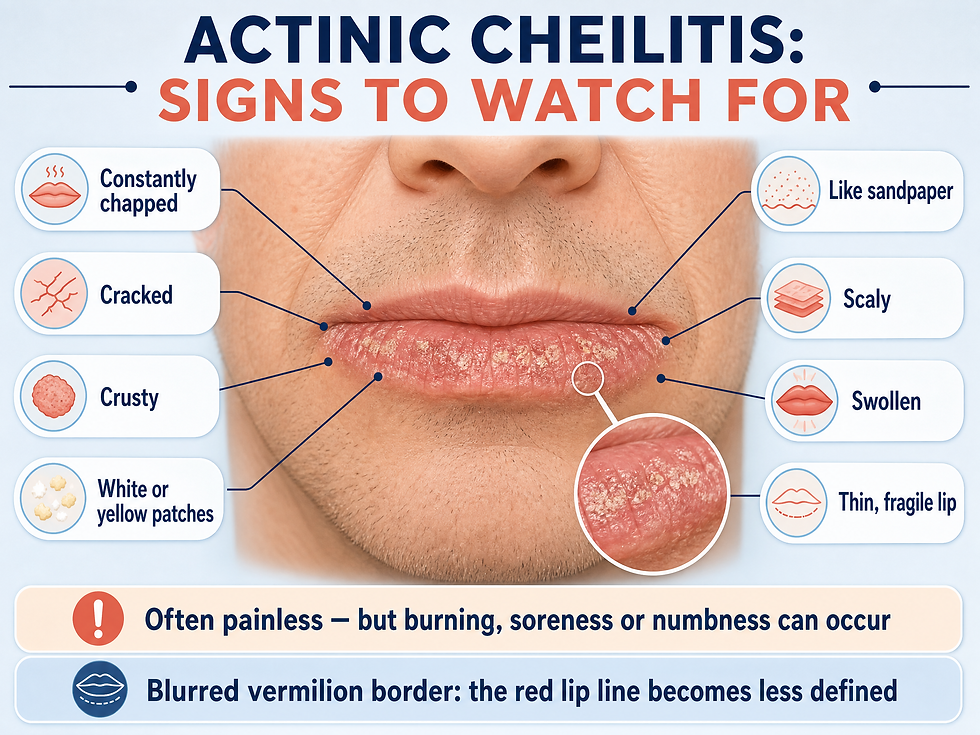
Is actinic cheilitis painful? Usually it is painless, but you might experience burning, numbness, pain, soreness, or tenderness.
How Is Actinic Cheilitis Diagnosed?
If you have symptoms of actinic cheilitis, talk to your healthcare provider. They will examine you to determine which of several conditions you have — simple cheilitis (inflammation that is not precancerous), actinic cheilitis, squamous cell carcinoma, or another condition entirely.
Your healthcare provider may diagnose actinic cheilitis based on three things:
Physical examination of your lips — the provider inspects texture, color, and the sharpness of the vermilion border
Questions about your life — your provider asks about the amount of time spent outdoors, your use of sun protection, and your history of cancer
Skin biopsy — a sample of skin is taken and reviewed microscopically for definitive detail
The biopsy is the only way to confirm whether the changes are simple inflammation, precancerous, or already cancerous — which is why visual inspection alone is not enough.
How Is Actinic Cheilitis Treated?
Actinic cheilitis can turn into cancer, so you should talk to your healthcare provider about treatment options. They will recommend strategies depending on how severe the condition is and your overall health. The goal of treatment is to reduce the risk that the condition will turn into SCC.
Prescription creams: Retinoids, 5-fluorouracil, or imiquimod applied to the affected area
Cryotherapy: Extremely cold temperatures freeze and destroy abnormal cells
Electrocautery: Heat from an electric current destroys abnormal tissue
Laser ablation: A laser destroys abnormal cells
Photodynamic therapy: A procedure that uses light to kill harmful cells
Vermilionectomy: A surgical procedure that removes part or all of the lower lip border

Your provider will choose among these based on the extent of the damage and your health. Milder cases may only need creams or freezing, while extensive or high-grade disease may warrant surgical removal of the affected lip border.
What Is the Outlook After a Diagnosis?
You can improve the outlook for actinic cheilitis by protecting your lips from the sun. Continued sun exposure will increase the risk of SCC, which can be life-threatening.
Actinic cheilitis progresses to squamous cell carcinoma in 6% to 10% of cases. SCC that starts on your lips is more likely to spread to other areas of your body than SCC that starts elsewhere on your skin.
The 6%–10% progression rate means most cases do not become cancer — but lip-originating SCC is among the more aggressive locations for this cancer type, which is why early treatment and ongoing sun protection are non-negotiable.
How Can Actinic Cheilitis and SCC Be Prevented?
The best way to prevent actinic cheilitis and SCC is to protect your lips from the sun's harmful rays year-round:
Apply lip balm with sunscreen regularly: Directly shields the thin, low-pigment lip skin from UV
Limit time in the sun, especially at peak solar strength: Reduces cumulative UV dose to the lips
Wear a hat with a brim that shades your lips: Physical shade that reaches the area lip balm cannot
Additional long-term habits also lower risk: routine checkups to detect changes that could be early warning signs of cancer (most providers recommend yearly skin checks by a dermatologist for people with actinic cheilitis), and quitting smoking, which your healthcare provider can help with.
What Happens After Diagnosis and Treatment?
If you have been diagnosed with and treated for actinic cheilitis, you should have routine checkups every six months to a year. These follow-ups catch recurrences early, before they progress toward cancer. This schedule exists because the same sun exposure that caused the condition the first time remains a risk factor going forward.
Conclusion
Actinic cheilitis is a warning sign from skin that has absorbed more sun than it can safely repair. It is usually painless, usually affects the lower lip, and usually appears in people whose lives keep them outdoors for decades. Left alone, it becomes skin cancer in 6% to 10% of cases — and lip-based squamous cell carcinoma spreads more readily than the same cancer elsewhere on the body. The good news is that it is highly treatable and largely preventable: six treatment options exist, and daily SPF lip balm, peak-hour sun avoidance, brimmed hats, and regular checkups stack the odds firmly in your favor.
If your lips stay chapped, scaly, or discolored no matter what you apply, schedule an exam with a dermatologist this month — and ask specifically whether a skin biopsy is warranted. Bring your sunscreen habit with you: apply SPF lip balm today, not after the appointment.
Frequently Asked Questions
Is actinic cheilitis cancer?
No. Actinic cheilitis is a precancerous condition — it is not cancer itself, but it can eventually turn into squamous cell carcinoma (SCC). It progresses to SCC in 6% to 10% of cases, which is why it deserves diagnosis and treatment rather than watchful neglect.
What does actinic cheilitis look like?
It typically appears as rough, scaly, discolored patches — most often on the lower lip. The lip may look constantly chapped, cracked, crusty, or dry, with white or yellow patches, a sandpaper-like texture, swelling, or thinning. The vermilion border (the red lip line) may blur.
What is the vermilion border, and why does it matter?
The vermilion border is the reddish-colored line that separates the lips from other skin. In actinic cheilitis this border may blur, and women sometimes report difficulty applying lipstick because the lip line is less defined. A blurred vermilion border is a useful clinical clue that changes are precancerous rather than simple dryness.
Who is most likely to get actinic cheilitis?
Fair-skinned men over 65 who work outdoors — sailors, farmers, lifeguards, and construction workers — are at highest risk. Men are more likely to be outdoor laborers and less likely to use sun-protective lip products. People near the equator, at higher altitudes, or with abnormal pigmentation such as albinism are also more vulnerable.
Why are the lips more vulnerable to sun damage than other skin?
The skin on the lips is thinner and contains less pigment than skin elsewhere on the body. Pigment protects cells from the sun's damaging rays, so the lips have less natural defense against the genetic damage that UV rays cause in skin cells.
Can actinic cheilitis go away on its own?
Actinic cheilitis does not reliably resolve without treatment, and continued sun exposure increases the risk of progression to cancer. Even after successful treatment, the condition can recur, which is why ongoing sun protection and checkups every six months to a year are recommended.
How is actinic cheilitis diagnosed?
A healthcare provider uses a physical examination of the lips, questions about outdoor time, sun protection habits, and cancer history, and often a skin biopsy — a sample of skin reviewed microscopically — to distinguish actinic cheilitis from simple cheilitis, squamous cell carcinoma, or other conditions.
What is the best way to prevent actinic cheilitis?
Apply lip balm containing sunscreen regularly, year-round; limit time in the sun, especially during peak solar hours; and wear a hat with a brim that shades your lips. If you smoke, quitting also helps. After diagnosis, keep yearly skin checks with a dermatologist.
References
This article is based on medically reviewed clinical information from the American Osteopathic College of Dermatology's overview of actinic cheilitis, DermNet NZ's clinical reference on actinic cheilitis, and Muse ME, Crane JS, Actinic Cheilitis (StatPearls, NCBI).
This article is for general informational purposes only and is not a substitute for professional medical advice, diagnosis, or treatment. Actinic cheilitis is a precancerous condition that can progress to skin cancer. Only a licensed healthcare provider can diagnose this condition — often requiring a skin biopsy — and recommend an appropriate treatment plan. If you notice persistent rough, scaly, or discolored patches on your lips, consult a physician or dermatologist promptly.
Comments