Acrophobia (Fear of Heights): Symptoms, Causes, Diagnosis, and Treatment (2026 Guide)

Updated: 2 days ago
Medically reviewed by Dr. Baraa Alnahhal, MD · Last reviewed: September 2026
TL;DR
Acrophobia is an intense, unreasonable fear of heights that counts as a specific phobia, a type of anxiety disorder. It affects roughly 3% to 6% of people, and it shows up in everyday moments like climbing stairs or standing near a balcony. Diagnosis requires at least six months of persistent fear. The first-line treatment is exposure therapy, including a virtual reality version, and untreated acrophobia doubles the risk of developing generalized anxiety or depression.
Quick Answer
What is acrophobia?
Acrophobia is an anxiety disorder (specific phobia) marked by intense, unreasonable fear of heights, affecting about 3% to 6% of people.
Symptoms include intense fear, rapid heartbeat, dizziness, trembling, shortness of breath, and a strong urge to escape high places.
Diagnosis requires at least six months of persistent, out-of-proportion fear that interferes with daily life.
Exposure therapy (in person or via virtual reality) is the first-line treatment; medications such as beta blockers are only temporary aids, not the usual treatment.
What Is Acrophobia?
Acrophobia is a mental health condition in which a person experiences an intense fear of heights. It is classified as an anxiety disorder, and more specifically as a type of specific phobia. Someone with acrophobia feels intense fear and anxiety both when thinking about tall heights and when physically positioned at a significant height. Most people with the condition end up avoiding situations or places that involve heights altogether.
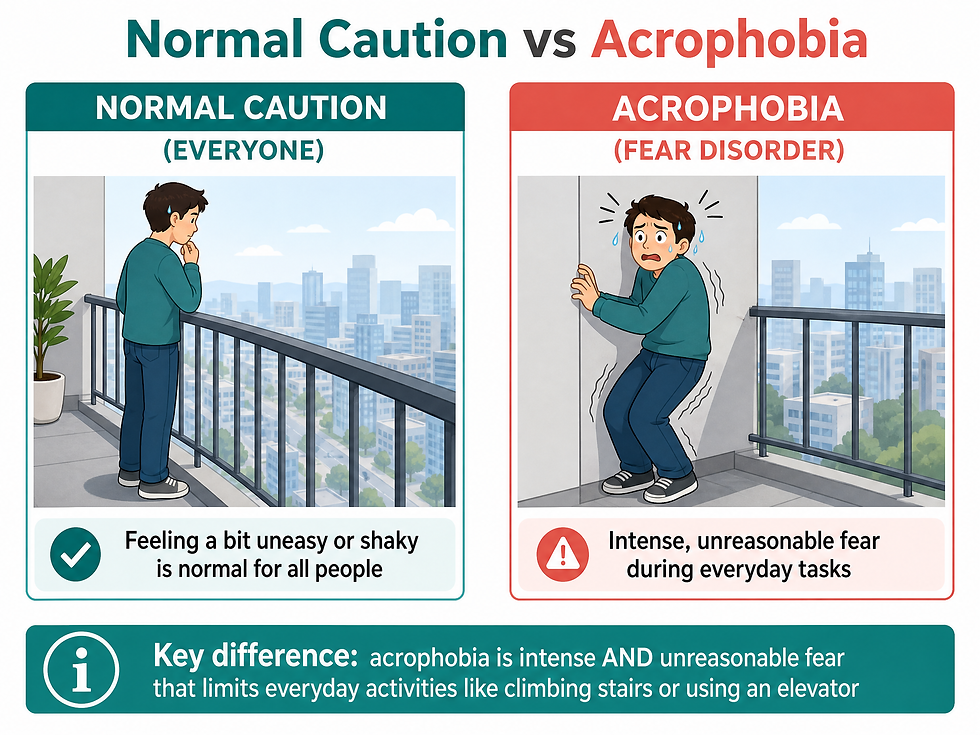
A certain amount of concern around heights is normal for everyone. Most people become more cautious than usual at a significant height, and many feel uneasy or a bit shaky looking down from a bridge. Acrophobia is different: the fear is intense and unreasonable, showing up during ordinary tasks like climbing a flight of stairs, standing near a balcony, or parking a car in a multi-level parking garage.
How Common Is Acrophobia?
Acrophobia is one of the most common phobias. Approximately 3% to 6% of people have the condition. Like other phobias, it can affect anyone at any age. Specific phobias tend to develop more often in children and become apparent in adolescents and young adults. Females are more likely to develop specific phobias than males.
Type of condition: Specific phobia (a type of anxiety disorder)
Prevalence: About 3% to 6% of people
Typical onset: Develops in children; becomes apparent in adolescence and young adulthood
Who is more affected: Females are more likely to develop specific phobias
Can it affect anyone?: Yes, at any age
What Heights Do People with Acrophobia Fear?
People with acrophobia may fear a wide range of heights and situations. The most commonly feared include walking up a flight of stairs, being on a ladder, and using a multi-level parking garage. Others fear being on or crossing a bridge, riding a rollercoaster, standing near a balcony or at the top of a building, and looking out a window of a tall building.
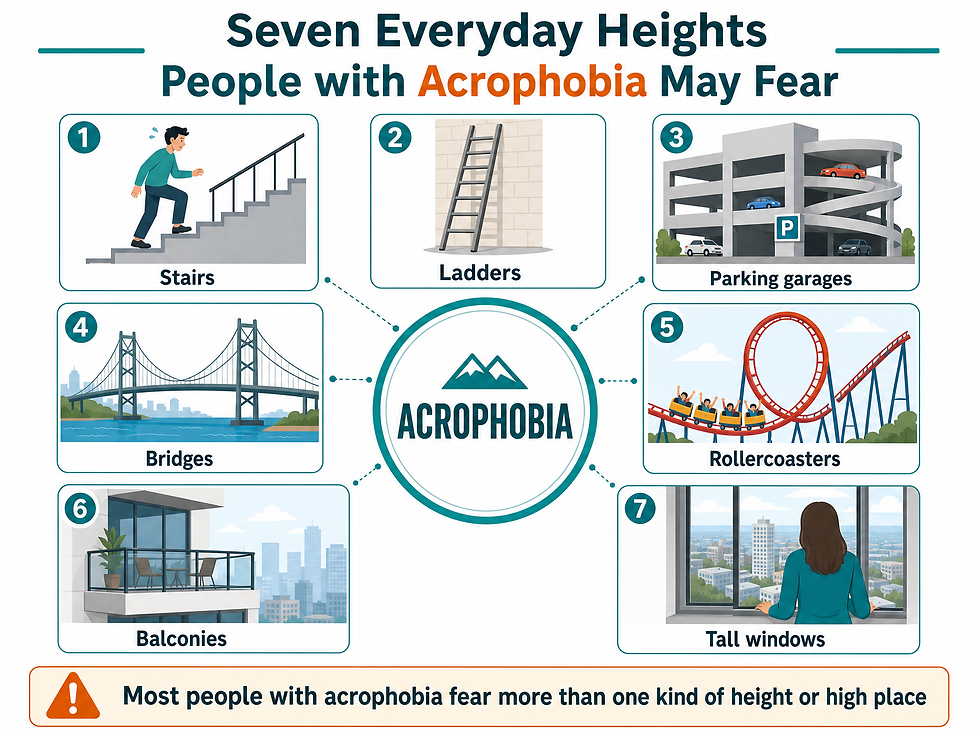
Two important diagnostic details matter here. First, people who have acrophobia generally fear more than one kind of height or high place, rather than a single situation. Second, other phobias can involve height without being acrophobia. For example, an intense fear of flying happens at a significant height, but if the height is not the main aspect of the fear, the condition is likely aerophobia (fear of flying), not acrophobia.
What Are the Signs and Symptoms?
The main symptom of acrophobia is intense anxiety and fear of heights. Some people fear only significant heights such as a tall bridge, while others also fear shorter heights such as standing on a ladder. Symptoms fall into two groups.
Psychological symptoms include feeling intense fear and anxiety when thinking about, looking at, or being in high places. People often fear that something negative will happen in a high place, such as falling or being trapped there. A strong desire to escape when in a high place is also typical.
Physical symptoms include a rapid heartbeat when thinking of or looking at heights, feeling dizzy and lightheaded, feeling queasy, trembling, and shortness of breath.
Intense fear at the thought, sight, or experience of heights: Fear appears even before you reach the high place
Fear of something negative happening (falling, being trapped): Catastrophic thoughts take over in high places
Strong desire to escape: You plan escape routes or leave early
Rapid heartbeat: Heart races just thinking about heights
Dizziness, lightheadedness, queasiness: Balance feels off near ledges or windows
Trembling, shortness of breath: Physical panic signs that may escalate to panic attacks
What Causes Acrophobia?
Researchers are not sure what exactly causes acrophobia. The leading theory is that it stems from the natural human concern about falling from a high place and hurting ourselves. Dwelling on and worrying about the possible pain of a fall may contribute to developing the phobia. A negative or traumatic experience involving a significant height is also believed to play a role.
Three risk factors have been identified: falling from a significant height or watching someone else fall, experiencing a negative event such as a panic attack while in a high place, and having a family history of anxiety disorders. There is no known way to prevent acrophobia, since the exact cause is not fully understood.
How Is Acrophobia Diagnosed?
Acrophobia is diagnosed through a thorough series of questions about a person's history, experiences, and symptoms. A key rule: you must have experienced persistent fear and anxiety of heights for at least six months in order to receive the diagnosis. Providers typically use standard psychiatric diagnostic criteria, and they rule out other physical or mental health conditions that could explain the symptoms.
Persistent duration: Fear and anxiety of heights lasts at least six months
Intense and unreasonable fear: The fear is persistent and out of proportion to the actual danger
Anticipatory anxiety: The person dwells on or dreads future situations involving heights
Avoidance: Active avoidance of heights, sometimes to extreme lengths
Life interference: The fear limits everyday life in some way
The last criterion is especially important. For fear to be diagnosed as a phobia rather than ordinary caution, it has to limit the person's day-to-day activities in some way.
How Is Acrophobia Treated?
Acrophobia can usually be treated with psychotherapy. The three main approaches are exposure therapy, virtual reality exposure therapy (VRET), and cognitive behavioral therapy (CBT). Sometimes medications are added to temporarily relieve fear and anxiety while the person participates in therapy.
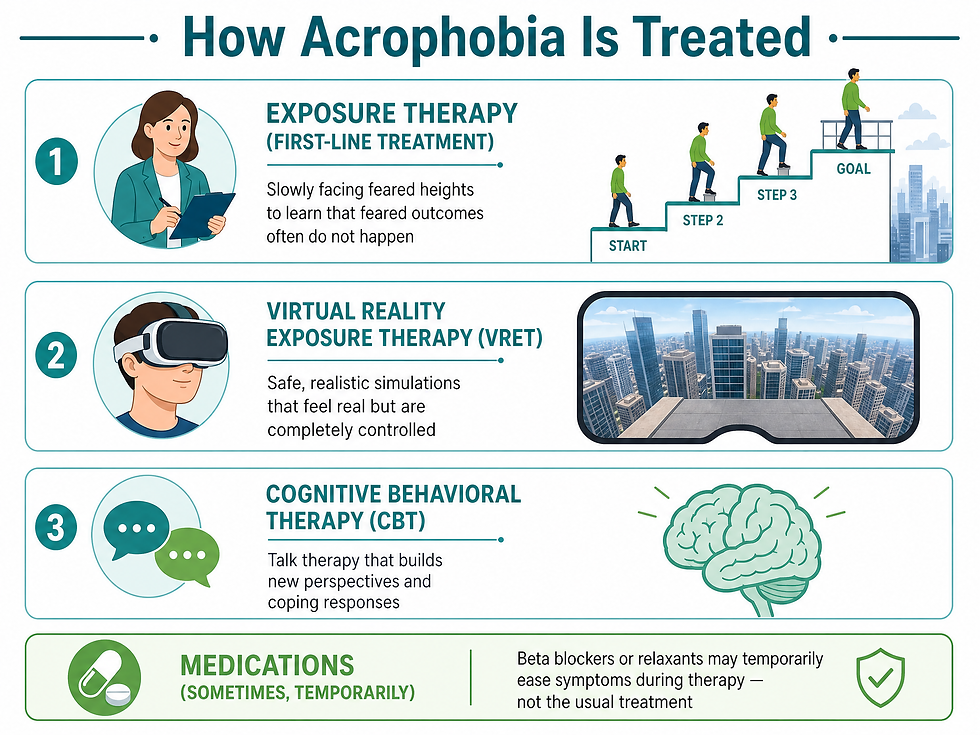
Exposure therapy is a common psychological treatment for specific phobias and is considered the first-line treatment. People with phobias avoid the situations they fear, which means they never learn that they can manage the fear or that feared outcomes often do not happen. In exposure therapy, a therapist or psychologist slowly encourages the person to enter anxiety-causing situations and stay in them long enough to learn coping skills.
Virtual reality exposure therapy (VRET) uses a VR headset to show realistic but simulated height situations. Exposure happens in a way that is completely safe yet feels real. Research has shown that VRET is effective in treating acrophobia.
Cognitive behavioral therapy (CBT) works through talking and questioning. The therapist helps the person gain a different perspective, learning to respond better to and cope with the stress and anxiety triggered by feared things.
Medications are not usually used to treat specific phobias. They may help temporarily during therapy or in unavoidable situations. Beta blockers can treat or prevent physical anxiety symptoms such as a fast heart rate, and benzodiazepines (relaxants) can temporarily reduce anxiety.
Exposure therapy: Gradual, repeated exposure to feared heights so the person learns to cope — first-line treatment
Virtual reality exposure therapy (VRET): Realistic but safe VR simulations of heights, backed by research
Cognitive behavioral therapy (CBT): Talk therapy that reframes thoughts and builds coping responses
Beta blockers: Reduce physical anxiety symptoms like fast heart rate — a temporary aid
Benzodiazepines: Relaxants that temporarily lower anxiety — not a standard long-term treatment
What Happens Without Treatment?
Only about 10% to 25% of people with a specific phobia such as acrophobia ever seek treatment, largely because avoidance feels like a solution. But avoidance is a trap. It can prevent everyday tasks such as walking up a flight of stairs or crossing a bridge, and it lowers overall quality of life. Acrophobia can also be potentially dangerous if a panic attack strikes at a significant height, such as while standing on a ladder.
The long-term stakes are higher still. Research shows that people with acrophobia who do not seek treatment are two times more likely to develop generalized anxiety disorder or depression unrelated to the phobia. There is currently no cure for acrophobia, but exposure therapy is successful at treating it, which is why it is considered the first-line treatment for specific phobias in general.
How Can You Cope in a High Place?
If you are in a high place, several self-care actions can decrease anxiety — as long as they can be done safely. Fixing your view on the horizon, looking at stationary objects nearby, sitting or lying down, pausing or stopping movement, and practicing cognitive distractions such as naming items from a certain category can all help in the moment.
Longer-term habits support treatment. Getting enough sleep and exercise, attending therapy sessions regularly, practicing mindfulness activities such as meditation, and using relaxation techniques like deep breathing and yoga all contribute. Reaching out to family and friends for support and joining a support group for acrophobia or specific phobias can also help.
What Questions Should You Ask Your Provider?
Talking about mental health can feel uncomfortable, but mental health is just as important as physical health. Helpful questions to ask your provider include: What kind of treatment do you recommend? Should I see a therapist, psychologist, and/or psychiatrist? Do you have provider recommendations? How long will treatment take? Do you know of any support groups for acrophobia or phobias in general? Do you have learning resources I could read?
When Should You Seek Help?
The message from clinicians is direct: if you have acrophobia, you are not alone. Avoiding heights provides short-term relief, but it does not address the underlying cause of the fear and anxiety. Although it can be difficult and uncomfortable, it is important to talk to a healthcare provider and seek proper treatment. The sooner you seek help, the sooner you can take back control of your life.
Conclusion
Acrophobia is a common and treatable anxiety disorder, affecting roughly 3 to 6 in every 100 people. It is more than ordinary caution about heights: it is an intense, unreasonable fear that persists for at least six months and limits daily life, from climbing stairs to crossing bridges. The good news is that treatment works. Exposure therapy — delivered in person or through virtual reality — is the proven first-line approach, and cognitive behavioral therapy provides lasting coping tools. Avoidance may feel safe today, but untreated acrophobia doubles the risk of generalized anxiety and depression.
If heights shape your daily choices — the routes you walk, the places you go, the tasks you refuse — talk to a healthcare provider this week. Ask specifically about exposure therapy or virtual reality exposure therapy, and ask whether you qualify for a formal diagnosis. Taking that first step is the fastest way to take back control.
Frequently Asked Questions
Is fear of heights a mental disorder?
Fear of heights becomes a mental disorder — acrophobia, a type of specific phobia under anxiety disorders — when the fear is intense, unreasonable, lasts at least six months, and limits everyday life. Mild unease on a high balcony is normal; fear that stops you from climbing stairs is a phobia.
How common is acrophobia?
Acrophobia is one of the most common phobias, affecting approximately 3% to 6% of people. It can develop at any age, often begins in childhood, becomes apparent in adolescence or young adulthood, and is more common in females.
What are the symptoms of acrophobia?
Symptoms include intense fear and anxiety when thinking about, looking at, or being in high places; fear of falling or being trapped; a strong urge to escape; plus physical reactions like rapid heartbeat, dizziness, queasiness, trembling, and shortness of breath.
Can acrophobia be cured?
There is currently no cure for acrophobia, but exposure therapy is successful at treating it and is considered the first-line treatment for specific phobias in general. Virtual reality exposure therapy is also proven effective.
What is the best treatment for fear of heights?
Exposure therapy is the first-line treatment: a therapist slowly encourages you to enter and stay in height situations until you learn that feared outcomes often do not happen. Virtual reality exposure therapy and cognitive behavioral therapy are effective alternatives or complements.
Why does my heart race when I look out a tall window?
A rapid heartbeat is one of the physical symptoms of acrophobia, along with dizziness, queasiness, trembling, and shortness of breath. These reactions can occur simply from thinking about or looking at heights, not only from being in them.
Is it dangerous to leave acrophobia untreated?
Yes. Avoidance lowers quality of life and prevents everyday tasks, and a panic attack at a significant height — such as on a ladder — can be physically dangerous. Untreated acrophobia also doubles the risk of later developing generalized anxiety disorder or depression.
How is acrophobia different from fear of flying?
Fear of flying (aerophobia) happens at a height, but the height itself is not the main fear. People with acrophobia generally fear multiple kinds of heights — stairs, ladders, bridges, balconies — and the height itself is what triggers the intense fear.
References
This article is based on medically reviewed clinical information from Acrophobia (Fear of Heights), which draws on research including Huppert D, Wuehr M, Brandt T. Acrophobia and visual height intolerance: advances in epidemiology and mechanisms (Journal of Neurology, 2020), Arroll B, et al. A systematic review and meta-analysis of treatments for acrophobia (Medical Journal of Australia, 2017), and guidance from the Society of Clinical Psychology on exposure therapies for specific phobias.
This article is for general informational purposes only and does not constitute medical advice. Always consult a qualified healthcare professional for diagnosis and treatment decisions.
Comments