What Are Chronic Daily Headaches? A Complete Guide (2026)

Updated: 2 days ago
Medically reviewed by Dr. Baraa Alnahhal, MD · Last reviewed: September 2026
"Chronic daily headaches" is not a single headache type — it describes headaches that occur 15 or more days a month for longer than three months, across a variety of subtypes. The four long-lasting types are chronic migraine, chronic tension-type headache, new daily persistent headache, and hemicrania continua. Taking pain relievers more than two days a week can create a cycle of rebound (medication-overuse) headaches, one of the leading causes. Warning signs like a sudden severe headache, headache with fever and stiff neck, or headache after a head injury need prompt medical care. Treatment focuses on preventing pain with antidepressants, beta blockers, anti-seizure drugs, NSAIDs, or botulinum toxin injections, while lifestyle changes — sleep, meals, exercise, stress reduction, and caffeine control — form the prevention foundation.
Quick Answer: What You Need to Know
Who is this for? Anyone who gets a headache more days than not, relies on pain relievers frequently, or wants to understand chronic headache prevention and treatment.
What it is: Headaches occurring 15 or more days a month for longer than three months — a category covering several headache subtypes, not one specific type.
Why it matters: The constant nature makes chronic daily headaches one of the most disabling headache conditions.
The four long-lasting types: Chronic migraine, chronic tension-type headache, new daily persistent headache, and hemicrania continua.
A leading cause: Medication overuse — taking pain relievers even over-the-counter more than two days a week (or nine days a month) risks rebound headaches.
Other possible causes: Blood vessel problems including stroke, infections such as meningitis, abnormal brain pressure, brain tumor, or traumatic brain injury.
Top risk factors: Female sex, anxiety, depression, sleep disturbances, obesity, snoring, caffeine overuse, medication overuse, and other chronic pain conditions.
How it's treated: Preventive daily medication — antidepressants, beta blockers, anti-seizure drugs, prescription NSAIDs, or botulinum toxin injections — chosen by headache type.
Prevention that helps: Track triggers in a headache diary, limit pain relievers to two days a week, sleep 7–8 hours at regular times, don't skip meals, exercise, reduce stress, and cut back caffeine.
What Are Chronic Daily Headaches?
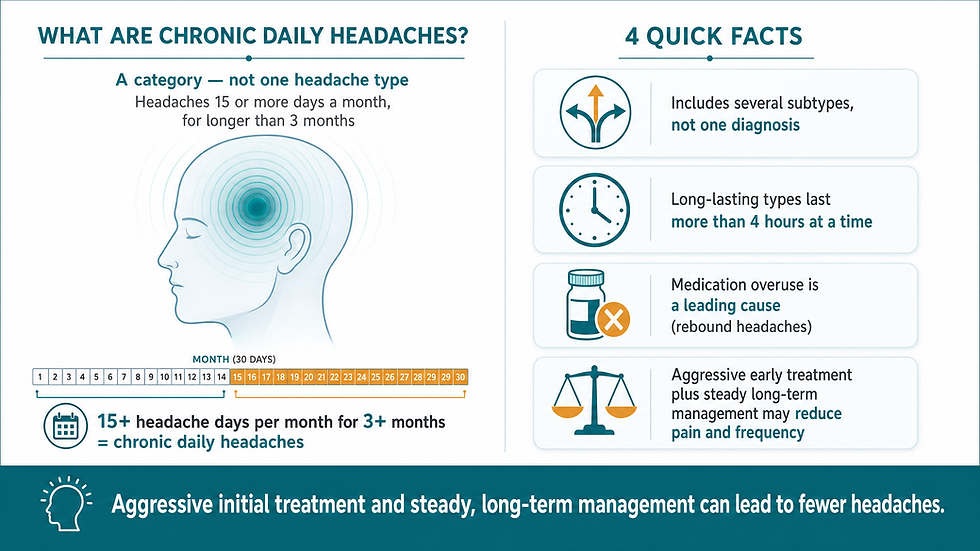
Most people have headaches from time to time. But if you have a headache more days than not, you might have chronic daily headaches.
It is important to understand that this is not one specific headache type. Chronic daily headaches include a variety of headache subtypes — "chronic" refers to how often the headaches occur and how long the condition lasts, not to a single diagnosis.
By definition, chronic daily headaches occur 15 days or more a month, for longer than three months.
The constant nature of chronic daily headaches makes them one of the most disabling headache conditions. The good news: aggressive initial treatment and steady, long-term management might reduce pain and lead to fewer headaches.
By definition, these headaches are split into two groups: short-lasting and long-lasting types. The long-lasting group — the focus of this guide — consists of headaches that last more than four hours at a time.
The 4 Long-Lasting Types of Chronic Daily Headaches
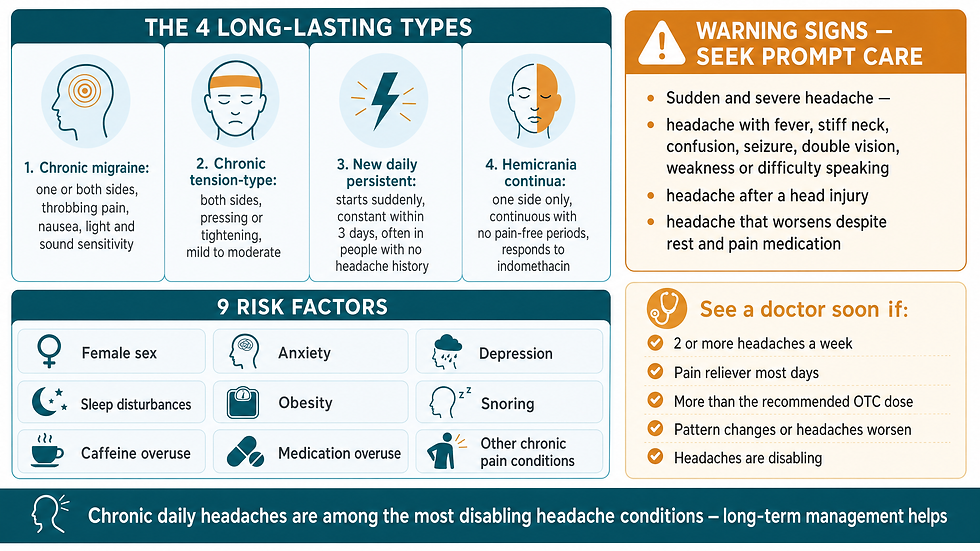
The four long-lasting subtypes each have a distinct pattern. Here is how they compare.
Chronic migraine: one side or both sides — pulsating, throbbing — moderate to severe — nausea, vomiting, or sensitivity to light and sound; typically occurs in people with a history of episodic migraines
Chronic tension-type headache: both sides — pressing or tightening, not pulsating — mild to moderate — steady pressure around the head
New daily persistent headache: often both sides — pressing or tightening, not pulsating — mild to moderate — comes on suddenly, usually in people without a headache history; becomes constant within three days of the first headache
Hemicrania continua: one side only — moderate with spikes of severe pain — moderate, spiking — daily and continuous with no pain-free periods; responds to the prescription indomethacin
Hemicrania continua deserves a closer look because of its distinctive features. At minimum, it involves one of the following: tearing or redness of the eye on the affected side, nasal congestion or runny nose, a drooping eyelid or pupil narrowing, or a sensation of restlessness. It is also notable that it responds to a specific prescription pain reliever — indomethacin — which helps clinicians confirm the diagnosis.
When Should You See a Doctor?
Occasional headaches are common and usually require no medical attention. The picture changes when headaches become frequent. Make an appointment if:
You usually have two or more headaches a week
You take a pain reliever for your headaches most days
You need more than the recommended over-the-counter dose
Your headache pattern changes or headaches worsen
Your headaches are disabling
Red flags — seek prompt medical care
Some headache patterns need urgent attention. Seek prompt medical care if your headache is sudden and severe, accompanies a fever, stiff neck, confusion, seizure, double vision, weakness, numbness, or difficulty speaking, follows a head injury, or gets worse despite rest and pain medication.
What Causes Chronic Daily Headaches?
The causes of many chronic daily headaches aren't well understood. True (primary) chronic daily headaches don't have an identifiable underlying cause — the pattern itself is the condition.
But some chronic daily headaches are secondary: caused by another condition. These include:
Blood vessel problems: inflammation or other problems with the blood vessels in and around the brain, including stroke
Infections: such as meningitis
Abnormal brain pressure: intracranial pressure that's either too high or too low
Brain tumor: pressure and irritation within the skull
Traumatic brain injury: injury-related headache patterns
Medication-overuse headaches (rebound headaches)
One cause deserves special attention because it is so common and so preventable. Medication-overuse headache usually develops in people who have an episodic headache disorder — usually migraine or tension-type — and take too much pain medication.
If you're taking pain medications — even over-the-counter — more than two days a week (or nine days a month), you're at risk of developing rebound headaches.
This creates a frustrating cycle: the more pain relievers you take, the more headaches you get, which drives more pain reliever use. Breaking the cycle usually requires a doctor's guidance.
Risk Factors: What Increases Your Chance of Chronic Daily Headaches?
Nine factors are associated with developing frequent headaches. Several are connected to each other — anxiety, depression, and sleep disturbances often travel together with chronic pain.
Female sex: women are more likely to develop frequent headaches
Anxiety: psychological strain is associated with headache frequency
Depression: often accompanies and complicates chronic headaches
Sleep disturbances: poor or disrupted sleep is a known trigger
Obesity: weight is associated with more frequent headaches
Snoring: sleep-breathing problems link to headache patterns
Overuse of caffeine: caffeine can aggravate headaches despite appearing in some headache medicines
Overuse of headache medication: the rebound cycle described above
Other chronic pain conditions: chronic pain conditions raise overall headache risk
People with chronic daily headaches are also more likely to develop depression, anxiety, sleep disturbances, and other psychological and physical problems — which is why treatment addresses both the headaches and their broader impact.
Can Chronic Daily Headaches Be Prevented?
There is no guaranteed prevention, but seven self-care steps can ease chronic daily headaches and reduce their frequency.
Avoid headache triggers: keep a headache diary — record when each headache started, what you were doing, and how long it lasted — to identify and avoid your personal triggers
Avoid medication overuse: taking headache medications, including over-the-counter ones, more than twice a week can increase headache severity and frequency; consult your doctor about weaning off
Get enough sleep: adults need seven to eight hours a night; go to bed and wake up at the same time every day; talk to your doctor about sleep disturbances such as snoring
Don't skip meals: eat healthy meals at about the same times daily; avoid foods and drinks — especially caffeine — that seem to trigger headaches; lose weight if you're obese
Exercise regularly: regular aerobic activity improves physical and mental well-being and reduces stress; with your doctor's OK, choose enjoyable activities like walking, swimming, or cycling
Reduce stress: stress is a common trigger; get organized, simplify your schedule, plan ahead, stay positive; try yoga, tai chi, or meditation
Reduce caffeine: some headache medicines include caffeine because it can reduce headache pain — but caffeine can also aggravate headaches; minimize or eliminate it from your diet
How Are Chronic Daily Headaches Diagnosed?
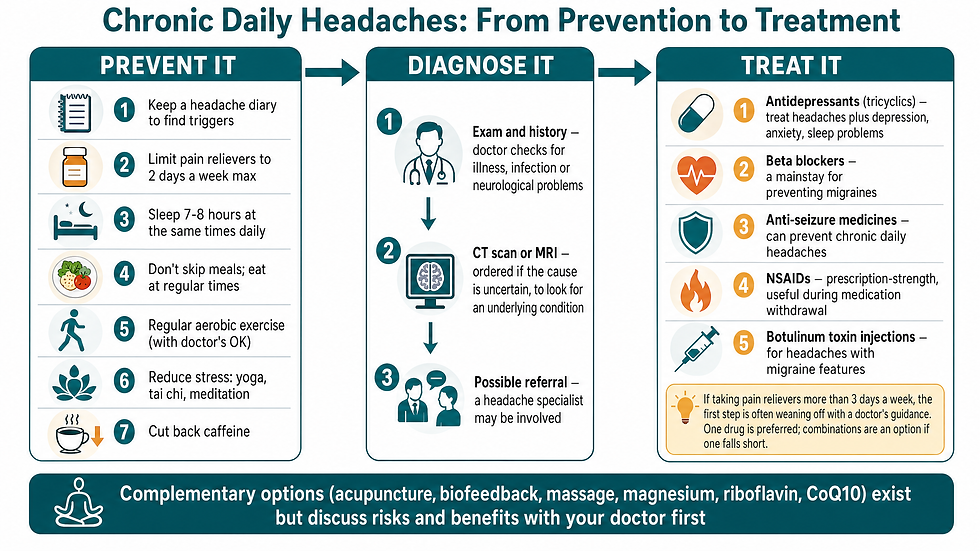
Diagnosis starts with the basics. Your doctor will likely examine you for signs of illness, infection, or neurological problems and ask about your headache history — including patterns, triggers, and what you take for relief.
Physical exam and history: the doctor checks for illness, infection, and neurological problems, and reviews your headache history in detail
Imaging tests: if the cause remains uncertain, a CT scan or MRI may be ordered to look for an underlying medical condition
Specialist referral: you're likely to start with your family doctor or general practitioner, but may be referred to a headache specialist
A headache journal makes diagnosis far easier. Before your appointment, record when each headache occurred, how long it lasted, how intense it was, what you were doing immediately before it started, and anything else notable.
How Are Chronic Daily Headaches Treated?
Treatment depends on whether another condition is causing the headaches. Treatment for an underlying condition often stops frequent headaches entirely. If no such condition is found, treatment focuses on preventing pain.
If you're taking pain relievers more than three days a week, the first step might be to wean yourself off these drugs with your doctor's guidance. Once you're ready, your doctor may recommend preventive therapy from these five options:
Antidepressants: tricyclics such as nortriptyline (Pamelor) — treat chronic headaches directly, and also help the depression, anxiety, and sleep disturbances that often accompany them
Beta blockers: atenolol (Tenormin), metoprolol (Lopressor), propranolol (Inderal) — commonly used for high blood pressure; a mainstay for preventing episodic migraines
Anti-seizure medications: topiramate (Topamax), divalproex sodium (Depakote), gabapentin (Neurontin) — some anti-seizure drugs seem to prevent migraines and might prevent chronic daily headaches as well
Prescription NSAIDs: naproxen sodium (Anaprox, Naprelan) — helpful especially when withdrawing from other pain relievers; can also be used periodically for more severe headaches
Botulinum toxin: onabotulinumtoxinA (Botox) injections — provide relief for some people; a viable option if you don't tolerate daily medication
Doctors generally prefer using one drug first. If one drug doesn't work well enough, combining drugs is an option.
Complementary and alternative approaches
Many people find relief through complementary therapies — but caution is warranted, because not all have been studied as headache treatments.
Acupuncture: hair-thin needles inserted at defined points; results are mixed, but some studies show reduced frequency and intensity of chronic headaches
Biofeedback: becoming more aware of — and then changing — bodily responses such as muscle tension, heart rate, and skin temperature
Massage: reduces stress, relieves pain, promotes relaxation; may help especially if you have tight muscles in the back of the head, neck, and shoulders
Herbs, vitamins, and minerals: feverfew and butterbur might prevent migraines; high-dose vitamin B-2 might reduce migraines; Coenzyme Q10 and magnesium might help some. Don't use riboflavin, feverfew, or butterbur if pregnant
Occipital nerve stimulation: a small battery-powered electrode surgically implanted near the occipital nerve sends continuous energy pulses to ease pain; considered investigational
Always discuss the risks and benefits with your doctor before trying any complementary or alternative therapy.
Coping and Support: What Helps People Through It
Chronic daily headaches can interfere with your job, your relationships, and your quality of life. Four strategies stand out:
Take control. Commit to living a full, satisfying life. Work with your doctor to develop a treatment plan that works for you, take good care of yourself, and do things that lift your spirits.
Seek understanding. Don't expect friends and loved ones to instinctively know what's best for you. Ask for what you need — whether it's time alone or less attention paid to your headaches.
Check out support groups. Talking with other people who have painful headaches can be genuinely useful.
Consider counseling. A counselor or therapist offers support and helps you manage stress and understand the psychological effects of headache pain. There is evidence that cognitive behavioral therapy can reduce headache frequency and severity.
Preparing for Your Appointment
You're likely to start by seeing your family doctor or a general practitioner, and may be referred to a headache specialist. A few steps help you make the most of the visit.
Be aware of pre-appointment restrictions, such as diet restrictions. Keep a headache journal. Write down your symptoms and when they began, along with key personal information — major stresses, recent life changes, and family history of headaches. List all medications, vitamins, and supplements with doses and frequency, including those you used previously. Write down your questions, and take a family member or friend along to help remember information.
Questions to ask your doctor
What's the likely cause of my headaches?
What are other possible causes?
What tests do I need?
Is my condition likely temporary or chronic?
What's the best course of action?
I have other health conditions — how can I best manage them together?
Should I see a specialist?
Are there printed materials I can have? What websites do you recommend?
What your doctor will ask you
Have your headaches been continuous or occasional?
How severe are your headaches?
What, if anything, seems to improve your headaches?
What, if anything, appears to worsen your headaches?
What you can do in the meantime
Until you see your doctor, avoid activities that worsen your headaches. Over-the-counter pain relief such as naproxen sodium (Aleve) or ibuprofen (Advil, Motrin IB) can ease pain — but to avoid rebound headaches, don't take these more than three times a week.
Conclusion
Chronic daily headaches are defined by frequency — 15 or more days a month for longer than three months — and they span several distinct subtypes, from chronic migraine to hemicrania continua. Their constant nature makes them one of the most disabling headache conditions, yet they respond well to structured care: identify and avoid triggers, break any medication-overuse cycle, and commit to a preventive treatment plan. Much of the foundation is within your control — regular sleep, regular meals, aerobic exercise, stress reduction, and caffeine moderation. When headaches strike suddenly and severely, follow a head injury, or come with fever, stiff neck, or neurological symptoms, don't wait: seek prompt medical care.
If headaches are taking over your calendar, don't just keep reaching for pain relievers — talk with a healthcare professional to build a prevention plan.
FAQ
How many headache days a month count as chronic daily headaches?
By definition, chronic daily headaches occur 15 or more days a month, for longer than three months. The term covers several headache subtypes rather than one specific condition.
What are the four long-lasting types of chronic daily headaches?
They are chronic migraine (throbbing, moderate to severe, with nausea or light/sound sensitivity), chronic tension-type headache (pressing on both sides, mild to moderate), new daily persistent headache (starts suddenly and becomes constant within three days), and hemicrania continua (one-sided, continuous with no pain-free periods, responsive to indomethacin).
Can too many pain relievers cause daily headaches?
Yes — this is called medication-overuse or rebound headache. Taking pain medications, even over-the-counter ones, more than two days a week (or nine days a month) puts you at risk. Breaking the cycle usually requires weaning off under a doctor's guidance.
What are the warning signs that a headache needs urgent care?
Seek prompt medical care for a headache that is sudden and severe, accompanies fever, stiff neck, confusion, seizure, double vision, weakness, numbness, or difficulty speaking, follows a head injury, or worsens despite rest and pain medication.
What medications prevent chronic daily headaches?
Options include tricyclic antidepressants (such as nortriptyline), beta blockers (such as propranolol and metoprolol), anti-seizure medications (such as topiramate and gabapentin), prescription NSAIDs (such as naproxen sodium), and botulinum toxin (Botox) injections — chosen based on headache type. One drug is preferred; combinations are possible if needed.
Do natural remedies help chronic daily headaches?
Some complementary options show promise: acupuncture has reduced frequency and intensity in some studies; biofeedback and massage help some people; and supplements such as feverfew, butterbur, high-dose riboflavin, Coenzyme Q10, and magnesium have varying levels of evidence. Discuss risks and benefits with your doctor first — and avoid riboflavin, feverfew, and butterbur if pregnant.
How can I prevent chronic daily headaches with lifestyle changes?
Keep a headache diary to identify triggers, limit pain relievers to two days a week, sleep 7–8 hours at consistent times, don't skip meals, exercise regularly with your doctor's OK, reduce stress through techniques like yoga and meditation, and minimize or eliminate caffeine.
Is chronic daily headache linked to depression and anxiety?
Yes. People with chronic daily headaches are more likely to have depression, anxiety, and sleep disturbances — and these conditions can worsen headaches. Treatment plans often address both the headaches and their psychological impact, and cognitive behavioral therapy has evidence for reducing headache frequency and severity.
References
This article is for general information only and does not replace professional medical advice. Always consult a qualified healthcare provider about diagnosis and treatment decisions.
Health information, not medical advice. This article is for general education and is not a substitute for professional diagnosis or treatment. Always consult a qualified healthcare provider about your own health, and seek emergency care for urgent symptoms.
Comments