Understanding Levoscoliosis and Dextroscoliosis: Causes, Symptoms, and Care

Updated: 2 days ago
Medically reviewed by Dr. Baraa Alnahhal, MD · Last reviewed: September 2026
TL;DR
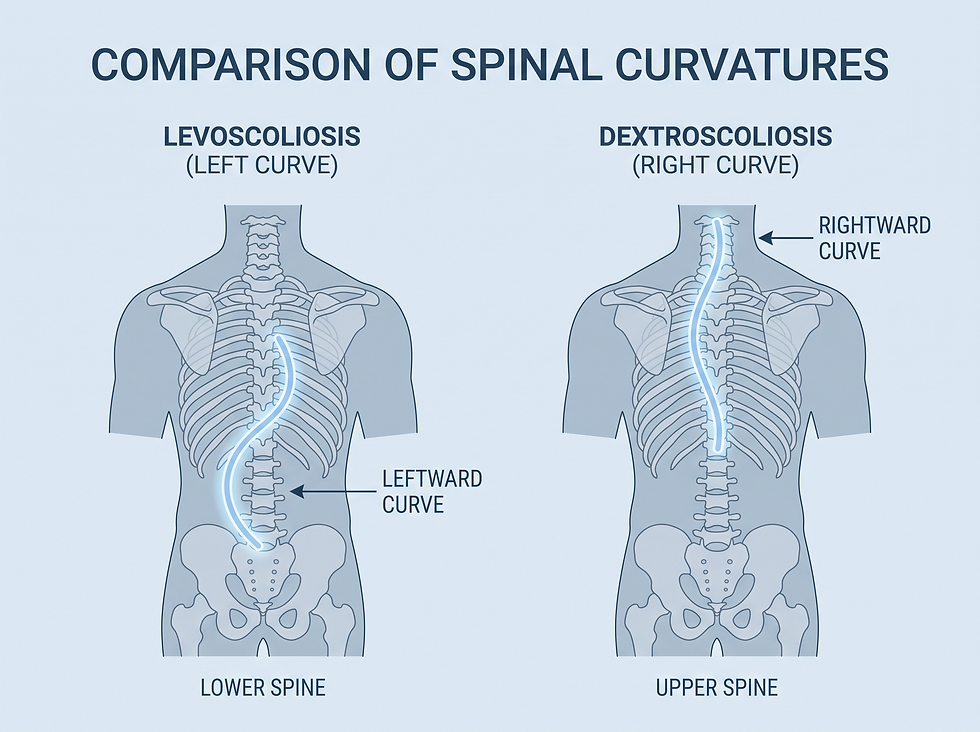
Levoscoliosis and dextroscoliosis are specific types of scoliosis characterized by the direction of the spine's abnormal curve. Levoscoliosis refers to a leftward curve, typically in the lower back, while dextroscoliosis involves a rightward curve, often in the upper back. Most cases are mild and require only periodic monitoring, though severe curves may necessitate bracing or surgery to prevent progression and protect internal organs.
Quick Answer
Levoscoliosis is an abnormal spinal curve to the left, while dextroscoliosis is a curve to the right. Both are forms of scoliosis that rotate the spine away from its natural alignment. While often asymptomatic, they can cause uneven shoulders or hips. Diagnosis involves physical exams and imaging, and treatment ranges from observation to bracing or surgery, depending on the curve's severity. Most individuals live active lives without needing intensive intervention.
Scoliosis is a complex condition that involves more than just a simple bend in the back; it is a three-dimensional rotation and curvature of the spine. When healthcare providers diagnose this condition, they often use the terms levoscoliosis and dextroscoliosis to specify the direction of the curve. These classifications are essential for developing a management plan, as the location and direction of the curve can influence which parts of the body are most affected.
While the prospect of a spinal curvature diagnosis can be concerning, it is important to note that the vast majority of cases do not require aggressive treatment. Instead, the focus is on regular monitoring to ensure the curve does not progress to a point where it interferes with physical function or internal organ health. Understanding the differences between these two types of scoliosis is the first step in proactive spinal care. For a broader overview, see our Scoliosis Guide; another common spinal curvature is covered in our complete guide to kyphosis.
Differentiating Levoscoliosis and Dextroscoliosis
The primary distinction between these two conditions is the direction of the spinal deviation. This direction is often linked to specific regions of the spine, although both types can occur at any level.
Feature | Levoscoliosis | Dextroscoliosis |
Curve Direction | Curves to the left (resembles a "C"). | Curves to the right (resembles a backward "C"). |
Common Location | Most frequently affects the lumbar spine (lower back). | Most common in the thoracic spine (upper back). |
Prevalence | Less common than the rightward variety. | The most common form of scoliosis. |
Visual Sign | The spine appears to bulge toward the left side. | The spine appears to bulge toward the right side. |
Regardless of the direction, the underlying mechanics of the curvature remain similar. The spine rotates as it bends, which can lead to visible changes in posture and, in rare cases, physical discomfort or functional limitations.
Causes and Risk Factors
Scoliosis is rarely the result of a single action or habit. Contrary to common myths, it is not caused by poor posture, carrying heavy backpacks, or playing specific sports. Instead, the condition is categorized by its underlying origin.
Primary Classifications
Idiopathic Scoliosis: This is the most common form, where the exact cause is unknown. However, there is a strong genetic component, as approximately 30% of affected individuals have a close relative with the condition.
Congenital Scoliosis: A rare form present at birth, resulting from abnormal spinal development in the womb.
Degenerative Scoliosis: Caused by the natural wear and tear of the spine that occurs with aging, making it the most frequent cause in adults.
Neuromuscular Scoliosis: Stemming from conditions that affect the nerves and muscles supporting the spine, such as cerebral palsy or muscular dystrophy.
Genetic factors play a significant role in the prevalence of the condition, with girls being more likely to develop scoliosis than boys. Early screening, particularly during the rapid growth phases of adolescence, is critical for identifying curves before they become severe.
Recognizing Symptoms and Seeking Diagnosis
For many, scoliosis is a silent condition that does not cause pain or obvious discomfort. It is often first noticed by others who observe subtle changes in the individual's posture or alignment.
Signs to Watch For
Uneven Shoulders: One shoulder blade may appear more prominent or higher than the other.
Hip Asymmetry: One hip may seem higher or more pushed to one side when standing.
Visible Spinal Curve: A noticeable "C" or "S" shape when the individual bends forward.
Diagnosis typically begins with a physical assessment known as the Adam's forward bend test. A healthcare provider may also use a scoliometer to measure the degree of rotation. If a curve is detected, imaging tests such as X-rays, MRIs, or CT scans are used to confirm the diagnosis and measure the exact angle of the curvature.
Management and Treatment Options
The goal of scoliosis treatment is to prevent the curve from worsening rather than "curing" the curvature itself. The chosen path depends heavily on the severity of the curve and the age of the patient.
Treatment Level | Application and Goals |
Observation | Regular check-ups every 4-6 months for mild curves to monitor for changes. |
Bracing | Customized braces worn at least 20 hours a day to stop progression in growing children. |
Physical Therapy | Specialized methods, like the Schroth method, to strengthen supporting muscles. |
Surgery | Spinal fusion or bone grafting for severe curves that threaten organ function. |
Most people with scoliosis can continue their daily routines and participate in sports without restriction. In fact, staying active is encouraged as it strengthens the core and back muscles that support the spine.

Outlook and Long-Term Care
With proper monitoring and timely intervention, the outlook for individuals with levoscoliosis or dextroscoliosis is excellent. Most people never require surgery and lead full, active lives.

Conclusion
Levoscoliosis and dextroscoliosis are manageable conditions that primarily require awareness and regular professional monitoring. By understanding the direction of the curve and its potential impact, individuals can work with their healthcare providers to maintain spinal health and prevent future complications. Early detection remains the most effective tool in ensuring a positive long-term outcome.
Next Steps
If you notice uneven shoulders, hips, or a visible curve in your or your child's spine, schedule an evaluation with a healthcare professional today. Regular monitoring is the best way to ensure spinal health and prevent the progression of scoliosis.
Frequently Asked Questions
What is the difference between levoscoliosis and dextroscoliosis?
Levoscoliosis is a spinal curve to the left, while dextroscoliosis is a curve to the right.
Which type is more common?
Dextroscoliosis (rightward curve) is more common than levoscoliosis.
Does scoliosis cause pain?
Most mild cases do not cause pain, though severe curves can lead to muscle strain or nerve pressure.
Can poor posture cause scoliosis?
No, scoliosis is not caused by slouching, heavy backpacks, or poor posture.
Is scoliosis hereditary?
Yes, about 30% of people with scoliosis have a family history of the condition.
How is scoliosis diagnosed?
It is diagnosed through a physical exam (forward bend test) and confirmed with imaging like X-rays.
What is a scoliometer?
It is a handheld tool used by providers to measure the rotation and curvature of the spine.
Do all cases of scoliosis require treatment?
No, most mild cases only require periodic monitoring every few months.
How long must a scoliosis brace be worn?
Most braces must be worn for at least 20 hours a day to be effective.
When is surgery necessary?
Surgery is typically reserved for severe curves or those that continue to worsen over time.
What is the Schroth method?
It is a specialized form of physical therapy involving exercises to strengthen muscles around the spine.
Can I still play sports with scoliosis?
Yes, staying active is generally encouraged to help strengthen the muscles supporting the spine.
Can adults develop scoliosis?
Yes, adults can develop degenerative scoliosis due to age-related wear and tear.
Can scoliosis affect internal organs?
In very rare, severe cases, it can put pressure on the heart, lungs, or spinal cord.
What is idiopathic scoliosis?
It is the most common type of scoliosis where the exact cause is unknown.
Medical Disclaimer
The information provided in this article is for educational purposes only and is not intended as medical advice, diagnosis, or treatment. Always seek the advice of your physician or other qualified health provider with any questions you may have regarding a medical condition. Never disregard professional medical advice or delay in seeking it because of something you have read here.
Comments