Plexiform Neurofibroma: Symptoms, Causes, Diagnosis and Treatment Options

Updated: 2 days ago
Medically reviewed by Dr. Baraa Alnahhal, MD · Last reviewed: September 2026
TL;DR: A plexiform neurofibroma is a noncancerous nerve-sheath tumor that grows along a nerve and can involve several nerve bundles. It is most often linked to neurofibromatosis type 1 (NF1), a genetic condition, and is usually found in children and teens. Most grow slowly and are not life-threatening, but they can cause pain, movement problems, and appearance changes. There is no cure, but treatment options include surgery, targeted oral medicines (MEK inhibitors), supportive therapy, and regular monitoring.
Quick Answer: What You Need to Know About Plexiform Neurofibroma
What it is: A benign (noncancerous) tumor that grows along a nerve and can span several nerve bundles, spreading into nearby skin, fat, bone, and muscle.
What causes it: Most occur in people with neurofibromatosis type 1 (NF1), caused by a change in the NF1 gene on chromosome 17 that controls how cells grow.
Classic sign: A soft, tangled lump under the skin that feels like a bundle of cords — the "bag of worms" texture.
Who gets it: Up to 50% of people with NF1 develop one or more plexiform neurofibromas, most often in childhood or adolescence.
Common symptoms: Ongoing pain, soft lumps, appearance changes, movement difficulty, vision changes, numbness or tingling, bladder or bowel changes.
Main treatments: Surgery (most common), FDA-approved MEK inhibitor pills (selumetinib for children 2+, mirdametinib for ages 2+), supportive therapy, or watchful monitoring.
Outlook: No cure, but most do not become cancerous, and many people live well with them for years with regular monitoring.
What Is a Plexiform Neurofibroma?
A plexiform neurofibroma (PN) is a type of benign — meaning noncancerous — tumor that forms in or around a nerve. Like other neurofibromas, it grows on the protective covering around the nerve, called the nerve sheath. What makes the plexiform type different is its shape and reach.
When a neurofibroma grows on several nerve bundles, it is called a plexiform neurofibroma. Instead of forming one compact mass, it spreads out in a network-like pattern along the nerve. It can also extend into nearby tissues, including skin, fat, bone, and muscle.

Because of how they grow along the nerve, plexiform neurofibromas often feel like a bundle of tangled cords or threads when pressed. This distinctive "bag of worms" texture is a classic sign clinicians look for. Most are found in childhood and adolescence.
Plexiform neurofibromas most often appear in the head, neck, trunk, arms, or legs, but they can form anywhere in the body. Most grow slowly and are not life-threatening. However, depending on their size and location, some can press on nerves and tissues and cause serious symptoms. In a small number of cases, they can become cancerous.
Most people with a plexiform neurofibroma have neurofibromatosis type 1 (NF1), a condition caused by a gene change that affects how nerve cells grow and develop. Up to half of people with NF1 develop one or more plexiform neurofibromas during their lives.
What Are the Symptoms of a Plexiform Neurofibroma?
Symptoms depend on where the tumor grows, how large it is, and how much pressure it places on nerves and nearby tissues. Some people have no symptoms at first.
Pain is one of the most common symptoms. It can be ongoing, moderate to severe, and can make daily activities difficult and affect movement.
Swelling or a soft lump may be seen or felt under the skin. These lumps can feel soft and spongy or thickened, and they may grow over time.
Symptom Category | What You May Notice |
Pain | Ongoing pain, moderate to severe, affecting movement and daily activities |
Lumps or swelling | Soft, spongy, or thickened lump under the skin that may grow over time |
Appearance changes | Visible tumors on the face or limbs can cause disfigurement and emotional distress |
Movement changes | Difficulty walking, grasping objects, or performing everyday tasks |
Vision changes | Blurred vision, drooping eyelids, or other eye changes when tumors grow near the eyes or optic nerve |
Numbness or tingling | Caused when the tumor presses on or grows into a nerve |
Bladder or bowel changes | Urgency, frequent urination, leakage, trouble emptying the bladder, constipation, or stool leakage |
High blood pressure | Can occur if tumors press on blood vessels or involve the kidneys or adrenal glands |
Emotional changes | Children may feel anxious, sad, or lonely because of symptoms, appearance, or ongoing pain |
When tumors grow near the pelvis or lower spine, they can affect the nerves that control the bladder and bowel. This can cause urgency, frequent urination, leakage, or trouble emptying the bladder, as well as constipation or stool leakage.
Children are especially affected emotionally. Ongoing pain, visible appearance changes, and the need for regular medical care can make a child feel anxious, sad, or lonely. Emotional support is a genuine part of managing this condition, not an afterthought.
What Causes a Plexiform Neurofibroma?
Most plexiform neurofibromas occur in people with neurofibromatosis type 1 (NF1). NF1 is caused by a change in the NF1 gene located on chromosome 17.
The NF1 gene normally helps control how cells grow. When it is not working properly, the cells that support nerves may grow too much. Over time, this overgrowth can form tumors such as plexiform neurofibromas.
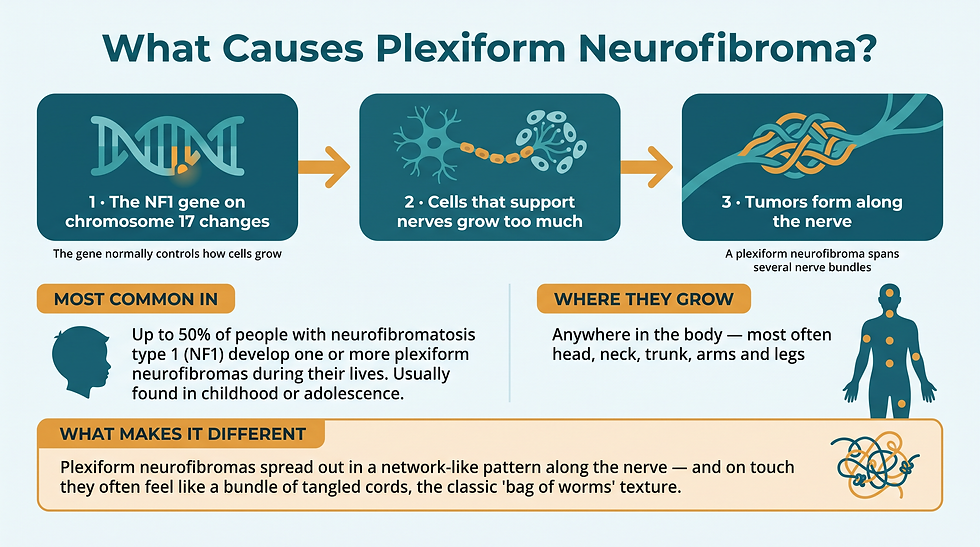
The number, size, and location of tumors vary from person to person, even within the same family. There is no known way to prevent plexiform neurofibromas. The gene change is present from birth and cannot be reversed.
Who Is at Higher Risk?
Risk Factor | Why It Matters |
Neurofibromatosis type 1 (NF1) | The main risk factor; up to 50% of people with NF1 develop one or more plexiform neurofibromas |
Family history of NF1 | NF1 is genetic, so affected parents can pass the gene change to children |
Being diagnosed in childhood or adolescence | Most plexiform neurofibromas are found in children and teens |
How Is a Plexiform Neurofibroma Diagnosed?
Diagnosis is based on a combination of medical history, a physical exam, and imaging tests. Most people with a plexiform neurofibroma already have NF1, which is often diagnosed in early childhood.
During the physical exam, a clinician looks for visible signs of tumors or skin changes. When a tumor is close to the surface, it typically feels soft and irregular under the skin. The "bag of worms" texture — like a bundle of tangled cords — is a classic sign.
Imaging plays an important role because many of these tumors grow deep inside the body, where they cannot be seen or felt. MRI or CT scans can find tumors even when they are very small, and they show whether nearby tissues are affected.
PET scans are not used to diagnose plexiform neurofibromas. But they can be helpful when there is concern that a tumor might be becoming cancerous. PET scans show how active tumor cells are, which helps distinguish a noncancerous plexiform neurofibroma from a malignant peripheral nerve sheath tumor (MPNST). Even then, it can be difficult to tell on a PET scan, and surgery or a biopsy may still be needed.
Diagnostic Step | What It Checks |
Medical history | Family history of NF1, when symptoms began, how tumors have changed |
Physical exam | Soft, irregular lumps; "bag of worms" texture; skin changes |
MRI or CT scan | Locates tumors, including deep ones, and shows whether nearby tissues are affected |
PET scan | Not for diagnosis — used only if a tumor might be becoming cancerous |
Genetic testing | Confirms NF1 in a child who has signs of the condition but no family history |
If a child shows signs of NF1 but has no family history, genetic testing can check for NF1 gene changes and confirm the condition. An NF1 diagnosis requires at least two of seven clinical features, and a plexiform neurofibroma counts as one of those features.
How Is a Plexiform Neurofibroma Treated?
Treatment depends on the tumor's size, location, and symptoms. Some tumors do not need treatment right away.

Surgery
Surgery is the most common treatment. Clinicians may try to remove a tumor that is causing problems. However, many plexiform neurofibromas are hard to remove completely because they grow into nearby nerves and tissues. Surgery can carry risks, including nerve damage, bleeding, and slow healing.
Medicines (MEK Inhibitors)
Two oral MEK inhibitor medicines are now FDA-approved for plexiform neurofibromas. MEK inhibitors work by blocking a signal in cells that drives unhealthy tumor growth.
Selumetinib (Koselugo) is an oral pill approved for children age 2 and older with plexiform neurofibromas. It can shrink tumors.
Mirdametinib (GOMEKLI) is an oral MEK inhibitor approved for adults and children age 2 and older with NF1 who have symptomatic plexiform neurofibromas that cannot be completely removed by surgery.
Treatment Option | Who It's For | How It Works |
Surgery | Tumors causing pain, functional problems, or other issues | Removes all or part of the tumor; not always fully removable |
Selumetinib (Koselugo) | Children 2+ with PN tumors | Oral MEK inhibitor that shrinks tumors by blocking unhealthy growth signals |
Mirdametinib (GOMEKLI) | Adults and children 2+ with NF1 and symptomatic PN not fully removable | Oral MEK inhibitor that shrinks tumors |
Monitoring | Slow-growing tumors without symptoms | Regular checkups; imaging repeated if the tumor grows or new symptoms appear |
Physical therapy | Movement, strength, balance, or coordination problems | Improves strength, balance, and coordination |
Occupational therapy | Fine motor skill difficulties | Helps with writing, dressing, and using utensils |
Pain medicines | Ongoing nerve pain | Medicines targeting nerve pain |
Monitoring and Supportive Care
These tumors often grow slowly, so regular checkups are essential. Sometimes monitoring is all that is needed. If a tumor grows or causes new symptoms such as pain, numbness, or weakness, imaging may be repeated. A sudden change in symptoms can be a warning that a tumor is growing or becoming cancerous.
Supportive care rounds out the treatment plan. Physical therapy can improve strength, balance, and coordination. Occupational therapy helps with fine motor skills such as writing, dressing, and using utensils. Medicines targeting nerve pain may also be part of the plan.
Can a Plexiform Neurofibroma Become Cancerous?
In some cases, a plexiform neurofibroma can turn into an aggressive cancer called a malignant peripheral nerve sheath tumor (MPNST). This is one reason regular monitoring matters.
It is important to know that most plexiform neurofibromas do not become cancerous. With routine monitoring and treatment when symptoms appear, many people manage their tumors and maintain a good quality of life.
What New Treatments Are Being Studied?
Researchers are studying MEK inhibitors beyond selumetinib. These medicines block the signals that tell tumors to grow and may shrink tumors or slow their growth.
Trametinib (Mekinist) and binimetinib (Mektovi) are under study to see whether they can produce similar or better tumor reduction with fewer or more manageable side effects than selumetinib. Cabozantinib (CABOMETYX), a multityrosine kinase inhibitor, is also under investigation.
Which Specialists Should Be Involved?
Caring for plexiform neurofibromas often takes a team. The specialists commonly involved include neurologists, who treat brain and nerve conditions; medical oncologists, who treat cancer with medicine; radiation oncologists, who use radiation; neuro-oncologists, who specialize in cancers of the nervous system; neurosurgeons, who perform brain and nervous system surgery; medical geneticists, who focus on genetics and inherited conditions; and rehabilitation specialists.
Only a few hospitals have the expertise to care for these tumors. If you are uncomfortable with the level of local care, consider a second opinion at a center experienced with neurofibromatosis.
Living With a Plexiform Neurofibroma
Many people live well with plexiform neurofibromas for years. Some tumors stay the same size without causing symptoms. Others grow and cause pain, appearance changes, or pressure on nerves and tissues.
Practical accommodations can make daily life easier. These include wheelchair access and accessible seating, limits on physical activity, flexible scheduling or rest breaks to manage fatigue and pain, excused absences for appointments and therapy, and extra time or assistive technology if thinking skills are affected. Adaptive furniture and layout changes at home can reduce pressure or discomfort from tumors.
Living Accommodation | What It Helps With |
Mobility support | Wheelchair access, accessible seating, physical activity limits |
Flexible scheduling | Managing fatigue and pain with rest breaks |
Excused absences | Attending medical appointments and therapy |
Learning supports | Extra time and assistive technology if thinking skills are affected |
Adaptive furniture | Reducing pressure and discomfort from tumors at home |
Therapy or counseling | Body image, stigma, and adjustment challenges |
Therapy or counseling can help with body image, stigma, and adjustment issues — especially for children and teens.
Coping and Support
Learning enough about plexiform neurofibroma to make confident decisions helps. Ask your healthcare team about the tumor type, treatment options, and prognosis.
Keep friends and family close. They provide practical and emotional support. Finding someone to talk with — a friend, family member, counselor, medical social worker, clergy member, or support group — can make a real difference.
When Should You See a Doctor?
See a doctor if you notice a soft lump under the skin that is growing, ongoing unexplained pain, or changes in movement, vision, bladder, or bowel function. A sudden change in symptoms is a warning sign that should be checked promptly, because it may mean a tumor is growing or becoming cancerous.
How to Prepare for Your Appointment
Before your appointment, ask whether any restrictions apply, such as fasting for certain tests. Write down your symptoms and how long they have lasted.
Bring a list of key medical information, including conditions, all medicines you take (prescription and over-the-counter), and vitamins or supplements with their doses. Take a family member or friend along to help remember the information. Write down your questions in advance, and note the three most important ones.
Conclusion: Taking the Next Step
A plexiform neurofibroma diagnosis can feel overwhelming, but there is a clear path forward. Most of these tumors are benign and grow slowly. Treatment options — surgery, targeted oral medicines, supportive therapy, and monitoring — continue to improve, and two MEK inhibitors now offer real, FDA-approved ways to shrink tumors in both children and adults.
If you or your child has NF1 or has noticed a soft, growing lump or unexplained nerve symptoms, talk to a healthcare professional. Early evaluation, regular monitoring, and a team with the right expertise make the most significant difference in long-term outcomes.
Ready to act on what you've learned? Share this guide with family members managing NF1, and discuss these treatment options at your next appointment.
Frequently Asked Questions
What is a plexiform neurofibroma?
A plexiform neurofibroma is a noncancerous tumor that grows along a nerve and can involve several nerve bundles. It usually forms in or around the nerve's protective sheath and can spread into nearby skin, fat, bone, and muscle. Most occur in people with neurofibromatosis type 1 (NF1).
Is a plexiform neurofibroma the same as cancer?
No. A plexiform neurofibroma is benign (noncancerous). Most grow slowly and are not life-threatening. In a small number of cases, however, one can change into a cancer called malignant peripheral nerve sheath tumor (MPNST), which is why regular monitoring is important.
Why is it called a "bag of worms"?
On touch, plexiform neurofibromas often feel like a bundle of tangled cords or threads. This distinctive "bag of worms" texture is a classic clinical sign, because the tumors spread out in a network-like pattern along the nerve rather than forming one compact mass.
Is plexiform neurofibroma hereditary?
The tumors themselves are not inherited, but the underlying cause usually is. Most people with plexiform neurofibromas have NF1, a genetic condition caused by a change in the NF1 gene on chromosome 17. Up to 50% of people with NF1 develop one or more plexiform neurofibromas during their lives.
What are the most common symptoms?
Common symptoms include ongoing pain, a soft or spongy lump under the skin, changes in appearance, difficulty walking or grasping objects, numbness or tingling, and vision changes. Tumors near the pelvis can also cause bladder or bowel problems.
Can plexiform neurofibroma be cured?
There is currently no cure. However, many people live well with these tumors for years. Some tumors stay the same size without causing symptoms, while others can be treated with surgery, MEK inhibitor medicines, or supportive therapy.
What are the treatment options?
Treatment depends on the tumor's size, location, and symptoms. Options include surgery (the most common), FDA-approved oral MEK inhibitors such as selumetinib for children and mirdametinib for adults and children, physical and occupational therapy, pain medicines, and watchful monitoring for slow-growing tumors.
What is selumetinib and how does it work?
Selumetinib (Koselugo) is an oral MEK inhibitor pill approved for children age 2 and older with plexiform neurofibromas. It works by blocking a signal in cells that drives unhealthy tumor growth, and it can shrink tumors. A second MEK inhibitor, mirdametinib (GOMEKLI), is approved for adults and children with NF1 whose tumors cannot be completely removed by surgery.
Related Articles
References
Disclaimer: This article is for general educational purposes only and is not a substitute for professional medical advice. Always consult a qualified health care provider for diagnosis and treatment.
Comments