Pervasive Developmental Disorders: Symptoms, Causes, and Management

Updated: 2 days ago
Medically reviewed by Dr. Baraa Alnahhal, MD · Last reviewed: September 2026
TL;DR
Pervasive developmental disorders (PDD), now classified under autism spectrum disorder (ASD), involve developmental delays in social and communication skills. Typically appearing by age 3, these conditions manifest as difficulty with social interactions, repetitive behaviors, and routine changes. While no single cause exists, a combination of genetic and environmental factors is likely responsible. Management focuses on supportive therapies like speech and occupational therapy to enhance quality of life and functional independence.
Quick Answer
Pervasive developmental disorders (PDD) are a group of developmental delays affecting communication and social interaction skills. Now categorized under the autism spectrum disorder (ASD) umbrella, PDD includes conditions like Asperger's syndrome and childhood disintegrative disorder. Common symptoms include repetitive behaviors, avoidance of eye contact, and difficulty expressing thoughts. Management typically involves a personalized combination of speech, occupational, and behavioral therapies to support developmental progress and social engagement.
Understanding Pervasive Developmental Disorders
Pervasive developmental disorders (PDD) is a term historically used to describe a group of developmental delays that impact a person's ability to communicate and socialize. In 2013, the American Psychiatric Association reclassified these conditions under the single umbrella diagnosis of autism spectrum disorder (ASD) in the DSM-5. This reclassification included autistic disorder, Asperger's syndrome, childhood disintegrative disorder, and pervasive developmental disorder not otherwise specified (PDD-NOS).
PDD is a common subtype of the autism spectrum, accounting for approximately 47% of all ASD diagnoses. While the terminology has evolved, the core challenges remain focused on language delays, difficulty adjusting to routine changes, and challenges in relating to others.
Common Symptoms and Behavioral Signs
The onset of PDD typically occurs around age 3, though some signs may be noticeable during infancy. Because no two individuals with the disorder are exactly alike, symptoms can range from mild to severe.
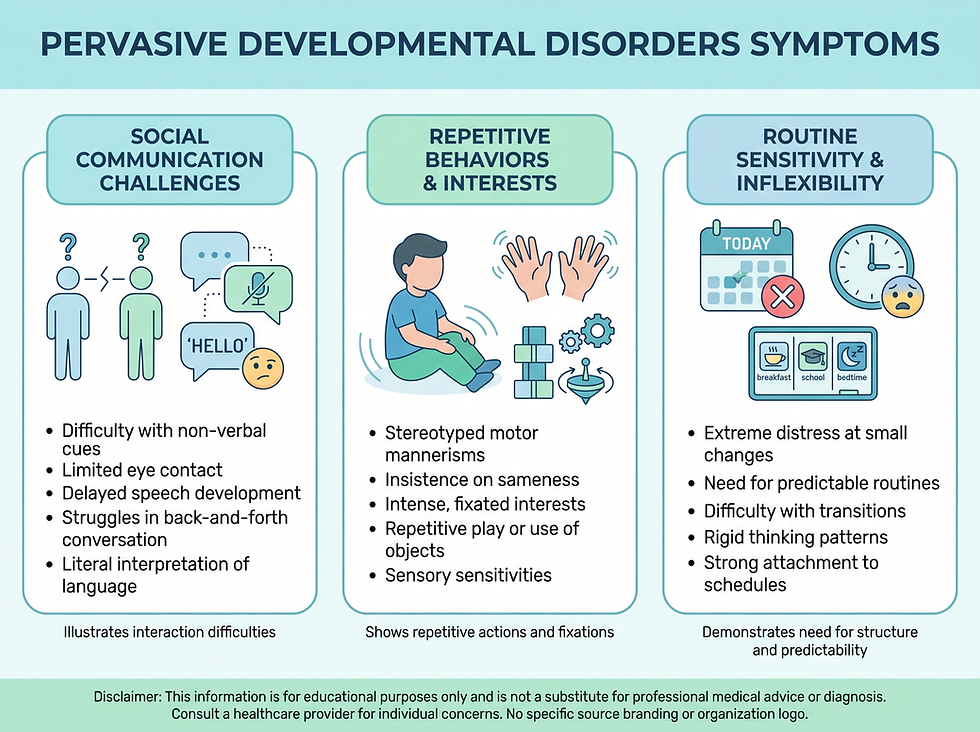
Core Symptoms
Social and Communication Challenges: Difficulty engaging in conversation, avoiding eye contact, and having trouble expressing thoughts through language.
Repetitive Behaviors: Engaging in actions such as hand flapping, body rocking, or head banging.
Routine Sensitivity: Experiencing significant distress or difficulty when routines or surroundings change.
Vocal Characteristics: Speaking with a flat, monotone voice or an unusually high-pitched tone.
Emotional Regulation: Difficulty controlling emotions or responding to social cues appropriately.
Causes and Risk Factors
Researchers believe that PDD results from a complex combination of genetic, environmental, and biological factors rather than a single identifiable cause.
Contributing Factors
Genetics: Over 100 genes on different chromosomes have been linked to autism spectrum disorder. Specific gene mutations may influence the type and severity of symptoms.
Environment: In individuals with a genetic predisposition, exposure to certain toxins or infections may increase the likelihood of developing the condition.
Biology: Factors affecting the immune system, metabolism, or specific brain regions are currently under investigation as potential contributors.
Identified Risk Factors
Risk Factor | Description |
Family History | Having a sibling with PDD or another type of ASD increases risk. |
Genetic Conditions | Presence of conditions like fragile X syndrome or Down syndrome. |
Parental Age | Being born to biological parents who were 35 or older. |
Birth Weight | Infants born with a low birth weight are at higher risk. |
Diagnostic Process
There is no medical exam or laboratory test to diagnose PDD. Instead, healthcare providers rely on observing behavior and reviewing a person's developmental history.
Screenings are recommended for all children between 18 and 24 months of age during routine wellness checkups. Providers interact with the child and ask parents detailed questions about communication, movement, and behavior at home. While most diagnoses occur in early childhood, evaluations can be performed for older children, teenagers, and adults who exhibit symptoms.
Management and Supportive Therapies
Management of PDD is highly personalized, focusing on the specific needs of the individual. Supportive therapy is the primary treatment method.
Mainstay Therapies
Speech Therapy: Focuses on building comprehension and communication skills.
Occupational Therapy: Strengthens coordination and teaches routine daily tasks like bathing and dressing.
Physical Therapy: Helps develop motor skills, stamina, and physical coordination.
Applied Behavioral Analysis (ABA): Aims to increase positive behaviors while decreasing negative ones through structured reinforcement. Read more in our guide to Applied Behavior Analysis (ABA).

Complementary and Medical Support
While no medication treats PDD directly, providers may prescribe medications to manage co-occurring conditions such as anxiety, depression, or ADHD. Complementary approaches like music therapy, art therapy, massage, and yoga may also be integrated into a child's wellness plan to enhance overall stamina and emotional well-being.
Outlook and Prevention
Pervasive developmental disorders cannot be prevented, and they are not caused by parenting choices or childhood vaccinations. Early diagnosis and intervention are the most effective ways to manage symptoms and support long-term development, though treatment remains beneficial at any age.

Conclusion
Pervasive developmental disorders represent a diverse spectrum of social and communication challenges. By utilizing a personalized combination of supportive therapies and behavioral interventions, individuals can develop the skills necessary for greater independence and social engagement. If you have concerns about a child's developmental milestones, consult a healthcare provider for a formal evaluation.
Frequently Asked Questions
1. What is the difference between PDD and autism?
PDD was formerly a separate category, but it is now officially classified as part of the autism spectrum disorder (ASD) umbrella.
2. At what age do symptoms usually appear?
Symptoms typically become evident by age 3, though some parents may notice subtle signs during infancy.
3. Is PDD-NOS still a valid diagnosis?
In the current DSM-5, PDD-NOS is no longer a standalone diagnosis and is instead categorized under autism spectrum disorder.
4. Can adults be diagnosed with PDD?
Yes, healthcare providers can evaluate and diagnose PDD or ASD in older children, teenagers, and adults.
5. What are repetitive behaviors?
These are self-stimulatory actions like rocking, hand flapping, or spinning that are common in individuals with PDD.
6. Does PDD affect intelligence?
Intelligence levels vary widely among individuals with PDD, ranging from severe impairment to giftedness.
7. Are there medications for PDD?
No medication treats PDD itself, but drugs may be used to manage associated symptoms like anxiety or ADHD.
8. What is ABA therapy?
Applied Behavioral Analysis (ABA) is a structured therapy that uses reinforcement to improve social, communication, and learning skills.
9. Can vaccines cause PDD?
Scientific evidence does not support a link between childhood vaccinations and the development of PDD or ASD.
10. Is PDD hereditary?
Genetics play a major role, and having a sibling with the condition increases the risk for other children in the family.
11. What is the role of occupational therapy?
Occupational therapy helps individuals learn daily living skills and improves sensory processing and motor coordination.
12. Can diet affect PDD symptoms?
While some families explore dietary changes, these should be discussed with a healthcare provider as part of a broader management plan.
13. How common is PDD?
PDD-NOS was historically the most common subtype, representing about 47% of all autism spectrum diagnoses.
14. What are the signs of language delay in PDD?
Signs include not responding to their name, difficulty expressing needs, or using a flat, high-pitched voice.
15. What is the long-term outlook for PDD?
With early intervention and consistent therapy, many individuals with PDD lead fulfilling, independent lives.
Further Reading
Applied Behavior Analysis (ABA): Principles, Methods, and Benefits
American Academy of Pediatrics (developmental milestones)
National Institute of Mental Health (autism spectrum disorder)
Autism Speaks (resources and support)
Medical Disclaimer: The information provided in this article is for educational purposes only and should not be used as a substitute for professional medical advice, diagnosis, or treatment. Always seek the advice of your physician or other qualified health provider with any questions you may have regarding a medical condition.
Source Date: January 9, 2024
Comments