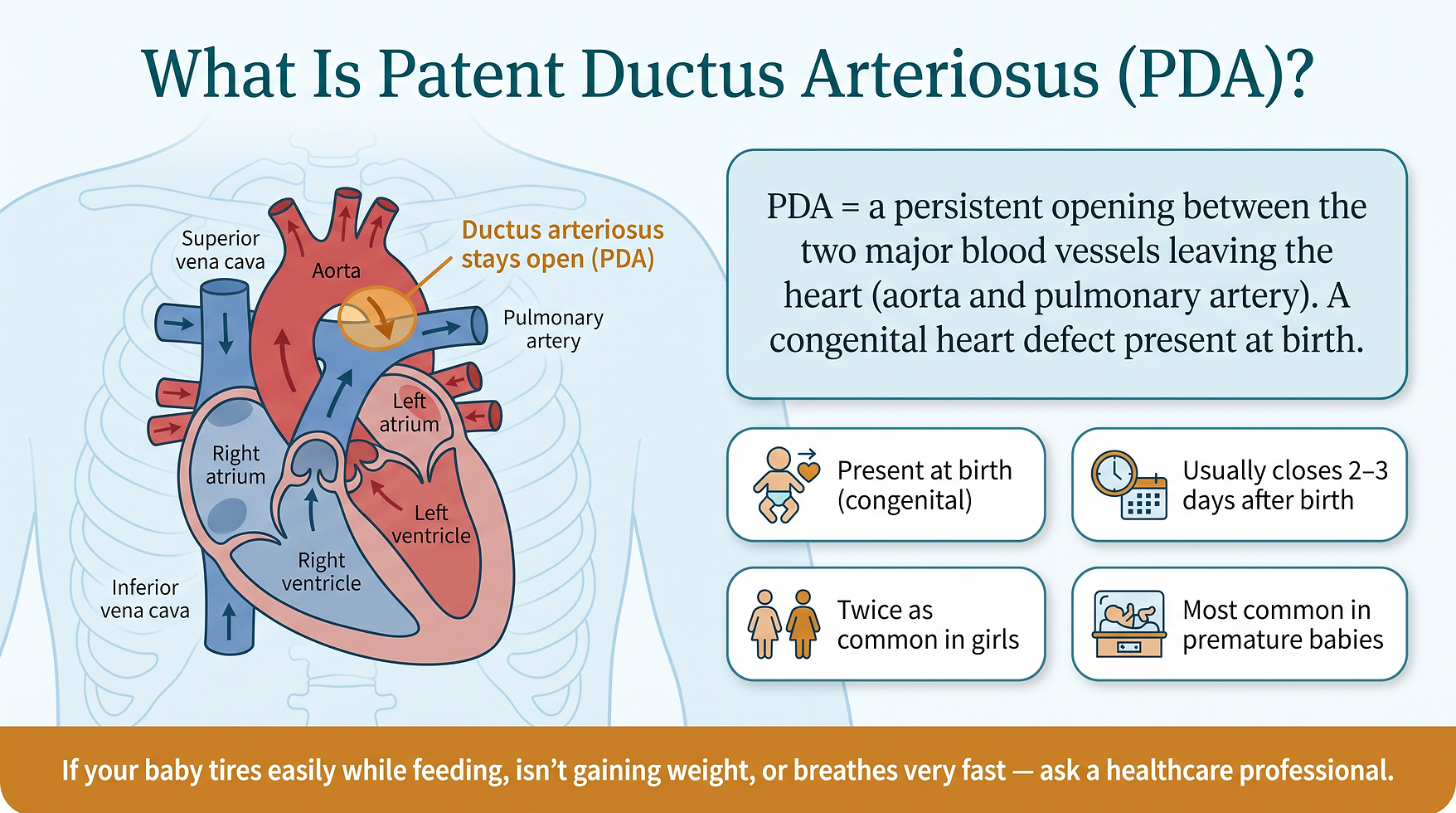
Patent Ductus Arteriosus: Symptoms, Causes & Treatment — A Parent's Guide

Updated: 2 days ago
Medically reviewed by Dr. Baraa Alnahhal, MD · Last reviewed: September 2026
TL;DR
Patent ductus arteriosus (PDA) is a congenital heart defect — a persistent opening between the aorta and the pulmonary artery that normally closes within 2 to 3 days after birth. Small PDAs may never cause problems or need treatment, but a large, untreated PDA can overwork the heart and raise pressure in the lungs. Diagnosis starts with a physical exam and an echocardiogram. Treatment ranges from watchful checkups, to NSAID medication for premature babies, to catheter plug or coil closure, or open-heart surgery for larger openings. Even after successful closure, lifelong cardiology checkups are often recommended.
Quick Answer: What Is Patent Ductus Arteriosus?
PDA is a persistent opening between the two major blood vessels leaving the heart — the aorta and the pulmonary artery — that fails to close after birth.
The opening, called the ductus arteriosus, is normal and needed before birth; it usually closes within 2 to 3 days after a baby is born.
Small PDAs often cause no symptoms and may need only regular checkups; some are not noticed until adulthood.
Large PDAs can cause fast breathing, tiring during feeds, sweating while crying or eating, poor weight gain, and a rapid heart rate.
A healthcare professional may hear a heart murmur during a routine exam; an echocardiogram confirms the diagnosis.
Premature babies may receive NSAID medication to help the opening close; larger PDAs are closed with a catheter plug or coil, or with surgery.
The condition is twice as common in girls and more common in babies born prematurely or at high altitude.
What Is a Patent Ductus Arteriosus?
Patent ductus arteriosus (PDA) is a persistent opening between the two major blood vessels leading from the heart. Those vessels are the aorta, which carries blood to the body, and the pulmonary artery, which carries blood to the lungs. The condition is present at birth, which makes it a congenital heart defect — a heart condition that forms before a baby is born.
Patent (PAY-tent) means "open" or "unblocked." So a "patent ductus arteriosus" is simply a ductus arteriosus that stayed open.
To understand why it matters, it helps to understand why the opening exists at all. A temporary passage called the ductus arteriosus is part of the blood-flow system of an unborn baby. It moves blood away from a baby's lungs while they develop, because the baby gets oxygen from the mother's blood rather than from breathing.
After birth, the ductus arteriosus is no longer needed. It usually closes within 2 to 3 days. When the opening stays open, it is called a patent ductus arteriosus.
| Fact | Detail | |---|---| | What it is | A persistent opening between the aorta and the pulmonary artery | | When it forms | Before birth; fails to close within 2–3 days after birth | | Classification | Congenital heart defect (present at birth) | | Small PDA | May never need treatment; may not be noticed until adulthood | | Large, untreated PDA | Lets oxygen-poor blood move the wrong way, weakening the heart muscle and potentially causing heart failure |
A small PDA might never need treatment. But a large, untreated patent ductus arteriosus can let oxygen-poor blood move the wrong way. That can make the heart muscle weak, leading to heart failure and other complications. Treatment options may include regular health checkups, medicines, and a procedure or surgery to close the opening.
What Are the Symptoms of a Patent Ductus Arteriosus?
Symptoms depend on the size of the opening and the person's age. A small PDA might not cause any symptoms at all. Some people do not notice symptoms until adulthood. A large PDA can cause symptoms of heart failure soon after birth.
A large PDA found during infancy or childhood might cause the following:
| Symptom | What parents notice | |---|---| | Poor eating | Leads to poor growth and slow weight gain | | Sweating | Occurs with crying or feeding | | Fast breathing | Constant rapid breathing or being out of breath | | Easy tiring | Baby tires during feeds or play | | Rapid heart rate | Heart beats faster than normal |
In some cases, no symptoms appear at all. The condition may first be noticed when a healthcare professional hears a murmur — an extra heart sound — while listening with a stethoscope during a routine exam.
When to See a Doctor
Parents and caregivers should contact a healthcare professional if a baby or older child shows any of these signs:
| Warning sign | What it looks like | |---|---| | Tires easily | Exhaustion during eating or playing | | Poor weight gain | Baby is not gaining weight as expected | | Breathlessness | Becomes breathless when eating or crying | | Fast breathing | Always breathes fast or is short of breath |
Because these signs can also point to many common, harmless causes of fussiness, they are not reasons to panic — but they are reasons to have a baby checked. An exam is the only way to know whether a heart murmur or an underlying condition like PDA is involved.
What Causes a Patent Ductus Arteriosus?
The exact causes of patent ductus arteriosus — and of other congenital heart defects — are not clear.
The window of risk is early. During the first six weeks of pregnancy, an unborn baby's heart starts to form and beat, and the major blood vessels to and from the heart grow. It is during this time that certain congenital heart defects may begin to develop.
The mechanics of the defect are well understood, however. Before birth, the temporary ductus arteriosus connects the aorta and the pulmonary artery and moves blood away from the developing lungs. After birth, the opening is no longer needed and usually closes within 2 to 3 days. When it stays open, the constant passage causes too much blood to flow to the baby's lungs and heart. Untreated, the blood pressure in the baby's lungs can increase, and the heart may grow larger and get weak.
Who Is Most at Risk?
Several factors increase the chance of a patent ductus arteriosus. Premature birth is the most important one: PDA occurs more commonly in babies born too early than in babies born full term, because the premature baby's systems are less developed at the time of birth.
| Risk factor | Why it matters | |---|---| | Premature birth | Most common factor; underdeveloped systems delay closure | | Female sex | PDA is twice as common in girls | | Family history | A family history of heart conditions present at birth raises risk | | Down syndrome | Babies with an extra chromosome 21 are more likely to have PDA | | Rubella in pregnancy | German measles during pregnancy can change an unborn baby's heart; a pre-pregnancy blood test checks immunity, and a vaccine is available | | High-altitude birth | Babies born above 8,200 feet (2,499 meters) have greater risk |
It is worth noting what does not have a prevention pathway: no lifestyle change can guarantee the ductus will close. What parents can influence is overall pregnancy health, covered below.
Can a Patent Ductus Arteriosus Cause Complications?
A small patent ductus arteriosus might not cause complications. Larger, untreated PDAs can. The main concern is the extra blood flow the opening creates.
| Complication | What happens | Key signs | |---|---|---| | Pulmonary hypertension | High blood pressure in the lungs; irregular blood flow raises pressure in the pulmonary artery and, over time, damages the smaller lung vessels | A life-threatening and lasting form of lung damage called Eisenmenger syndrome may develop | | Heart failure | The heart works harder to pump extra blood; over time it enlarges and weakens | Rapid breathing (often with gasping breaths) and poor weight gain | | Endocarditis | A heart infection; turbulent flow increases the chance that germs attach to areas in the heart | Without quick treatment, it can damage or destroy the heart valves |
PDA and Pregnancy
It may be possible to have a successful pregnancy with a small patent ductus arteriosus. However, having a large PDA — or a complication such as heart failure, lung damage, or irregular heartbeats — increases the risk of serious complications during pregnancy.
Some heart medicines can be dangerous for an unborn baby, so a healthcare professional may stop or change medicines before pregnancy. Planning ahead matters: anyone with a known PDA who is considering pregnancy should discuss risks with their care team first. If there is a high risk of a baby with a heart condition present at birth, genetic testing and screening may be done during pregnancy.
How Is a Patent Ductus Arteriosus Diagnosed?
Diagnosis usually begins with a physical exam and questions about the patient's — or child's — medical history. The healthcare professional may hear a heart murmur while listening with a stethoscope. A large PDA, or one causing serious health concerns, may be diagnosed immediately at birth; smaller ones might not be found until later in life.
If the findings point to a possible PDA, several tests can confirm it:
| Test | What it does | What it shows in PDA | |---|---|---| | Echocardiogram | Sound waves make pictures of the beating heart | How blood flows through the heart and valves; confirms the persistent opening and can detect higher pressures in the lung arteries | | Chest X-ray | Images of the chest | The condition of the heart and lungs | | ECG or EKG | Records the electrical signals of the heartbeat | How fast or slow the heart is beating | | Cardiac catheterization | A thin tube (catheter) is guided through a blood vessel in the groin or wrist to the heart | Not usually needed for diagnosis, but may be done if other heart conditions exist — and treatment can be performed during the same test |
An echocardiogram is the key test. It confirms the opening, measures its size, and shows whether lung pressures are rising — the information that decides whether a PDA can be watched or should be closed.
How Is a Patent Ductus Arteriosus Treated?
Treatment depends on the age of the person being treated and the size of the opening. Not every PDA needs to be closed.
Watchful Waiting: Checkups Only
Some people with small PDAs need only regular health checkups to watch for complications. A premature baby born with PDA also needs regular checkups to confirm that the opening closes on its own.
Medication for Premature Babies
A premature baby born with PDA may receive medicines called nonsteroidal anti-inflammatory drugs (NSAIDs). These medicines block certain body chemicals that keep the PDA open. Importantly, NSAIDs will not close a PDA in full-term babies, children, or adults — medication is a premature-baby treatment.
Catheter Procedure (No Open-Heart Surgery)
A catheter procedure closes the opening using a thin tube. The doctor places the catheter into a blood vessel in the groin and guides it to the heart. A plug or coil passes through the catheter and closes the patent ductus arteriosus.
| Feature | What families should know | |---|---| | Surgery type | None — no open-heart surgery | | Hospital stay | Usually does not require an overnight stay | | Size limit | Premature babies are too small for catheter treatment | | Timing for infants | If the PDA is not causing trouble, closure may be done when the baby is older |
Open-Heart Surgery
Surgical closure may be needed if medicine does not work, if the PDA is large, or if it is causing complications. A surgeon makes a small cut between the ribs to reach the heart, and the PDA is closed using stitches or clips. Full recovery usually takes a few weeks.
How the Options Compare
| Scenario | Typical approach | |---|---| | Small PDA, no symptoms | Regular checkups; watch for complications | | Premature baby with PDA | Regular checkups; NSAID medication to help it close; catheter closure later if needed | | Full-term baby, child, or adult with small PDA | Observation; medicine does not close the opening at this age | | Large PDA or PDA causing complications | Catheter plug/coil closure, or surgical closure | | Medication ineffective | Surgical closure |
Lifelong Follow-Up
Some people born with PDA need regular health checkups for life, even after treatment to close the opening. During these checkups, a healthcare professional may run tests to look for complications. Care is ideally provided by a congenital cardiologist — a doctor trained in treating adults with heart conditions present at birth. Children are typically seen by a pediatric cardiologist.
What About Antibiotics Before Dental Work?
In the past, people born with patent ductus arteriosus were told to take antibiotics before dental work and some surgeries to prevent heart infection. This is no longer recommended for most people with PDA. Whether preventive antibiotics are needed after certain heart procedures is a decision for the treating professional, so it is worth asking at each appointment.
What Can Families Do at Home?
Anyone born with a patent ductus arteriosus can take steps to keep the heart healthy and prevent complications.
| Habit | Why it helps | |---|---| | Do not smoke | Smoking is a major risk factor for heart disease; quitting is the best way to reduce risk | | Eat healthy foods | Plenty of fruits, vegetables, and whole grains; limit sugar, salt, and saturated fats | | Practice good hygiene | Regular handwashing and brushing and flossing teeth support overall health | | Ask about sports limits | Some heart conditions restrict certain exercises or sports; the care team can advise what is safe | | Manage stress | Exercise, mindfulness, and support groups help; anxiety or depression warrant a conversation with a healthcare professional |
During pregnancy, there is no known way to prevent PDA, but healthy-pregnancy practices support the baby's heart development. These include getting early prenatal care (even before becoming pregnant), taking 400 micrograms of folic acid daily before and during pregnancy, staying active, avoiding alcohol and smoking (including secondhand smoke), updating recommended vaccines before pregnancy, and keeping blood sugar well controlled if the mother has diabetes.
Preparing for a PDA Appointment
If a large PDA or one causing serious health concerns is suspected, diagnosis may happen at birth. Smaller PDAs may be found later in life, often after a referral to a congenital cardiologist or pediatric cardiologist. Coming prepared makes the visit more productive.
Before the appointment, be aware of any restrictions (such as fasting before certain tests), write down all symptoms, note any family history of heart conditions, bring copies of past medical records and test reports, and list every medicine, vitamin, and supplement with dosages. Taking someone along helps with remembering the information given.
Questions worth asking the doctor:
| Question | Why ask it | |---|---| | Is the PDA causing complications? | Sets the urgency of treatment | | What tests are needed? | Clarifies the diagnostic plan | | Will I or my child need surgery? | Prepares for the treatment path | | Should we see a congenital heart specialist? | Ensures the right expertise | | Is this condition inherited? Could our other children have PDA? | Informs family planning | | Are there activity limits? | Protects day-to-day safety | | What take-home information or websites do you recommend? | Supports learning between visits |
The healthcare professional is likely to ask when symptoms began, whether they are constant or come and go, how severe they are, what makes them better or worse, and what medicines or surgeries have already happened. Do not hesitate to ask other questions too.
Conclusion
A patent ductus arteriosus sounds alarming, but the outlook is often straightforward. Small openings frequently cause no problems and may need only watchful checkups. For those that do need attention, modern closure methods — medication for premature babies, catheter plug or coil procedures, and surgery when needed — are well established, and many closures do not require open-heart surgery or even an overnight stay.
If your baby tires easily during feeds, is not gaining weight as expected, breathes fast and constantly, or becomes breathless when eating or crying, schedule an evaluation with a healthcare professional. For anyone diagnosed with PDA — in infancy or adulthood — a care plan with a cardiologist trained in congenital heart conditions is the safest long-term path.
Frequently Asked Questions
Is patent ductus arteriosus curable?
Yes, in the sense that the opening can be fully closed. Medication helps it close in premature babies, and catheter procedures or surgery close it in older infants, children, and adults. Even after closure, lifelong checkups may be recommended.
Can a patent ductus arteriosus close on its own?
The ductus arteriosus normally closes within 2 to 3 days after birth. Premature babies are often watched to confirm the opening closes on its own, and NSAID medication can help it close. Spontaneous closure is less likely in full-term babies, children, and adults.
Is a patent ductus arteriosus serious?
A small PDA may never cause problems. A large, untreated PDA is more serious because it can overwork the heart, raise pressure in the lungs, and increase infection risk. The size of the opening and the person's symptoms determine how seriously it is managed.
Why is it called "patent" ductus arteriosus?
"Patent" means open or unblocked. The ductus arteriosus is the normal blood vessel connection before birth; when it fails to close after birth, it remains "patent."
What are the first signs of PDA in a baby?
The earliest signs of a large PDA are poor feeding with poor growth, sweating while crying or eating, constant fast breathing, easy tiring, and a rapid heart rate.
Can adults have a patent ductus arteriosus?
Yes. Some people do not notice symptoms until adulthood, and some PDAs are discovered in adult life when a murmur is heard or an echocardiogram is done for another reason. Treatment options — including catheter closure — remain available for adults.
Is PDA inherited or genetic?
A family history of heart conditions present at birth increases risk, and PDA is more common in babies with Down syndrome (an extra chromosome 21). However, the exact causes of PDA are not fully understood, so a family history raises risk rather than guarantees it.
Will my child need antibiotics before dental visits?
Routine preventive antibiotics before dental work are no longer recommended for most people with PDA. The treating professional can advise whether they are needed after certain heart procedures.
Related Reading on Rinnit
References
Patent ductus arteriosus (PDA) — Symptoms & Causes. https://www.mayoclinic.org/diseases-conditions/patent-ductus-arteriosus/symptoms-causes/syc-20376145
Patent ductus arteriosus (PDA) — Diagnosis & Treatment. https://www.mayoclinic.org/diseases-conditions/patent-ductus-arteriosus/diagnosis-treatment/drc-20376150
This article is for general informational purposes and is not a substitute for professional medical advice, diagnosis, or treatment. Always consult a qualified healthcare professional about any medical condition.
Comments