Parasitic Twin: Understanding Heteropagus Twins and Surgical Care

Updated: 26 minutes ago
Medically reviewed by Dr. Baraa Alnahhal, MD · Last reviewed: September 2026
TL;DR
A parasitic twin is an extremely rare type of conjoined twin pregnancy where one fetus fails to develop fully and remains attached to its dominant, surviving twin. Affecting fewer than one in one million births, the condition involves the dominant twin being born with vestigial limbs or organs from the underdeveloped twin. While the parasitic twin cannot survive, the dominant twin typically has a positive prognosis following surgical separation, which is usually performed shortly after birth to prevent cardiovascular and respiratory complications.
Quick Answer: What Is a Parasitic Twin?
A parasitic twin, also known as a heteropagus or vestigial twin, occurs when an embryo partially divides during an identical twin pregnancy, but one fetus stops developing. This underdeveloped fetus remains attached to the dominant (autositic) twin, relying on their blood supply for growth. Unlike vanishing twin syndrome, where the fetus is reabsorbed, a parasitic twin results in the birth of the dominant twin with extra limbs, tissue, or internal masses. Treatment requires surgical removal of the parasitic tissue to protect the dominant twin's health.
Classification of Parasitic Twins
Healthcare providers classify parasitic twins based on where the underdeveloped tissue attaches to the dominant twin.
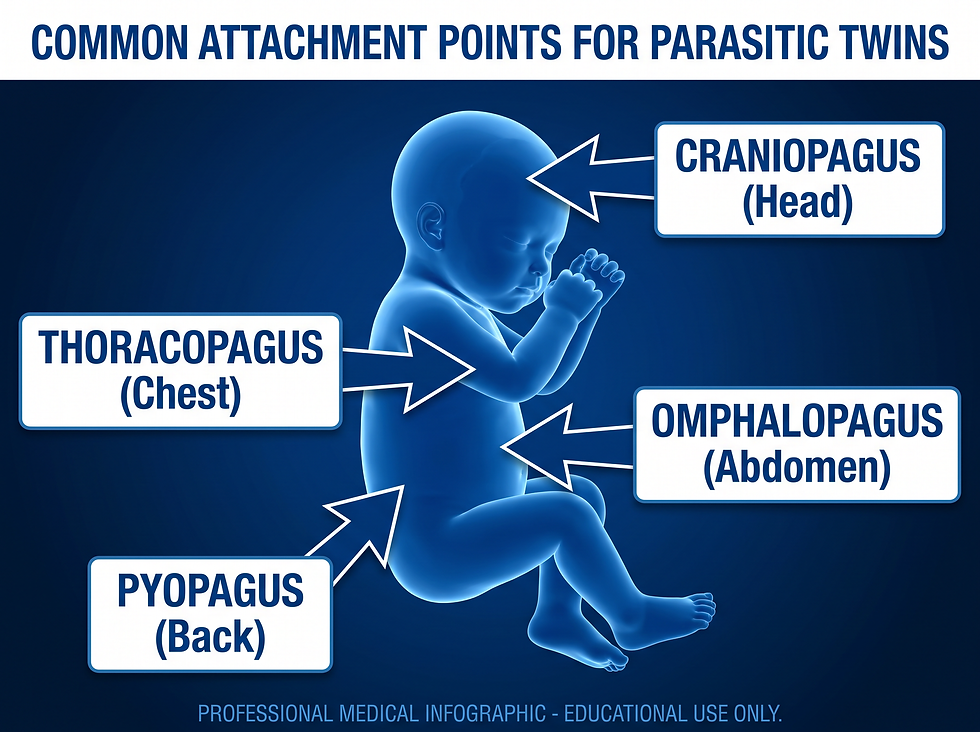
Attachment Type | Location of Attachment |
Omphalopagus | At the belly (the most common type) |
Cephalopagus | From the top of the head to the navel |
Craniopagus | At the skull |
Epigastric | The upper part of the abdomen |
Thoracopagus | At the chest |
Ischiopagus | At the pelvis |
Pyopagus | At the lower back or spine |
Rachipagus | At the middle of the back |
Parapagus | At the torso |
Pygomelia | At the buttocks |
Causes and Internal Variations
The primary theory for parasitic twins is an incomplete division of the embryo very early in an identical twin pregnancy. A blood flow imbalance causes one twin's development to stall, leading their remaining parts to depend entirely on the dominant twin's circulatory system.
Specialized Types
Fetus in Fetu: A rare variation where the malformed fetus develops inside the dominant twin's body rather than attached externally. It is often mistaken for a tumor (teratoma) and may not be discovered until childhood or adulthood.
Acardiac Twin (TRAP Sequence): A condition where one twin lacks a functional heart and receives blood supply from the "pump twin."
Complications and Risks
While the parasitic twin has no chance of survival, the dominant twin faces several potential health risks due to the physical attachment and shared resources.
Congenital Heart Disease: The most common complication for the dominant twin.
Omphalocele: Abdominal organs protruding through the navel, covered by a membrane.
Myelomeningocele: A form of spina bifida where the backbone and spinal canal do not close properly.
Tethered Spinal Cord: Abnormal attachment of the spinal cord to the spinal canal wall.
Diagnosis and Surgical Treatment
Most cases are identified during prenatal ultrasounds. If an ultrasound is inconclusive, providers may use MRI, CT scans, or fetal echocardiograms to map the attachment and assess the dominant twin's internal health.
The Separation Process
Surgery is essential to remove the parasitic tissue, as leaving it attached can lead to severe breathing, heart, and growth issues.
Prenatal Planning: Mapping blood vessels and shared structures.
Birth: Often via a scheduled C-section to ensure a controlled delivery.
Surgery: Typically performed within a few days of birth to separate the vestigial tissue.
Prognosis and Long-Term Outlook
The outlook for the dominant twin is generally positive, with approximately 90% of dominant twins surviving in studied cases. The specific prognosis depends on the attachment site and the presence of underlying conditions like heart disease. Long-term follow-up is necessary to monitor for reconstructive needs and provide mental health support as the child learns about their birth history.
Frequently Asked Questions (FAQ)
Is a parasitic twin the same as vanishing twin syndrome?
No. In vanishing twin syndrome, the undeveloped twin is completely reabsorbed by the mother's body or placenta. A parasitic twin remains physically attached to the dominant twin.
Can a parasitic twin survive?
No. The parasitic twin lacks vital organs, such as a functional heart or brain tissue, and cannot survive independently.
How rare are parasitic twins?
They are extremely rare, occurring in fewer than 1 in 1 million births worldwide.
What causes a parasitic twin to form?
The main theory is an incomplete division of the embryo during an identical twin pregnancy, combined with a blood flow imbalance.
Can you prevent a parasitic twin pregnancy?
No. There are no known environmental or lifestyle factors that cause or prevent this condition.
What does a parasitic twin look like?
It usually appears as underdeveloped limbs (arms or legs) or a mass of tissue attached to the dominant twin.
Is the dominant twin always healthy?
The dominant twin is at higher risk for complications like congenital heart disease and may require specialized care.
When is the surgery performed?
Separation surgery is typically performed within a few days after birth.
What is "fetus in fetu"?
It is a rare type where the parasitic twin is located inside the dominant twin's body instead of on the outside.
How is the condition diagnosed before birth?
It is most commonly diagnosed via prenatal ultrasound, followed by MRI or CT scans for detailed mapping.
Are parasitic twins always identical?
Yes, they originate from a single fertilized egg that failed to divide completely.
What are the most common attachment points?
The most common attachment point is the abdomen (omphalopagus).
Can the parasitic twin have a brain?
It is extremely rare for a parasitic twin to have any brain tissue.
What are the risks of leaving the parasitic twin attached?
Potential risks include heart failure, breathing difficulties, and impaired growth for the dominant twin.
Do dominant twins need plastic surgery later?
Some children may require reconstructive or plastic surgery as they grow to address cosmetic or functional needs.
References
Medical Disclaimer: This content is for informational purposes only and does not constitute medical advice. Always seek the advice of your physician or other qualified health provider with any questions you may have regarding a medical condition.
Comments