Conjoined Twins: Causes, Diagnosis, Separation Options and Prognosis — What You Need to Know

Updated: 2 days ago
Medically reviewed by Dr. Baraa Alnahhal, MD · Last reviewed: September 2026
TL;DR: Conjoined twins form when a single embryo (from one egg and one sperm) divides 12 to 14 days after fertilization, too late to form two separate identical twins, leaving the fetal parts connected. There are five main connection types, from the most common (chest and abdomen, called thoraco-omphalopagus) to connection at the cranium or head-to-belly-button. Twins may share organs such as the heart, liver, or digestive system. About 45% of conjoined twins are live births, and experts estimate about 8% survive. Care is lifelong and may include surgery, physical and occupational therapy, and early intervention services.
Quick Answer: What Are Conjoined Twins?
Conjoined twins are twin fetuses with connected body parts or organs. It happens when identical twin embryos don't fully split after fertilization. It is a rare condition, estimated to occur in only 1 in every 50,000 to 100,000 pregnancies.
The most common connection point is the chest and abdomen. Signs often appear first on routine prenatal ultrasound, and follow-up MRI shows which body areas the twins share. In some cases the twins can be separated through surgery; in others they remain connected for life. Nearly all conjoined twins need medical support and care throughout their lives, whether or not they are separated.
When Should You Talk to a Specialist?
If a routine prenatal ultrasound suggests your twins are physically connected, the most important step is to be referred quickly to a maternal-fetal medicine specialist, a doctor who manages complicated pregnancies, including conjoined twins.
Early detection matters because it gives the healthcare team more opportunity to plan treatment. It also gives your family time to understand the issues and challenges that come with having twin babies who share physical connections.
Conjoined twins are associated with an increased risk of miscarriage, stillbirth, and premature labor, all of which deserve close, specialist-led monitoring throughout pregnancy. If you are expecting twins and your ultrasound shows anything unusual, ask for a specialist referral without delay.
What Are Conjoined Twins?
Conjoined twins are twin fetuses that have connected body parts or organs. The condition is rare: experts estimate only 1 in every 50,000 to 100,000 pregnancies involve conjoined twins.
In some cases, conjoined twins can have surgery to separate them from each other. Other times, conjoined twins remain linked to each other for a lifetime. In some circumstances, the fetuses may not be able to survive outside the mother's body. But nearly all conjoined twins will need medical support and care throughout their lives. The most common point of connection is the twins' chests and abdomens.
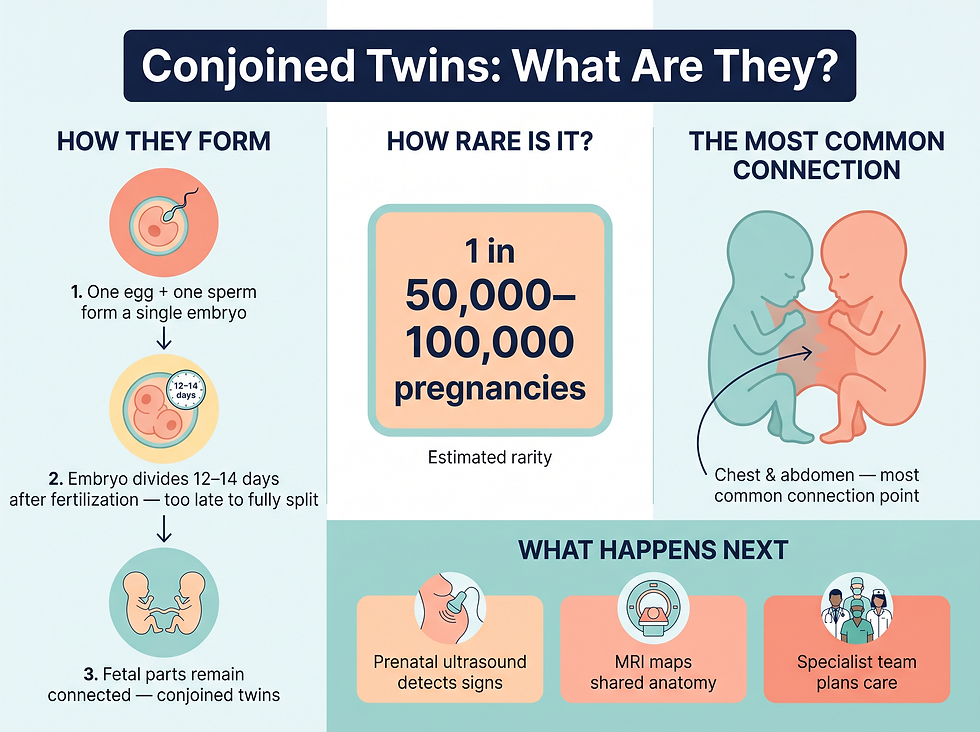
What Causes Conjoined Twins?
Experts know that changes during early fetal development lead to conjoined twins. The change occurs when something disrupts the process that creates identical twins.
Identical twins happen when a single embryo, from one egg and one sperm, divides into two embryos that are close together. If that embryo division happens 12 to 14 days after fertilization, the fetal parts may remain connected, or conjoined, instead of forming two individual but identical twins.
Fertilization: one egg and one sperm form a single embryo.
Division at 12 to 14 days: the embryo begins to split into two, but the split happens late.
Result: fetal parts remain connected instead of forming two separate twins.
How Are Conjoined Twins Diagnosed?
Obstetricians often detect signs of conjoined fetuses during routine prenatal ultrasounds, as early as the first trimester of pregnancy.
If an ultrasound shows signs of conjoined twins, your obstetrician will refer you to a maternal-fetal medicine specialist who manages complicated pregnancies. The specialist may order an MRI to get more information about the fetuses, including which body areas they share.
What Are the Connection Types?
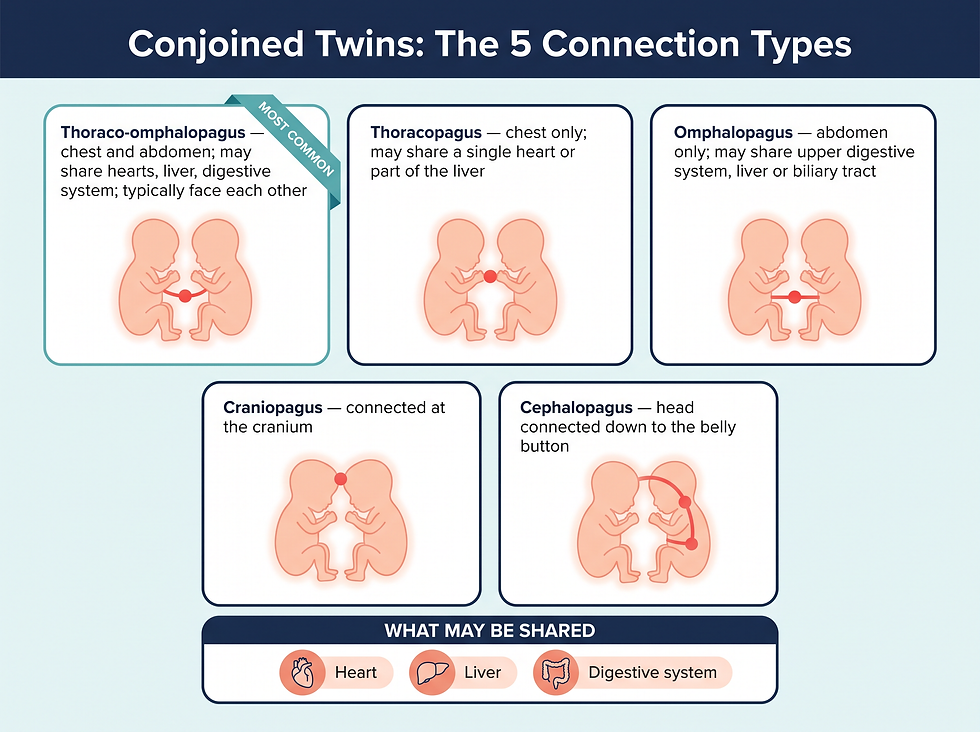
There are five connection types described in clinical reference material:
Thoraco-omphalopagus (chest and abdomen): the most common form; twins typically face each other and may share their hearts, liver, and digestive system.
Thoracopagus (chest only): twins face each other and may share a single heart or part of their liver.
Omphalopagus (abdomen only): may share part of the upper digestive system, liver, or biliary tract.
Craniopagus (cranium): connected at the cranium (skull).
Cephalopagus (head to belly button): connected at the head, down to the belly button.
What Happens After Diagnosis?
Your maternal-fetal medicine provider will explain what you can expect during the pregnancy and birth. The care team typically includes:
Maternal-fetal medicine specialist: manages the complicated pregnancy.
Genetic counselors: discuss genetic factors and family planning.
Pediatric surgeon specialists: cardiothoracic, urologic, or digestive surgery specialists, depending on which organs are connected.
The team answers your questions, discusses potential options, and develops a plan for managing the twins' specific health issues.
Can Conjoined Twins Be Separated?
In some cases, it is possible to separate conjoined twins. The care team reviews imaging tests to identify the areas where the twins' bodies connect, then evaluates how separation surgery would affect the babies. In general, there are three paths:
No separation: when surgery could create life-threatening risks or significant medical issues, for example if the babies share vital organs.
Immediate separation: emergency surgery when life-threatening medical issues affect one or both twins.
Delayed separation: surgery at 9 to 12 months old; delaying gives the babies time to grow and develop.
Who Decides?
Your care team will make recommendations for you to consider. They'll respect your opinions and concerns and work with you to make treatment decisions.
What Are the Risks During Pregnancy?
The most common complications are miscarriage or stillbirth. Premature labor is very common in pregnancies involving conjoined twins. All babies born early have health risks, and those risks may further complicate care for conjoined twins.
What Is the Prognosis?
Research shows that about 45% of conjoined twins are live births. But the prognosis for newborn conjoined twins is poor. Often, one twin won't live very long after they're born because of life-threatening medical issues. Experts estimate that about 8% of conjoined twins survive.
Conjoined twins will need medical support and other care throughout their lives, whether they have separation surgery or remain conjoined. That care may include:
Additional surgery to manage issues like scoliosis.
Physical therapy to support movement and strength.
Pediatric occupational therapy to support daily skills and independence.
Early intervention to help with learning disabilities.
Can Conjoined Twins Be Different Sexes?
No. Conjoined twins form when a single identical-twin embryo doesn't fully divide into two. Just like identical twins, conjoined twins are always the same sex. About 70% of all conjoined twins are female.
Why the Term "Siamese Twins"?
That term dates to the 1800s and the lives of conjoined twins Chang and Eng, who were joined at the sternum. The twins were born in Siam (now Thailand). Today, "conjoined twins" is the respectful, standard medical term.

What Questions Should I Ask the Healthcare Team?
Conjoined twins are rare, and you may not know much about the issues involved when prenatal tests show physical connections between twins. Here are some suggestions:
Where are my twins connected, and what organs are shared?
What specialists are available to oversee fetal development and treat my babies once they're born?
Can you say if separation surgery is a possibility?
What circumstances would mean the babies need immediate separation?
What resources are available to help me and my family manage the challenges?
Conclusion
Conjoined twins are a rare condition in which twin fetuses have connected body parts or organs, caused by a late split of a single embryo 12 to 14 days after fertilization. The condition occurs in roughly 1 in every 50,000 to 100,000 pregnancies, most commonly connecting the twins at the chest and abdomen.
Diagnosis usually begins with a routine prenatal ultrasound, followed by MRI to map the shared anatomy. Five connection types range from thoraco-omphalopagus (chest and abdomen) to craniopagus (skull) and cephalopagus (head to belly button). Separation surgery is possible in some cases, sometimes urgently, sometimes delayed until the babies are 9 to 12 months old, while in others the twins remain connected for life.
The prognosis is sobering: about 45% are live births and an estimated 8% survive. Yet families who walk this path are never alone. Maternal-fetal medicine teams, genetic counselors, pediatric surgeons, and support communities are essential throughout pregnancy, birth, and beyond.
If prenatal imaging suggests your twins are connected, ask for an immediate referral to a maternal-fetal medicine specialist. The more time the team has to plan, the better prepared your family will be.
Frequently Asked Questions (FAQ)
What are conjoined twins?
Conjoined twins are twin fetuses that have connected body parts or organs. It is a rare condition, estimated to occur in 1 in every 50,000 to 100,000 pregnancies.
How do conjoined twins form?
They form when a single embryo, from one egg and one sperm, divides 12 to 14 days after fertilization. The late split means the fetal parts remain connected instead of forming two separate identical twins.
Why is the 12 to 14 day window important?
If the embryo divides earlier, two separate identical twins form. A division at 12 to 14 days is late enough that the twins stay physically connected.
Where are conjoined twins usually connected?
The most common point of connection is the chest and abdomen.
Can conjoined twins share organs?
Yes. Depending on the connection type, they may share organs such as the heart, liver, digestive system, or biliary tract.
What is thoraco-omphalopagus?
The most common form of connection, where twins are joined at the chest and abdomen. They typically face each other and may share their hearts, liver, and digestive system.
What is thoracopagus?
Connection at the chest only. The twins face each other and may share a single heart or part of their liver.
What is omphalopagus?
Connection at the abdomen only. The twins may share part of the upper digestive system, liver, or biliary tract.
What is craniopagus?
The twins connect at the cranium (the skull).
What is cephalopagus?
The twins are connected at the head, down to the belly button.
How are conjoined twins first detected?
Often through routine prenatal ultrasounds, sometimes as early as the first trimester of pregnancy.
What happens after an ultrasound suggests conjoined twins?
Your obstetrician will refer you to a maternal-fetal medicine specialist, who may order an MRI to see which body areas the fetuses share.
Why does early detection matter?
Early detection gives the healthcare team more opportunity to plan treatment and gives your family time to understand the issues and challenges involved.
Who is on the care team?
A maternal-fetal medicine specialist, genetic counselors, and pediatric surgeon specialists (such as cardiothoracic, urologic, or digestive surgery specialists, depending on the connected organs).
What are the risks during pregnancy?
The most common complications are miscarriage or stillbirth. Premature labor is very common, and early birth adds health risks that may further complicate care.
Can conjoined twins be separated?
In some cases, yes. The team reviews imaging to identify the connection areas and evaluates how separation surgery would affect the babies.
When is separation not an option?
When surgery could create life-threatening risks or significant medical issues, for example if the babies share vital organs.
What is immediate separation?
Emergency surgery performed when life-threatening medical issues affect one or both twins.
What is delayed separation?
Separation surgery recommended when the babies are 9 to 12 months old, giving them time to grow and develop first.
Who decides about separation surgery?
The care team makes recommendations, respects the parents' opinions and concerns, and works with the family to make treatment decisions.
What is the survival rate for conjoined twins?
Research shows about 45% of conjoined twins are live births, and experts estimate about 8% survive. The prognosis for newborn conjoined twins is generally poor.
Do conjoined twins always need lifelong care?
Yes. Nearly all conjoined twins need medical support and care throughout their lives, whether or not they are separated.
What ongoing care may they need?
Additional surgery (for issues like scoliosis), physical therapy, pediatric occupational therapy, and early intervention for learning disabilities.
Can conjoined twins be different sexes?
No. They always share the same sex, just like identical twins. About 70% of conjoined twins are female.
Why were they once called "Siamese twins"?
The term dates to the 1800s and twins Chang and Eng, joined at the sternum, who were born in Siam (now Thailand). "Conjoined twins" is the respectful, standard medical term today.
Sources
Medical disclaimer: This article is for general informational purposes only and does not constitute medical advice, diagnosis, or treatment. Always seek the advice of your physician or another qualified health provider with any questions you may have regarding a medical condition, especially concerning a complicated pregnancy. Never disregard professional medical advice or delay seeking care because of something you have read here. If prenatal imaging suggests your twins are connected, ask for an immediate referral to a maternal-fetal medicine specialist.
Comments