Pancoast Tumor: Symptoms, Causes, and Management

Updated: 2 days ago
Medically reviewed by Dr. Baraa Alnahhal, MD · Last reviewed: September 2026
TL;DR
A Pancoast tumor is a rare form of lung cancer that develops at the very top of the lung. Unlike typical lung cancers, it often presents with severe shoulder pain and arm weakness rather than a cough. While diagnosis can be challenging in early stages, modern treatments including surgery, radiation, and chemotherapy can effectively manage the condition. Early detection and specialized care are key to improving patient outcomes.
Quick Answer
A Pancoast tumor, also known as a superior sulcus tumor, is a rare lung cancer located at the lung's apex. It primarily affects nearby nerves and blood vessels, leading to "Pancoast syndrome," which involves severe shoulder pain and hand weakness. Up to 50% of patients also experience Horner’s syndrome, affecting facial sweating and eyelid function. Treatment typically involves a combination of chemotherapy, radiation, and surgery to shrink and remove the tumor [1].
What is a Pancoast Tumor?
A Pancoast tumor is a rare malignancy that begins in the upper part of the lung, known as the apex. Located above the first rib, these tumors are distinct because they often do not cause the "classic" symptoms associated with lung cancer, such as persistent coughing or chest pain. Instead, they are defined by their tendency to invade surrounding structures, including nerves and blood vessels in the upper chest and neck [1].
Healthcare providers also refer to these as superior sulcus tumors. They are named after the radiologist who first identified the specific clinical pattern in the early 20th century. While rare, making up less than 5% of all lung tumors, they require specialized diagnostic and treatment approaches due to their unique location [1].
Recognizing Pancoast Syndrome
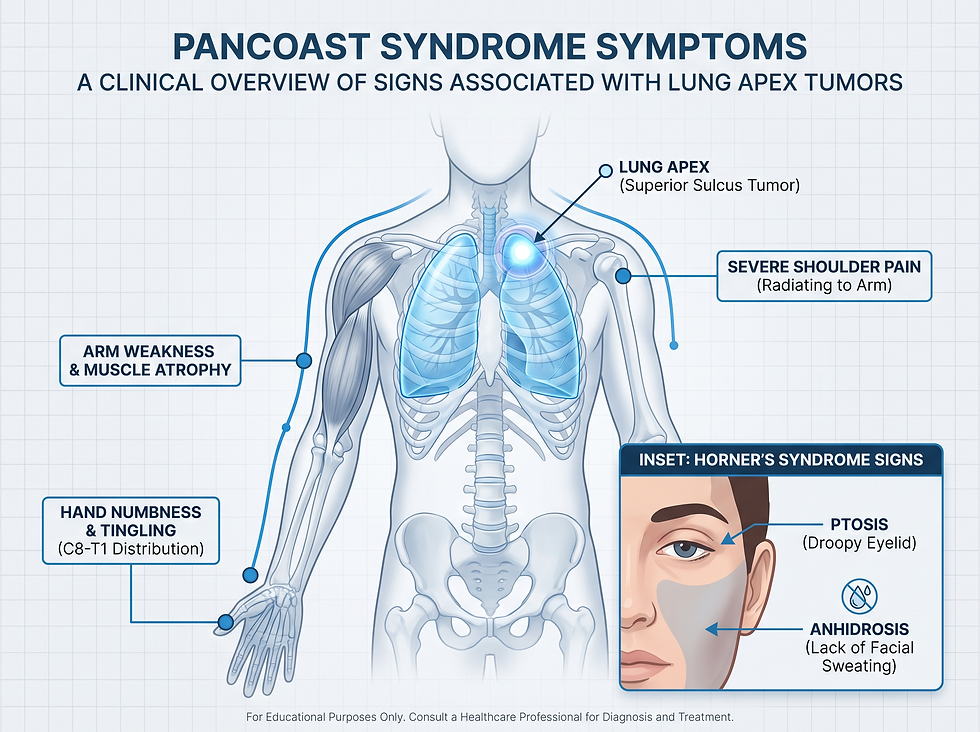
When a Pancoast tumor places pressure on the brachial plexus—a network of nerves extending from the chest to the arms—it produces a collection of symptoms known as Pancoast syndrome. These symptoms typically appear only on the side of the body where the tumor is located.
Common Symptoms
Symptom Category | Specific Experiences |
Pain | Severe shoulder and shoulder blade pain; neck pain; pain in the upper ribs. |
Neurological | Arm and hand weakness; tingling or numbness in the hand; loss of finger dexterity. |
Physical Changes | Upper arm swelling; tightness in the chest; unexplained weight loss; fatigue. |
Horner’s Syndrome
In approximately 50% of cases, patients develop Horner’s syndrome due to nerve involvement. This condition manifests as facial flushing, a droopy eyelid (ptosis), a lack of sweating on one side of the face (anhidrosis), and a slightly displaced eyeball (enophthalmos) [1].
Causes and Risk Factors
The underlying causes of Pancoast tumors are consistent with other forms of lung cancer. The majority of these tumors are adenocarcinomas, which begin in the mucus-making gland cells of the airways.
Tobacco Use: Smoking remains the most significant risk factor.
Environmental Exposure: Long-term exposure to secondhand smoke increases risk.
Industrial Hazards: Prolonged contact with substances like asbestos or heavy metals.
Radon Gas: Exposure to naturally occurring radon gas in homes or workplaces [1].
Diagnosis and Clinical Staging
Because Pancoast tumors are located at the very top of the lung, they are notoriously difficult to detect on standard two-dimensional chest X-rays during their early stages. This often leads to a delay in diagnosis until the cancer has progressed.
Diagnostic Tools
Tool | Purpose and Description |
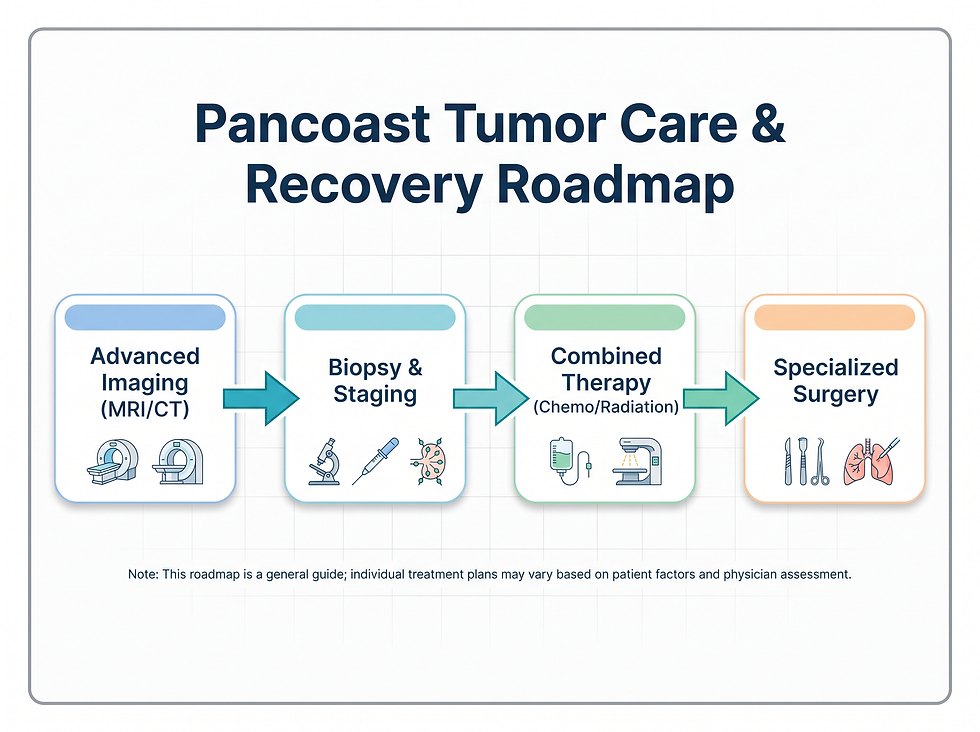
Advanced Imaging | CT, PET, and MRI scans provide detailed views of the lung apex and surrounding nerves. |
Needle Biopsy | Extraction of tissue or fluid from abnormal lumps for laboratory analysis. |
VATS | Video-assisted thoracic surgery using a tiny camera to inspect the chest cavity. |
Thoracotomy | A surgical incision that allows direct visualization and simultaneous biopsy or removal. |
Staging Severity
Most Pancoast tumors are classified as stage T3 or T4 at the time of diagnosis. T3 indicates the cancer has reached the chest wall or sympathetic nerves, while T4 signifies it has spread to deeper structures like the spinal cord or brachial nerves [1].
Treatment and Recovery Roadmap
The management of a Pancoast tumor depends on how far the cancer has spread and the patient's overall health. A multidisciplinary approach is almost always required.
Chemoradiation and Surgery: This is often the preferred path. Doctors use chemotherapy and radiation to shrink the tumor before a surgeon removes it.
Surgical Complexity: Surgery may involve removing the top two ribs or replacing major arteries with vascular grafts to ensure proper blood flow.
Immunotherapy: These treatments stimulate the body's own immune system to identify and fight cancer cells more effectively.
Targeted Therapy: Specialized medications designed to attack specific vulnerabilities in the cancer cells [1].

Conclusion
While a Pancoast tumor diagnosis is serious, advancements in combined therapies have made the condition increasingly manageable. The absence of traditional lung cancer symptoms like coughing means that paying attention to persistent shoulder or arm pain is vital. By working closely with a specialized oncology team, patients can access personalized treatment plans designed to target the tumor and preserve nerve function.
CTA: If you are experiencing unexplained, severe shoulder pain or arm weakness that does not respond to standard treatments, consult a healthcare provider immediately. Early diagnostic imaging can be the first step toward effective management and recovery.
Frequently Asked Questions
Is a Pancoast tumor the same as regular lung cancer?
It is a type of lung cancer, but its location at the lung's apex and its symptoms (shoulder pain rather than cough) make it unique.
Can a Pancoast tumor be cured?
While often described as not curable in a traditional sense, many cases are manageable with long-term treatment and surgery.
Why does it cause shoulder pain?
The tumor grows at the top of the lung and presses against the brachial plexus nerves that lead to the shoulder and arm.
What is Horner’s syndrome?
It is a group of symptoms caused by nerve damage, including a droopy eyelid and a lack of facial sweating on one side.
Are Pancoast tumors common?
No, they are rare, accounting for less than 5% of all lung cancer cases.
Does smoking cause Pancoast tumors?
Yes, smoking is the primary risk factor, similar to other types of lung cancer.
Can an X-ray find a Pancoast tumor?
Early-stage tumors are often missed on X-rays; CT or MRI scans are much more reliable.
What is the most common type of Pancoast tumor?
Most are adenocarcinomas, a subtype of non-small cell lung cancer.
Is surgery always necessary?
Surgery is preferred if the tumor can be safely removed, often after shrinking it with radiation or chemo.
What is a superior sulcus tumor?
This is simply another medical name for a Pancoast tumor.
Can asbestos exposure cause this?
Yes, long-term exposure to asbestos is a known environmental risk factor.
What does T3 or T4 staging mean?
These stages indicate the tumor has invaded nearby structures like the chest wall (T3) or spinal cord (T4).
How does immunotherapy work for this?
It helps your own immune system recognize and attack the cancer cells.
Is arm swelling a symptom?
Yes, if the tumor presses against blood vessels, it can cause swelling in the upper arm.
Should I see a specialist?
Yes, Pancoast tumors are best treated by a multidisciplinary team including oncologists and thoracic surgeons.
References
Medical Disclaimer: This article is for informational purposes only and does not constitute medical advice. Always seek the advice of your physician or other qualified health provider with any questions you may have regarding a medical condition.
Comments