Medullary Thyroid Cancer: Symptoms, Genetics, and Treatment Options

Updated: 2 days ago
Medically reviewed by Dr. Baraa Alnahhal, MD · Last reviewed: September 2026
TL;DR: Medullary thyroid cancer (MTC) is a rare form of thyroid cancer that develops in the parafollicular C cells of the thyroid gland. While most cases occur sporadically, approximately 25% are linked to inherited genetic mutations. Early detection through neck exams and blood tests is critical, as surgery to remove the thyroid gland remains the primary treatment for ensuring long-term health.
Quick Answer: Medullary thyroid cancer (MTC) arises from calcitonin-producing C cells in the thyroid's medulla. Symptoms often include a thyroid nodule or swollen neck lymph nodes. About 75% of cases are sporadic, while 25% are inherited via Multiple Endocrine Neoplasia type 2 (MEN2). Treatment typically involves a total thyroidectomy, followed by lifelong hormone replacement. While more aggressive than common thyroid cancers, MTC often progresses slowly and is curable if caught early.
What is Medullary Thyroid Cancer?
Medullary thyroid cancer (MTC) is a rare malignancy that forms in the interior portion of the thyroid gland, known as the medulla. Unlike more common thyroid cancers that originate in follicular cells, MTC arises from parafollicular C cells. These specialized cells are responsible for producing calcitonin, a hormone involved in calcium regulation. When these C cells grow uncontrollably, they form a tumor within the thyroid.
MTC accounts for approximately 4% to 10% of all thyroid cancer diagnoses in the United States, with roughly 1,000 new cases identified annually. While the diagnosis can be concerning due to its rarity, medical advancements have provided several effective therapeutic pathways for managing the condition.
Symptoms and Warning Signs
In many instances, medullary thyroid cancer progresses slowly and may remain asymptomatic for an extended period while the tumor is small. When symptoms do emerge, they are most frequently related to the physical presence of a mass in the neck area.
Thyroid Nodule (Lump): present in 75% to 95% of patients at diagnosis.
Swollen Neck Lymph Nodes: present in approximately 70% of patients at diagnosis.
In rare or more advanced cases, a large thyroid nodule may press against nearby structures, leading to hoarseness, difficulty swallowing (dysphagia), or breathing challenges. These symptoms warrant immediate evaluation by a healthcare professional.

Causes and Genetic Factors
The causes of medullary thyroid cancer are divided into two primary categories: sporadic and inherited. Understanding the origin of the cancer is essential for determining the appropriate screening and treatment plan for both the patient and their family.
Sporadic vs. Inherited MTC
Sporadic MTC (75% of cases): These occur randomly in individuals with no family history of the disease. While the exact cause is often unknown, nearly half of these patients have acquired mutations in the RET gene later in life.
Inherited MTC (25% of cases): This form is linked to Multiple Endocrine Neoplasia type 2 (MEN2). Patients with MEN2A have a 90% chance of developing MTC, while those with MEN2B have a near 100% chance, often at a very young age.
Because of the strong genetic link in inherited cases, providers often recommend genetic testing for patients and their biological family members to identify potential risks early.

Diagnosis and Testing
Medullary thyroid cancer is often discovered during a routine neck examination or incidentally during imaging for other health concerns. If a nodule is detected, several diagnostic steps are taken to confirm the presence of MTC.
Imaging Tests: Ultrasounds, CT scans, and MRIs are used to visualize the nodule and determine if it has spread to nearby lymph nodes.
Fine Needle Aspiration (Biopsy): A thin needle is used to extract a small tissue sample from the thyroid nodule for microscopic analysis.
Blood Tests: Providers measure levels of calcitonin and carcinoembryonic antigen (CEA). Elevated levels of these markers are characteristic of MTC and are also used to monitor treatment progress.
Treatment and Management
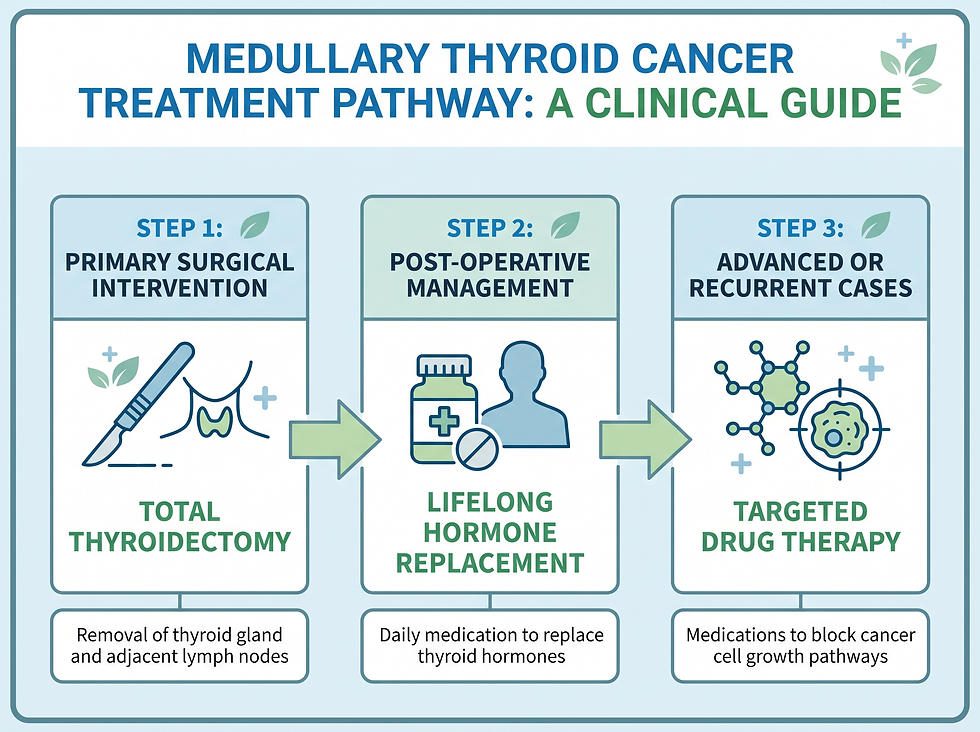
The primary treatment for medullary thyroid cancer is surgical intervention. Because MTC originates in the medulla and can be aggressive, a total thyroidectomy (the complete removal of the thyroid gland) is typically required.
Surgical and Post-Surgical Care
If the cancer has metastasized to the lymph nodes in the neck, those nodes are also removed during surgery. Following a thyroidectomy, patients must take thyroid hormone replacement medication for the rest of their lives to maintain normal metabolic function.
Additional Therapies
For cases where surgery is not sufficient or the cancer has spread further, other treatments may be utilized:
Targeted Therapies: Medications such as vandetanib and cabozantinib specifically target DNA changes in the cancer cells.
Radiation and Chemotherapy: These may be recommended for advanced cases to help control tumor growth.
Outlook and Prognosis
The prognosis for medullary thyroid cancer depends on the stage at diagnosis, the patient's age, and the success of surgical removal. While MTC is more aggressive than other thyroid cancers, it often grows slowly, allowing for effective management over many years.
Current data suggests a five-year survival rate of approximately 93% for stages 1 through 3. For stage 4, the rate is lower, at about 28%. However, early detection significantly improves these outcomes, and many patients live active lives following successful treatment.
Frequently Asked Questions
1. What is medullary thyroid cancer (MTC)?
MTC is a rare cancer that starts in the C cells located in the medulla (center) of the thyroid gland.
2. How rare is this type of cancer?
It accounts for only 4% to 10% of all thyroid cancers, with about 1,000 cases diagnosed annually in the U.S.
3. What are the most common symptoms?
The most common sign is a lump or nodule on the thyroid gland, often accompanied by swollen lymph nodes in the neck.
4. Is MTC hereditary?
About 25% of cases are inherited through a genetic condition called Multiple Endocrine Neoplasia type 2 (MEN2).
5. What is the RET gene?
The RET gene is a specific gene that, when mutated, can cause MTC. Mutations can be inherited or acquired randomly.
6. How is MTC diagnosed?
Diagnosis involves neck exams, imaging (ultrasound, CT, MRI), blood tests for calcitonin/CEA, and a needle biopsy.
7. What is the main treatment for MTC?
The primary treatment is a total thyroidectomy, which is the surgical removal of the entire thyroid gland.
8. Will I need to take medication after surgery?
Yes, because the thyroid is removed, you will need lifelong thyroid hormone replacement medication.
9. Can MTC spread to other parts of the body?
Yes, it can spread (metastasize) to neck lymph nodes and, in advanced stages, to other organs.
10. Is MTC more aggressive than other thyroid cancers?
Yes, it is generally more aggressive than papillary or follicular thyroid cancers, but it still often grows slowly.
11. What are targeted therapies?
These are drugs like vandetanib that target specific genetic mutations in cancer cells to stop them from growing.
12. Does radiation therapy work for MTC?
Radiation may be used in advanced cases to control the tumor, though surgery is the preferred first-line treatment.
13. What is the survival rate for MTC?
For stages 1-3, the five-year survival rate is about 93%. It is lower for stage 4, emphasizing the need for early detection.
14. Should my family get tested if I have MTC?
If your MTC is found to be the inherited type (MEN2), genetic testing for biological family members is highly recommended.
15. Can I live a normal life after treatment?
Yes, many people live full, active lives after surgery, provided they maintain their hormone replacement therapy and regular follow-ups.
Medical Disclaimer: The information provided in this article is for educational purposes only and should not be used as a substitute for professional medical advice, diagnosis, or treatment. Always seek the advice of a qualified healthcare provider with any questions you may have regarding a medical condition.
Comments