Gastrointestinal Stromal Tumor (GIST): Symptoms, Causes & Treatment

Updated: 2 days ago
Medically reviewed by Dr. Baraa Alnahhal, MD · Last reviewed: September 2026
A gastrointestinal stromal tumor (GIST) is a type of cancer that begins in the digestive system, most often in the stomach or small intestine. GISTs are thought to form from nerve cells in the walls of the digestive organs, and small GISTs can grow slowly and cause no symptoms at all. This guide walks through the symptoms to watch for, what causes a GIST to form, the risk factors, how doctors diagnose it, and the treatment path that usually combines surgery with targeted therapy.
Quick Answer
What is it? A type of cancer that begins in the digestive system, most often the stomach and small intestine, thought to form from nerve cells in the organ walls.
What causes it? DNA changes in digestive-organ nerve cells that tell the cells to grow quickly and live longer than healthy cells would. The cause of most GISTs is not known.
Symptoms: A belly-area growth, belly pain, fatigue, nausea and vomiting, loss of appetite, feeling full after a small amount of food, and dark-colored stools from digestive bleeding.
Risk factors: Family history of GISTs, hereditary syndromes (neurofibromatosis type 1, Carney-Stratakis syndrome), and adult age — GISTs are very rare in children.
How is it diagnosed? Imaging tests (ultrasound, CT, MRI, PET), upper endoscopy, endoscopic ultrasound (EUS), and biopsy with laboratory testing of the tissue sample.
How is it treated? Often with surgery to remove all the tumor, plus targeted therapy (usually beginning with imatinib) that blocks the tyrosine kinase enzyme in cancer cells.
When is treatment needed? Some very small GISTs that cause no symptoms are monitored with tests first; treatment starts if the tumor grows.
What Is a Gastrointestinal Stromal Tumor, and How Does It Form?
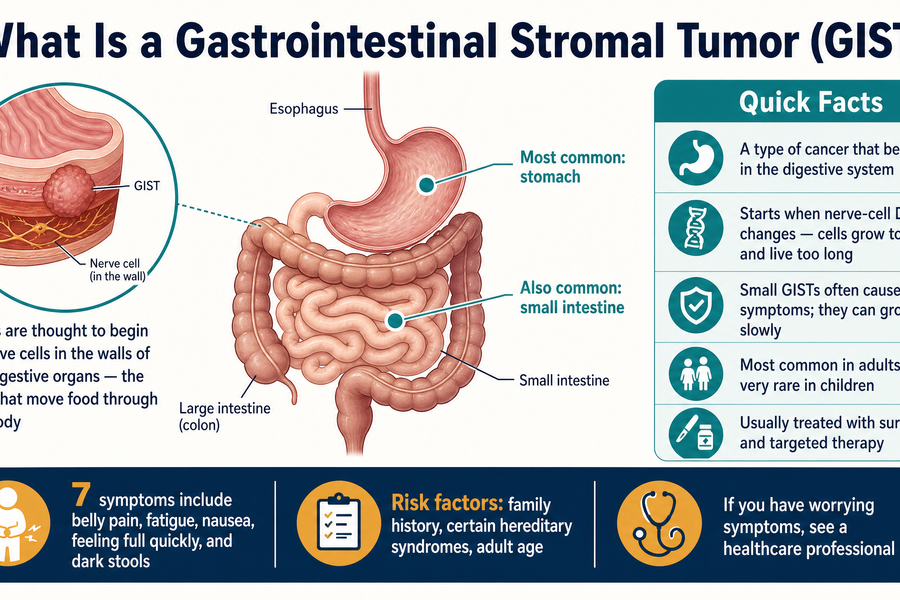
GISTs most often form in the stomach and small intestine and are thought to begin in the nerve cells within the walls of the digestive organs.
A gastrointestinal stromal tumor — usually called a GIST — is a type of cancer that begins in the digestive system. It happens most often in the stomach and the small intestine.
A GIST is a growth of cells that is thought to form from nerve cells in the walls of the digestive organs. These nerve cells play a part in the process that moves food through the body.
Small GISTs may cause no symptoms at all. They may also grow so slowly that they don't cause problems at first. But as a GIST grows, it can cause symptoms that may include belly pain and nausea. GISTs can happen in people at any age. They are most common in adults and very rare in children — and the cause of most GISTs is not known.
What Does GIST Feel Like? The 7 Symptoms to Notice
Small GISTs may stay silent for a long time. As the tumor grows, the symptoms that can appear include:
A growth in the belly area: A visible or palpable lump in the abdomen
Belly pain: Pain in the abdominal area
Fatigue: Unusual tiredness or exhaustion
Nausea and vomiting: Stomach upset with or without vomiting
Loss of appetite: Not feeling hungry when you would expect to
Early fullness: Feeling full after eating only a small amount of food
Dark-colored stools: Stools darkened by bleeding in the digestive system

GISTs often cause no symptoms when small — but a growing tumor can cause belly pain, early fullness, and dark stools from digestive bleeding.
When to See a Doctor
The guidance here is simple: make an appointment with a doctor or other healthcare professional if you have any symptoms that worry you. Persistent belly pain, unexplained fatigue, and dark stools all deserve a proper evaluation.
What Causes GIST? The DNA Changes Behind It
The cause of a gastrointestinal stromal tumor often isn't known. What researchers understand is how the tumor starts at the cellular level. GISTs are thought to begin in nerve cells in the walls of the digestive organs — the nerve cells that play a part in the process that moves food through the body.
A GIST starts when these nerve cells develop changes in their DNA. A cell's DNA holds the instructions that tell the cell what to do. In healthy cells, the DNA gives instructions to grow and multiply at a set rate, and it tells the cells to die at a set time. In cancer cells, the DNA changes give different instructions: they tell the cancer cells to grow and multiply quickly, and to keep living when healthy cells would die. This causes too many cells.
The cancer cells might form a mass called a tumor. The tumor can grow to invade and destroy healthy body tissue. In time, cancer cells can break away and spread — when cancer spreads, it is called metastatic cancer.
What Raises Your Risk? The 3 Risk Factors
Three factors are associated with a higher chance of developing a GIST:
Family history: People with a family history of GISTs may be at increased risk of this cancer
Hereditary syndromes: Conditions that run in families — examples include neurofibromatosis type 1 and Carney-Stratakis syndrome
Adult age: A GIST can happen at any age, but this cancer happens most often in adults; it is rare in children
How Is a GIST Diagnosed? The 5-Step Testing Pathway
To diagnose a gastrointestinal stromal tumor, your healthcare professional might start by asking you about your symptoms and your health history. If symptoms suggest that you may have a GIST, you might need other tests to find the cancer.
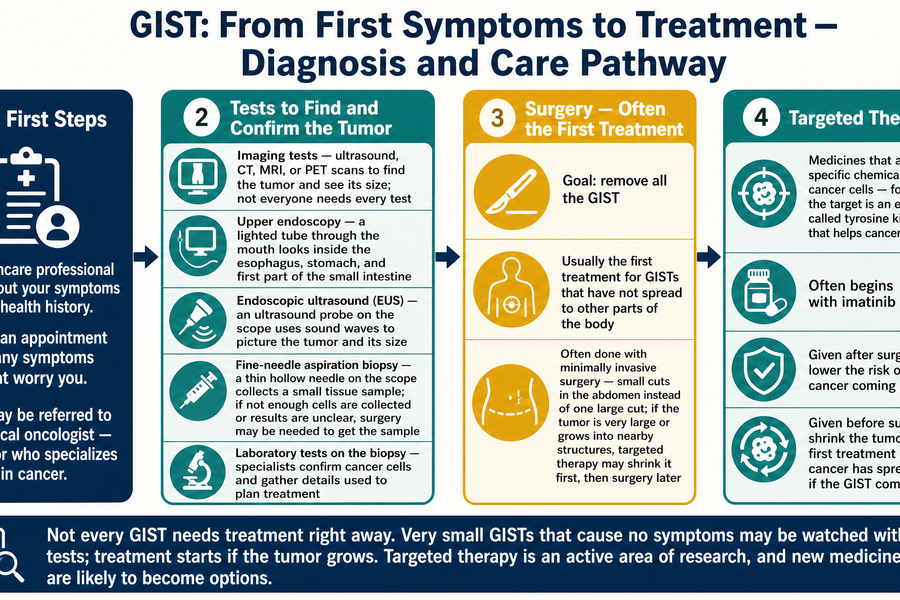
The typical GIST care pathway — from first appointment and five diagnostic tests through surgery and targeted therapy, with a note that small GISTs may simply be watched.
Imaging tests: Help the team find your tumor and see its size; might include ultrasound, CT, MRI, and PET scans; not everyone needs every test
Upper endoscopy: A lighted tube through the mouth looks inside the esophagus, stomach, and first part of the small intestine
Endoscopic ultrasound (EUS): An ultrasound probe on the tip of the scope uses sound waves to picture the tumor and show its size
Fine-needle aspiration biopsy: A thin, hollow needle on the tip of the endoscope collects a small tissue sample; the EUS finds the tumor and the needle collects the tissue
Laboratory tests on biopsies: Specialists confirm cancer cells and gather details used to plan treatment
A biopsy note worth knowing: sometimes the needle can't get enough cells, or the results aren't clear. In that case, you might need surgery to collect the sample.
How Is GIST Treated? Surgery and Targeted Therapy
GIST treatment often involves surgery and targeted therapy. Which treatments are best for you depends on your situation. Some GISTs don't need treatment right away — very small GISTs that don't cause symptoms might not need treatment. Instead, you might have tests to see if the cancer grows, and start treatment if it does.
Surgery: Removing the Whole Tumor
The goal of surgery is to remove all the GIST. It is often the first treatment for GISTs that haven't spread to other parts of the body.
Surgery might not be used first if your tumor grows very large or if it grows into nearby structures. If this happens, your first treatment might be targeted therapy to shrink the tumor, with surgery later. Often surgeons can access the GIST using minimally invasive surgery — surgical tools go through small cuts in the abdomen rather than through one large cut.
Targeted Therapy: Attacking the Cancer at the Molecular Level
Targeted therapy for cancer uses medicines that attack specific chemicals in the cancer cells. By blocking these chemicals, targeted treatments can cause cancer cells to die. For GISTs, the target of these medicines is an enzyme called tyrosine kinase that helps cancer cells grow. Targeted therapy for GISTs often begins with imatinib and can be given at different points in your care:
After surgery: To lower the risk that the cancer will come back
Before surgery: To shrink the tumor and make it easier to remove
As the first treatment: If the cancer has spread to other parts of the body
If the GIST comes back: To treat the recurrent cancer
Other targeted therapy medicines might be used if imatinib doesn't work for you or if it stops working. Targeted therapy is an active area of cancer research, and new medicines are likely to become options in the future.
How to Prepare for Your Appointment
If your healthcare professional thinks you might have a gastrointestinal stromal tumor, they may refer you to a specialist — often a doctor who specializes in cancer, called a medical oncologist. Appointments can be short, and being prepared can help. When you make the appointment, ask if there is anything you need to do in advance, such as fasting before a specific test. Then make a list of:
Your symptoms: Including any that seem unrelated to the reason for your appointment
Key personal information: Major stresses, recent life changes, and family medical history
All medicines, vitamins, or other supplements: Including the doses you take
Questions to ask: Your own list of questions for the healthcare professional
Take a family member or friend along, if possible, to help you remember the information you are given.
Questions to Ask Your Healthcare Team
Do I have cancer?
Do I need more tests?
What are my treatment options, and what are their potential risks?
Do any of the treatments cure my cancer?
Can I have a copy of my pathology report?
How much time can I take to consider my treatment options?
Are there brochures or other printed materials I can take with me? What websites do you recommend?
What would happen if I chose not to have treatment?
What to Expect From Your Doctor
When did your symptoms begin?: Establishes the timeline of the illness
Have your symptoms been continuous or occasional?: Helps distinguish patterns
How severe are your symptoms?: Guides urgency and testing
What, if anything, seems to improve or worsen your symptoms?: Provides diagnostic clues
Bottom Line
If you have noticed a growth in your belly area, persistent belly pain, unexplained fatigue, early fullness, or dark-colored stools, the single most important step is to make an appointment with a healthcare professional. GISTs grow slowly and are often very treatable when caught early, and a diagnosis starts with a conversation about your symptoms — not with fear.
Once diagnosed, treatment is usually a combination of surgery and targeted therapy, and your care team — often led by a medical oncologist — will tailor the plan to your specific tumor. If imatinib stops working, other targeted medicines exist, and new options continue to emerge from cancer research.
Your next step: write down your symptoms, gather your medicine list, and book an appointment — early evaluation is what keeps a GIST manageable.
Frequently Asked Questions
What is a gastrointestinal stromal tumor (GIST)?
A GIST is a type of cancer that begins in the digestive system, most often in the stomach and small intestine. It is thought to form from nerve cells in the walls of the digestive organs.
What causes a GIST?
A GIST starts when nerve cells in the digestive system develop changes in their DNA that tell the cells to grow and multiply quickly and keep living when healthy cells would die, causing too many cells and, in time, a tumor. The cause of most GISTs is not known.
What are the symptoms of a GIST?
Symptoms include a growth in the belly area, belly pain, fatigue, nausea and vomiting, loss of appetite, feeling full after eating only a small amount of food, and dark-colored stools caused by digestive bleeding. Small GISTs may cause no symptoms.
Who is at risk for a GIST?
People with a family history of GISTs, people with hereditary syndromes such as neurofibromatosis type 1 and Carney-Stratakis syndrome, and adults — GISTs are most common in adults and very rare in children.
How is a GIST diagnosed?
Diagnosis typically involves imaging tests (ultrasound, CT, MRI, PET scans), an upper endoscopy, an endoscopic ultrasound (EUS), and a fine-needle aspiration biopsy of the tumor, followed by laboratory tests on the biopsy sample.
Is surgery always needed for a GIST?
No. Very small GISTs that cause no symptoms might not need treatment right away — they may be monitored with tests, with treatment starting if the tumor grows. For GISTs that haven't spread, surgery to remove the entire tumor is often the first treatment.
What is targeted therapy for GIST?
Targeted therapy uses medicines that attack specific chemicals in cancer cells — for GISTs, the target is an enzyme called tyrosine kinase. Treatment often begins with imatinib and can be given before or after surgery, as a first treatment for cancer that has spread, or if the GIST comes back.
References
Clinical content reviewed through December 24, 2025, based on the reference sources listed above. This article is for general information only and is not a substitute for professional medical advice, diagnosis, or treatment.
Comments