Fibrosarcoma: Types, Symptoms, Causes, Diagnosis, Treatment and Outlook — What You Need to Know

Updated: 3 hours ago
Medically reviewed by Dr. Baraa Alnahhal, MD · Last reviewed: September 2026
Fibrosarcoma is a rare and serious form of soft tissue cancer that develops in the body's connective tissues, such as tendons, ligaments, and bones. It primarily affects the legs, trunk, and arms, though it can occur anywhere in the body. There are two distinct forms: infantile (congenital) fibrosarcoma, which affects newborns and young children and is often curable, and adult-type fibrosarcoma, which is more aggressive and typically affects adults between ages 20 and 60. The most common sign is a new, often painless lump. Because these tumors grow deep within soft tissues, symptoms may not appear until the growth presses against nerves or blood vessels. Diagnosis requires advanced imaging like MRIs and CT scans, followed by a biopsy to confirm the presence of malignant cells. Treatment strategies vary by type but generally involve surgical removal, radiation, and sometimes chemotherapy or targeted therapies.
Quick Answer: What is Fibrosarcoma?
Fibrosarcoma is a rare type of soft tissue sarcoma that originates in fibrous connective tissue. Unlike benign fibromas, fibrosarcoma is malignant, meaning it is cancerous and can spread to other parts of the body. It most commonly develops in the deep soft tissues of the legs, particularly near the thigh or shin bones, but can also be found in the trunk, upper arms, head, and neck. The adult form is more aggressive and accounts for about 10% of all soft tissue sarcomas. The infantile form is rare, affecting fewer than 5 out of every 1 million infants, but it is one of the most common sarcomas in children under age five and generally responds better to treatment and is more often curable than the adult type.
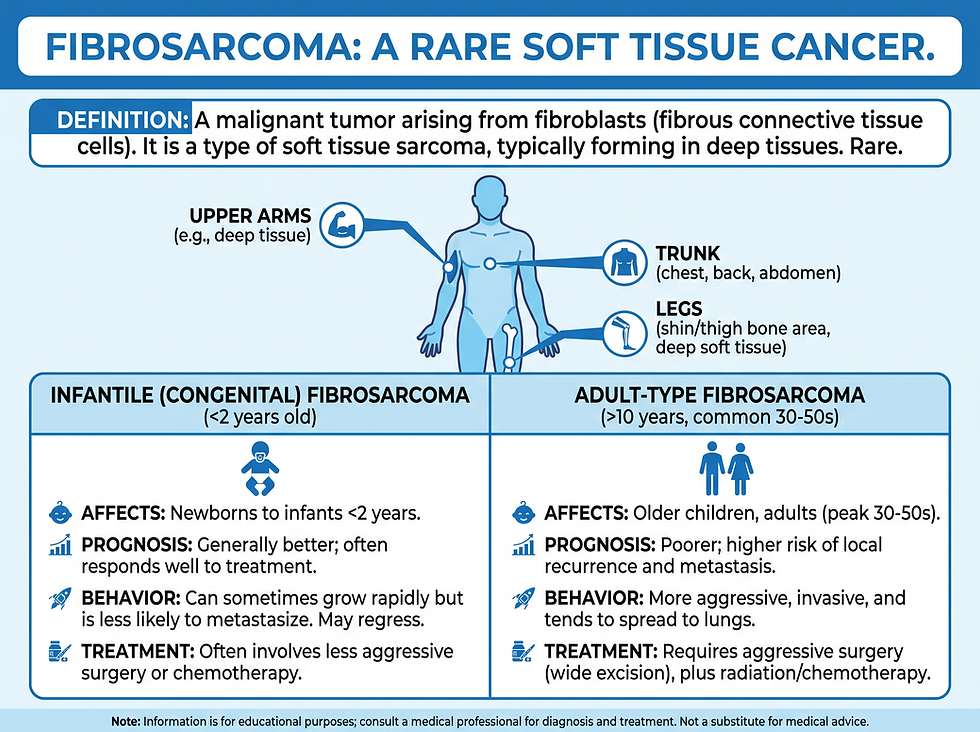
Typical Age: Infantile (Congenital) Fibrosarcoma: Birth to age 5; Adult-Type Fibrosarcoma: 20 to 60 years old
Aggressiveness: Infantile (Congenital) Fibrosarcoma: Grows fast but rarely spreads; Adult-Type Fibrosarcoma: Highly aggressive and prone to spreading
Response to Chemo: Infantile (Congenital) Fibrosarcoma: Usually responds very well; Adult-Type Fibrosarcoma: Often resistant to chemotherapy
Curability: Infantile (Congenital) Fibrosarcoma: Frequently curable; Adult-Type Fibrosarcoma: Harder to treat; depends on stage
Symptoms and Warning Signs
Fibrosarcoma often develops slowly and silently. Because the tumors form deep within the body's soft tissues, you may not feel or see anything until the mass becomes large enough to affect surrounding structures.
New Lump: A soft mass in the leg, arm, or trunk that may be painless or tender.
Nerve Pain: Tingling, "pins and needles," or sharp, aching, or burning sensations.
Swelling: Unusual puffiness or localized swelling if the tumor presses on blood vessels.
Functional Issues: Difficulty moving a limb or joint if the tumor interferes with muscles or tendons.

Causes and Risk Factors
While the exact cause of fibrosarcoma remains unknown, researchers believe genetic mutations—changes in a cell's DNA—trigger the rapid multiplication of cells that form these tumors. In infantile cases, about 90% involve a specific mutation in the NTRK gene family.
Inherited Risk Factors
Certain genetic syndromes can increase a person's likelihood of developing fibrosarcoma:
Familial Adenomatous Polyposis (FAP)
Li-Fraumeni Syndrome
Neurofibromatosis Type 1 (NF1)
Nevoid Basal Cell Carcinoma Syndrome (Gorlin Syndrome)
Retinoblastoma (a rare eye cancer)
Tuberous Sclerosis
Werner Syndrome
Environmental and Medical Risk Factors
Exposure to certain substances or previous medical treatments can also elevate risk:
Radiation Therapy: Previous treatment directed at the area where the tumor forms.
Severe Burns: History of a severe burn at the eventual tumor site.
Chemical Exposure: Long-term exposure to arsenic, vinyl chloride, or thorium dioxide.
Metal Exposure: Contact with chromium, cobalt, or nickel, sometimes found in older orthopedic implants.
Pre-existing Bone Conditions: Chronic osteomyelitis, Paget’s disease of the bone, or fibrous dysplasia.
Diagnosis and Staging
If a healthcare provider suspects fibrosarcoma, they will order a series of tests to confirm the diagnosis and determine the cancer's stage and grade.
MRI: The primary tool for seeing the tumor's size, location, and impact on nerves/vessels.
CT Scan: Uses X-rays to create 3D images of soft tissues and bones.
Biopsy: Removing a tissue sample (via needle or surgery) to check for cancer cells.
Immunohistochemistry: A lab test using antibodies to distinguish fibrosarcoma from other tumors.
The Four Stages of Fibrosarcoma
Staging helps providers understand how far the cancer has progressed:
Stage I: Low-grade tumors, usually smaller than 5 cm.
Stage II: Mid-grade or high-grade tumors larger than 5 cm that haven't spread.
Stage III: High-grade tumors larger than 5 cm that have spread to nearby lymph nodes.
Stage IV: Cancer of any grade or size that has spread to distant organs or tissues.
Treatment Options
Treatment is highly personalized and depends on the patient's age, the tumor's location, and whether the cancer has spread.
Surgery: Adult-Type Fibrosarcoma: The primary treatment; involves removing the tumor and a healthy margin. Infantile Fibrosarcoma: Often curative; involves removing the tumor mass.
Radiation: Adult-Type Fibrosarcoma: Used before surgery to shrink tumors or after to kill remaining cells. Infantile Fibrosarcoma: May be used to shrink tumors or clean up margins post-surgery.
Chemotherapy: Adult-Type Fibrosarcoma: Results are mixed; often ineffective for adult-type tumors. Infantile Fibrosarcoma: Most infantile-type tumors respond very well to this treatment.
Targeted Therapy: Adult-Type Fibrosarcoma: Less common; focus is usually on surgery and radiation. Infantile Fibrosarcoma: Highly effective for tumors with NTRK gene mutations.
Outlook and Recovery
The prognosis for fibrosarcoma depends heavily on the stage at diagnosis and the type of tumor.
Infantile Type: The outlook is generally very positive. Most cases are curable, especially when caught early and treated with a combination of surgery and chemotherapy.
Adult Type: The prognosis varies. High-grade tumors (Stage III and IV) are more aggressive and harder to treat, requiring intensive management and long-term follow-up care.

Limitation Statement
Note on Statistics: While medical literature provides general percentages for sarcoma diagnoses, specific global prevalence and survival rates for fibrosarcoma are limited due to the extreme rarity of the condition. Most data is derived from small clinical studies and national cancer databases.
When to See a Healthcare Provider
You should schedule an appointment with a medical professional if you notice:
A new lump anywhere on your body, especially if it is growing.
Persistent tingling, numbness, or "pins and needles" in your limbs.
Unexplained swelling in your legs, arms, or trunk.
Chronic pain that does not go away with rest or standard over-the-counter treatments.
Conclusion
Fibrosarcoma is a rare but formidable cancer that requires specialized care from an oncology team. While an adult-type diagnosis presents significant challenges due to its aggressive nature, the infantile form offers a high chance of a cure. Early detection remains the most critical factor in improving outcomes. If you discover a new lump or experience persistent nerve-related symptoms, consult a healthcare provider immediately to rule out serious conditions.
Next Steps for Your Health
Perform a Self-Exam: Regularly check your body for new or changing lumps.
Consult a Specialist: If you have a family history of genetic syndromes like NF1 or FAP, discuss screening with your doctor.
Seek a Second Opinion: Given the rarity of fibrosarcoma, consulting with a specialized sarcoma center can ensure you receive the most advanced treatment options available.
Frequently Asked Questions (FAQ)
What is the main difference between a fibroma and a fibrosarcoma?
A fibroma is a benign (noncancerous) growth that does not spread. A fibrosarcoma is a malignant (cancerous) tumor that can invade nearby tissues and spread to distant organs.
Where does fibrosarcoma usually start?
It most commonly starts in the soft tissues of the legs, trunk, and upper arms, though it can also form inside bones or in the head and neck.
Is infantile fibrosarcoma hereditary?
While it involves genetic mutations (like the NTRK gene), it is usually not inherited from parents. It typically occurs spontaneously during fetal development.
How rare is adult-type fibrosarcoma?
It is very rare, accounting for approximately 10% of all soft tissue sarcoma diagnoses.
Can a fibrosarcoma be painless?
Yes. Many patients do not experience pain until the tumor grows large enough to press against a nerve or blood vessel.
What is the most common age for an adult-type diagnosis?
It most frequently affects adults between the ages of 20 and 60.
Does radiation therapy cause fibrosarcoma?
Previous radiation therapy to a specific area is a known risk factor for developing fibrosarcoma in that same location later in life.
Can chemicals cause this cancer?
Yes, long-term exposure to certain chemicals like vinyl chloride, arsenic, and thorium dioxide has been linked to an increased risk.
Is chemotherapy effective for adults?
Chemotherapy has mixed results for adult-type fibrosarcoma and is often less effective than it is for the infantile type.
What is targeted therapy?
Targeted therapy uses drugs to attack specific genetic mutations, such as the NTRK gene mutation found in many infantile fibrosarcomas.
How is the stage of the cancer determined?
Staging is based on the tumor's size, its grade (how abnormal the cells look), and whether it has spread to lymph nodes or other organs.
What is a "high-grade" tumor?
A high-grade tumor has cells that look very abnormal under a microscope and tend to grow and spread more aggressively than low-grade tumors.
Can fibrosarcoma spread to the lungs?
Yes, like many sarcomas, if it spreads (metastasizes), it often travels to the lungs.
Is surgery always required?
Surgery is the primary treatment for both adult and infantile types to remove the cancerous mass.
What is a "margin" in surgery?
A margin is a rim of healthy tissue removed along with the tumor to ensure that no microscopic cancer cells are left behind.
Can children over age 5 get infantile fibrosarcoma?
The infantile type is most common in children under 5, but the adult type can sometimes affect older children and adolescents.
What is an MRI used for in diagnosis?
An MRI is the most common imaging test used to determine the tumor's exact size and its relationship to nearby nerves and blood vessels.
How long does diagnosis take?
Diagnosis usually involves several days to weeks to complete imaging, perform a biopsy, and have a pathologist analyze the tissue.
Can you prevent fibrosarcoma?
There is no known way to prevent it, but avoiding exposure to certain chemicals and monitoring inherited risk factors can help with early detection.
Does a lump always mean cancer?
No. Most lumps are benign, but any new or changing lump should be evaluated by a healthcare provider.
What is Werner syndrome?
Werner syndrome is a rare inherited condition that causes premature aging and increases the risk of various cancers, including fibrosarcoma.
What is Li-Fraumeni syndrome?
It is a rare genetic disorder that greatly increases the risk of developing several types of cancer, particularly in children and young adults.
Can orthopedic implants cause fibrosarcoma?
There is a rare association between certain metals used in older implants (like chromium and nickel) and the development of sarcomas.
What is bone infarction?
Bone infarction is the death of bone tissue due to a lack of blood supply, which can sometimes lead to the development of fibrosarcoma in the affected bone.
How often should I follow up after treatment?
Follow-up schedules vary but typically involve regular imaging and exams every few months for several years to monitor for recurrence.
Is fibrosarcoma curable?
The infantile type is frequently curable. The adult type is harder to treat but can be managed effectively if caught in early stages.
What is immunohistochemistry (IHC)?
It is a specialized lab test that uses antibodies to identify specific proteins in cells, helping pathologists confirm the tumor type.
Can fibrosarcoma cause swelling?
Yes, if the tumor presses against blood vessels, it can cause localized swelling in the affected limb or area.
What should I ask my doctor after a diagnosis?
Ask about the stage and grade of the tumor, the recommended treatment plan, potential side effects, and the expected outlook.
Is there support for rare cancer patients?
Yes, many oncology centers offer support groups and resources specifically for patients dealing with rare sarcomas.
Related Guides on Rinnit
References and Further Reading
Dahl M, Aurit SJ, Silberstein PT, Gootee J. Primary Site and Other Prognostic Factors for Fibrosarcoma: An Analysis of the National Cancer Database. Cureus. 2021 Oct;13(10):e19163.
Davis DD, Shah SJ, Kane SM. Fibrosarcoma. StatPearls. 2023 Nov 12.
Han Y, Lian K, Zhang D. Treatment of infantile fibrosarcoma: A tertiary care center experience. Front Pediatr. 2022 Nov;10:1015185.
Lapeña LM, et al. Larotrectinib as an Effective Therapy in Congenital Infantile Fibrosarcoma: Report of Two Cases. European J Pediatr Surg Rep. 2022 Jan;10(1):e76-e79.
Siozopoulou V, et al. NTRK Fusions in Sarcomas: Diagnostic Challenges and Clinical Aspects. Diagnostics (Basel). 2021 Mar;11(3):478.
References
Medical Disclaimer: This article is for informational purposes only and does not constitute medical advice, diagnosis, or treatment. Always seek the advice of your physician or other qualified health provider with any questions you may have regarding a medical condition.
Comments