Extramammary Paget's Disease (EMPD): Symptoms, Types, Causes, Diagnosis, Treatment and Outlook — What You Need to Know

Updated: 2 days ago
Medically reviewed by Dr. Baraa Alnahhal, MD · Last reviewed: September 2026
Quick Answer
Extramammary Paget's disease (EMPD) is a rare, slow-growing skin condition that causes a red, scaly or crusty rash, usually in the genital or anal area. It can develop on its own (primary EMPD) or result from an underlying cancer such as rectal, bladder, or gynecologic cancers (secondary EMPD). About 7% to 40% of cases are linked to an underlying cancer, which is why cancer screening is a standard part of the workup. Diagnosis is confirmed with a skin biopsy showing Paget cells. Surgery — often Mohs surgery or wide local excision — is the usual treatment, and people without an underlying cancer typically recover fully. Because EMPD commonly recurs, sometimes more than 15 years after treatment, long-term follow-up is essential.
TL;DR
Extramammary Paget's disease (EMPD) is a rare, slow-growing skin condition most often found near the genitals. It causes crusty, red, or scaly skin — a rash very similar to eczema — that grows slowly and may have irregular borders.
Two types exist: primary EMPD, which develops in the skin on its own, and secondary EMPD, which results from an underlying cancer. Available research shows about 65% of cases affect the vulva and 20% affect the area around the anus. Because 7% to 40% of cases are associated with an underlying cancer, diagnosis always includes screening tests.
Treatment is usually surgery, and people without cancer typically recover fully — but recurrence is common, even after more than 15 years, so ongoing monitoring matters.
Limitation statement: The referenced clinical source describes EMPD as rare and reports location and cancer-association figures from available research, but it does not publish overall prevalence or incidence statistics. No other statistics are invented in this article.

What Is Extramammary Paget's Disease (EMPD)?
Extramammary Paget's disease (EMPD) is a rare type of skin condition that may be associated with different types of cancer. It is a slow-growing condition, most often found near the genitals. It causes red, scaly skin that's often itchy.
EMPD is named for Sir James Paget, a famed 19th-century British physician. Multiple forms of cancer carry Paget's name because of his work in pathology. "Extramammary" means "outside the breast," which helps avoid confusion with other diseases named for Paget, such as Paget's disease of the breast.
About 7% to 40% of EMPD cases are associated with an underlying cancer. But EMPD isn't always a sign of another disease. Getting treatment can help improve symptoms and evaluate for underlying cancer.
Key facts at a glance
Medical name: Extramammary Paget's disease (EMPD)
Type: Rare, slow-growing skin condition; may be associated with underlying cancer
Two forms: Primary (develops in the skin on its own) and secondary (develops due to an underlying cancer)
Main symptom: Red, scaly or crusty rash, very similar to eczema, that grows slowly
Common locations: Vulva (~65% of cases) and the area around the anus (~20%)
Cancer association: About 7% to 40% of cases are linked to an underlying cancer
Usual treatment: Surgery (Mohs surgery or wide local excision)
Prognosis note: People without cancer typically recover fully; the condition often recurs, so long-term monitoring is needed
What Are the Types of Extramammary Paget's Disease?
There are two types of EMPD. Primary EMPD develops in the skin on its own, without an underlying cancer. Secondary EMPD develops due to an underlying cancer.
The distinction matters for your outlook: people without an underlying cancer typically recover fully after treatment, but the risk of death can increase if you also have cancer. Primary EMPD is usually treated with surgery, and typical recovery is full. With secondary EMPD, the underlying cancer also needs treatment.
What Are the Symptoms of Extramammary Paget's Disease?
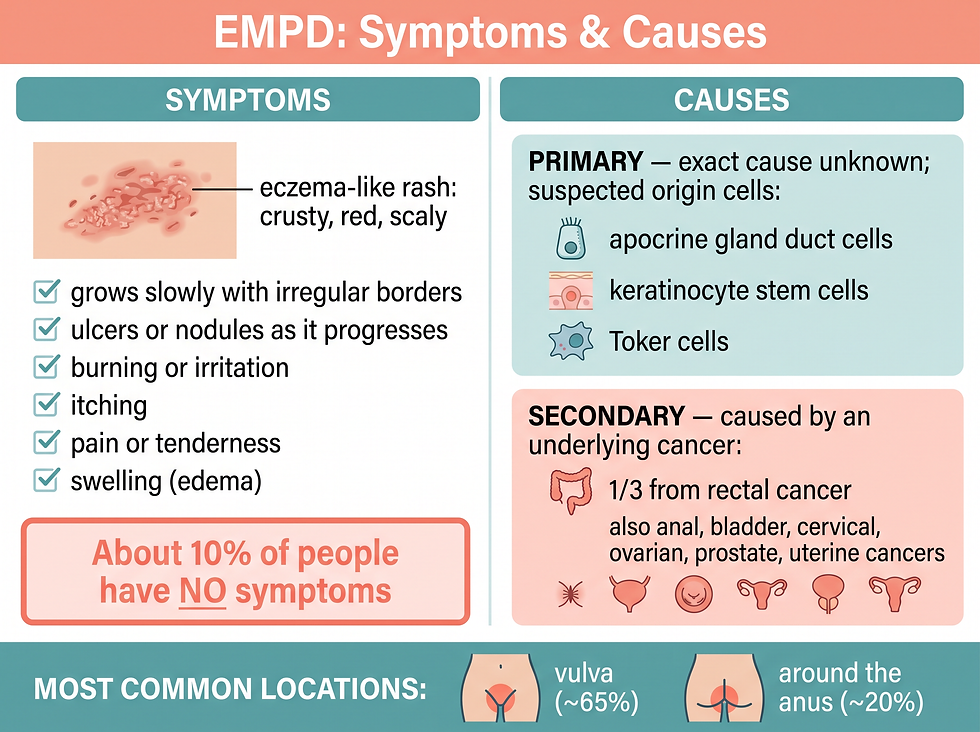
The main symptom of EMPD is a skin rash very similar to eczema. Available research shows that about 65% of EMPD cases affect the vulva and 20% affect the area around the anus. Affected areas of skin may be:
Crusty
Red
Scaly
The rash grows slowly and may have irregular borders. As EMPD progresses, deep sores called ulcers or nodules may occur. Other symptoms may include skin that's:
Burning
Irritated
Itchy
Painful or tender
Swollen (edema)
EMPD most often occurs where you have many apocrine skin glands — sweat glands that open into your hair follicles. It most commonly appears on the vulva. It can also appear on the skin around the anus, penis, perineum, and scrotum.
In rare cases, EMPD may appear near other body parts, including the abdomen, armpit, bellybutton, buttocks, ear, eyelid, face or scalp, lower chest, and knee or thigh.
Notably, about 10% of people with EMPD don't have any symptoms at all.
What Causes Extramammary Paget's Disease?
Providers don't know the exact cause of primary extramammary Paget's disease. They suspect it may form from specific types of cells found in certain areas of the body. Those suspected cell types include:
Apocrine gland duct cells — sweat glands in the skin related to hair follicles
Keratinocyte stem cells — cells that help with skin repair
Toker cells — cells in the skin of the nipple and vulvar tissue
Secondary EMPD has a known cause: it results from an underlying cancer. One-third of EMPD cases result from rectal cancer. Other cancers that may cause secondary EMPD include anal, bladder, cervical, ovarian, prostate, and uterine cancers.
Who Gets Extramammary Paget's Disease?
Everyone can develop extramammary Paget's disease. However, EMPD is most likely to affect people who are between 50 and 80 years old, female, male and Asian, or White. EMPD is rare.
Is Extramammary Paget's Disease Contagious?
No. EMPD is not an infection you can catch or pass to someone else. It develops from cell changes in the skin (primary) or from an underlying cancer (secondary).
How Is Extramammary Paget's Disease Diagnosed?
A healthcare provider will first ask about symptoms and perform a physical exam. If EMPD is suspected, they will do a skin biopsy. During a biopsy, a small sample of skin is taken and examined under a microscope.
Under the microscope, a pathologist looks for abnormal large cells with distinctive characteristics called Paget cells. They also examine how Paget cells react to various chemicals through a technique called immunohistochemistry to correctly identify these cells.
How Is the Underlying Cancer Diagnosed?
After an EMPD diagnosis, providers use additional tests to check for an underlying cancer, including:
Ultrasound — imaging of internal organs
Mammogram — breast screening
Pap smear — cervical screening
Colonoscopy or proctoscopy — the colon and rectum (rectal cancer causes one-third of EMPD cases)
CT scan — detailed internal imaging
Cystoscopy — the bladder
Prostate exam — the prostate
Retrograde pyelogram — the urinary tract
Lymph node ultrasound or needle biopsy — nearby lymph nodes
Upper endoscopy — the upper digestive tract
How Is Extramammary Paget's Disease Treated?
Providers usually treat EMPD with surgery:
Mohs surgery — the surgeon removes affected skin cells layer by layer, a technique that helps save surrounding healthy skin
Wide local excision — the surgeon removes the area of EMPD along with some healthy tissue around it, then sews the wound edges together
Surgeons often need to remove a large area of skin and other tissue. Some people with EMPD of the vulva may need all or part of the vulva removed (vulvectomy).
If surgery isn't possible due to poor health or other conditions, providers may suggest:
Immunotherapy
Laser skin resurfacing
Photodynamic therapy (PDT)
Radiation therapy
Topical cytotoxic drugs — medications used to treat cancer
Any underlying cancers will also need additional treatment.
Can Extramammary Paget's Disease Come Back?
After treatment, you'll need ongoing visits with your doctor depending on the location of the EMPD. It's not uncommon for EMPD to come back in the same area or the surrounding treated area, so follow-up is important.
Reoccurrence years after initial treatment is common. In some cases, EMPD can return after more than 15 years, so providers recommend long-term monitoring and follow-up.
Does EMPD Spread?
It's rare for EMPD to spread (metastasize), but it may sometimes progress to lymph nodes or other organs. Other factors can also influence the outcome.
What Is the Outlook for EMPD?
Without underlying cancer: people typically recover fully after treatment
With underlying cancer: the risk of death can increase
Recurrence: common; can return after more than 15 years
Metastasis: rare, but may reach lymph nodes or other organs
Monitoring: long-term follow-up visits are essential
Can I Prevent Extramammary Paget's Disease?
Unfortunately, you can't reduce your risk of EMPD.
How Do I Live With EMPD?
You can continue to take care of yourself by seeing your provider for regular follow-up appointments. If your provider sees any signs of reoccurrence, prompt treatment can help.

When Should I See My Healthcare Provider?
Alert: See your healthcare provider if you notice any new signs of EMPD or have any new symptoms.
A persistent, eczema-like rash in the genital or anal area that grows slowly deserves professional evaluation. Early diagnosis matters because EMPD can take years to diagnose — and because up to 40% of cases may be associated with an underlying cancer that needs treatment.
A note from your care team: "Having any kind of skin rash on sensitive or intimate parts of your body can be scary, embarrassing and frustrating. Extramammary Paget's disease (EMPD) is often mistaken for other skin conditions and may not be properly diagnosed for quite some time. EMPD can be more serious if you also have an underlying cancer. Fortunately, many people with EMPD live full lives after they receive treatment. Providers usually treat EMPD with surgery. If you do have an underlying cancer, you'll also need cancer treatments. As it's common for extramammary Paget's disease to recur, seeing your provider for regular visits can help catch it early if it comes back."
Conclusion and Next Steps
Extramammary Paget's disease is a rare, slow-growing skin condition that causes an eczema-like rash near the genitals. Because the rash mimics common skin conditions and sometimes signals an underlying cancer, it deserves prompt medical attention — not home treatment. If you have a persistent red, scaly, or crusty rash in the genital or anal area, book an appointment with a healthcare provider or dermatologist. A simple skin biopsy can confirm the diagnosis, cancer screening can follow if needed, and surgery usually offers full recovery for people without an underlying cancer. Regular follow-up keeps recurrence in check — even years later.
Next step: Talk to a dermatologist or healthcare provider about any persistent rash in a sensitive area. Ask whether a skin biopsy is right for you, and whether cancer screening should be part of your workup.
Frequently Asked Questions
What is extramammary Paget's disease (EMPD)? A rare, slow-growing skin condition that causes a red, scaly or crusty rash, usually near the genitals, and is sometimes associated with an underlying cancer.
What does EMPD mean? "Extramammary" means "outside the breast"; the condition is named after Sir James Paget, a 19th-century British physician.
Is extramammary Paget's disease a cancer? EMPD itself is a rare skin condition that may be associated with different types of cancer; secondary EMPD results directly from an underlying cancer.
What's the difference between primary and secondary EMPD? Primary EMPD develops in the skin on its own; secondary EMPD develops due to an underlying cancer.
Where does EMPD usually appear? About 65% of cases affect the vulva and 20% affect the area around the anus; it can also involve the penis, perineum, and scrotum.
Can EMPD appear on other body parts? In rare cases, yes — the abdomen, armpit, bellybutton, buttocks, ear, eyelid, face or scalp, lower chest, and knee or thigh.
What does the EMPD rash look like? Crusty, red, or scaly skin that grows slowly and may have irregular borders — very similar to eczema.
Does EMPD itch? Yes, the rash is often itchy; it may also burn, feel irritated, be painful or tender, or become swollen.
Can EMPD cause ulcers? Yes; as EMPD progresses, deep sores called ulcers or nodules may occur.
Can I have EMPD without symptoms? Yes; about 10% of people with EMPD don't have any symptoms.
Why does EMPD take so long to diagnose? The rash looks like other common skin conditions, so EMPD is often mistaken for them and may not be properly diagnosed for quite some time.
What causes primary EMPD? The exact cause is unknown; providers suspect it may form from apocrine gland duct cells, keratinocyte stem cells, or Toker cells.
What causes secondary EMPD? An underlying cancer; one-third of EMPD cases result from rectal cancer, and others from anal, bladder, cervical, ovarian, prostate, or uterine cancers.
What percent of EMPD cases are linked to cancer? About 7% to 40% of cases are associated with an underlying cancer.
How is EMPD diagnosed? With a skin biopsy: a pathologist looks under the microscope for abnormal large Paget cells and uses immunohistochemistry to confirm them.
Why do I need cancer screening after an EMPD diagnosis? Because 7% to 40% of cases are associated with an underlying cancer, and tests like colonoscopy, cystoscopy, mammogram, and Pap smear check for one.
What cancer-screening tests are used for EMPD? Ultrasound, mammogram, Pap smear, colonoscopy or proctoscopy, CT scan, cystoscopy, prostate exam, retrograde pyelogram, lymph node ultrasound or needle biopsy, and upper endoscopy.
How is EMPD treated? Usually surgery: Mohs surgery or wide local excision; non-surgical options exist for people who can't have surgery.
What is Mohs surgery for EMPD? The surgeon removes affected skin cells layer by layer, which helps save surrounding healthy skin.
Do I need a vulvectomy for vulvar EMPD? Some people with EMPD of the vulva may need all or part of the vulva removed; your provider decides based on the case.
What if I can't have surgery? Providers may suggest immunotherapy, laser skin resurfacing, photodynamic therapy, radiation therapy, or topical cytotoxic drugs.
Can EMPD be cured? People without an underlying cancer typically recover fully after treatment; the underlying cancer, if present, also needs treatment.
Does EMPD come back? Yes; recurrence is common, sometimes more than 15 years after initial treatment, so long-term monitoring is recommended.
Does EMPD spread to other organs? Metastasis is rare, but EMPD may sometimes progress to lymph nodes or other organs.
Can I prevent EMPD? Unfortunately, you can't reduce your risk of EMPD.
Who gets EMPD? Anyone can; it is most likely in people aged 50 to 80, females, males who are Asian, and White individuals.
How common is EMPD? It is rare; the source does not publish a specific prevalence figure.
Is EMPD painful? It can be; affected skin may be burning, irritated, itchy, painful, tender, or swollen.
Should I be embarrassed about a genital rash? A rash on sensitive or intimate skin can be scary, embarrassing, and frustrating — but prompt evaluation matters because EMPD is often mistaken for other conditions and can be more serious if an underlying cancer is present.
When should I see my healthcare provider? If you notice any new signs of EMPD or have any new symptoms; regular follow-up appointments help catch recurrence early.
References
Extramammary Paget's Disease — Cleveland Clinic (last updated Oct 7, 2022): https://my.clevelandclinic.org/health/diseases/24266-extramammary-pagets-disease
Additional sources cited by the clinical reference: American Academy of Dermatology; Genetic and Rare Diseases (GARD) Information Center; Ishizuki S, Nakamura Y. Extramammary Paget's Disease: Diagnosis, Pathogenesis, and Treatment with Focus on Recent Developments. Curr Oncol 2021;28(4):2969-2986; McDaniel B, Brown F, Crane JS. Extramammary Paget Disease. StatPearls Publishing, 2022; DermNet NZ.
Medical disclaimer: This article is for general informational purposes only and is not medical advice. Always consult a qualified healthcare provider for diagnosis and treatment decisions.
Comments